2009 SKODA OCTAVIA battery
[x] Cancel search: batteryPage 135 of 304

Automatic gearbox
134
result of this the vehicle can no longer be
driven. If the clutch opens automatically,
depress the brake pedal, wait a few se
conds and only then continue driving.
Selector lever positionsThe current selector lever position is in
dicated in the information display of the
instrument cluster
⇒fig. 154
. In the positions
D and
S the gear you have already
engaged will be additionally displayed on the display. P - Parklock The driven wheels are locked mechanically in this position. The Parklock must only be engaged when the vehicle is stationary
⇒
.
I f y o u w i s h t o m o v e t h e s e l e c t o r l e v e r i n to
or out of this position, you must press the
Shiftlock button in the handle of the selector lever and at the same time depress the brake pedal. If the battery is used, the selector leve
r cannot be moved out of the position
P.
R - Reverse Reverse gear must only be engaged when
the vehicle is stationary and the engine
idling
⇒
.
The brake pedal must be depressed and at the same time the Shiftlock must be pressed, if you wish to obtain the selector lever positions
R, P or N.
When the ignition is switched on and the selector lever is in position
R, the reverse
lights will come on. N - Neutral The transmission is in Neutral in this position. The brake pedal must be depressed (if the lever is in its position for longer than 2 seconds) in order to move the selector lever out of the position
N into the position
D or R, with the ignition switched on, on a vehicle travelling at less than 5 km/hour
or on a stationary vehicle. D - Drive, position for driving forward When the selector lever is in this position, the forward gears are shifted up and down automatically in line with engine load, vehicle speed and the dynamic shift programme. You must depress the brake pedal if you wish to move into position
D from
N when
the vehicle is travelling
at less than 5 km/hour or is stationary
⇒
.
In certain circumstances (e.g. when driving in mountainous regions or when towing a trailer) it may be beneficial to
select the manual shift programme
⇒page 136 for
a short time in order to adapt the gearbox ratios manually to the driving situations. S - Position for sporty style of driving Shifting up later into a higher gear make
s it possible to fully exploit the power
potential of the engine. The gearbox also then shifts down at higher engine speeds as in the position
D.
Fig. 153 Selector leverFig. 154 Information display: Selector lever posi-tions
se0.1.book Page 134 Frida
y, April 10, 2009 3:19 PM
Page 139 of 304

Automatic gearbox
138
Selector lever-emergency unlockingIn case of interruption of the power su
pply (e.g. flat vehicle battery, defec-
tive fuse) or defect of the selector lever lock, the selector lever can no longer be shifted from the position
P in the normal way and the vehicle
can no longer be moved. The selector
lever must be unlocked in case of
emergency. – Apply the handbrake firmly. – Open the storage compartment in front centre console* or the front
ashtray.
– Carefully pull up the front left and right cover. – Pull up rear cover. – Press with a narrow object (e.g. ignition key) the yellow plastic hoop
⇒
fig. 158
to the left.
– Simultaneously press the shiftlock button in the handle of the selector
lever in the position
N13).
Tow-starting and towing vehicle Tow-starting a vehicle It is not possible to tow-start vehi
cles fitted with automatic gearbox
⇒page 253.
you can use jump-start cables connected
to the battery of another vehicle for
starting your car if the vehicle battery is flat
⇒page 252.
Towing a vehicle Please pay attention to the following info
rmation if it comes necessary to tow-in
your car
⇒page 253.
13)If the selector lever is moved again into the position
P, it is once again blocked.
Fig. 158 Selector lever- emergency unlocking
se0.1.book Page 138 Frida
y, April 10, 2009 3:19 PM
Page 144 of 304

Communication
143
Using the system
Safety
Driving Tips
General Maintenance
Breakdown assistance
Technical Data
end the dialogue at any time by pres
sing the PTT button on the adapter*
⇒ page 145 or on the multifunction steering wheel*
⇒page 146.
The dialogue is always automatically ended after carrying out an operation, e.g. after erasing the name from the phonebook. When receiving an incoming call, the dialogue is immediately interrupted and you can accept the call by
pressing the button°
on the multifunction steering wheel*
⇒ page 146 or by pressing the button for
receiving a call directly on your tele-
phone. If a voice command is not detected, the system answers with “
Sorry?
” and a new
entry can be performed. After the 2nd error
the system repeats the aid. After the 3rd
error the answer “
Cancel
” is given and the dialogue is ended.
Optimum understanding of the voice
commands depends on the following
factors:•
Speak with a normal tone of voice wi
thout intonation and excessive voice
pauses.•
Avoid insufficient articulation.
•
Close the doors, windows and sliding roof, in order to reduce or stop disturbing
exterior noise.•
It is recommended to speak louder at hi
gher speeds, so that the tone of your
voice is louder than the increased surrounding noise.•
During the dialogue avoid additional noise in the vehicle, e.g. simultaneously
talking occupants.•
Do not speak, if the system makes an announcement.
•
The microphone for voice control is directed to the driver and front passenger.
Therefore the driver and the front passenger can operate the equipment.
WARNING
Pay attention primarily to the traffic situation! As the driver you are fully responsible for road safety. Use the telephone system only to such an extent, so that you are in full control of your vehicle at any time.
Caution
Taking the mobile phone out of the adapter during the call can lead to interruption of the connection. When taking out th
e mobile phone, the connection to the
factory-fitted antenna is interrupted, this reduces the quality of the transmitting and receiving signal. The charging of the
mobile phone battery is also interrupted.
Note
•
Please also refer to the additional instructions
⇒page 142, “Mobile phones
and two-way radio systems”.•
Should you have any questions, please
contact an authorised Škoda Service
Par tner.Bluetooth
®
The Bluetooth
® technology serves as ca
bleless connection of a
mobile phone to a hands-free system of your vehicle.In order to connect a mobile phone with Bluetooth
® to the hands-free
system, it is necessary to adapt the phone and the hands-free system to each other. Detailed information on this is provided in the operating instructions of your mobile phone.
The following steps must be carried
out for the connection: – Switch on the ignition.– Select Bluetooth
® on the mobile phone and select the menu with
which the mobile phone searches for suitable Bluetooth
® devices.
– If the hands-free system on the display of the mobile phone
announces
Skoda UHV
, enter the PIN°
1234
within 30 seconds and
wait, until the connection is established.
16)
16)Some mobile phones have a menu, in which th
e authorization for establishing a Bluetooth
®
connection is performed via the input of a code. If the input for the authorization is neces- sary, it must always be performed when
re-establishing the Bluetooth connection.
se0.1.book Page 143 Frida
y, April 10, 2009 3:19 PM
Page 145 of 304

Communication
144
While connecting the mobile phone with the hands-free system by means of Blue- tooth
®, no other phone can be connected wi
th the hands-free system via Blue-
tooth
®.
Up to three mobile phones can be connect
ed to the hands-free system by means
of Bluetooth
®, whereby only one mobile phone can communicate via Bluetooth
®
with the hands-free system. If a fourth
mobile phone is connected to the hands-
free-system, then the telephone, which ha
s not been used together with the hands-
free-system for the longest period, is
disconnected by means of Bluetooth
®.
Establish Bluetooth
® connection
After switching on the ignition, the Blue
tooth connection is automatically estab-
lished for the already adapted mobile phone
16). Check on the mobile unit if the
automatic connection was established. Disconnect Bluetooth
® connection
After withdrawing the ignition key, the Bluetooth
® connection is disconnected.
WARNING
•
Pay attention primarily to the traffic situation! As the driver you are fully
responsible for road safety. Use the tele
phone system only to such an extent,
so that you are in full control of your vehicle at any time - risk of accident!•
In the event of air transport, the Bluetooth
® function of the handsfree-
system must be switched off by a specialist garage!
Caution
Taking the mobile phone out of the adapter
during the call can lead to interruption
of the connection. When taking out th
e mobile phone, the connection to the
factory-fitted antenna is interrupted, this reduces the quality of the transmitting and receiving signal. The charging of the
mobile phone battery is also interrupted.
Note
•
Not valid for all mobile phones which
enable a communication via Bluetooth
®.
You can ask at an authorised Škoda Service
Partner if your telephone is compatible
with the universal teleph
one preinstallation GSM II.
•
Please operate your mobile phone exclus
ively with a suitable adapter in order
to keep a low radiation in the vehicle.•
Inserting the mobile phone into the adapter ensures an optimal sending and
receiving power and offers at the same time the advantage of the battery charging.•
Note that the range of the Bluetooth
® connection to the handsfree-system is
limited to the vehicle interior. The range is dependent on local factors, e.g. obstacles between the devices and interferences with
other devices. If yo
ur mobile phone is
e.g. in a jacket pocket, this can lead to
difficulties when establishing the Bluetooth
®
connection with the handsfree-sy
stem or the data transfer.
Inserting the mobile phone with the adapter*Only one telephone mount* is factory-fitted. An adapter for the phone can be purchased from the Škoda original accessories. Inserting the mobile phone with the adapter – First of all push the adapter in the direction of arrow
⇒
fig. 160
up
to the stop into the mount. Press the adapter slightly downwards, until it locks securely into position.
– Insert the mobile phone into the adapter (as specified in manufac-
turer's instructions).
Fig. 160 Universal prepara- tion for the phone
AA
AA
se0.1.book Page 144 Frida
y, April 10, 2009 3:19 PM
Page 146 of 304
Communication
145
Using the system
Safety
Driving Tips
General Maintenance
Breakdown assistance
Technical Data
Removing the mobile phone with the adapter – Press simultaneouly the side l
ocks of the mount and remove the
mobile phone and adapter
⇒
page 144, fig. 160
.
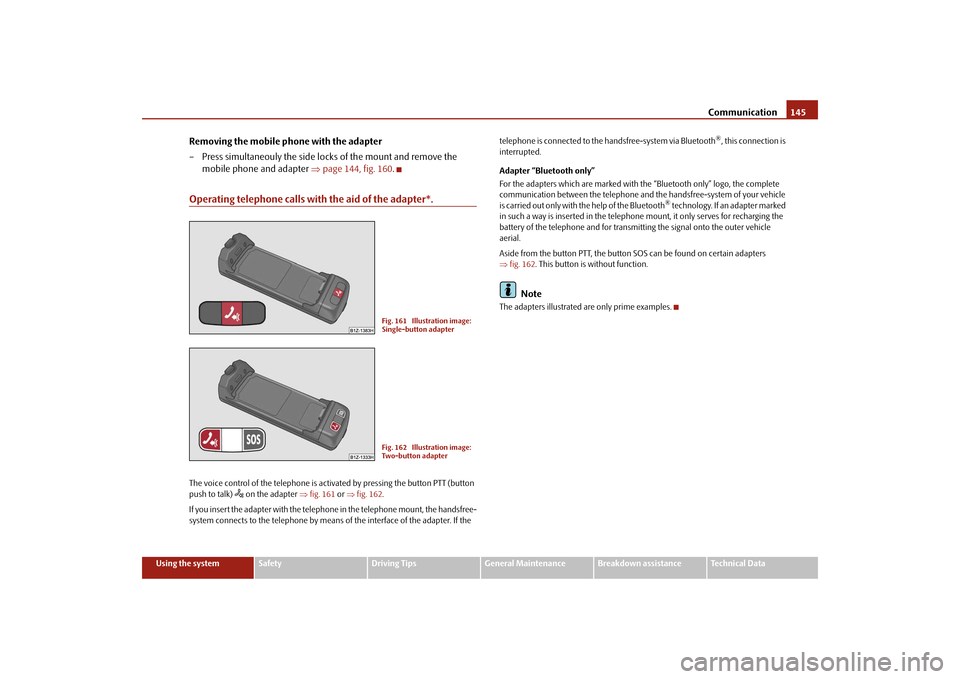
Operating telephone calls with the aid of the adapter*.The voice control of the telephone is acti
vated by pressing the button PTT (button
push to talk)
on the adapter
⇒fig. 161
or ⇒fig. 162
.
If you insert the adapter with the telephone in the telephone mount, the handsfree- system connects to the telephone by means of the interface of the adapter. If the
telephone is connected to the
handsfree-system via Bluetooth
®, this connection is
interrupted. Adapter “Bluetooth only” For the adapters which are marked with the “Bluetooth only” logo, the complete communication between the telephone and the handsfree-system of your vehicle is carried out only with the help of the Bluetooth
® technology. If an
adapter marked
in such a way is inserted in the telephone
mount, it only serves for recharging the
battery of the telephone and for transmit
ting the signal onto the outer vehicle
aerial. Aside from the button PTT, the button SOS can be found on certain adapters ⇒ fig. 162
. This button is without function.
Note
The adapters illustrated are only prime examples.
Fig. 161 Illustration image: Single-button adapterFig. 162 Illustration image: Two-button adapter
se0.1.book Page 145 Frida
y, April 10, 2009 3:19 PM
Page 226 of 304

Inspecting and replenishing
225
Using the system
Safety
Driving Tips
General Maintenance
Breakdown assistance
Technical Data
– Pulling on the locking lever
⇒
page 224, fig. 208
will unlock the
bonnet fully.
– Grip with the hand under
the radiator grille and lift up the bonnet.
– Take the bonnet support out of its holder and set it in the opening
designed for it
⇒
page 224, fig. 209
.
Closing the bonnet – Lift the bonnet slightly and unhook the bonnet support. Press the
bonnet support into the hold
er designed to hold it.
– Allow the bonnet to drop from a height of about 20 cm into the lock -
bonnet
do not press down on it
!
WARNING
•
Never open the bonnet if you see that steam or coolant is flowing out of
the engine compartment - risk of scaldi
ng! Wait long enough until the steam
or coolant has stopped escaping.•
For safety reasons, the bonnet must always be properly closed when
driving. One should therefore check that
the lock has in fact engaged prop-
erly after closing the bonnet.•
Stop your vehicle immediately while driv
ing if you notice that the lock is
not properly engaged and close the bonne
t properly - risk of an accident!
Caution
Never open the bonnet using the locking lever - danger of causing damage.Working in the engine compartment Particular care is required when carrying out any work in the engine compartment!There is a risk of injuries, scalding,
accidents and fire when working in the
engine compartment, e.g. inspecting and replenishing oil and other fluids. For
this reason, it is essential to comply with the warning instructions stated below and with the general applicable
rules of safety. The engine compart-
ment of your car is a hazardous area
⇒
.
WARNING
•
Never open the bonnet if you see that steam or coolant is flowing out of
the engine compartment - risk of scaldi
ng! Wait long enough until the steam
or coolant has stopped escaping.•
Switch off the engine and pull out the ignition key.
•
Apply the handbrake firmly.
•
If your vehicle is fitted with a ma
nual gearbox, move the gearshift lever
into Neutral, or if it is fitted with
automatic gearbox, move the selector lever
into position P.•
Allow the engine to cool down.
•
Keep children clear of the engine compartment.
•
Never spill oil and other fluids over the hot engine. Such fluids (e.g. the
antifreeze contained in the coolant) may ignite!•
Avoid short circuits in the electrical system - particularly on the battery.
•
Never place your hand into the radiator fan as long as the engine is still
warm. The fan might suddenly start running!•
Never open the cap of the coolant expa
nsion bottle as long
as the engine
is still warm. The cooling system is pressurized!•
Cover over the cap of the coolant expansion reservoir with a large cloth
when opening it as protection for your
face, hands and arms from hot steam
or hot coolant.•
Do not let objects, such as e.g cleani
ng cloth or tools lie in the engine
compartment.•
If you wish to work under the vehicle, you must secure the vehicle from
rolling away and support it with suitab
le supporting blocks
; the lifting jack*
is not sufficient for this - risk of injury!•
In cases where it be necessary to carry out inspection work when the
engine is running there is an additional risk from rotating parts (e.g. the V-
se0.1.book Page 225 Frida
y, April 10, 2009 3:19 PM
Page 227 of 304

Inspecting and replenishing
226
ribbed belt, alternator, radiator fan) and from the high-voltage ignition system. Please observe in addition the following:
− Never touch the electrical cabl
es of the ignition system.
− Absolutely avoid any jewellery, loose items of clothing or long hair from getting into the rotating parts of the engine - Hazard! Therefore remove any jewellery beforehand, tie up your hair and wear tight fitting clothing.
•
Please also comply with the warnin
g instructions st
ated below when
carrying out any essential work on the fuel system or on the electrical system:
− Always separate the car batter
y from the electrical system.
− Do not smoke. − Never carry out any work close to naked flames. − Always keep a working fire
extinguisher at hand.
Caution
When replenishing fluids in the engine, always ensure that the fluids are on no account mixed up. This may result in ma
jor operating problems and also vehicle
damage!
Overview of the engine compartment The main inspection pointsFig. 210 Petrol engine 1.8 ltr./118 kW TSI
Coolant expansion bottle . . . . . . . . . . . . . . . . . . . . . . . . . . . . . . . . . . . Windshield washer fluid reservoir . . . . . . . . . . . . . . . . . . . . . . . . . . . Engine oil filler opening . . . . . . . . . . . . . . . . . . . . . . . . . . . . . . . . . . . . . Engine oil dipstick . . . . . . . . . . . . . . . . . . . . . . . . . . . . . . . . . . . . . . . . . . Brake fluid reservoir . . . . . . . . . . . . . . . . . . . . . . . . . . . . . . . . . . . . . . . . Battery (below a cover) . . . . . . . . . . . . . . . . . . . . . . . . . . . . . . . . . . . . . Note
The location of the inspection points in
the engine compartment of petrol and
diesel engines is practically identical.
WARNING (continued)
A1
229
A2
236
A3
228
A4
227
A5
231
A6
232
se0.1.book Page 226 Frida
y, April 10, 2009 3:19 PM
Page 233 of 304

Inspecting and replenishing
232
We recommend that you have the brake fluid replaced by a
Škoda Service Partner
as part of an Inspection Service.
WARNING
•
Using old brake fluid can result in seve
re stress on the brakes because of
the formation of vapour bubbles in the brake system. This greatly impairs the braking efficiency and thus also the safety of your vehicle.•
Brake fluid is toxic! It must therefore be kept safely in closed original
containers and well aw
ay from children and unauthorized persons.
Caution
Brake fluid damages the pa
intwork of the vehicle.
For the sake of the environment
In view of the problems involved with prop
er disposal of brake fluid, the special
tools and the professional knowledge required, you should have the brake fluid replaced by a Škoda Service Partner.BatteryWorking on the battery
The battery is located in the engine
compartment in a polyester cover or
in a plastic cover*. – Open the battery cover in direction of arrow
⇒
fig. 214
or press the
interlock on the side of the battery cover
⇒
fig. 215
, fold the cover up
and remove the battery.
– The installation of the battery cov
er takes place in the reverse order.
Removal and installation of the battery
is not recommended since it can, under
certain circumstances, lead to major
damage. Contact a specialist garage.
There is a risk of injuries, scalding, acci
dents and burns when carrying out any work
on the battery and on the electrical system. For this reason, it is essential to comply with the warning instructions
⇒
stated below and with the general applicable
rules of safety.
WARNING
•
The battery acid is strongly corros
ive and must, therefore, be handled
with the greatest of care. Always we
ar protective gloves, eye and skin
protection when handling batteries. Corrosive fumes in the air irritate the air passages and lead to conjunctivitis and inflammation of the air passages in the lungs. Battery acid corrodes dental enamel and creates deep wounds after contact with the skin which take a long time to heal. Repeated contact with diluted acids causes skin diseases (inflammations, ulcers, slin cracks).
Fig. 214 Engine compart- ment: Polyester cover of the vehicle battery
Fig. 215 Engine compart-ment: Plastic cover of the vehicle battery
se0.1.book Page 232 Frida
y, April 10, 2009 3:19 PM