2009 Seat Ibiza SC turn signal
[x] Cancel search: turn signalPage 94 of 257
Lights and visibility
92•The main beam headlights can only be switched on if the dipped beam
headlights are already on. The warning lamp
then comes on in the combi-
instrument.
•The headlight flasher comes on for as long as you pull the lever – even if
no other lights are switched on. The warning lamp
then comes on in the
combi-instrument.
•When the parking lights are switched on, the headlight and the rear light
on the corresponding side of the vehicle light up. The parking lights will only
work if the key is removed from the ignition. If the lights are switched on, a
buzzer gives an audible warning while the driver door is open.•If the turn signal lever is left on after the key has been taken out of the
ignition lock, an acoustic signal sounds when the driver door is opened. This
is a reminder to switch off the turn signal, unless of course you wish to leave
the parking light on.
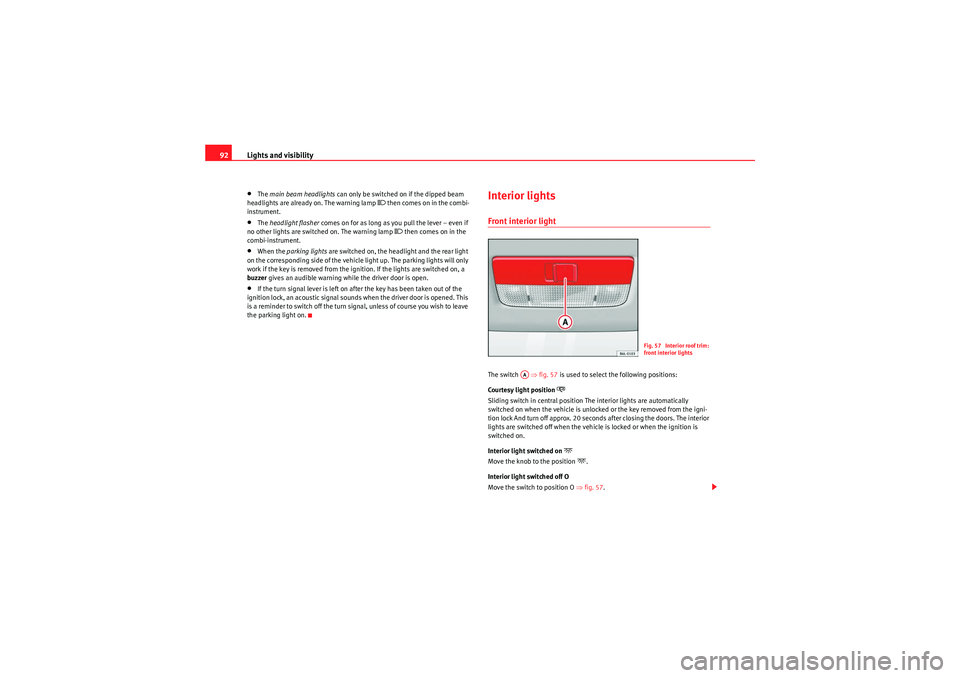
Interior lightsFront interior light The switch ⇒fig. 57 is used to select the following positions:
Courtesy light position
Sliding switch in central position The interior lights are automatically
switched on when the vehicle is unlocked or the key removed from the igni-
tion lock And turn off approx. 20 seconds after closing the doors. The interior
lights are switched off when the vehicle is locked or when the ignition is
switched on.
Interior light switched on
Move the knob to the position
.
Interior light switched off O
Move the switch to position O ⇒fig. 57 .
Fig. 57 Interior roof trim:
front interior lights
AA
IbizaSC_EN.book Seite 92 Mittwoch, 16. September 2009 12:11 12
Page 144 of 257

Driving
142Reverse gear
The distance warning will begin as soon as an obstacle is detected by the
system. The frequency of the bleeps emitted by the system will increase
rapidly as the vehicle approaches the obstacle.
Within a short distance of about 30 cm, a continuous signal sounds (stop
signal). The driver should not reverse any further.
Models with a factory-fitted towing bracket: When the vehicle is less than
0.35 m away from the obstacle the warning tone will sound continuously. The
driver should then not reverse any further.
The warning tone decreases by 30% after 3 seconds from the start of the
system.
Provided that it is not in continuous mode, the tone on the parking aid system
stops when it detects a wall parallel to the vehicle.
Trailer towing
For factory-fitted vehicles with a towing bar, the parking aid system will not
be activated by the engagement of the reverse gear when pulling a trailer, as
the trailer's electric connector will be plugged into the vehicle.
Possible faults
If a continuous bleep sounds for some seconds when the reverse gear is
engaged, this indicates that there is a fault in the parking aid system.
If the fault continues until the ignition is turned off, the acoustic signal
warning of the fault will not be emitted every time the system is reactivated
(by engaging the reverse gear). Thus, the system ready indication will not
sound either. Have the fault repaired by an Authorised Service Centre as soon
as possible.
If there is no ready signal or no acoustic warning signal, then the parking aid
loudspeaker is faulty and may not warn of obstacles.
To ensure that the system works properly, the sensors must be kept clean and
free of ice and snow.
WARNING
•The sensors have blind spots in which obstacles may not be detected.•Always look out for small children and animals because the system will
not always detect them. Always pay attention when reversing to avoid acci-
dents.•The parking aid is not a replacement for driver awareness. The driver
must take full responsibility for parking and other manoeuvres.Caution
•Please note that low obstacles detected by the system may no longer be
registered by the sensors as the car moves closer, so the system will not give
any further warning. Certain kinds of obstacles (such as wire fences, chains,
thin posts or trailer draw bars, high kerbs or painted railings etc) may not
always be detected by the system, so there is a risk of damaging the vehicle
in such cases.•In some cases, obstacles with uniform edges and bumps may not be
detected immediately by the system due to their geometry. Take special care
of this type of obstacle such as corners, rectangular objects, etc.., these can
cause damage to the vehicle.•Be especially careful when manoeuvring into a corner between two
perpendicular walls. Survey the approach of the wall to the side of the vehicle
(using the mirrors)•The parking aid system does not replace use of the mirrors for manoeu-
vres.•Distant ultra-sonic sources (hammers, tyres, construction machinery,
other vehicles with PDC) may interfere with the operation of the system.•Periodic cleaning of the sensors, take care not to damage or scratch them.
When cleaning with high pressure washers or steam cleaners, the sensors
should be sprayed for only a very short period and from a distance of more
than 10 cm.
IbizaSC_EN.book Seite 142 Mittwoch, 16. September 2009 12:11 12
Page 145 of 257

Driving143
Safety First
Controls and equipment
Practical tips
Technical Data
Cruise control* (GRA)Description
The cruise control system is able to maintain the set speed in
the range from approx. 30 km/h to 180 km/h.Once the speed setting has been saved, you may take your foot off the accel-
erator.
WARNING
It could be dangerous to use the cruise control system if it is not possible
to drive at constant speed.•For safety reasons the cruise control system should not be used in
dense traffic, in sections with bends or where roads are in bad conditions
(e.g. aquaplaning, loose chippings, slippery surfaces, snow). Risk of acci-
dent.•Always switch the CCS off when finish to use it in order to avoid an
involuntary use.•It is dangerous to use a set speed which is too high for the current road,
traffic or weather conditions. Risk of accident.Note
The cruise control cannot maintain a constant speed when descending down
hills. The vehicle will accelerate due to its own weight. Use the foot brake to
slow the vehicle.
Switching the cruise cont rol system on and offSwitching on the system
–Move the control ⇒fig. 104 to the left to ON.
Switching off system
– Move the control to the right to OFF or turn the ignition off
when the vehicle is stationary.When the cruise control is on and a speed is programmed, the indicator on
the instrument panel is lit.
10)
If the cruise control system is switched off, the
symbol is switched off. The
system will also be fully switched off when the 1st gear is selected.*
10)Depending on the model version
Fig. 104 Turn signal and
main beam headlight
lever switch and rocker
switch for the cruise
control
AA
AA
IbizaSC_EN.book Seite 143 Mittwoch, 16. September 2009 12:11 12
Page 147 of 257

Driving145
Safety First
Controls and equipment
Practical tips
Technical Data
When you increase speed with the accelerator and then release the pedal, the
system will automatically restore the set speed. This will not be the case,
however, if the vehicle speed is more than 10 km/h higher than the stored
speed for longer than 5 minutes. The speed will have to be stored again.
Control of the set speed is switched off if you reduce speed by depressing the
brake pedal. Reactivate the control by pressing once on the upper part of the
rocker switch
RES+ ⇒ page 144, fig. 106 .
WARNING
It is dangerous to use a set speed which is too high for the current road,
traffic or weather conditions. Risk of accident.Switching off system temporarily*The cruise control system will be switched off in the following situations:•if the brake pedal is depressed,
•if the clutch pedal is depressed,•if the vehicle is accelerated to over 180 km/h,•when the lever is moved in the direction of OFF without fully being
engaged.
To resume cruise control, release the brake or clutch pedal or reduce the
vehicle speed to less than 180 km/h and press once on the upper part of the
rocker switch RES ⇒fig. 107 .WARNING
It is dangerous to use a set speed which is too high for the current road,
traffic or weather conditions. Risk of accident.Completely switching off the system
AB
Fig. 107 Turn signal and
main beam headlight
lever switch and rocker
switch for the cruise
control
AA
AB
Fig. 108 Indicator and
main beam headlight
lever: switch and rocker
switch for the cruise
control
IbizaSC_EN.book Seite 145 Mittwoch, 16. September 2009 12:11 12
Page 151 of 257

Intelligent technology149
Safety First
Controls and equipment
Practical tips
Technical Data
T h e T C S is s w i tch e d o n a u t o m a t i ca ll y w h e n t h e e n g i n e is s ta r t e d . I f n e ce s sa r y,
it may be turned on or off by briefly pushing the ESP button on the centre
console.
When the TCS is switched off, the warning lamp flashes slowly. The TCS
should normally be left switched on at all times. Only in exceptional circum-
stances, when the slipping of the wheels is required, they can be discon-
nected with the ESP button, for example.
•With compact temporary spare wheel.•When using the snow chains.•When driving in deep snow or on loose surfaces•When the vehicle is bogged-down, to free it by “rocking.”
The TCS should be switched on again afterwards as soon as possible.WARNING
•It must be remembered that TCS cannot defy the laws of physics. This
should be kept in mind, particularly on slippery and wet roads and when
towing a trailer.•Always adapt your driving style to suit the condition of the roads and
the traffic situation. Do not let the extra safety afforded by TCS tempt you
into taking any risks when driving, this can cause accidents.Caution
•In order to ensure that TCS function correctly, all four wheels must be
fitted with the same tyres. Any differences in the rolling radius of the tyres can
cause the system to reduce engine power when this is not desired.•Modifications to the vehicle (e.g. to the engine, the brake system, running
gear or any components affecting the wheels and tyres) could affect the effi-
ciency of the ABS and TCS.
XDS*
Driveshaft differentialWhen taking a bend, the driveshaft differential mechanism allows the outer
wheel to turn at a higher speed than the inner wheel. In this way, the wheel
that is turning faster (outer wheel) receives less drive torque than the inner
wheel. This may mean that in certain situations the torque delivered to the
inner wheel is too high, causing the wheels to spin. On the other hand, the
outer wheel is receiving a lower drive torque than it could transmit. This
causes an overall loss of lateral grip on the front axle, resulting in understeer
or “lengthening” of the trajectory.
By using the ESP sensors and signals, the XDS system is able to detect and
correct this effect.
Through the ESP, the XDS brakes the inner wheel, thereby counteracting the
excess drive torque in this wheel. This means that the driver's desired trajec-
tory is much more precise,
The XDS system operates in combination with the ESP and is always active,
even when the traction control, TCS, is disconnected.Electronic stabilisation programme (ESP)*General notes
The electronic stabilisation programme increases the
vehicle's stability on the road.The electronic stabilisation programme helps reduce the danger of skidding.
The electronic stabilisation programme (ESP) consists of ABS, EDL and TCS.
IbizaSC_EN.book Seite 149 Mittwoch, 16. September 2009 12:11 12
Page 212 of 257
If and when
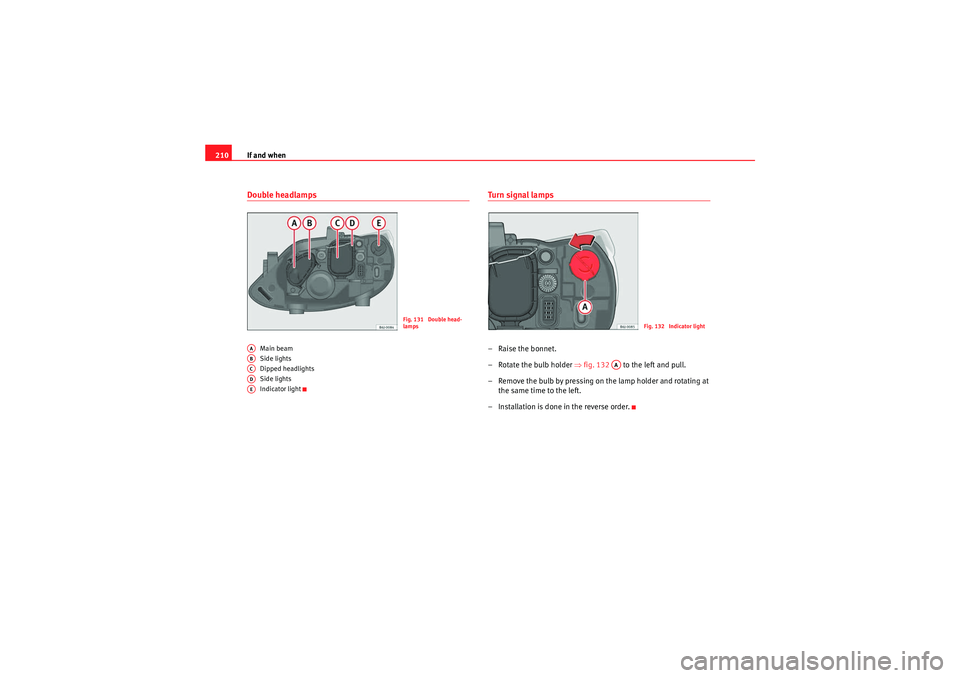
210Double headlamps
Main beam
Side lights
Dipped headlights
Side lights
Indicator light
Turn signal lamps– Raise the bonnet.
– Rotate the bulb holder ⇒fig. 132 to the left and pull.
– Remove the bulb by pressing on the lamp holder and rotating at the same time to the left.
– Installation is done in the reverse order.
Fig. 131 Double head-
lamps
AAABACADAE
Fig. 132 Indicator light
AA
IbizaSC_EN.book Seite 210 Mittwoch, 16. September 2009 12:11 12
Page 224 of 257
If and when
222Do not pull too hard with the towing vehicle and take care to avoid jerking the
tow-rope. When towing on an unpaved road, there is always a risk of over-
loading and damaging the anchorage points.
The ignition of the vehicle being towed must be switched on to prevent the
steering wheel from locking and also to allow the use of the turn signals,
horn, windscreen wipers and washers.
As the brake servo does not work if the engine is not running, you must apply
considerably more pressure to the brake pedal than you normally would.
As the power assisted steering does not work if the engine is not running, you
will need more strength to steer than you normally would.
Towing vehicles with an automatic gearbox•Put the selector lever into position “N”.•Do not drive faster than 50 km/h when towing a vehicle.•Do not tow further than 50 km.•If a breakdown vehicle is used, the vehicle must be towed with the front
wheels raised.Note
•Observe legal requirements when towing or tow-starting.•Switch on the hazard warning lights of both vehicles. However, observe
any regulations to the contrary.•For technical reasons, vehicles with an automatic gearbox must not be
tow-started.•If damage to your vehicle means that there is no lubricant in the gearbox,
you must raise the drive wheels while the vehicle is being towed.•If the vehicle has to be towed more than 50 km, the front wheels must be
raised during towing, and towing should be carried out by a qualified person.•The steering wheel is locked when the vehicle has no electrical power. The
vehicle must then be towed with the front wheels raised. Towing should be
carried out by a qualified person.
•The towing eye should always be kept in the vehicle.Trailer eyesFitting the towing eye
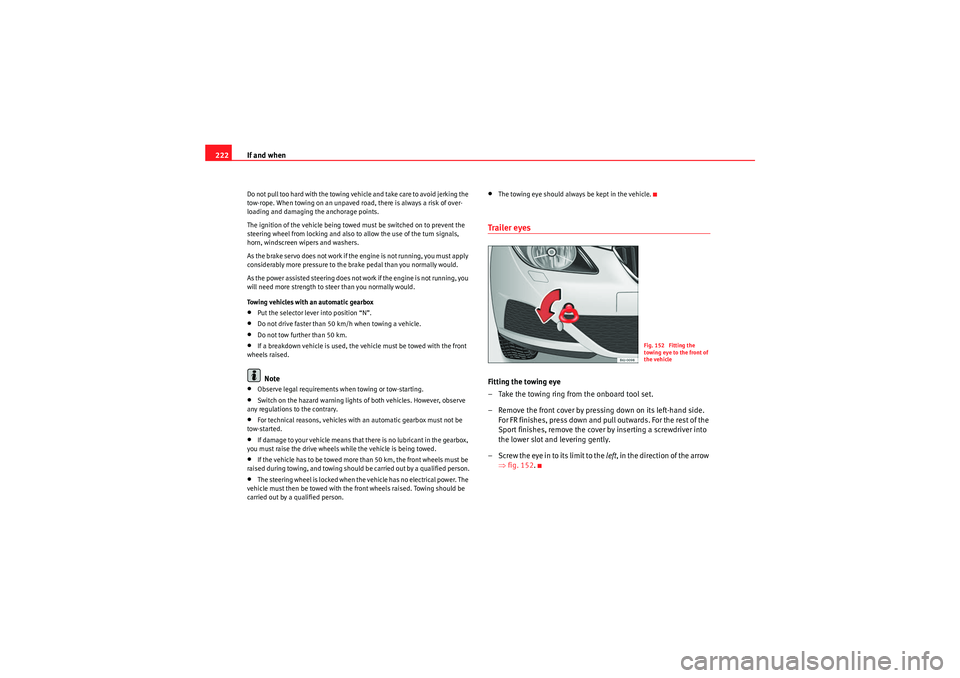
– Take the towing ring from the onboard tool set.
– Remove the front cover by pressing down on its left-hand side. For FR finishes, press down and pu ll outwards. For the rest of the
Sport finishes, remove the cover by inserting a screwdriver into
the lower slot and levering gently.
– Screw the eye in to its limit to the left, in the direction of the arrow
⇒ fig. 152 .
Fig. 152 Fitting the
towing eye to the front of
the vehicle
IbizaSC_EN.book Seite 222 Mittwoch, 16. September 2009 12:11 12
Page 250 of 257
Index
248Selective unlocking system* . . . . . . . . . . . . 71
Unlocking system* . . . . . . . . . . . . . . . . . . . . 72
Central locking button Central locking . . . . . . . . . . . . . . . . . . . . . . . 73
unlocking . . . . . . . . . . . . . . . . . . . . . . . . . . . . 73
Cetane number . . . . . . . . . . . . . . . . . . . . . . . . . 175
Changing bulbs on rear lights . . . . . . . . . 215, 216
Changing double headlight lamps dipped headlights and side lights . . . . . . . 211
main headlights and side lights . . . . . . . . 212
Changing gear See Manual gearbox . . . . . . . . . . . . . . . . . . 131
Changing gear in Tiptronic mode . . . . . . . . . . . 136
Changing lamps interior light and reading light . . . . . . . . . . 217
Changing the lamps Main headlight lamps . . . . . . . . . . . . . 210, 212
number plate light . . . . . . . . . . . . . . . . . . . 217
Side indicator lights . . . . . . . . . . . . . . . . . . 216
Changing the main headlight lamps turn signal lamps . . . . . . . . . . . . . . . . . . . . 210
Changing the single headlight lamps dipped/main beam . . . . . . . . . . . . . . . . . . . 213
indicator lamps . . . . . . . . . . . . . . . . . . . . . . 213
Side lights . . . . . . . . . . . . . . . . . . . . . . . . . . 214
Changing windscreen wiper blades . . . . . . . . . 186
Chassis number . . . . . . . . . . . . . . . . . . . . . . . . 226
Checking . . . . . . . . . . . . . . . . . . . . . . . . . . . . . . 190
Checking battery electrolyte level . . . . . . . . . . 190
Checking engine oil level . . . . . . . . . . . . . . . . . 180
Child safety . . . . . . . . . . . . . . . . . . . . . . . . . . . . . 38 Child seat . . . . . . . . . . . . . . . . . . . . . . . . . . . . . . . 40
Categorisation in groups . . . . . . . . . . . . . . . 40
Group 1 . . . . . . . . . . . . . . . . . . . . . . . . . . . . . 41
Group 2 . . . . . . . . . . . . . . . . . . . . . . . . . . . . . 41
Group 3 . . . . . . . . . . . . . . . . . . . . . . . . . . . . . 41
Groups 0 and 0+ . . . . . . . . . . . . . . . . . . . . . . 40
ISOFIX system . . . . . . . . . . . . . . . . . . . . . . . . 43
Safety notes . . . . . . . . . . . . . . . . . . . . . . . . . . 38
Securing . . . . . . . . . . . . . . . . . . . . . . . . . . . . . 43
Child seats on the front passenger seat . . . . . . . . . . . . . 26
Cigarette lighter . . . . . . . . . . . . . . . . . . . . . . . . 110
Cleaning alloy wheel rims . . . . . . . . . . . . . . . . 164
Cleaning chrome . . . . . . . . . . . . . . . . . . . . . . . . 163
Cleaning engine compartment . . . . . . . . . . . . . 165
Cleaning steel wheel rims . . . . . . . . . . . . . . . . 164
Cleaning windows . . . . . . . . . . . . . . . . . . . . . . . 162
Climatronic automatic mode . . . . . . . . . . . . . . . . . . . . . 122
controls . . . . . . . . . . . . . . . . . . . . . . . . . . . . 121
General notes . . . . . . . . . . . . . . . . . . . . . . . 124
manual mode . . . . . . . . . . . . . . . . . . . . . . . 123
Clock . . . . . . . . . . . . . . . . . . . . . . . . . . . . . . . . . . 50
Cloth seat covers cleaning . . . . . . . . . . . . . . . . 166
Cockpit . . . . . . . . . . . . . . . . . . . . . . . . . . . . . . . . . 47
Coming home function . . . . . . . . . . . . . . . . . . . . 88
Control wing mirrors . . . . . . . . . . . . . . . . . . . . . . . . . . 98
Control lamps . . . . . . . . . . . . . . . . . . . . . . . . . . . 56
Control lighting . . . . . . . . . . . . . . . . . . . . . . . . . . 47 Controls
Electric windows . . . . . . . . . . . . . . . . . . . . . . 81
Light switches . . . . . . . . . . . . . . . . . . . . . . . . 86
Convenience closing Sliding/tilting roof . . . . . . . . . . . . . . . . . . . . 84
Windows . . . . . . . . . . . . . . . . . . . . . . . . . . . . 83
Convenience opening Windows . . . . . . . . . . . . . . . . . . . . . . . . . . . . 83
Coolant . . . . . . . . . . . . . . . . . . . . . . . . . . . 183, 184
Coolant Level . . . . . . . . . . . . . . . . . . . . . . . . . . . 184
Coolant level warning light . . . . . . . . . . . . . . . . . . . . . . . . . 63
Coolant Loss . . . . . . . . . . . . . . . . . . . . . . . . . . . 184
Coolant temperature Safety instructions . . . . . . . . . . . . . . . . . . . . 64
Correct adjustment of front head restraints . . . 12
Cruise control . . . . . . . . . . . . . . . . . . . . . . . . . . 143
Cruise control system Warning lamp . . . . . . . . . . . . . . . . . . . . . . . . 61
Curtain airbags . . . . . . . . . . . . . . . . . . . . . . . . . . 34 Description . . . . . . . . . . . . . . . . . . . . . . . . . . 34
Function . . . . . . . . . . . . . . . . . . . . . . . . . . . . . 35
Safety notes . . . . . . . . . . . . . . . . . . . . . . . . . . 35
DDanger of fitting a child seat on the front passenger seat . . . . . . . . . . . . . . . . . . . . . . . . . . . . . . . 26
Dash panel cleaning . . . . . . . . . . . . . . . . . . . . . 166
Daytime running lights . . . . . . . . . . . . . . . . . . . . 87
Diesel . . . . . . . . . . . . . . . . . . . . . . . . . . . . . . . . . 175
IbizaSC_EN.book Seite 248 Mittwoch, 16. September 2009 12:11 12