2009 Seat Exeo ST tailgate
[x] Cancel search: tailgatePage 147 of 316
Seats and stowage145
Safety First
Controls and equipment
Practical tips
Technical Data
Retaining strap*
The retaining strap can be used to secure items of luggage to
the right-hand side lining in the luggage compartment.– Hook the retaining strap into housing or ⇒fig. 119 .You can attach the strap to the top or bottom housing, depending on the size
of the object you wish to secure.
To secure shorter objects, the retaining strap can also be attached to the
centre. However, this is only possible if the strap is attached to housing .
WARNING
The retaining strap should only be used to hold objects weighing up to 5
kg. Heavier objects cannot be safely secured (injury risk).
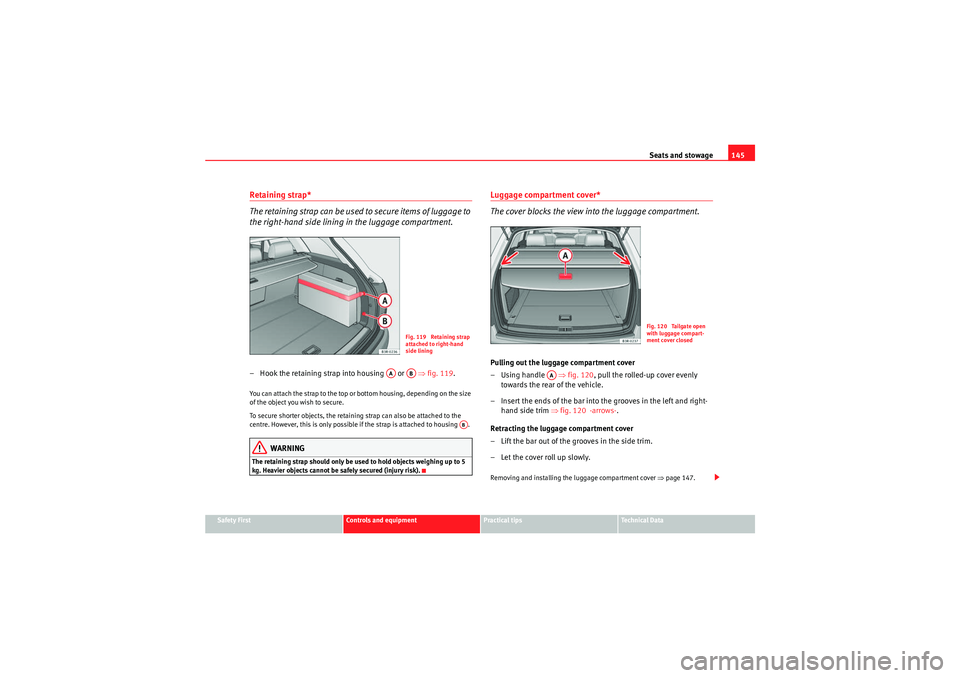
Luggage compartment cover*
The cover blocks the view into the luggage compartment.Pulling out the luggage compartment cover
–Using handle ⇒fig. 120 , pull the rolled-up cover evenly
towards the rear of the vehicle.
– Insert the ends of the bar into the grooves in the left and right- hand side trim ⇒fig. 120 -arrows-.
Retracting the luggage compartment cover
– Lift the bar out of the grooves in the side trim.
– Let the cover roll up slowly.Removing and installing the luggage compartment cover ⇒page 147.
Fig. 119 Retaining strap
attached to right-hand
side lining
AA
AB
AB
Fig. 120 Tailgate open
with luggage compart-
ment cover closed
AA
ExeoST_EN.book Seite 145 Donnerstag, 3. September 2009 12:24 12
Page 150 of 316

Seats and stowage
148Luggage compartment liner*
You can use the liner to protect the inside of the luggage
compartment when carrying wet or dirty items.
Folding out floor panel to upright position
–Open the tailgate.
– Take hold of handle ⇒fig. 124 , lift the floor panel and line
up the bottom corners of the floor panel with the recesses .
– Put the items you are transporting onto the luggage compart- ment liner
Folding floor panel up against rear backrest
–Open the tailgate.
– Take hold of the handle ⇒fig. 124 and fold out the floor
panel as far as the rear backrest.
Removing floor panel
–Open the tailgate.
– Take hold of the handle ⇒fig. 124 and fold out the floor
panel as far as the rear backrest.
– Pull the complete floor panel towards the rear of the vehicle so it comes out of the retainers ⇒ fig. 125.Small items can also be stored under floor panel ⇒ fig. 124.
The space available for carrying items in the luggage compartment liner can
be increased by folding out the floor panel or removing it completely.
Caution
When the floor panel is folded out to the upright position you should not
transport items weighing more than about 7.5 kg, or items which exceed 2/3
of the height of the upright floor panel.
Fig. 124 Floor panel
raisedFig. 125 Floor panel
removed for increased
luggage space
AA
AB
AC
AAAAAD
AB
ExeoST_EN.book Seite 148 Donnerstag, 3. September 2009 12:24 12
Page 153 of 316

Seats and stowage151
Safety First
Controls and equipment
Practical tips
Technical Data
Loading
–Open the tailgate.
– Press the release catch for the ski bag cover ⇒page 150,
fig. 128 -arrow- and swivel the cover downwards.
– Pull down the centre rear armrest.
– From the passenger compartment, press down the release catch for the ski bag cover and pull out the cover.
– Pull out and unfold the ski bag.
– The long items can now be loaded through the luggage compart- ment into the ski bag ⇒.
Securing
– Insert the fastening belt ⇒page 150, fig. 129 of the ski bag
into the centre seat belt buckle .
– Pull the free end of belt to tighten.
Storing
– Close the cover of the load-through hatch in the luggage compartment.
– Carefully fold away the ski bag.
– Close the inside cover of the load-through hatch from the passenger compartment.
WARNING
The ski bag must be secured in place with the fastening belt after it has
been loaded.
Note
Do not fold away the ski bag after use if it is still damp.Roof carrier / roof rails*Description
Additional luggage can be carried on the roof carrier.Note the following points if you intend to carry loads on the roof:•We recommend using the cross bars from the of SEAT Genuine Accesso-
ries range.•These cross bars form the basic elements of a complete roof carrier
system. For safety reasons, however, the corresponding additional fastenings
must be fitted to carry luggage, bicycles, surfboards, skis and boats. All the
components of this system are available from Authorised Service Centres.Caution
Any damage to the vehicle caused by the use of other types of roof rack or
incorrect installation will not be covered by the factory warranty. The roof
carrier system must therefore be installed exactly according to the instruc-
tions provided.
AA
AB
AC
ExeoST_EN.book Seite 151 Donnerstag, 3. September 2009 12:24 12
Page 154 of 316

Seats and stowage
152Attachment points
The roof carrier must be attached at the marked points only.The cross-bars must be fitted exactly between the points marked on the roof
railings ⇒fig. 130 . The markings are visible on the inside of the railings.
Caution
A roof carrier unit must not be used if the vehicle is not equipped with roof
rails (basic support).Roof load
Loads carried on the roof must be securely attached. The car's
handling is affected whenever you carry loads on the vehicle.The authorised load on the roof of your vehicle is 75 kg. Use the weight of the
roof carrier system and that of the load as a basis to calculate the roof load. If less resistant systems are used, the roof carrier must not be loaded to the
maximum weight permitted. If less resistant systems are used, these must
only be loaded to the maximum weight permitted indicated in the assembly
instructions.
WARNING
•Loads carried on the roof must be securely attached. Failure to do so
could result in an accident.•Do not exceed the maximum roof load for the vehicle, the maximum
axle loads or the maximum gross vehicle weight. Failure to do so could
result in an accident.•When transporting heavy or bulky loads on the roof, bear in mind that
t h e ca r ' s ha n d l i ng is a f fe c te d by t h e e x t ra w e i g h t o n t h e ro o f a n d a p os s ibl e
susceptibility to cross winds. Adjust your speed and driving style accord-
ingly to avoid accidents.Caution
Please take extra care not to let the tailgate strike the roof load when open.
For the sake of the environment
Roof carriers are often left attached for convenience, even when they are not
being used. However, the increased air resistance means that the vehicle
uses more fuel. For this reason you should always take off the roof carrier
when it is not in use.
Fig. 130 Attachment
points for cross bars
ExeoST_EN.book Seite 152 Donnerstag, 3. September 2009 12:24 12
Page 215 of 316

Your vehicle maintenance and cleaning213
Safety First
Controls and equipment
Practical tips
Technical Data
Caution
•Never remove dirt, mud or dust if the vehicle surface is dry. Never use a
dry cloth or sponge for cleaning purposes. This could scratch the paintwork
or glass on your vehicle.•Washing the vehicle in low temperatures: when washing the vehicle with
a hose, do not direct water into the lock cylinders or the gaps around the
doors, tailgate, or sunroof. Risk of freezing.For the sake of the environment
To protect environment, the car should be washed only in specially provided
wash bays. This prevents toxic, oil-laden waste water entering the sewerage
system. In some districts, washing vehicles outside wash bays is prohibited.
Note
Do not wash the vehicle in direct sunlight.Washing the car with a high pressure cleaner
Be particularly careful when using a high pressure cleaner!– Always observe the instructions for the high-pressure cleaner, particularly those concerning the pressure and the spraying
distance.
– Increase the spraying distance for soft materials and painted
bumpers.
– Do not use a high pressure cleaner to remove ice or snow from windows ⇒page 214. – Never use concentrated jet nozzles (“rotating jets”)
⇒.
– Directly after washing, avoid sudden and sharp braking. “Dry” ⇒page 195 the brakes by braking several times.
WARNING
•Never wash tyres with a concentrated jet (“rotating nozzle”). Even at
large spraying distances and short cleaning times, visible and invisible
damage can occur to the tyres. This may cause an accident.•Water, ice and salt on the brakes can reduce braking efficiency. Risk of
accident.Caution
•Do not use water hotter than 60°C. This could damage the vehicle.•To avoid damage to the vehicle, keep a sufficient distance from sensitive
materials such as flexible hoses, plastic, soundproofing material, etc. This is
also important for bumpers painted as the paintwork. The closer the nozzle is
to the surface, the greater the wear on the material.Vehicle paint maintenance requirements
Regular waxing protects the paintwork.You need to apply wax to your car if water does not form small drops and run
off the paintwork when it is clean.
A good quality hard wax product is available from your Authorised Service
Centre.
ExeoST_EN.book Seite 213 Donnerstag, 3. September 2009 12:24 12
Page 225 of 316

Checking and refilling levels223
Safety First
Controls and equipment
Practical tips
Technical Data
−
Insert the fuel nozzle into the mouth of the canister as far as
possible.
− If the spare fuel canister is made of metal, the filling nozzle must be
in contact with the canister during filling. This helps prevent an electro-
static charge building up.
− Never spill fuel in the vehicle or in the luggage compartment. Fuel
vapours are explosive. Danger of death.
Caution
•Fuel spills should be removed from the paintwork immediately.•Never run the tank completely dry. An irregular fuel supply could cause
misfiring. As a result, unburnt fuel could enter the catalytic converter and
cause damage.•When filling the fuel tank after having run it completely dry on a vehicle
with a diesel engine the ignition must be switched on for at least 30 seconds
without starting the engine. When you then start the engine it may take
longer than normal (up to one minute) for the engine to start firing. This is due
to the fact that the fuel system has to purge itself of air before starting.For the sake of the environment
Do not try to put in more fuel after the automatic filler nozzle has switched off;
this may cause the fuel to overflow if it becomes warm.
Releasing the tank flap manuallyThe tank flap can be released manually if the central locking
system fails to operate.–Open the tailgate.
– Open the cover in the right-hand side trim.
– Pull the ring to unlock the fuel tank flap ⇒fig. 175 .
WARNING (continued)
Fig. 175 Luggage
compartment: Releasing
the fuel tank flap by hand
in case of emergency
ExeoST_EN.book Seite 223 Donnerstag, 3. September 2009 12:24 12
Page 280 of 316

If and when
278
A special retaining screw is used to secure and guide the rear light.
– Check which of the bulbs is defective.
–Open the tailgate.
– Take the screwdriver out of the vehicle's tool kit ⇒ page 251.
– Use the flat-blade side of th e reversible screwdriver insert.
– Prise off the cover with a screwdriver in the slot ⇒page 277,
fig. 225 and remove the cover (with the retaining clips) from
the opening.
– Carefully loosen the screw located behind the cover with the screwdriver, turning it anti-clockwise (arrows) .
– Gradually ease the rear light out of the housing ( ⇒page 277,
fig. 226 positions and ) by pulling alternately in positions
and .
– Remove the bulb holder ⇒page 278.
CautionWhen removing or installing the rear light, take care not to cause any
damage.•Removing the rear light in particular can lead to the paintwork or rear light
becoming damaged. This is another reason why we recommend having the
bulbs changed by a qualified workshop.Note
Make sure you have a soft cloth ready to place under the glass on the rear
light, to avoid any scratches.
Removing the bulb holder
When changing a bulb, you must first remove the bulb holder.There are four securing tabs on the inside of the rear light unit.
– Release the retaining tabs ⇒fig. 227.
– Lift the bulb carrier off in the direction of the arrow .
– Change the defective bulb ⇒page 279.
A1
A2
A3
A4
A1
A2
Fig. 227 Retaining tabs
on reverse side of rear
light
AA
AB
ExeoST_EN.book Seite 278 Donnerstag, 3. September 2009 12:24 12
Page 283 of 316

If and when281
Safety First
Controls and equipment
Practical tips
Technical Data
Caution
Take care when fitting the rear light unit to make sure there is no damage to
the paintwork or any of its components.Changing rear light bulbs (in boot lid)Overview of rear lightsRear lights in the boot lid•Rear light•Rear fog light•Reverse light
Removing the bulb holder
The tailgate must be open to change the bulbs.
F ig. 232 O ver vie w of rear
lights
Fig. 233 Remove the
cover of the tailgate trimFig. 234 Remove the bulb
holder
ExeoST_EN.book Seite 281 Donnerstag, 3. September 2009 12:24 12