2009 Seat Exeo lock
[x] Cancel search: lockPage 201 of 310

Trailer towing199
Safety First
Controls and equipment
Practical tips
Technical Data
Make sure the ball joint is clean and undamaged
– Check the locking pin , release pin , shaft section and
knob ⇒page 198, fig. 155 on the ball joint to make sure they
are clean and undamaged.
The spring mechanism inside the ball joint must be in the ready
position
– Check that the red marking ⇒page 198, fig. 156 on the knob
is inside the black zone marked on the ball joint.
– Check that the locking pin is inside the holes in the shaft section of the ball joint.
– Check that the knob protrudes visibly from the ball joint, so that there is a clear gap between the knob and the ball joint.The ball joint can only be installed if the internal spring mechanism is in the
ready position.
Cont ⇒page 199, “Fitting the ball joint (step 3)”.
Fitting the ball joint (step 3)
AA
AB
AC
AD
AAAB
AC
Fig. 157 Removable
towing bracket: Setting
the spring mechanism to
the "ready" positionFig. 158 Removable
towing bracket: inserting
the ball joint
Exeo_EN.book Seite 199 Freitag, 28. August 2009 10:14 10
Page 202 of 310

Trailer towing
200
Setting the spring mechanism to the ready position (if required)
– Insert the key ⇒page 199, fig. 157 in the lock on the knob
and turn it towards the red marking.
– Pull out the knob in direction , hold and turn in direction
until the locking pin engages and the release pin moves
out visibly ⇒.
inserting the ball joint
– With the spring mechanism in the ready position, insert the ball joint into the mounting fixture and push it upwards ⇒page 199,
fig. 158 in the direction indicated (arrow) ⇒. It should lock
into position automatically. You should now clearly hear it click
into place.
– Lock the ball joint by turning the key to the green marking.
– Remove the key.Cont ⇒page 200, “Fitting the ball joint (step 4)”.
WARNING
•If it is not possible to set the spring mechanism to the ready position as
described above, do not use the ball joint. Please contact a specialist
garage.•To avoid injury, keep your hands away from the knob or cover piece
when inserting the ball joint in the mounting fixture. Otherwise, you could
be injured.
Fitting the ball joint (step 4)
A1
AA
AB
A2
A3
Fig. 159 Removable
towing bracket: Safety
checkFig. 160 Rear bumper:
Pulling down the
connecting socket
Exeo_EN.book Seite 200 Freitag, 28. August 2009 10:14 10
Page 203 of 310

Trailer towing201
Safety First
Controls and equipment
Practical tips
Technical Data
Safety check
– Check that the green marking ⇒page 200, fig. 159 on the
knob is inside the black zone marked on the ball joint.
– Check that the knob is directly against the ball joint, so that there is no gap between the knob and the ball joint -arrow-.
– Check that the ball joint is locked and the key is removed so that the knob cannot be pulled out ⇒.
– Check that the ball joint fits tightly in the mounting fixture (try moving it about to check).
To w i n g s o c k e t
– To plug in the electrical connection for the trailer, pull down the socket below the bumper ⇒page 200, fig. 160 .If the safety check is not satisfactory, the ball joint must be fitted again prop-
erly.
WARNING
To avoid accidents, the ball joint must meet all the safety requirements
listed in the safety check. The towing bracket must not be used if any one
of these requirements is not met. If this is the case, you should contact a
specialist garage.
Removing the ball joint– Insert the key in the lock ⇒fig. 161 on the knob.
– Unlock the ball joint by turning the key to the red marking.
AA
Fig. 161 Removable
towing bracket: Removing
the ball jointFig. 162 Rear bumper:
fitting the cover piece
A1
Exeo_EN.book Seite 201 Freitag, 28. August 2009 10:14 10
Page 204 of 310

Trailer towing
202
– Take hold of the ball joint and pull out the knob in direction .
– Keep hold of the knob and turn it as far as it will go in direction
.
– Release the knob. The spring mechanism will remain in the ready position ⇒.
– Pull the ball joint down out of the mounting fixture ⇒page 201, fig. 162. The cover piece will cover the mounting
fixture automatically .
– Put away the ball joint attachment under the floor panel in the luggage compartment.
– Move the socket back up to its original position.
WARNING
•To avoid injury, keep your hands away from the locking pin and the
release pin when releasing the locking mechanism.•Make sure that the cover piece is properly engaged on the mounting
fixture on the vehicle. Otherwise the ball joint may fail to engage securely
if dirt accumulates in the mounting fixture.
AA
AB
A1
A2
Exeo_EN.book Seite 202 Freitag, 28. August 2009 10:14 10
Page 209 of 310

Your vehicle maintenance and cleaning207
Safety First
Controls and equipment
Practical tips
Technical Data
Caution
•Never remove dirt, mud or dust if the vehicle surface is dry. Never use a
dry cloth or sponge for cleaning purposes. This could scratch the paintwork
or glass on your vehicle.•Washing the vehicle in low temperatures: when washing the vehicle with
a hose, do not direct water into the lock cylinders or the gaps around the
doors, tailgate, or sunroof. Risk of freezing.For the sake of the environment
To protect environment, the car should be washed only in specially provided
wash bays. This prevents toxic, oil-laden waste water entering the sewerage
system. In some districts, washing vehicles outside wash bays is prohibited.
Note
Do not wash the vehicle in direct sunlight.Washing the car with a high pressure cleaner
Be particularly careful when using a high pressure cleaner!– Always observe the instructions for the high-pressure cleaner, particularly those concerning the pressure and the spraying
distance.
– Increase the spraying distance for soft materials and painted
bumpers.
– Do not use a high pressure cleaner to remove ice or snow from windows ⇒page 208. – Never use concentrated jet nozzles (“rotating jets”)
⇒.
– Directly after washing, avoid sudden and sharp braking. “Dry” ⇒page 189 the brakes by braking several times.
WARNING
•Never wash tyres with a concentrated jet (“rotating nozzle”). Even at
large spraying distances and short cleaning times, visible and invisible
damage can occur to the tyres. This may cause an accident.•Water, ice and salt on the brakes can reduce braking efficiency. Risk of
accident.Caution
•Do not use water hotter than 60°C. This could damage the vehicle.•To avoid damage to the vehicle, keep a sufficient distance from sensitive
materials such as flexible hoses, plastic, soundproofing material, etc. This is
also important for bumpers painted as the paintwork. The closer the nozzle is
to the surface, the greater the wear on the material.Vehicle paint maintenance requirements
Regular waxing protects the paintwork.You need to apply wax to your car if water does not form small drops and run
off the paintwork when it is clean.
A good quality hard wax product is available from your Authorised Service
Centre.
Exeo_EN.book Seite 207 Freitag, 28. August 2009 10:14 10
Page 211 of 310
Your vehicle maintenance and cleaning209
Safety First
Controls and equipment
Practical tips
Technical Data
to the windscreen washer fluid prevents wiper blades from juddering. Wax
deposits are not removed.
Caution
•Never use warm or hot water to remove snow and ice from windows and
mirrors. This could cause the glass to crack!•The heating element for the rear window is located on the inner side of the
window. To prevent damage, do not put stickers on the heating elements
inside the window.Cleaning windscreen wiper bladesClean wiper blades are essent ial to provide clear vision.
1. Use a soft cloth to remove dust and dirt from the windscreen wiper blades.
2. Use window cleanser to clean the windscreen wiper blades. Use
a sponge or a cloth to remove stubborn stains.Rubber seals maintenance
If rubber seals are well looked after, they will not freeze so
quickly.1. Use a soft cloth to remove dust and dirt from the rubber seals.
2. Apply a specialist care product to the rubber seals.
The strips on the doors, windows, bonnet and rear lid will remain pliable and
last longer if they are treated with a suitable care product (for example sili-
cone spray).
Caring for rubber seals will also prevent premature ageing and leaks. The
doors will be easier to open. If rubber seals are well looked after, they will not
freeze so quickly in winter.Door lock cylinders
The door lock cylinders can freeze up in winter.To de-ice the lock cylinders you should only use spray with lubricating and
anti-corrosive properties.Cleaning chrome parts1. Clean chrome parts with a damp cloth.
2. Polish chrome parts with a soft, dry cloth.If this does not provide satisfying results, use a specialist chrome cleaning
product . Chrome cleaning products will remove stains and coatings from the
surface.
Caution
To prevent scratching chrome surfaces:•Never use an abrasive care product on chrome.•Do not clean or polish chrome parts in a sandy or dusty environment.
Exeo_EN.book Seite 209 Freitag, 28. August 2009 10:14 10
Page 218 of 310
Checking and refilling levels
216Checking and refilling levelsRefuellingThe tank flap is released manually. The tank holds approxi-
mately 70 litres.The flap that covers the tank cap is unlocked and locked automati-
cally by the central locking.
Unscrewing the tank cap
– Press the right side of the flap to open it.
– Unscrew the fuel tank cap anti-clockwise.
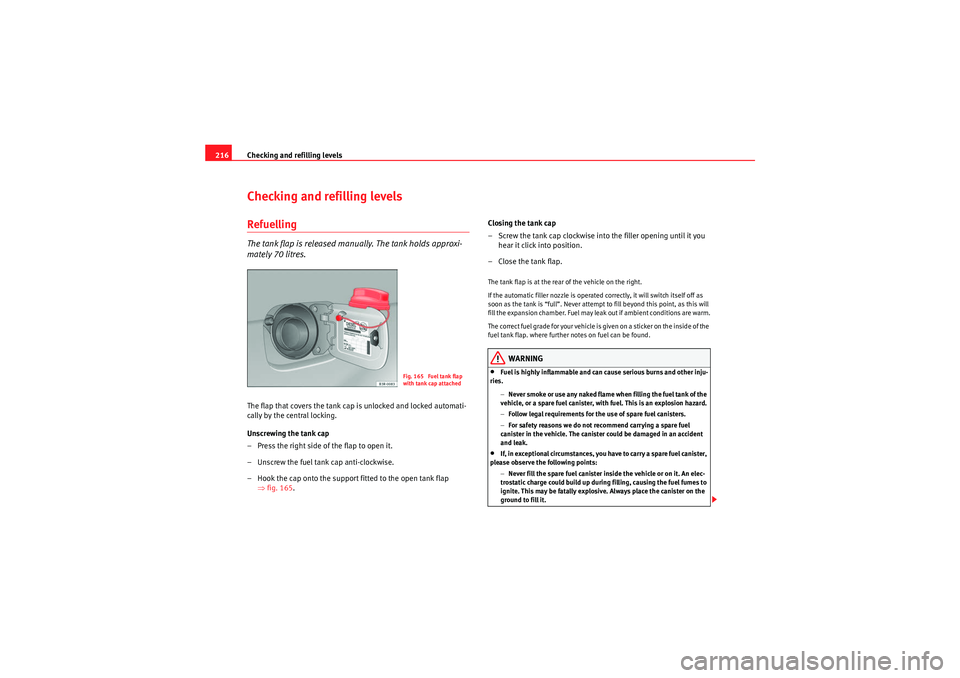
– Hook the cap onto the support fitted to the open tank flap
⇒fig. 165 . Closing the tank cap
– Screw the tank cap clockwise into the filler opening until it you
hear it click into position.
– Close the tank flap.
The tank flap is at the rear of the vehicle on the right.
If the automatic filler nozzle is operated correctly, it will switch itself off as
soon as the tank is “full”. Never attempt to fill beyond this point, as this will
fill the expansion chamber. Fuel may leak out if ambient conditions are warm.
T he co rr ec t fu el g rad e fo r you r v eh icle is giv en on a sti cker o n th e i nsid e of the
fuel tank flap. where further notes on fuel can be found.
WARNING
•Fuel is highly inflammable and can cause serious burns and other inju-
ries.
−Never smoke or use any naked flame when filling the fuel tank of the
vehicle, or a spare fuel canister, with fuel. This is an explosion hazard.
− Follow legal requirements for the use of spare fuel canisters.
− For safety reasons we do not recommend carrying a spare fuel
canister in the vehicle. The canister could be damaged in an accident
and leak.•If, in exceptional circumstances, you have to carry a spare fuel canister,
please observe the following points:
−Never fill the spare fuel canister inside the vehicle or on it. An elec-
trostatic charge could build up during filling, causing the fuel fumes to
ignite. This may be fatally explosive. Always place the canister on the
ground to fill it.
Fig. 165 Fuel tank flap
with tank cap attached
Exeo_EN.book Seite 216 Freitag, 28. August 2009 10:14 10
Page 219 of 310

Checking and refilling levels217
Safety First
Controls and equipment
Practical tips
Technical Data
−
Insert the fuel nozzle into the mouth of the canister as far as
possible.
− If the spare fuel canister is made of metal, the filling nozzle must be
in contact with the canister during filling. This helps prevent an electro-
static charge building up.
− Never spill fuel in the vehicle or in the luggage compartment. Fuel
vapours are explosive. Danger of death.
Caution
•Fuel spills should be removed from the paintwork immediately.•Never run the tank completely dry. An irregular fuel supply could cause
misfiring. As a result, unburnt fuel could enter the catalytic converter and
cause damage.•When filling the fuel tank after having run it completely dry on a vehicle
with a diesel engine the ignition must be switched on for at least 30 seconds
without starting the engine. When you then start the engine it may take
longer than normal (up to one minute) for the engine to start firing. This is due
to the fact that the fuel system has to purge itself of air before starting.For the sake of the environment
Do not try to put in more fuel after the automatic filler nozzle has switched off;
this may cause the fuel to overflow if it becomes warm.
Releasing the tank flap manuallyThe tank flap can be released manually if the central locking
system fails to operate.–Open the tailgate.
– Open the cover in the right-hand side trim.
– Pull the ring to unlock the fuel tank flap ⇒fig. 166 .
WARNING (continued)
Fig. 166 Luggage
compartment: Releasing
the fuel tank flap by hand
in case of emergency
Exeo_EN.book Seite 217 Freitag, 28. August 2009 10:14 10