2009 Seat Exeo maintenance
[x] Cancel search: maintenancePage 221 of 310

Checking and refilling levels219
Safety First
Controls and equipment
Practical tips
Technical Data
Your Authorised Service Centre can also be consulted to know if the vehicle
has been prepared for biodiesel use.
Things to note about RME fuel (biodiesel)
•The performance of a vehicle using biodiesel maybe somewhat reduced.•Fuel consumption of a vehicle using biodiesel may be slightly higher.•RME fuel is resistant to the cold down to approx. -10°C.•At temperatures below -10°C, we recommend using winter diesel fuel.•Your vehicle is designed to be refuelled with up to a maximum of 7%
biodiesel blend, in accordance with the DIN 51628 standard.Caution
•RME fuel can damage the fuel system in vehicles which are not suitably
adjusted.•If you decide to use biodiesel in your vehicle, please use only RME fuel
which is DIN E 14.214 compliant.•If you use biodiesel that does not meet the required standard, the fuel
filter could become clogged.Note
•In case of low exterior temperatures and a fuel biodiesel percentage of
higher than 50%, an increase in gas emission may occur during operation of
the independent heating.•The fuel filter may become clogged when fuel is changed to biodiesel. For
this reason, we recommend you that, when having run 300 or 400 km after a
fuel change, the fuel filter change must also be done. Also note the instruc-
tions in the Inspection and Maintenance plan.•If the vehicle is to remain parked for more than about two weeks, we
recommend filling the fuel tank with biodiesel and driving about 50 km in
order to avoid damage to the injection system.
Winter driving
Diesel can thicken in winter.Winter-grade diesel
When using summer-grade diesel fuel, difficulties may be experienced at
sub-zero temperatures because the fuel thickens due to wax separation.
Therefore, winter-grade diesel fuel is available in some countries during the
cold months. It can be used at temperatures as low as -22°C.
In countries with different climatic conditions the diesel fuel generally sold
has different temperature characteristics. Check with an Authorised Service
Centre or filling stations in the country concerned regarding the type of diesel
fuels available.
Filter pre-heater
Your vehicle is fitted with a fuel filter pre-heater, making it well equipped for
operation in winter. This ensures that the fuel system remains operational to
approx. -24°C, provided you use winter-grade diesel which is safe to -15°C.
However, if the fuel has waxed to such an extent that the engine will not start
at temperatures of under -24°C, simply place the vehicle in a warm place for
a while.
Caution
Do not mix fuel additives (“thinners”, or similar additives) with diesel fuel.
Exeo_EN.book Seite 219 Freitag, 28. August 2009 10:14 10
Page 224 of 310

Checking and refilling levels
222
NoteOn right-hand drive vehicles some of the containers/ reservoirs mentioned
below are located on the other side of the engine compartment.Closing the bonnet– To close the bonnet, pull it down to overcome the spring pres- sure.
– Leave the bonnet secured in the locking part. Do not tighten
⇒ .
WARNING
•For safety reasons the bonnet must always be completely closed when
the vehicle is moving. After closing it always check that it is properly
secured. The bonnet must be flush with the adjacent body panels.•Should you notice that the bonnet is not safely secured when the
vehicle is moving, stop the vehicle immediately and close the bonnet.
Failure to do so could result in an accident.
Engine oilGeneral notesWe recommend that the oil change should be performed by an Authorised
Service Centre or a qualified workshop, according to the Maintenance
Program. The correct oil specifications for your engine are listed in the
⇒page 223,
“Oil properties”.
Check that the specifications quoted (VW standards) appear on the container
either singly or in combination with other specifications.
Flexible maintenance intervals (Extended Service Intervals*)
Special lubricating oils ⇒page 223 have been developed in the framework
of the SEAT “Extended Service Intervals” ⇒Booklet “Maintenance Program”
This type of oil must be used if you intend to take advantage of the prolonga-
tion of the maintenance intervals in the framework of the “Extended Service
Intervals” program.
•Do not mix the LongLife oil with oil intended for fixed service intervals, as
the requirements for the extended service intervals are then no longer guar-
anteed.•Only in exceptional circumstances, if the engine oil level is too low
⇒ page 224 and LongLife oil is not available, it is permitted to top up (once)
with oil for fixed service intervals ⇒ page 223 (up to a maximum of 0.5
litres).
Fixed service intervals*
If “Extended Service Intervals” are not applied to your vehicle, you can use
oils for fixed service intervals ⇒ page 223. In this case, your vehicle must be
serviced after a fixed interval of 1 year / 15,000 km (10,000 miles) (see the
Maintenance Program).•In exceptional circumstances, if the engine oil level is too low
⇒ page 224 and you cannot obtain the oil specified for your vehicle, you can
put in a small quantity of oil conforming to the specification ACEA A2 or
ACEA A3 (petrol engines) or ACEA B3 or ACEA B4 (diesel engines) (up to 0.5l).
Vehicles with diesel particulate filter*
The Maintenance Program states whether your vehicle is fitted with a diesel
particulate filter.
Exeo_EN.book Seite 222 Freitag, 28. August 2009 10:14 10
Page 233 of 310

Checking and refilling levels231
Safety First
Controls and equipment
Practical tips
Technical Data
Topping up and changing the brake fluid
It is best to have the brake fluid changed by a professional.Brake fluid absorbs damp. Therefore, in the course of time it will absorb water
from the ambient air. If the water content in the brake fluid is too high, the
brake system could corrode. In addition, the boiling point of the brake fluid
will be considerably reduced. This could adversely affect the braking ability in
certain circumstances.
For this reason the brake fluid must be changed periodically.
Your vehicle's Service Schedule will tell you when the brake fluid has to be
renewed.
We recommend you have the brake fluid changed as part of a regular Inspec-
tion Service at your garage. They are familiar with the procedure and have the
necessary special tools and spare parts as well as the proper facilities for
disposing of the old fluid.
Use only the genuine brake fluid specified by the factory Specialist garages
know that the brake fluid -DOT 4- is factory approved. The brake fluid must be
new.
WARNING
•Therefore, it must always be kept closed in its original container. Keep
out of the reach of children. Failure to comply could result in poisoning.•Heavy use of the brakes may cause a vapour lock if the brake fluid is left
in the system for too long. This would seriously affect the efficiency of the
brakes and the safety of the car, leading to the risk of accident.Caution
Please note that brake fluid will attack the paintwork on contact.
For the sake of the environment
If the fluid has to be drained out of the brake system, use an appropriate
container to catch the used brake fluid and dispose of it in the proper
manner.BatteryGeneral notes
All work on batteries requires specialist knowledge.The battery is virtually maintenance-free and is checked in the Inspection
Services.
We recommend that you replace a battery once it is older than 5 years.
Disconnecting the battery
If the battery is disconnected, some of the vehicle's functions will become
inoperative (e.g. electric windows). These functions will require resetting
after the battery is reconnected. For this reason, the battery should only be
disconnected from the vehicle's electrical system when absolutely necessary.
Long periods of non-use
The battery will gradually lose its charge because certain electrical equip-
ment continues to draw current even when the ignition is off. If you park the
vehicle for long periods of time in winter you should take the battery out of
the vehicle and keep it in a frost-proof room. Store the battery in a place
where it cannot “freeze up” and become damaged. At warm outside temper-
atures it is sufficient to disconnect the negative terminal of the battery. Even
when the battery is not connected you should charge it from time to time.
Exeo_EN.book Seite 231 Freitag, 28. August 2009 10:14 10
Page 234 of 310

Checking and refilling levels
232Winter operations
The battery is drained more in cold weather, which means that the starting
power is reduced. For this reason, have the battery checked and charged if
necessary before the start of winter.
Replacing the battery
A replacement battery must have the same capacity, voltage and current
rating. It must also have the same di mensions as the original, factory-fitted
battery and have sealed caps. The SEAT batteries which have been specially
developed fulfil the maintenance, performance and safety specifications for
your vehicle.
We recommend you use maintenance-free batteries.
WARNING
•All work on batteries requires specialist knowledge. If work is required
on the battery, this should be performed by a Technical Service or
specialist garage. Danger of caustic burns and explosion!•The battery must not be opened. Never try to change the battery's
liquid level. Explosive gas is released from the battery that could lead to an
explosion.Caution
•The battery holder and clamps must always be correctly secured.•Before starting any work on the battery, always observe the warnings
listed under ⇒.For the sake of the environment
Batteries contain toxic substances including sulphuric acid and lead.
Therefore, they must be disposed in line with environmental regulations and
must not be disposed of with ordinary household waste. Make sure discon-
nected batteries cannot tip over. Sulphuric acid could be spilt!
Important safety warnings for handling a car batteryThe battery is located at the back of the engine compartment ⇒page 289.
WARNING
Always be aware of the danger of injury and chemical burns as well as the
risk of accident or fire when working on the battery and the electrical
system:•Wear eye protection. Protect your eyes, skin and clothing from acid and
particles containing lead.•Battery acid is very corrosive and caustic. Wear protective gloves and
eye protection. Do not tilt the batteries. This could spill acid through the
vents. Rinse battery acid from eyes immediately for several minutes with
clear water. Then seek medical care immediately. Neutralize any acid
splashes on the skin or clothing with a soapy solution, and rinse off with
plenty of water. If acid is swallowed by mistake, consult a doctor immedi-
ately.•Fires, sparks, naked lights and smoking are prohibited. When handling
cables and electrical equipment, av oid causing sparks and electrostatic
charge. Never short the battery terminals. High-energy sparks can cause
injury.
Wear eye protection
Battery acid is very corrosive and caustic. Wear protective
gloves and eye protection!
Fires, sparks, naked lights and smoking are prohibited!
A highly explosive mixture of gases is released when the bat-
tery is under charge.
Keep children away from acid and batteries!
Exeo_EN.book Seite 232 Freitag, 28. August 2009 10:14 10
Page 287 of 310
General notes on the technical data285
Safety First
Controls and equipment
Practical tips
Technical Data
Te ch n i c a l D a t aGeneral notes on the technical dataOutstanding informationImportant considerations
All data in the official vehicle documents take precedence
over this data.All data provided in this manual are valid for the standard model in Spain. The
vehicle data card included in the Maintenance Programme or the vehicle
registration documents shows which engine is installed in the vehicle.
The figures may be different depending on if additional equipment is fitted,
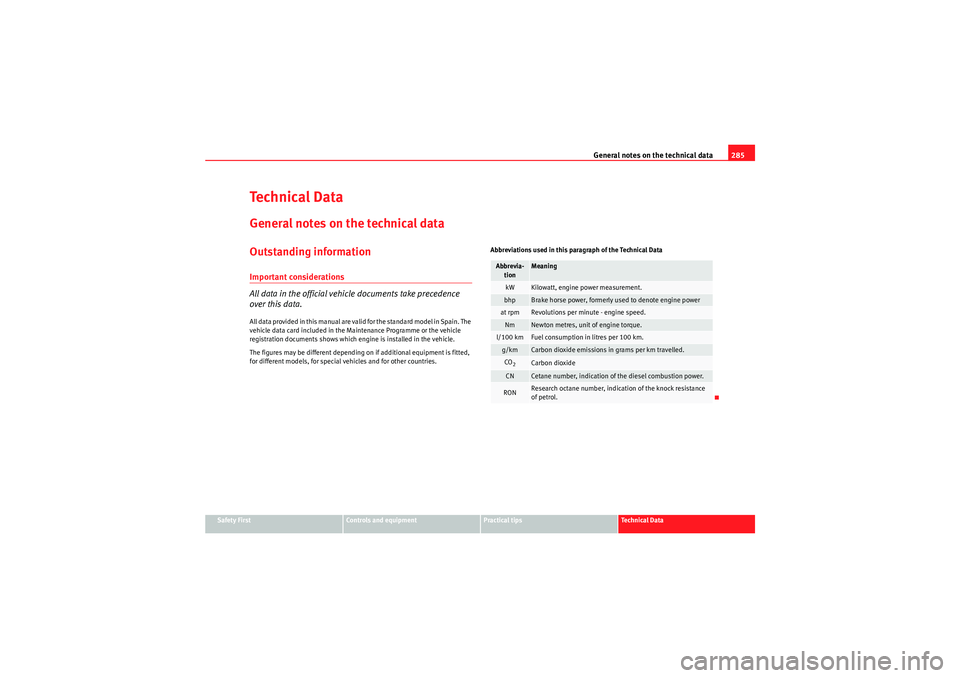
for different models, for special vehicles and for other countries. Abbreviations used in this paragraph of the Technical Data
Abbrevia-
tion
Meaning
kW
Kilowatt, engine power measurement.
bhp
Brake horse power, formerly used to denote engine power
at rpm
Revolutions per minute - engine speed.
Nm
Newton metres, unit of engine torque.
l/100 km
Fuel consumption in litres per 100 km.
g/km
Carbon dioxide emissions in grams per km travelled.
CO2
Carbon dioxide
CN
Cetane number, indication of the diesel combustion power.
RON
Research octane number, indication of the knock resistance
of petrol.
Exeo_EN.book Seite 285 Freitag, 28. August 2009 10:14 10
Page 288 of 310

General notes on the technical data
286Vehicle identification data
The most important data are given on the type plate and the
vehicle data sticker.Vehicles for certain export countries do not have a type plate.
Type plate
The type plate is located on the left rib inside the engine compartment.
Vehicle identification number
The vehicle identification number (chassis number) can be read from outside
the vehicle through a viewer in the windscreen. This is located on the left-
hand side of the vehicle in the lower area of the windscreen. It is also located
on the right hand side of the engine compartment. Vehicle data
The data sticker is placed on the inside of the spare wheel recess in the
luggage compartment.
The following information is provided on the vehicle data sticker:
⇒fig. 232 .
These data are also provided in the Maintenance Program. Production control number
Vehicle identification number (chassis number)
Model code number
Model designation / engine power output
Engine and gearbox code letters
Paintwork number / interior trim code
Optional equipment codes
Consumption values
CO
2 emissions values
Data from 2 to 9 are also provided in the Maintenance Program.
Consumption figures and CO
2
Consumption (litres/100 km) / CO
2 emissions (g/km) urban
Consumption (litres/100 km) / CO2 emissions (g/km) motorway
Consumption (l/100 km) / CO
2 Emissions (g/km) mixed
Fig. 232 Vehicle data
sticker – boot
A1A2A3A4A5A6A7A8A9AAABAC
Exeo_EN.book Seite 286 Freitag, 28. August 2009 10:14 10
Page 305 of 310

Index303
Ignition key
Safety interlock . . . . . . . . . . . . . . . . . . . . . . 165
Ignition lock . . . . . . . . . . . . . . . . . . . . . . . . . . . . 165
Indicator lamps Cruise control system . . . . . . . . . . . . . . . . . . 67
Glow plug system . . . . . . . . . . . . . . . . . . . . . 70
Hazard warning lights . . . . . . . . . . . . . . . . . . 68
Indicators . . . . . . . . . . . . . . . . . . . . . . . . . . . . 68
Main beam headlights . . . . . . . . . . . . . . . . . 69
Trailer indicators . . . . . . . . . . . . . . . . . . . . . . 67
Indicator lamps - overview . . . . . . . . . . . . . . . . . 65
Indicators . . . . . . . . . . . . . . . . . . . . . . . . . . . . . . 122
Instruments Lighting . . . . . . . . . . . . . . . . . . . . . . . . 62, 119
Interior lights Background lighting . . . . . . . . . . . . . . . . . . 124
Front . . . . . . . . . . . . . . . . . . . . . . . . . . . . . . . 123
Luggage compartment . . . . . . . . . . . . . . . . 125
Rear . . . . . . . . . . . . . . . . . . . . . . . . . . . . . . . . 125
Interior monitoring . . . . . . . . . . . . . . . . . . . . . . . 107
Intermittent wipe . . . . . . . . . . . . . . . . . . . . . . . . 128
ISOFIX . . . . . . . . . . . . . . . . . . . . . . . . . . . . . . . . . . 52JJack . . . . . . . . . . . . . . . . . . . . . . . . . . . . . . 244, 249
Jump leads . . . . . . . . . . . . . . . . . . . . . . . . . . . . . 279
Jump-starting . . . . . . . . . . . . . . . . . . . . . . . . . . . 279
KKeys . . . . . . . . . . . . . . . . . . . . . . . . . . . . . . . . . . . 96 Battery . . . . . . . . . . . . . . . . . . . . . . . . . . . . . . 97
Climate control settings . . . . . . . . . . . . . . . 162
Remote control key . . . . . . . . . . . . . . . . . . . 104
Settings for the driver's seat . . . . . . . . . . . . 139
Kick-down feature . . . . . . . . . . . . . . . . . . . . . . . 179LLeather cleaning . . . . . . . . . . . . . . . . . . . . . . . . 212
Light sensor faulty . . . . . . . . . . . . . . . . . . . . . . . . 80
Lighting Instruments . . . . . . . . . . . . . . . . . . . . . . 62, 119
Lights . . . . . . . . . . . . . . . . . . . . . . . . . . . . . . . . . 115 Adaptive headlights . . . . . . . . . . . . . . . . . . 121
Automatic headlight control . . . . . . . . . . . . 115
Cornering light . . . . . . . . . . . . . . . . . . . . . . . 121
Dipped headlights faulty . . . . . . . . . . . . . . . 81
Dynamic headlight range control . . . . . . . . 120
Headlight flasher . . . . . . . . . . . . . . . . . . . . . 123
Parking light . . . . . . . . . . . . . . . . . . . . . . . . . 123
Rear lights faulty . . . . . . . . . . . . . . . . . . . . . . 81
Switching on and off . . . . . . . . . . . . . . . . . . 115
Xenon lights . . . . . . . . . . . . . . . . . . . . . . . . . 120
Liquid coolant Anti-freeze . . . . . . . . . . . . . . . . . . . . . . . . . . 225
Checking the level . . . . . . . . . . . . . . . . . . . . 226
Liquid coolant additive . . . . . . . . . . . . . . . . 225
Topping up . . . . . . . . . . . . . . . . . . . . . . . . . . 227 Load compartment in the boot
See Luggage compartment . . . . . . . . . . . . . . 16
Locking the doors manually if the central locking fails to work
Locking the doors manually if the central lock- ing fails to work . . . . . . . . . . . . . . . . . . . . 102
Locks . . . . . . . . . . . . . . . . . . . . . . . . . . . . . . . . . 209
Long periods of non-use Battery . . . . . . . . . . . . . . . . . . . . . . . . . . . . . 231
Luggage compartment . . . . . . . . . . . . . . . . 16, 142 Extending . . . . . . . . . . . . . . . . . . . . . . . . . . . 144
Fastening rings . . . . . . . . . . . . . . . . . . . . . . 143
Light . . . . . . . . . . . . . . . . . . . . . . . . . . . . . . . 125
Loading . . . . . . . . . . . . . . . . . . . . . . . . . . . . 142
Luggage net . . . . . . . . . . . . . . . . . . . . . . . . . 143
Ski bag . . . . . . . . . . . . . . . . . . . . . . . . . . . . . 145
See also Luggage compartment . . . . . . . . . . 16
Luggage rack See Roof carrier . . . . . . . . . . . . . . . . . . . . . . 146
MMain beam headlights . . . . . . . . . . . . . . . . . . . 122
Maintenance
airbags . . . . . . . . . . . . . . . . . . . . . . . . . . . . . . 30
Maintenance and cleaning . . . . . . . . . . . . . . . . 205
Manual gearbox . . . . . . . . . . . . . . . . . . . . . . . . . 175
Manual operation Closing the sunroof manually . . . . . . . . . . . 113
Fuel tank flap . . . . . . . . . . . . . . . . . . . . . . . . 217
Exeo_EN.book Seite 303 Freitag, 28. August 2009 10:14 10
Page 306 of 310

Index
304Mirrors
Anti-dazzle interior rear-view mirror with auto-matic adjustment . . . . . . . . . . . . . . . . . . . 130
Automatic exterior mirror adjustment . . . . 137
Enabling stored settings . . . . . . . . . . . . . . . 138
Heated exterior mirrors . . . . . . . . . . . . . . . . 131
Make-up mirrors . . . . . . . . . . . . . . . . . . . . . 126
Storing settings . . . . . . . . . . . . . . . . . . . . . . 138
Mobile telephones and radiotelephones . . . . 215
multitronic® . . . . . . . . . . . . . . . . . . . . . . . . . . . 175 Driving with multitronic® . . . . . . . . . . . . . . 176NNumber of seats . . . . . . . . . . . . . . . . . . . . . . . . . 18OObservations . . . . . . . . . . . . . . . . . . . . . . . . . . . 193
Octane number . . . . . . . . . . . . . . . . . . . . . . . . . 218
Oil consumption . . . . . . . . . . . . . . . . . . . . . . . . 224
Oil dipstick . . . . . . . . . . . . . . . . . . . . . . . . . . . . 224
Oil level
Check level . . . . . . . . . . . . . . . . . . . . . . . . . . 80
Oil properties . . . . . . . . . . . . . . . . . . . . . . . . . . . 223
On-board computer . . . . . . . . . . . . . . . . . . . . . . . 85
Override function Sunroof override function . . . . . . . . . . . . . . 113
Overview Cockpit . . . . . . . . . . . . . . . . . . . . . . . . . . . . . . 57
PPaddle levers
tiptronic . . . . . . . . . . . . . . . . . . . . . . . . . . . . 182
Paintwork Polishing . . . . . . . . . . . . . . . . . . . . . . . . . . . 208
Parking . . . . . . . . . . . . . . . . . . . . . . . . . . . . . . . . 169 multitronic® . . . . . . . . . . . . . . . . . . . . . . . . 176
Parking aid SEAT parking system . . . . . . . . . . . . . . . . . 170
SEAT parking system plus . . . . . . . . . . . . . 170
Parking aid acoustic system . . . . . . . . . . . . . . . 169
Pedals . . . . . . . . . . . . . . . . . . . . . . . . . . . . . . . . . 15
Petrol . . . . . . . . . . . . . . . . . . . . . . . . . . . . . . . . . 218 Driving abroad . . . . . . . . . . . . . . . . . . . . . . . 193
Petrol additives . . . . . . . . . . . . . . . . . . . . . . . . . 218
Physical principles of a frontal collision . . . . . . 19
Plastic parts . . . . . . . . . . . . . . . . . . . . . . . . . . . . 208
Plastic parts cleaning . . . . . . . . . . . . . . . . . . . . 211
Power steering . . . . . . . . . . . . . . . . . . . . . . . . . . 188
Products for vehicle maintenance . . . . . . . . . . 205QQuartz clock . . . . . . . . . . . . . . . . . . . . . . . . . . . . . 61RRadiator fan . . . . . . . . . . . . . . . . . . . . . . . . . . . . 227
Radio display . . . . . . . . . . . . . . . . . . . . . . . . . . . . 72
Rain sensor . . . . . . . . . . . . . . . . . . . . . . . . . . . . 128 Rain sensor faulty . . . . . . . . . . . . . . . . . . . . . . . . 80
Reading lights
Front . . . . . . . . . . . . . . . . . . . . . . . . . . . . . . . 123
Rear . . . . . . . . . . . . . . . . . . . . . . . . . . . . . . . 125
Rear drinks holder . . . . . . . . . . . . . . . . . . . . . . . 148
Rear fog light . . . . . . . . . . . . . . . . . . . . . . . . . . . 117
Rear side window sun blind . . . . . . . . . . . . . . . 127
Rear view mirror With manual anti-dazzle setting . . . . . . . . 130
Rear view mirrors Anti-dazzle setting . . . . . . . . . . . . . . . . . . . 130
Interior rear view mirror . . . . . . . . . . . . . . . 130
Rear window heating Heating element wires . . . . . . . . . . . . . . . . 209
Rear window sun blind . . . . . . . . . . . . . . . . . . . 127
Refuelling . . . . . . . . . . . . . . . . . . . . . . . . . . . . . 216
Registration light . . . . . . . . . . . . . . . . . . . . . . . 278
Remote control key Indicator light . . . . . . . . . . . . . . . . . . . . . . . . 97
Locking and unlocking . . . . . . . . . . . . . . . . 105
Locking and unlocking the vehicle . . . . . . 105
Replacing the battery . . . . . . . . . . . . . . . . . . 97
Remote control keys . . . . . . . . . . . . . . . . . . . . . . 96 Re-synchronising . . . . . . . . . . . . . . . . . . . . 106
Removing and fitting the wheel . . . . . . . . . . . . 250
Repairs airbags . . . . . . . . . . . . . . . . . . . . . . . . . . . . . . 30
Replacement of parts . . . . . . . . . . . . . . . . . . . . 214
Replacing rear bulbs . . . . . . . . . . . . . . . . . . . . . 270
Rev counter . . . . . . . . . . . . . . . . . . . . . . . . . . . . . 61
Exeo_EN.book Seite 304 Freitag, 28. August 2009 10:14 10