2009 Seat Altea XL ESP
[x] Cancel search: ESPPage 235 of 297

Wheels and tyres
234
Driving with anti-puncture tyres (emergency gear)
– Leave the ESP/TCS (electronic stabilisation programme) switched on, or switch on ⇒page 185.
– Continue driving carefully and slowly (80 km/h maximum).
– Avoid sudden manoeuvres and sharp turns.
– Avoid driving over obstacles (for example kerbs) or potholes.
– Look out for the ESP/TCS intervening often, smoke coming from the tyres or the smell of rubber, the vehicle vibrating or a clat-
tering noise. If any of these occur, stop the vehicle.The anti-puncture tyres have a tag on the side of the tyre, with the description:
“DSST”, “Eufonia”, “RFT”, “ROF”, “RSC”, “SSR” or “ZP”.
The sides of this type of tyre are reinforced. When the tyres lose air they are
supported on the sides (emergency driving).
The loss of pressure in the tyre is shown on the instrument panel. You can
then drive a maximum of 80 km and if the circumstances are favourable (for
example, low load), even more.
The damaged tyre should be changed as soon as possible. The rim should be
checked in a specialist workshop to detect possible damage and replace it if
necessary. We recommend you contact Technical Service. If more than one
tyre is being used under emergency co nditions, this reduces the distance
which can be travelled.
Starting driving in emergency conditions
When the loss in tyre pressure is displayed on the instrument panel, this
implies that at least one tyre is being driven in emergency conditions ⇒.
End of emergency operation
Do not drive on if:
•
smoke is coming from one of the tyres,
•
there is a smell of rubber,
•
the vehicle vibrates,
•
there is a rattling noise.
When is it no longer possible to co ntinue driving even using anti-puncture
tyres?
•
If one of the tyres has been severely damaged in an accident, etc. If a tyre
has been badly damaged there is a risk that parts of the tread can be thrown
off and cause damage to the fuel lines, brake pipes or fuel filler.
•
It is also advisable to stop driving if severe vibrations occur, or if the wheel
starts overheating and gives off smoke.
WARNING
When driving in emergency conditions, the driving quality of the vehicle is
considerably impaired.•
The maximum permitted speed of 80 km/h is subject to road and
weather conditions. Please observe legal requirements when doing so.
•
Avoid sharp turns and rapid manoeuvres, and brake earlier than usual.
•
Avoid driving over obstacles (for example kerbs) or potholes.
•
If one or more tyres is being driven in emergency conditions, the driving
quality of the vehicle is impaired and there is a risk of accident.Note
•
The anti-puncture tyres do not “deflate” on losing pressure because they
are supported on the reinforced sides. Th erefore defects in the tyre can not be
detected with a visual inspection.
•
Snow chains must not be used on front tyres used in emergency
conditions.
AlteaXL_EN.book Seite 234 M ontag, 2. Februar 2009 12:26 12
Page 241 of 297

If and when
240reliably seal punctures up to a size of about 4 mm caused by the penetration
of a foreign body into the tyre.
Note
•
Seek professional assistance if the repair of a tyre puncture is not
possible with the sealing compound.
Wheel changePreparation work
What you must do before changing a wheel.– If you have a flat tyre or puncture, park the vehicle as far away from the flow of traffic as possible. Choose a location that is as
level as possible.
– All passengers should leave the ve hicle. They should wait in a
safe area (for instance behind the roadside crash barrier).
– Switch off the engine. Switch on the hazard warning lights.
–Apply the handbrake firmly.
– Engage the first gear, or put the selector lever to position P for
those vehicles with an automatic gearbox.
– If you are towing a trailer, unhitch it from your vehicle.
– Take the vehicle tools and the spare wheel out of the luggage
compartment.
WARNING
Put the hazard warning lights on and place the warning triangle in position.
This is for your own safety and also warns other road users.
Caution
If you have to change the tyre on a gradient, block the wheel opposite the
wheel being changed by placing a stone or similar object under it to prevent
the vehicle from rolling away.
Note
Please observe legal requirements when doing so.Changing a wheelChange the wheel as described below
–Pull off the hub cap. Also see ⇒page 241.
– Slacken the wheel bolts.
– Raise the car with the jack in the corresponding zone.
– Remove the wheel and then mount the spare wheel
– Lower the vehicle.
– Tighten the wheel bolts firmly with the box spanner.
–Replace the hub cap.
AlteaXL_EN.book Seite 240 M ontag, 2. Februar 2009 12:26 12
Page 252 of 297

If and when251
Safety First
Operating instructions
Practical tips
Te c h n i c a l D a t a
Fuses on left side of dash panelFusesNumber
Consumer
Amps
1
Va can t
2
Va can t
3
Va can t
4
Va can t
5
Va can t
6
Va can t
7
Va can t
8
Va can t
9
Airbag
5
10
RSE input (roof screen)
10
11
Va can t
11
Vacant
12
Left xenon headlight
10
13
Instrument panel (oil le vel)/Switchboard wiring
(BCM)/Heater / ABS, ESP/ Park Pilot/ Gate-
way/Flow meter
5
14
Gearbox/Servosteering/Brake light sensor/
Trailer/ ABS, ESP/ Haldex/ Light switch
10
15
Heated windscreen / Instrument lighting / Diag-
nosis switchboard/Engine management/Addi-
tional heating/AFS headlamps/Park Pilot
10
16
Right xenon headlight
10
17
Engine management
10
18
Vacant
19
Vacant
20
Park Pilot (Parking assistant) / Gear lever/ ESP
switchboard
10
21
Vacant
22
Volumetric alarm sensor/ Alarm horn
5
23
Diagnosis / Rain sensor / Light switch
10
24
Vacant
25
Switchboard coupling automatic gearbox
20
26
Vacu um pum p
20
27
RSE input (roof screen)
10
28
Rear wiper motor / Switchboard wiring
20
29
Vacant
30
Cigarette lighter / socket
20
31
Vacant
32
Vacant
33
Heater
40
34
Vacant
35
Vacant
36
Engine management
10
37
Engine management
10
38
Engine management
10
39
Trailer control unit (coupling)
15
Number
Consumer
Amps
AlteaXL_EN.book Seite 251 M ontag, 2. Februar 2009 12:26 12
Page 254 of 297

If and when253
Safety First
Operating instructions
Practical tips
Te c h n i c a l D a t a
Bulb changeGeneral notesBefore changing any bulb, first turn off the failed component.
Do not touch the bulb glass. Fingerprints vaporise in the heat, causing a
reduction in the bulb life and conden sation on the mirror surface, thus
reducing efficiency.
A bulb should only be replaced by one of the same type. The type is inscribed
on the bulb, either on the glass part or on the base.
It is highly recommended to keep a box of spare bulbs in the vehicle. At the
very least, the following spare bulbs, which are essential for road safety,
should be kept in the vehicle.
Main headlights
Dipped beam - H7
Main beam - H1
Position - W5W
Indicator - PY21W
Xenon headlights
23) /self-directing
Dipped and full beam - D1S
24)
Daylight - P21W SLL
Position W5W
Indicators PY21W
15
Engine management
5
Pump relay
10
16
Right lighting
30
17
Horn
15
18
Vacant
19
Clean
30
20
Water pump
10
Pressure sensor pump for 1.8 engine
20
21a)
Lambda probe
15
22
Brake pedal, speed sensor
5
23a)
Engine management
5
Engine management
10
Engine management
15
24
AKF, gearbox valve
10
25a)
ABS pump
40
26
Left lighting
30
27a)
Engine management
40
Engine management
50
28
Vacant
29a)
Electric windows (front and back)
50
Electric windows (front)
30
30
Ignition key
50
a)Ampere rating according to motorisationNumber
Consumer
Amps
23)On this type of headlight, the bulb changes must be made by the SEAT dealer, given
that complex elements must be removed from the vehicle and a reset must be made
on the automatic control system incorporated.24)The Xenon bulbs discharge 2.5 times the light flux and have an average lifespan of 5
times more than that of halogen bulbs, this means that, except due to unusual circum-
stances, there is no need to change the bulbs for the whole life of the vehicle.
AlteaXL_EN.book Seite 253 M ontag, 2. Februar 2009 12:26 12
Page 255 of 297
If and when
254Fog lights
Fog lights - H3
Fixed rear light
Stop/Position - P21W
25)
Indicator - P21W
Rear tailgate light unit
Fog light (driver's side) - P21W
Reverse (passenger's side) - P21W
Position - W5W
Side indicator
Side indicator - W5W
Registration plate light
Registration plate light - C5W
Note
•
Depending on weather conditions (cold or wet), the front lights, the fog
lights, the rear lights and the indicato rs may be temporarily misted. This has
no influence on the life expectancy of the lighting system. By switching on the
lights, the area through which the beam of light is projected will quickly be
demisted. However, the edges may continue to be misted.
•
Please check at regular intervals that all lighting (especially the exterior
lighting) on your vehicle is functioning pr operly. This is not only in the interest
of your own safety, but also in that of all other road users.
•
Due to the difficulty in accessing the lamps, any replacement work should
be done by a SEAT dealer. However, the following is a description of how to
change the lamps except for the fog lights* and interior lamps.
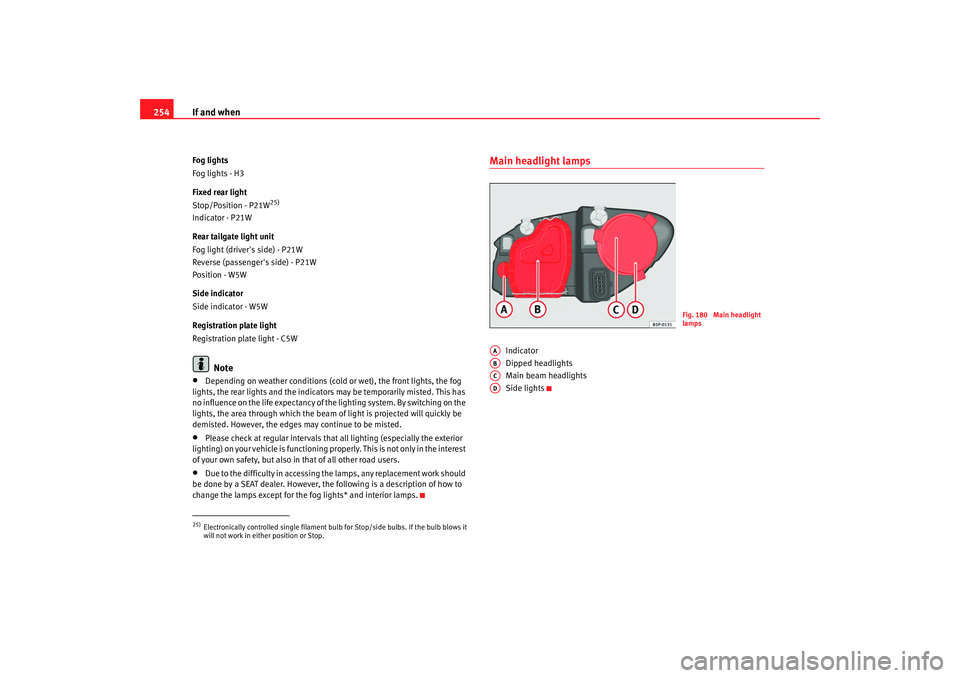
Main headlight lamps
Indicator
Dipped headlights
Main beam headlights
Side lights
25)Electronically controlled single filament bulb for Stop/side bulbs. If the bulb blows it
will not work in either position or Stop.
Fig. 180 Main headlight
lamps
AAABACAD
AlteaXL_EN.book Seite 254 M ontag, 2. Februar 2009 12:26 12
Page 266 of 297

If and when265
Safety First
Operating instructions
Practical tips
Te c h n i c a l D a t a
Towing and tow-startingTo w - s t a r t i n g
The use of jump leads is preferable to tow-starting.We recommend that you do not tow-start your vehicle. Jump-starting
is preferable ⇒page 262.
However, if your vehicle has to be tow-started:
–Engage the 2
nd or the 3
rd gear.
– Keep the clutch pressed down.
– Switch the ignition on.
– Once both vehicles are mo ving, release the clutch.
– As soon as the engine starts, press the clutch and move the gear lever into neutral. This helps to prevent driving into the towing
vehicle.
WARNING
The risk of accidents is high when tow-starting. The vehicle being towed
can easily collide with the towing vehicle.
Caution
When tow-starting, fuel could enter the catalytic converter and damage it.
General notesPlease observe the following points if you use a tow-rope:
Notes for the driver of the towing vehicle
– Drive slowly at first until the tow-rope is taut. Then accelerate gradually.
– Begin and change gears cautiously. If you are driving an auto- matic vehicle, accelerate gently.
– Remember that the brake servo and power steering are not working in the vehicle you are towing. Brake earlier than you
would normally, but with a more gentle pressure on the brake.
Notes for the driver of the towed vehicle
– Ensure that the tow-rope remains taut at all times when towing.Tow-rope or tow-bar
It is easier and safer to tow a vehicle with a tow-bar. You should only use a
tow-rope if you do not have a tow-bar.
A tow-rope should be slightly elastic to reduce the loading on both vehicles.
It is advisable to use a tow-rope made of synthetic fibre or similarly elastic
material.
Attach the tow-rope or the tow-bar only to the towing eyes provided or a
towing bracket.
Driving style
Towing requires some experience, especially when using a tow-rope. Both
drivers should be familiar with the technique required for towing. Inexperi-
enced drivers should not attempt to tow-start or tow away another vehicle.
AlteaXL_EN.book Seite 265 M ontag, 2. Februar 2009 12:26 12
Page 273 of 297

General notes on the technical data
272To w i n g a t r a i l e rTrailer weightsTrailer weights
The trailer weights and drawbar loads approved are selected in intensive
trials according to precisely defined criteria. The approved trailer weights are
valid for vehicles in the EU for maximum speeds of 80 km/h (in certain
circumstances up to 100 km/h). The figu res may be different in other coun-
tries. All data in the official vehicl e documents take precedence over these
data ⇒ .
Drawbar load
The maximum permitted weight exerted by the trailer drawbar on the ball joint
of the towing bracket must not exceed 75 kg.
In the interest of road safety, we recommend that you always tow
approaching the maximum drawbar load. The response of the trailer on the
road will be poor if the drawbar load is too small.
If the maximum permissible drawbar loa d cannot be met (e.g. with small,
empty and light-weight single axle trailers or tandem axle trailers with an axle
base of less than 1 metre), at least 4% of the actual trailer weight is a legal
stipulation for a drawbar load.
WARNING
•
For safety reasons, do not exceed the 80 km/h limit. This is also valid in
countries where higher speeds are permitted.
•
Never exceed the maximum trailer weights or the draw bar loading. If
the permissible axle load or the permissible total weight is exceeded, the
driving characteristics of the vehicle may change, leading to accidents,
injuries and damage to the vehicle.
AlteaXL_EN.book Seite 272 M ontag, 2. Februar 2009 12:26 12
Page 290 of 297

Index289
DDanger of fitting a child seat on the front passenger
seat . . . . . . . . . . . . . . . . . . . . . . . . . . . . . . . 30
Dash panel cleaning . . . . . . . . . . . . . . . . . . . . . 206
Daytime lights . . . . . . . . . . . . . . . . . . . . . . . . . . 111 activating . . . . . . . . . . . . . . . . . . . . . . . . . . . 111
deactivating . . . . . . . . . . . . . . . . . . . . . . . . . 111
Diesel . . . . . . . . . . . . . . . . . . . . . . . . . . . . . . . . . 212
Diesel engine Winter driving . . . . . . . . . . . . . . . . . . . . . . . . 213
Diesel engine particulate filter . . . . . . . . . . . . . 192
Differential lock . . . . . . . . . . . . . . . . . . . . . . . . . 186
Differential lock fault (EDL) warning lamp . . . . . . . . . . . . . . . . . . . . . . . . . 82
Digital clock . . . . . . . . . . . . . . . . . . . . . . . . . . . . . 57
Dipped headlights . . . . . . . . . . . . . . . . . . . . . . . 109
Disabling front passenger airbag Safety notes . . . . . . . . . . . . . . . . . . . . . . . . . . 44
Disabling the airbag Disabling front passenger airbag . . . . . . . . . 43
Display (without warning or information texts) . 58
Displays in the Multi-function display Memory displays . . . . . . . . . . . . . . . . . . . . . . 61
Disposal Airbags . . . . . . . . . . . . . . . . . . . . . . . . . . . . . . 31
Door lock cylinders . . . . . . . . . . . . . . . . . . . . . . 203
Door release lever . . . . . . . . . . . . . . . . . . . . . . . . 53
Doors Childproof locks . . . . . . . . . . . . . . . . . . . . . . . 96
Warning lamp . . . . . . . . . . . . . . . . . . . . . . . . . 80 Drawer . . . . . . . . . . . . . . . . . . . . . . . . . . . . . . . . 136
Drinks holders at the front . . . . . . . . . . . . . . . . 140
Drive wheels traction control system . . . . . . . . 184
Driveshaft differential
XDS . . . . . . . . . . . . . . . . . . . . . . . . . . . . . . . . 185
Driving Driving abroad . . . . . . . . . . . . . . . . . . . . . . . 194
Economical/ Environtmental . . . . . . . . . . . 192
With a trailer . . . . . . . . . . . . . . . . . . . . . . . . . 196
Driving abroad . . . . . . . . . . . . . . . . . . . . . . . . . . 194 Headlights . . . . . . . . . . . . . . . . . . . . . . . . . . 194
Driving programmes . . . . . . . . . . . . . . . . . . . . . 170
Driving safety . . . . . . . . . . . . . . . . . . . . . . . . . . . . . 8
Driving with an automati c gearbox / DSG automatic
gearbox* . . . . . . . . . . . . . . . . . . . . . . . . . . 171
Duplicate keys . . . . . . . . . . . . . . . . . . . . . . . . . . . 97
Dust filter . . . . . . . . . . . . . . . . . . . . . . . . . . . . . . 161
Dynamic curve lights . . . . . . . . . . . . . . . . . . . . . 113
Dynamic headlight range control . . . . . . . . . . . 113
EEcological driving . . . . . . . . . . . . . . . . . . . . . . . 192
Economical driving . . . . . . . . . . . . . . . . . . . . . . 192
EDL . . . . . . . . . . . . . . . . . . . . . . . . . . . . . . . . . . . 186
EDS Warning lamp . . . . . . . . . . . . . . . . . . . . . . . . . 77
Electric steering system warning light . . . . . . . . . . . . . . . . . . . . . . . . . 80
Electrical sockets . . . . . . . . . . . . . . . . . . . . . . . . 145 Electronic differential lock . . . . . . . . . . . . . . . . 186
Warning lamp . . . . . . . . . . . . . . . . . . . . . . . . 77
Electronic immobiliser . . . . . . . . . . . . . . . . 82, 166
Electronic stabilisation program . . . . . . . . . . . 185
Electronic stabilisation programme . . . . . . . . . . 81 Description . . . . . . . . . . . . . . . . . . . . . . . . . . 164
Warning light . . . . . . . . . . . . . . . . . . . . . . . . 165
Electronic stabilisation programme (ESP) warning lamp . . . . . . . . . . . . . . . . . . . . . . . . . 81
Emergency braking function . . . . . . . . . . 115, 183
emergency manual locking . . . . . . . . . . . . . . . . . 95
Emergency opening Doors . . . . . . . . . . . . . . . . . . . . . . . . . . . . . . 100
Emission control system warning lamp . . . . . . . . . . . . . . . . . . . . . . . . . 81
Engine Running in . . . . . . . . . . . . . . . . . . . . . . . . . . 190
Engine compartment Working in the engine compartment . . . . . 213
Engine coolant . . . . . . . . . . . . . . . . . . . . . . . . . . 220
Engine fault Warning lamp . . . . . . . . . . . . . . . . . . . . . . . . 76
Engine management Warning lamp . . . . . . . . . . . . . . . . . . . . . . . . 76
Engine oil . . . . . . . . . . . . . . . . . . . . . . . . . . . . . . 216 Changing . . . . . . . . . . . . . . . . . . . . . . . . . . . 219
Checking level . . . . . . . . . . . . . . . . . . . . . . . 217
Oil properties . . . . . . . . . . . . . . . . . . . . . . . . 217
Specifications . . . . . . . . . . . . . . . . . . . . . . . 216
Topping up . . . . . . . . . . . . . . . . . . . . . . . . . . 218
Engine oil dipstick . . . . . . . . . . . . . . . . . . . . . . . 217
AlteaXL_EN.book Seite 289 M ontag, 2. Februar 2009 12:26 12