2009 SAAB 9-5 roof
[x] Cancel search: roofPage 137 of 272

137 Interior equipment and trunk
Cargo net
3
Install the net behind the rear seat backrest.
1 Remove the rearmost covers from the
roof.
2 Fasten the attachments at the top of the
net to the two attachment points in the
roof.
3 Secure a lashing eye furthest forward on
each of the CargoTracks (see previous
page). Attach the hooks on the net to
these eyes. Tension the straps.You can also install the cargo net directly
behind the front seats when the rear seats
are folded.
1 Remove the front covers from the roof.
2 Fasten the attachments at the top of the
net to the two attachment points in the
roof.
3 Wrap each strap around the tube
running under the rear edge of each
front seat and attach the hook to the eye
on the strap.
WARNING
The cargo in the luggage compartment
must be anchored properly, even if the
cargo net is correctly in position. The only
purpose of the net is to prevent light
objects from being thrown about in the
cabin during heavy braking or in the event
of a crash.
IB1217
Cover over the fixing point for the cargo
net
IB1218
Attaching the cargo net to the roof
IB4091
Hook attached to a lashing eye
95_US_MY09.book Page 137 Tuesday, April 15, 2008 11:03 AM
ProCarManuals.com
Page 139 of 272
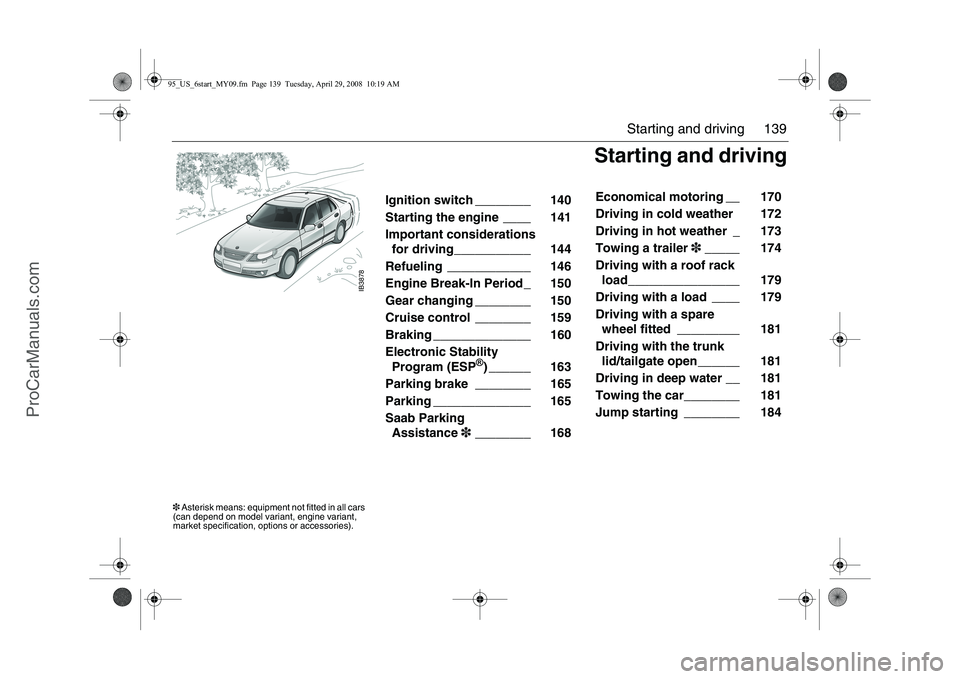
139
Starting and driving
IB3878
Starting and driving
Ignition switch ________ 140
Starting the engine ____ 141
Important considerations
for driving___________ 144
Refueling ____________ 146
Engine Break-In Period_ 150
Gear changing ________ 150
Cruise control ________ 159
Braking ______________ 160
Electronic Stability Program (ESP
®) ______ 163
Parking brake ________ 165
Parking ______________ 165
Saab Parking Assistance 3________ 168 Economical motoring __ 170
Driving in cold weather 172
Driving in hot weather _ 173
Towing a trailer
3_____ 174
Driving with a roof rack load________________ 179
Driving with a load ____ 179
Driving with a spare wheel fitted _________ 181
Driving with the trunk lid/tailgate open______ 181
Driving in deep water __ 181
Towing the car________ 181
Jump starting ________ 184
3 Asterisk means: equipment not fitted in all cars
(can depend on model variant, engine variant,
market specification, options or accessories).95_US_6start_MY09.fm Page 139 Tuesday, April 29, 2008 10:19 AM
ProCarManuals.com
Page 171 of 272

171 Starting and driving
Driving technique To obtain the best running economy, not
only regarding fuel consumption but
general wear also, regular service is
required.
High speed, unnecessary acceleration,
heavy braking and much low gear work all
gives rise to higher fuel consumption.
Frequent gear changing in traffic, starting
in cold weather, the use of studded tires
and roof racks, and towing a trailer all
increase fuel consumption.
Do not run the engine when the car is
stationary.
If idling, it will take much longer before the
engine becomes hot. Engine wear is
greatest during this warming-up phase.
Therefore drive away as soon as possible
after the engine is started and avoid high
revving. Driving in a low gear results in higher fuel
consumption than in a high gear because
of the higher engine speed for a given
road speed. Always change up to a higher
gear as soon as traffic conditions allow
and use the highest gear as much as
possible.
Check the air pressure in the tires once a
month. Incorrect pressures increase tire
wear. It is better to have slightly higher
pressure than lower.
Check fuel consumption regularly.
Increased consumption can indicate that
something is wrong and that the car
needs to be checked by a workshop. We
recommend that you contact an autho-
rized Saab dealer.
Practical trials on the roads have demon-
strated that substantial savings in fuel con-
sumption can be made if the above advice
is heeded.
Road conditionsWet roads increase fuel consumption, as do
unpaved roads and driving in hilly country
(the amount of fuel saved driving downhill is
less than the additional amount required to
climb the hill).
WARNING
Never switch the engine off while driving
as the effect of the brakes and power
steering will be greatly reduced.
95_US_MY09.book Page 171 Tuesday, April 15, 2008 11:03 AM
ProCarManuals.com
Page 179 of 272

179 Starting and driving
Driving with a roof rack
loadThe maximum permissible roof load is
220 lbs. (100 kg).
Note that the roof load is included in the
car’s maximum permissible load (see
page 258).
Strong, sturdy roof carriers3 designed spe-
cially for the car are available from your
Saab dealer. Always secure the roof load
safely.
Driving with a loadThe driving characteristics of the car are
affected by the way it is loaded.
Place heavy loads as far forward and as
low as possible in the trunk.
Secure the load to the tie downs, see
page 131.
The load should be such that the car´s
total weight or axle weight are not
exceeded, see page 258.
Heavy loads mean that the car’s center of
gravity is further back. As a result, the car
will sway more during evasive steering.
Never exceed the permissible load in the
roof box3, even if there is room for more.
Ensure that the tire pressure is correct –
slight overinflation is preferable to under-
inflation.
The braking distance of a loaded car is
always greater. Keep your distance from
the vehicle in front.
Roof loads can negatively affect tele-
communication.
Tire pressure, see page 263.
Additional information on tires, see page
220.
WARNING
A roof load will affect the car’s center
of gravity and aerodynamics. Be
aware of this when cornering and driv-
ing in crosswinds.
Suit your speed to the prevailing con-
ditions.
Due to higher aerodynamic drag, fuel
economy may suffer when driving with
a roof rack.95_US_MY09.book Page 179 Tuesday, April 15, 2008 11:03 AM
ProCarManuals.com
Page 181 of 272

181 Starting and driving
Driving with a spare
wheel fittedSee page 236.Driving with the trunk
lid/tailgate openAvoid driving with the trunk lid/tailgate partly
or fully open, since exhaust fumes can be
drawn into the cabin.
If you must drive with the trunk lid/tailgate
open, all windows and the moonroof3 must
be closed and the cabin fan on at its highest
speed setting.
Driving in deep water Towing the carNOTICEDo not drive in water deeper than
12 inches (30 cm) and do not drive faster
than 3–4 mph. Water can otherwise be
sucked into the engine. The engine will be
seriously damaged if water enters the
intake system.
WARNING
Remember that the brake servo does
not operate when the engine is off.
Much greater pressure than normal
will therefore be required to operate
the brake pedal.
Nor does the steering servo operate
when the engine is off. The steering
will therefore be much heavier than
usual.
The towing vehicle should always be
heavier than the vehicle on tow.
Never allow passengers to ride in the
car being towed.
Always seek professional help if the
car needs to be towed.
95_US_MY09.book Page 181 Tuesday, April 15, 2008 11:03 AM
ProCarManuals.com
Page 216 of 272

216 Car care and technical informationFuse panel in instrument panel
# Amp Function
A 30 Trailer lights
B 10 Automatic transmission
C 7.5 Electric door mirrors; DICE: manual beam length
adjustment3
1 15 Brake lights; Park Brake Shift Lock (cars with auto-
matic transmission)
2 15 Reversing lights
3 10 Parking lights and taillights, left
4 10 Parking lights and taillights, right
5 7.5 DICE / TWICE
6 30 Electric windows, right; trailer charging
6B 7.5 Brake lights, trailer
7 10 Engine injectors
8 15 Trunk lighting; trunk lock; door lighting; parking
assistant3; SID
9 15 Audio System; CD changer3
10 15 Heating, rear seat3; moonroof3, remote control
receiver
11 30 Electrically adjusted passenger seat3
12 7.5 Automatic transmission3
13 20 Audio System, amplifier
14 30 Ignition system, engine
15 20 Fuel pump
16 20 DICE (direction indicators)
16B – OnStar3
17 20 Engine-management system; main instrument;
DICE/TWICE
18 40 Door-mirror heating; rear-window heating
19 10 OnStar3; Telematics3
20 15 ACC; interior lighting; rear fog light; high beam flasher
21 10 Audio System; rear-view mirror; load angle sensor3;
navigation3; Cruise Control3
22 40 Interior fan
23 15 Central locking; navigation3; door mirror memory3
24 20 Main light switch
25 30 Electrically adjustable driver’s seat
IB2439
BC123456 A
14
121110987
13
6B
1516
2324
222120191817
16B25262728293031
3635343332
393837
95_US_MY09.book Page 216 Tuesday, April 15, 2008 11:03 AM
ProCarManuals.com
Page 217 of 272

217 Car care and technical information
Relay panel under instrument panel
26 7,5 Driver seat memory3; mirrors memory3;
moonroof3; parking assistant3; seatbelt reminder;
ACC
27 10 Engine-management system; SID; main instrument
28 7.5 Airbag
29 7.5
ABS/ESP
®
30 7.5 Starter motor; transmission control module (cars with
automatic transmission)
31 7.5 Cruise control3; water valve; fog lights, front3; rain
sensor3
32 – –
33 7.5 Direction-indicator switch
34 30 12-volt socket (cigarette lighter) front/rear
35 15 Daytime running light
36 30 Electric windows, left
37 30 Windshield wipers
38 30 Electric heating, front seats3
39 20 Limp-home solenoid
# Function
A –
B Electric heating of rear seat
C1 –
C2 –
D–
E Main relay (engine management system)
F–
GFuel pump
H Ignition switch
I Rear-window / door mirrors heating
IB3916
A
BC1
C2
L2 L1 D
GE
F
H
I
K J
95_US_MY09.book Page 217 Tuesday, April 15, 2008 11:03 AM
ProCarManuals.com
Page 258 of 272

258 SpecificationsGeneral Overall length, including bumpers:
9-5 Sedan _______________________ 190.4 in (4836 mm)
9-5 SportCombi __________________ 190.6 in (4841 mm)
Overall width, including door mirrors ____ 80.4 in (2042 mm)
Maximum height:
9-5 Sedan _______________________ 57.3 in (1454 mm)
9-5 SportCombi __________________ 57.7 in (1465 mm)
Wheelbase _______________________ 106.4 in (2703 mm)
Ground clearance at gross vehicle weight approx. 4.6 in
(116 mm)
Tr a c k :
Front __________________________ 59.9 in (1522 mm) *)
Rear ___________________________ 60.2 in (1528 mm) *)
Turning circle (curb to curb) ___________ 37.1 ft (11.3 m)
Turning circle (measured at vehicle extremi-
ties) _____________________________ 39.0 ft (11.9 m)
Number of seats (incl. driver) _________ 5
*) Specified track applies to wheel sizes: 6.5 x 16
VIN on cars sold in
USAVIN on cars sold in CanadaPermissible load (in addition to driver) = GVW minus curb weight
The maximum permissible axle load, front or rear, must not be exceeded.
The maximum permissible axle load, front or rear, must not be exceeded. Chassis number in engine bay
Weight ready for driving (i.e. with full fuel
tank, washer-fluid reservoir, standard tools
and spare wheel) ____________________ 3450–3760 lbs.
(1565–1705 kg)
Gross vehicle weight (GVW) ___________ 4390–4700 lbs.
(1990–2130 kg)
Maximum axle load:
Front ___________________________ 2590 lbs. (1175 kg)
Rear, 9-5 Sedan ___________________ 2310 lbs. (1050 kg)
Rear, 9-5 SportCombi ______________ 2480 lbs. (1125 kg)
Weight distribution:
Curb weight, front/rear ______________ 60/40 %
GVW, front/rear ___________________ 50/50 %
Maximum roof load __________________ 220 lbs. (100 kg)
Maximum luggage compartment load§ ___ 176 lbs. (80 kg)
Maximum combined load, luggage
compartment and roof ________________ 264 lbs. (120 kg)
95_US_MY09.book Page 258 Tuesday, April 15, 2008 11:03 AM
ProCarManuals.com