Page 415 of 543

Recreational Towing – Four-Wheel Drive Models
CAUTION!
Failure to follow these requirements can cause severe
damage to the transmission and/or transfer case.
NOTE: The electronic shift transfer cases must be
shifted into NEUTRAL for recreational towing. The trans-
mission must be shifted into PARK for recreational
towing. Refer to the following for the proper transfer case
NEUTRAL shifting procedure for your vehicle.
Recreational Towing Procedure — Electronic Shift
Transfer Case — If Equipped
Use the following procedure to prepare your vehicle for
recreational towing:
WARNING!
You or others could be injured if you leave the
vehicle unattended with the transfer case in the
NEUTRAL position without first fully engaging the
parking brake. The transfer case NEUTRAL position
disengages both the front and rear driveshafts from
the powertrain and will allow the vehicle to move,
even if the transmission is in PARK. The parking
brake should always be applied when the driver is
not in the vehicle.
CAUTION!
It is necessary to follow these steps to be certain that
the transfer case is fully in NEUTRAL before recre-
ational towing to prevent damage to internal parts.
5
STARTING AND OPERATING 413
Page 429 of 543
NOTE:The winch mechanism is designed for use with
the jack extension tube only. Use of an air wrench or other
power tools is not recommended and can damage the
winch.
Preparations
1. Park the vehicle on a firm, level surface. Avoid ice or
slippery areas.
WARNING!
Do not attempt to change a tire on the side of the
vehicle close to moving traffic. Pull far enough off
the road to avoid the danger of being hit when
operating the jack or changing the wheel. 2. Set the parking brake.
3. Place the shift lever into PARK. On four-wheel drive
vehicles, shift the transfer case to the 4L position.
4. Turn the ignition OFF.
5. Turn on the Hazard Warning flasher.
6. Block both the front and rear of the
wheel diagonally opposite the jacking
position. For example, if the right front
wheel is being changed, block the left
rear wheel.
NOTE: Passengers should not remain in the vehicle
when the vehicle is being jacked.6
WHAT TO DO IN EMERGENCIES 427
Page 442 of 543

▫Exhaust System ..................... 455
▫ Cooling System ..................... 458
▫ Brake System ....................... 463
▫ Rear Axle And Four-Wheel Drive Front
Driving Axle Fluid Level ............... 465
▫ Transfer Case ....................... 466
▫ Automatic Transmission ............... 466
▫ Appearance Care And Protection From
Corrosion .......................... 469
� Fuses .............................. 475
▫ Totally Integrated Power Module ......... 475
� Vehicle Storage ....................... 480
� Replacement Light Bulbs ................ 481 �
Bulb Replacement ..................... 481
▫ Dual Or Quad Headlamp/Front Park And
Turn Signal — If Equipped ............. 481
▫ Fog Lamps ......................... 483
▫ Rear Tail/Stop, Turn Signal And Backup
Lamps ............................ 484
▫ Center High-Mounted Stoplamp (CHMSL)
With Cargo Lamp .................... 485
� Fluids And Capacities .................. 488
� Fluids, Lubricants And Genuine Parts ....... 489
▫ Engine ............................ 489
▫ Chassis ........................... 490
440 MAINTAINING YOUR VEHICLE
Page 467 of 543

Use only brake fluid that has been in a tightly-closed
container to avoid contamination from foreign matter or
moisture.
CAUTION!
Do not allow a petroleum-base fluid to contaminate
the brake fluid. Seal damage may result.
Rear Axle And Four-Wheel Drive Front Driving
Axle Fluid Level
For normal service, periodic fluid level checks are not
required. When the vehicle is serviced for other reasons
the exterior surfaces of the axle assembly should be
inspected. If gear oil leakage is suspected inspect the
fluid level. Refer to “Fluids, Lubricants, and Genuine
Parts” in this section for the correct fluid type,
This inspection should be made with the vehicle in a level
position. The fluid level should be even with the bottomof the fill hole for the manufacturer’s C205F HD front
axles. The fluid level should be 5/8 in (16 mm) below the
fill hole on 9 1/4 in manufacturer’s rear axles.
Drain and Refill
Refer to the “Maintenance Schedule” in Section 8 for the
proper maintenance intervals.
Lubricant Selection
Refer to “Fluids, Lubricants, and Genuine Parts” in this
section for the correct fluid type.
NOTE:
The presence of water in the gear lubricant will
result in corrosion and possible failure of differential
components. Operation of the vehicle in water, as may be
encountered in some off-highway types of service, will
require draining and refilling the axle to avoid damage.
Limited-Slip Differentials This vehicle requires that
4 oz. (118 ml) MOPAR� Limited Slip Additive be added
to the gear lubricant. Refer to “Fluids, Lubricants, and
7
MAINTAINING YOUR VEHICLE 465
Page 492 of 543
Chassis
ComponentFluid, Lubricant, or Genuine Part
Automatic Transmission MOPAR�ATF+4 Automatic Transmission Fluid or equivalent.
Transfer Case MOPAR�ATF+4 Automatic Transmission Fluid or equivalent.
Transfer Case — NVG 246 Only MOPAR� NVG 246 Automatic Transmission Fluid or equivalent.
Front Axle — Four-Wheel Drive
Models GL-5 SAE 75W-90 (MS-9763) or equivalent.
Rear Axle MOPAR�Synthetic Gear Lubricant SAE 75W-140 (MS-8985). Limited-Slip
Rear Axles require the addition of 118 ml (4 oz.) MOPAR� Limited Slip
Additive or equivalent.
Brake Master Cylinder MOPAR�DOT 3 and SAE J1703 or equivalent. If DOT 3 brake fluid is not
available, then DOT 4 is acceptable. Use only recommended brake fluids.
Power Steering Reservoir MOPAR�Power Steering Fluid +4, MOPAR� ATF+4 Automatic Transmis-
sion Fluid or equivalent.
490 MAINTAINING YOUR VEHICLE
Page 529 of 543
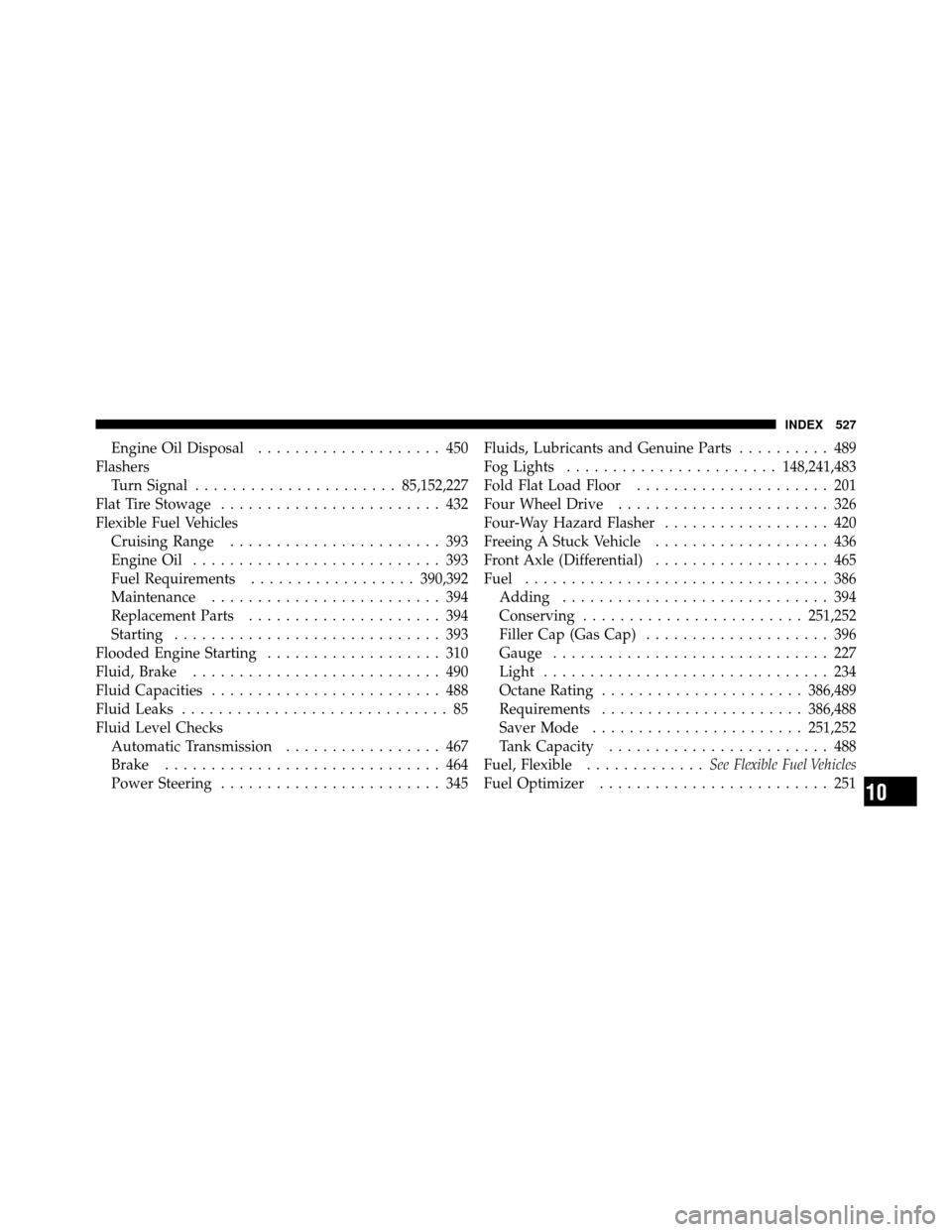
Engine Oil Disposal.................... 450
Flashers Turn Signal ...................... 85,152,227
Flat Tire Stowage ........................ 432
Flexible Fuel Vehicles Cruising Range ....................... 393
Engine Oil ........................... 393
Fuel Requirements .................. 390,392
Maintenance ......................... 394
Replacement Parts ..................... 394
Starting ............................. 393
Flooded Engine Starting ................... 310
Fluid, Brake ........................... 490
Fluid Capacities ......................... 488
Fluid Leaks ............................. 85
Fluid Level Checks Automatic Transmission ................. 467
Brake .............................. 464
Power Steering ........................ 345 Fluids, Lubricants and Genuine Parts
.......... 489
Fog Lights ....................... 148,241,483
Fold Flat Load Floor ..................... 201
Four Wheel Drive ....................... 326
Four-Way Hazard Flasher .................. 420
Freeing A Stuck Vehicle ................... 436
Front Axle (Differential) ................... 465
Fuel ................................. 386
Adding ............................. 394
Conserving ........................ 251,252
Filler Cap (Gas Cap) .................... 396
Gauge .............................. 227
Light ............................... 234
Octane Rating ...................... 386,489
Requirements ...................... 386,488
Saver Mode ....................... 251,252
Tank Capacity ........................ 488
Fuel, Flexible ............. See Flexible Fuel Vehicles
Fuel Optimizer ......................... 251
10
INDEX 527

