Page 386 of 543

Tire Pressure Monitoring Low Pressure Warnings
The Tire Pressure Monitoring Telltale Lamp will
illuminate in the instrument cluster, and an au-
dible chime will be activated when one or more of
the four active road tire pressures are low. Should this
occur, you should stop as soon as possible, check the
inflation pressure of each tire on your vehicle and inflate
each tire to the vehicle’s recommended cold placard
pressure value. The system will automatically update
and the Tire Pressure Monitoring Lamp will extinguish
once the updated tire pressures have been received. The
vehicle may need to be driven for up to 20 minutes above
15 mph (25 km/h) to receive this information.
Check TPMS Warnings
The “Tire Pressure Monitoring Telltale Light” located in
the instrument cluster will flash on and off for 75 seconds
and will remain on solid when a system fault is detected.
The system fault will also sound a chime. If the ignition key is cycled, this sequence will repeat, providing the
system fault still exists. A system fault can occur by any
of the following scenarios:
1. Signal interference due to electronic devices or driving
next to facilities emitting the same radio frequencies as
the TPMS sensors.
2. Installing aftermarket window tinting that affects ra-
dio wave signals.
3. Accumulation of snow or ice around the wheels or
wheel housings.
4. Using tire chains on the vehicle.
5. Using wheels/tires not equipped with TPM sensors.
6. Loss of communication with the tire pressure moni-
toring sensors.
NOTE: Your vehicle is equipped with a non-matching
full size spare wheel and tire assembly.
384 STARTING AND OPERATING
Page 399 of 543

included on this label and indicates the Month, Day and
Hour of manufacture. The bar code that appears on the
bottom of the label is your VIN.
Gross Vehicle Weight Rating (GVWR)
The GVWR is the total permissible weight of your vehicle
including driver, passengers, vehicle, options and cargo.
The label also specifies maximum capacities of front and
rear axle systems (GAWR). Total load must be limited so
GVWR and front and rear GAWR are not exceeded.
Payload
The payload of a vehicle is defined as the allowable load
weight a truck can carry, including the weight of the
driver, all passengers, options and cargo.
Gross Axle Weight Rating (GAWR)
The GAWR is the maximum permissible load on the front
and rear axles. The load must be distributed in the cargo
area so that the GAWR of each axle is not exceeded.Each axle GAWR is determined by the components in the
system with the lowest load carrying capacity (axle,
springs, tires or wheels). Heavier axles or suspension
components sometimes specified by purchasers for in-
creased durability does not necessarily increase the vehi-
cle’s GVWR.
Tire Size
The tire size on the label represents the actual tire size on
your vehicle. Replacement tires must be equal to the load
capacity of this tire size.
Rim Size
This is the rim size that is appropriate for the tire size
listed.
Inflation Pressure
This is the cold tire inflation pressure for your vehicle for
all loading conditions up to full GAWR.
5
STARTING AND OPERATING 397
Page 409 of 543

Towing Requirements — Tires
•
Do not attempt to tow a trailer while using a compact
spare tire.
•Proper tire inflation pressures are essential to the safe
and satisfactory operation of your vehicle. Refer to
“Tires–General Information” for proper tire inflation
procedures.
•Check the trailer tires for proper tire inflation pres-
sures before trailer usage.
•Check for signs of tire wear or visible tire damage
before towing a trailer. Refer to “Tires–General Infor-
mation” for the proper inspection procedure.
•When replacing tires, refer to “Tires–General Informa-
tion” for proper tire replacement procedures. Replac-
ing tires with a higher load carrying capacity will not
increase the vehicle’s GVWR and GAWR limits.
Towing Requirements — Trailer Brakes
•
Donot interconnect the hydraulic brake system or
vacuum system of your vehicle with that of the trailer.
This could cause inadequate braking and possible
personal injury.
•An electronically actuated trailer brake controller is
required when towing a trailer with electronically
actuated brakes. When towing a trailer equipped with
a hydraulic surge actuated brake system, an electronic
brake controller is not required.
•Trailer brakes are recommended for trailers over
1,000 lbs (454 kg) and required for trailers in excess of
2,000 lbs (907 kg).
5
STARTING AND OPERATING 407
Page 428 of 543
Removing The Spare Tire
Remove the spare tire before attempting to jack up the
truck. Attach the wheel wrench to the jack extension tube.
Insert the tube through the access hole between the lower
tailgate and the top of the bumper and into the winch
mechanism tube. Rotate the wheel wrench handle coun-
terclockwise until the spare tire is on the ground with
enough cable slack to allow you to pull it out from under
the vehicle. When the spare is clear, tilt the retainer at the
end of the cable and pull it through the center of the
wheel.It is recommended that you stow the flat or spare to
avoid tangling the loose cable.
1 — Lower
2 — Raise
426 WHAT TO DO IN EMERGENCIES
Page 430 of 543

Instructions
WARNING!
Carefully follow these tire changing warnings to
help prevent personal injury or damage to your
vehicle:
•Always park on a firm, level surface as far from
the edge of the roadway as possible before raising
the vehicle.
•Block the wheel diagonally opposite the wheel to
be raised.
•Set the parking brake firmly and set an automatic
transmission in PARK; a manual transmission in
REVERSE.
•Never start or run the engine with the vehicle on a
jack.
•Do not let anyone sit in the vehicle when it is on a
jack.(Continued)
WARNING! (Continued)
•Do not get under the vehicle when it is on a jack.
•Only use the jack in the positions indicated and
for lifting this vehicle during a tire change.
•If working on or near a roadway, be extremely
careful of motor traffic.
•To assure that spare tires, flat or inflated, are
securely stowed, spares must be stowed with the
valve stem facing the ground.
•Turn on the Hazard Warning flasher.
1. Remove the spare wheel, jack, and tools from storage.
Jack Warning Label
428 WHAT TO DO IN EMERGENCIES
Page 434 of 543

bolt circle, tightening the wheel nut opposite to the wheel
nut just previously tightened until final torque is
achieved. Recommended torques are shown in the fol-
lowing chart.
Disc
WheelsNut Type Stud Size Torque
(Ft. Lbs.)Torque
(N•m)
Cone 9/16-18 110-150 160-200
To Stow The Flat Or Spare
NOTE: Vehicles equipped with aluminum wheels can-
not be stored under the vehicle because the wheel
retainer will not fit through the wheel pilot hole. Secure
the flat tire in the bed of the truck. Have the flat tire
repaired or replaced immediately.
WARNING!
A loose tire thrown forward in a collision or hard
stop could injure the occupants in the vehicle. Have
the deflated (flat) tire repaired or replaced immedi-
ately.
Turn the wheel so that the valve stem is down. Slide the
wheel retainer through the center of the wheel and
position it properly across the wheel opening.
For convenience in checking the spare tire inflation, stow
with the valve stem toward the rear of the vehicle.
Attach the wheel wrench to the extension tube. Rotate the
winch mechanism until the wheel is drawn into place
against the underside of the vehicle. Continue to rotate
until you feel the winch mechanism slip or click three or
four times. It cannot be overtightened. Push against the
tire several times to be sure it is firmly in place.
432 WHAT TO DO IN EMERGENCIES
Page 522 of 543

WARNING!
The traction grade assigned to this tire is based on
straight-ahead braking traction tests, and does not
include acceleration, cornering, hydroplaning, or
peak traction characteristics.
Temperature Grades
The temperature grades are A (the highest), B, and C,
representing the tire’s resistance to the generation of heat
and its ability to dissipate heat, when tested under
controlled conditions on a specified indoor laboratory
test wheel. Sustained high temperature can cause the
material of the tire to degenerate and reduce tire life, and
excessive temperature can lead to sudden tire failure. The
grade C corresponds to a level of performance, which all
passenger car tires must meet under the Federal MotorVehicle Safety Standard No. 109. Grades B and A repre-
sent higher levels of performance on the laboratory test
wheel, than the minimum required by law.
WARNING!
The temperature grade for this tire is established for
a tire that is properly inflated and not overloaded.
Excessive speed, under-inflation, or excessive load-
ing, either separately or in combination, can cause
heat buildup and possible tire failure.
520 IF YOU NEED CONSUMER ASSISTANCE
Page 529 of 543
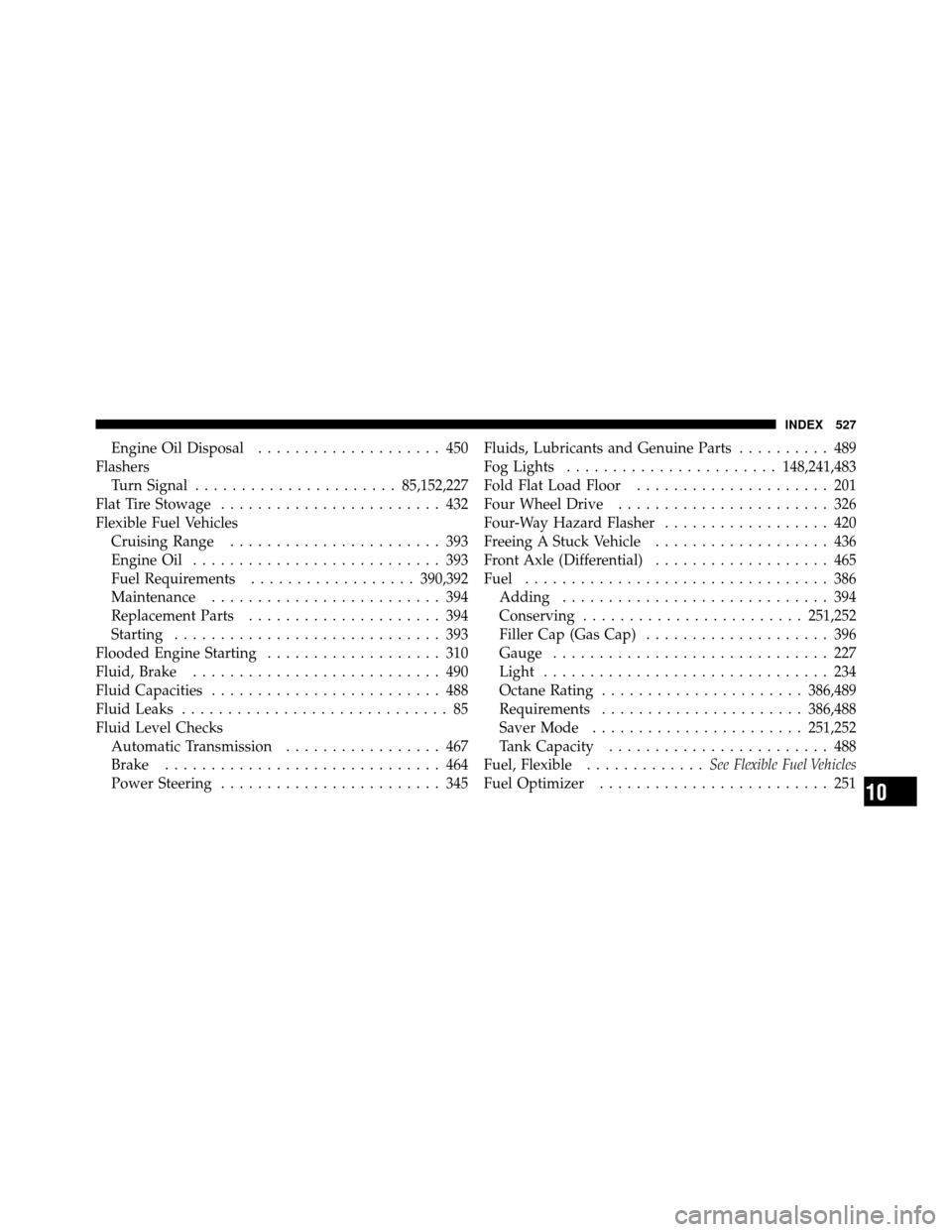
Engine Oil Disposal.................... 450
Flashers Turn Signal ...................... 85,152,227
Flat Tire Stowage ........................ 432
Flexible Fuel Vehicles Cruising Range ....................... 393
Engine Oil ........................... 393
Fuel Requirements .................. 390,392
Maintenance ......................... 394
Replacement Parts ..................... 394
Starting ............................. 393
Flooded Engine Starting ................... 310
Fluid, Brake ........................... 490
Fluid Capacities ......................... 488
Fluid Leaks ............................. 85
Fluid Level Checks Automatic Transmission ................. 467
Brake .............................. 464
Power Steering ........................ 345 Fluids, Lubricants and Genuine Parts
.......... 489
Fog Lights ....................... 148,241,483
Fold Flat Load Floor ..................... 201
Four Wheel Drive ....................... 326
Four-Way Hazard Flasher .................. 420
Freeing A Stuck Vehicle ................... 436
Front Axle (Differential) ................... 465
Fuel ................................. 386
Adding ............................. 394
Conserving ........................ 251,252
Filler Cap (Gas Cap) .................... 396
Gauge .............................. 227
Light ............................... 234
Octane Rating ...................... 386,489
Requirements ...................... 386,488
Saver Mode ....................... 251,252
Tank Capacity ........................ 488
Fuel, Flexible ............. See Flexible Fuel Vehicles
Fuel Optimizer ......................... 251
10
INDEX 527
