2009 PORSCHE PANAMERA ESP
[x] Cancel search: ESPPage 32 of 343
30
Opening and Locking
Detection of obstacles during closing Warning!
Danger of crushing.
f Despite the presence of this detection system,
you are still responsible for keeping yourself
and others entirely out of the way of the door as it is closing.
The closing operation is interrupted if closing
of the tailgate is blocked by an obstacle.
A warning signal sounds and the tailgate opens
again.
When the obstacle has been removed, the tailgate
can be closed by pressing the button in the
tailgate trim panel.
Automatic stop in the event of unintentional
tailgate movement
If the tailgate is moved too abruptly or lowers
unaided immediately after opening, e.g. due to
the weight of snow, an electrical mechanism
brakes the tailgate and a series of brief warning
signals sounds until the tailgate stops moving.
f Bring the tailgate to rest for approx. 1 second.
The braking function is deactivated. Adjusting the opening height of the tailgate
The opening height of the tailgate can be
individually adjusted so
that the tailgate does not
collide with the garage ceiling, for example.
On vehicles with level control, the vehicle height
changes according to the level control setting.
f Always adjust the opening height with the
vehicle at the highest level setting so that the
tailgate cannot accidentally collide with the
garage ceiling, for example.
Caution!
Risk of damage to the tailgate. If the luggage
compartment cover is not attached to the
tailgate, the tailgate continues to move
slowly upwards beyond the automatic stop.
f Only use the powerlift tailgate with the luggage compartment cover attached.
1. Stand behind the vehicl e and open the tailgate.
2. Press button on the key to stop the automatic opening operation at around 2/3
of the opening height.
3. Now move the tailgate up by hand until the desired opening height is reached. Make sure
that there is a sufficient minimum clearance
from any obstacle. 4. Press the button
A in the trim panel on the
tailgate for approximately 3 seconds.
An acknowledgement signal sounds.
The opening height of the tailgate has now
been programmed.
The tailgate can now be closed by briefly
pressing the button.
This setting cannot be deleted. If a different
setting is required, repeat steps 1 to 4.
Malfunctions of the tailgate drive
The automatic function is not active if the battery
voltage is too low.
If a button is pressed, th e tailgate lock is unlocked
and three brief warning sign als sound. The tailgate
can now be opened by hand.
f Charge the vehicle battery.
Emergency operation of tailgate
If the automatic opening or closing operation is
interrupted by a fault:
f Slowly open or close the tailgate by hand.
Overload protection
If overloading of the tailgate drive is detected,
three brief warning signals sound.
The tailgate cannot be operated automatically
for approx. 30 seconds.
Page 33 of 343
Opening and Locking
31
Opening and Locking From InsideThe factory settings of the vehicle are described
in this section.
In the multi-function display in the instrument
panel, you can change the settings and store
them on the respective key for vehicles with
comfort memory.
For information on modifying the opening and
locking settings:
fPlease see the chapter “LOCKING SETTINGS”
on page 145.
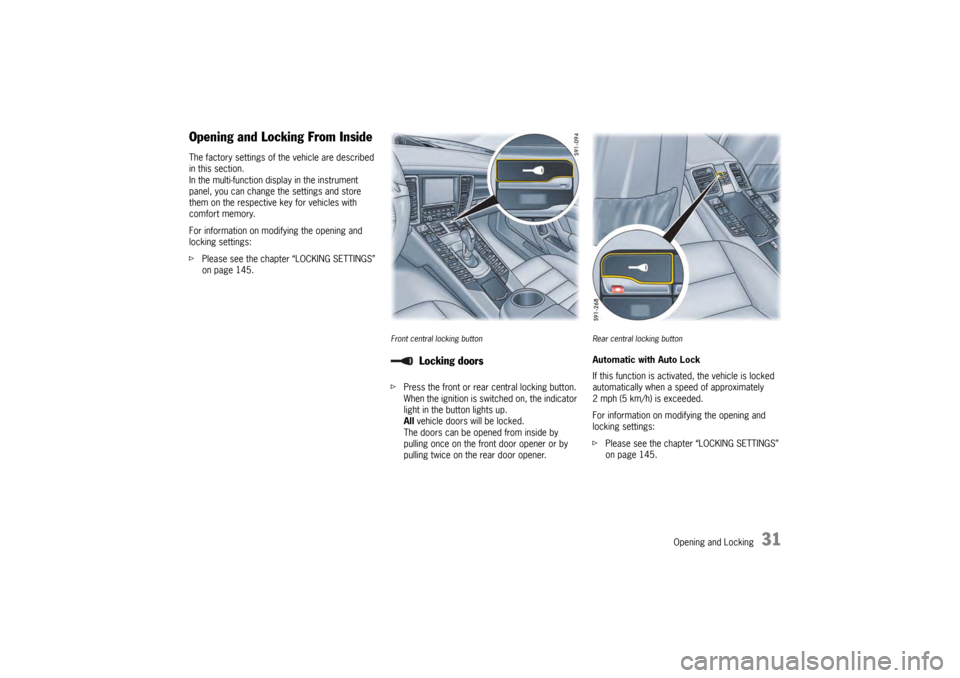
Front central locking buttonfPress the front or rear central locking button.
When the ignition is switched on, the indicator
light in the button lights up.
All vehicle doors will be locked.
The doors can be opened from inside by
pulling once on the front door opener or by
pulling twice on the rear door opener.
Rear central locking buttonAutomatic with Auto Lock
If this function is activate d, the vehicle is locked
automatically when a speed of approximately
2 mph (5 km/h) is exceeded.
For information on modifying the opening and
locking settings:
f Please see the chapter “LOCKING SETTINGS”
on page 145.
Locking doors
Page 37 of 343

Opening and Locking
35
Malfunctions When Opening and
ClosingEmergency operation of tailgateIf the tailgate cannot be opened with the radio
remote control (e.g. if th e battery of the remote
control is dead), the emergency operation must
be performed:
1. Unlock and open the driver’s door with the car key.
2. Switch on the ignition within 10 seconds to prevent the alarm system from
triggering.
3. Press the central locking button on the front or rear center console.
The tailgate is now unlocked and can be
opened with the unlocking handle.
Only one door is unlockedOn the multi-function di splay in the instrument
panel, you can set different variants for locking
and unlocking the doors and tailgate. You can
open all doors irrespective of the setting made.
f Press button on the key twice within
2seconds.The vehicle cannot be unlockedThe remote control of the key may
– not function correctly due to radio waves (also
radio contact between remote control and
vehicle in the case of Porsche Entry & Drive),
– fail due to a fault,
– fail due to a flat key battery.
f Unlock the vehicle using the emergency key
in the door lock.
If the vehicle was unlocked using the
emergency key in the door lock, only the
driver’s door can be opened.
In order to prevent the alarm system from
being triggered, switch the ignition on
within 10 seconds of opening the door .
The vehicle cannot be lockedThis is recognizable by the fact that the
emergency flasher does not flash and there is no
locking noise.
The remote control of the key may
– not function correctly due to radio waves (also radio contact between remote control
and vehicle in the case of Porsche Entry &
Drive),
– fail due to a fault,
– fail due to a flat key battery.
f Lock the vehicle usin g the emergency key
in the door lock.
If the central locking system is defective,
operating the lock cylinder in the driver’s door will
lock all functioning lockin g elements of the central
locking system.
For information on lockin g the doors by means of
the emergency operation:
f Please see the chapter “NOT ALL VEHICLE
DOORS ARE LOCKED” on page 36.
f Have faults in the central locking system
repaired.
Please contact a qualified specialist workshop.
We recommend that you have an authorized
Porsche dealer to do this work as they have
trained workshop personnel and the necessary
parts and tools.
Page 40 of 343

38
Seats, Mirrors and Steering Wheel
Seat Adjustment and Head
Restraints
Danger!
The seat may move unexpectedly if you
attempt to adjust while driving. This could
cause sudden loss of control, resulting in
serious personal injury or death.
f Do not adjust seats while the vehicle is in mo-
tion.The backrest locks must be engaged at all
times while the vehicle is in motion.
Safety belts only offer protection when the
backrest is upright and the belts are properly
positioned on the body.
Improperly positioned sa fety belts or safety
belts worn by passengers in an excessively
reclined position can cause serious personal
injury or death in an accident.
f Do not operate the car with the driver or
passenger backrests excessively reclined.
f Please see the chapter “SEAT POSITION” on
page 38.
Danger of injury if pe rsons or animals are in
the movement range of the seat during seat
adjustment.
f Adjust the seat so that no-one is put at risk.
f Do not activate the comf ort memory button if
there is any risk of the seat crushing the
occupant. f
Cancel automatic adjustment by pressing any
of the seat adjustment buttons.
f Do not leave children in the vehicle unattended,
since they may depress the comfort setting
button and crush themselves or another
occupant. Caution!
Risk of damage to wi ndshield, sun visor,
windstop, etc. when the seat is adjusted or
folded back or forward.
f Adjust the seat so that the s e a t b a c k re s t i s n o t in contact with any other object.
The driver, front, and back passenger seats
provide integrated head restraints in the
backrests. The head restraints are not adjustable. Warning!
All occupants, including the driver, should not
operate a vehicle or sit in a vehicle’s seat until the
head restraints and backrests, respectively, are
placed in their proper posi tions so that the risk of
neck injuries is minimize d in the event of a crash.
For a proper positioning of the head restraint, the
seatback’s inclination should be adjusted such
that the head restraint is in an upright position.
Driver and passengers should be seated upright
and in the center of their seats.
Seat positionAn ergonomically correct sitting position is
important for safe and fatigue-free driving. We
recommend the following procedure for adjusting
the driver’s seat to suit individual requirements:
1. Adjust the seat until, with your left foot on the footrest, your left leg remains at a slight angle.
2. Rest your outstretched arm on the steering wheel. Set the backrest angle and the steering-
wheel position so that your wrist rests on the
outer rim of the steering wheel. At the same
time, the shoulders must still be in noticeable
contact with the backrest.
3. Adjust the seat height to give yourself enough headroom and a good overview of the vehicle.
4. Electrically adjustable seat: Adjust the seat angle until your thighs rest
lightly on the seat cushion.
Page 51 of 343

Seats, Mirrors and Steering Wheel
49
Function of the air bag systemAir bags are a supplemental safety system. Your
primary protection comes from your safety belts.
The front air bags are triggered during a frontal
collision of sufficient force and direction.
In the event of a side impact of corresponding
force, the side air bag on the impact side is
triggered.
The inflation process generates the amount of gas
required to fill the air bags at the necessary
pressure in fractions of a second.
Air bags help to protect the head and body, while
simultaneously damping the motion of the driver
and passenger in the impact direction in the event
of a frontal impact or side impact.
In order to help provide protection in severe
collisions which can cause death and serious
injury, air bags must inflate extremely rapidly.
Such high speed inflation has a negative but
unavoidable side effect, which is that it can and
does cause injuries, including facial and arm
abrasions, bruising and broken bones. You can
help minimize such injuries by always wearing your
safety belts.
There are many types of accidents in which air
bags are not expected to deploy. These include
accidents where the air bags would provide no
benefit, such as a rear impact against your
vehicle. Other accidents where the air bags are
designed not to deploy are those where the risk of
injury from the air bag deployment could exceed any protective benefits, such as in low speed
accidents or higher speed accidents where the
vehicle decelerates over a longer time. Since air
bag deployment does not occur in all accidents,
this further emphasizes the need for you and your
passengers to always wear safety belts.
Your vehicle is equipped with a crash sensing and
diagnostic module. This module will record the
use of the seat belt restraint system by the driver
and front passenger when the air bags and/or belt
tentioner are triggered.
Precondition for activating the restraint systems:
f
Ignition is switched on.
Advanced air bagYour vehicle is equipped with occupant sensing for
the passenger's seat in accordance with
U.S. Federal Motor Vehicle Safety Standard 208.
Depending on the weight, body positioning and
shape acting on the passenger's seat, the
passenger's air bag will automatically be switched
on and off.
Depending on the angle and force of impact, the
passenger's air bag which is switched-on will be
triggered during a collision.
Precondition for switching the passenger's air bag
on and off, depending on weight, body positioning
and shape:
fIgnition is switched on.
Danger!
Risk of serious personal injury or death due
to the passenger air bag not triggering.
Improper handling of occupant sensing can
unintentionally impair switching the
passenger's air bag off and on.
If the weight on the passenger's seat is
reduced significantly, e.g., by supporting
weight on the armrest, the passenger's air
bag can be switched off.
f Select an upright seat position, and do not
support weight on the armrests or lean out of
the window.
Always keep feet in the footwell while driving.
Do not put feet on the dashboard or the seat
area. Do not lean against the inside of the door
or outside the window while the vehicle is
moving.
f If a child restraint system is installed on the passenger’s seat, do not adjust the seat.
Page 67 of 343
Seats, Mirrors and Steering Wheel
65
Roll-Up Sunblinds, Rear Side
WindowsNote on operation
The roll-up sunblinds on the rear side windows can
be raised or lowered only when the rear side
windows are closed.
If child protection is activated, the roll-up sunblinds
on the rear side windows can only be operated
using the roll-up sunblind button in the front center
console or the power window buttons in the
driver’s door.
For information on child protection:
f Please see the chapter “DISABLING THE
CONTROLS IN THE REAR” on page 88.
For information on the roll-up sunblind button:
f Please see the chapter “RAISING/LOWERING
ROLL-UP SUNBLIND ON REAR WINDOW” on
page 66.
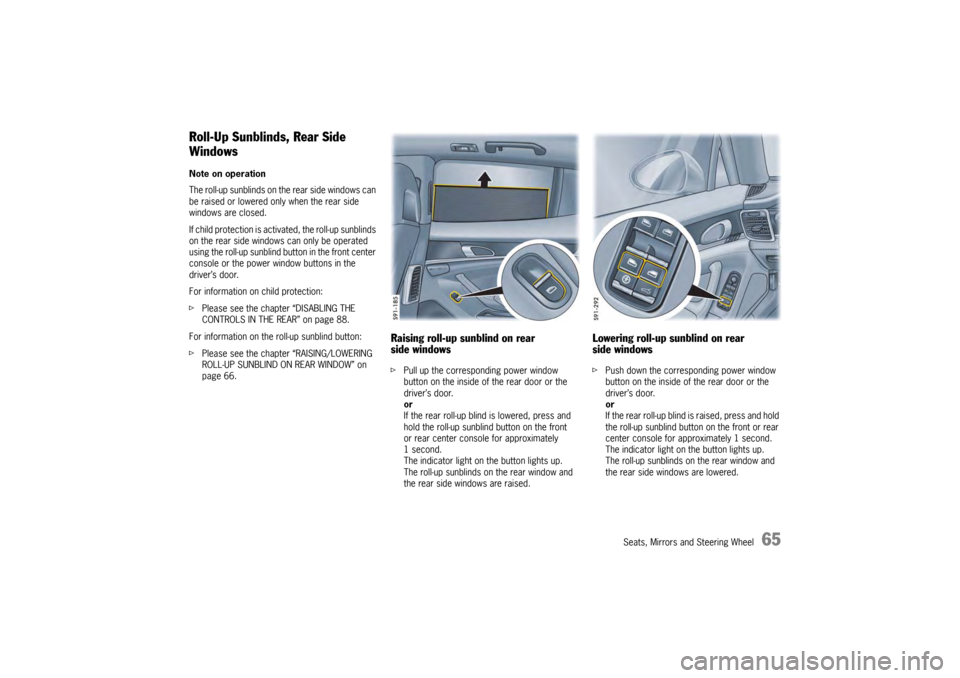
Raising roll-up sunblind on rear
side windowsfPull up the corresponding power window
button on the inside of the rear door or the
driver’s door.
or
If the rear roll-up blind is lowered, press and
hold the roll-up sunblind button on the front
or rear center console for approximately
1second.
The indicator light on the button lights up.
The roll-up sunblinds on the rear window and
the rear side windows are raised.
Lowering roll-up sunblind on rear
side windowsf Push down the corresponding power window
button on the inside of the rear door or the
driver’s door.
or
If the rear roll-up blind is raised, press and hold
the roll-up sunblind button on the front or rear
center console for approximately 1 second.
The indicator light on the button lights up.
The roll-up sunblinds on the rear window and
the rear side windows are lowered.
Page 88 of 343
86
Windows and Slide/Tilt Roof
Power Windows
Warning!
Risk of injury when closing the windows,
especially when windows close
automatically.
f Take care to ensure that nobody can be injured
when the windows close.
f Always remove ignition key when leaving the
vehicle or switch ignition off on vehicles with
Porsche Entry & Drive. Always take the ignition
key with you when leaving the vehicle.
Uninformed persons could injure themselves
by operating the power windows.
f In case of danger, immediately release the
button on the ignition key or the button in
the door handle on vehicles with Porsche
Entry & Drive.
f Do not leave children in the vehicle unattended.
Risk of an accident.
f Do not put anything on or near the windows that may interfere with the driver’s vision.
Readiness for operation of power windows– With ignition switched on.
– A maximum of 10 minutes after the ignition is
switched off, but only until driver’s or
passenger door is first opened.
– The one-touch operation for closing the door windows is available only when the ignition is
switched on.
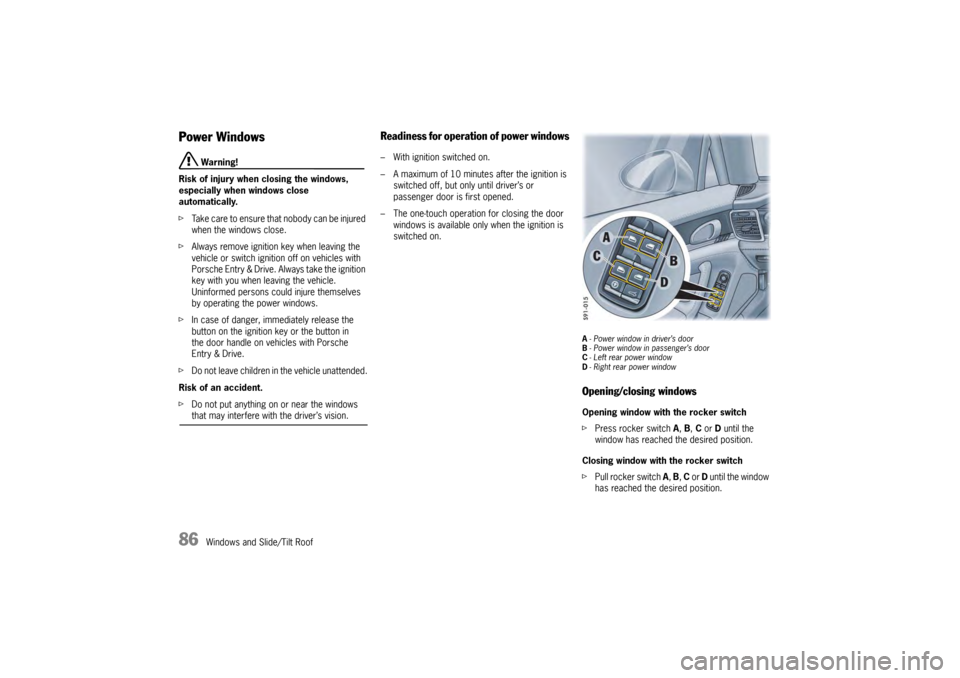
A- Power window in driver’s door
B - Power window in passenger’s door
C -Left rear power window
D - Right rear power windowOpening/closing windowsOpening window with the rocker switch
f Press rocker switch A, B, C or D until the
window has reached the desired position.
Closing window with the rocker switch
f Pull rocker switch A, B, C or D until the window
has reached the desired position.
Page 94 of 343

92
Lights, Turn Signals and Windshield WipersNote on operation
If the ignition key is removed and the door is
opened while the lights are on, an audible signal
(gong) warns of possible battery discharge.
In some countries, differences are possible
due to legal requirements.
Automatic Driving Light Assistant/
Adaptive Light SystemThe automatic driving light assistant is a comfort
function. Your Porsche’s driving light (low beam) is
switched on and off automatically depending on
the ambient brightness.
The automatic driving light assistant also controls
the daytime driving lights, the Automatic Coming
Home lights and the dy
namic cornering light.
The automatic driving light assistant is activated
when the light switch is set to the position .
Despite possible support by the driving light
assistant, it is the responsibility of the driver to
switch on the driving ligh t using the conventional
light switch in accordance with the relevant
national regulations.
Activating the headlights using the driving light
assistant therefore does not absolve the driver
of responsibility for correct operation of the
driving light.
Warning!
Risk of accidents if yo u drive your vehicle
without lights.
f Always carefully monitor the automatic driving light control.
Light SwitchLight is switched off.
The daytime driving lights are switched on
when the ignition is switched on, provided
that they are activated on the multi-
function display in the instrument panel.
For information on activating/deactivating
daytime driving lights:
fPlease see the chapter “ACTIVATING
AND DEACTIVATING AUTOMATIC
DAYTIME DRIVING LIGHTS” on
page 142.
Automatic driving light assistant
Side lights
Side marker lights , licence plate light,
instrument lighting, daytime driving lights
switched off.
Low beam/driving light
Only with ignition on.
Rear fog light
Pull the switch in the low beam position.
Indicator light lights up.