2009 PORSCHE PANAMERA ignition
[x] Cancel search: ignitionPage 265 of 343

Maintenance and Car Care
263
How Emission Control WorksWhen an automobile engine is running, it uses
energy generated through the combustion of a
mixture of air and fuel. Depending on whether a
car is driven fast or slowly or whether the engine
is cold or hot, some of the fuel (hydrocarbons)
may not be burned completely, but may be
discharged into the engine crankcase or exhaust
system. Additonal hydrocarbons may enter the
atmosphere through evaporation of fuel from the
fuel tank. These hydrocarbons (HC), when
released into the air, co ntribute to undesirable
pollution.
In addition, carbon monoxide (CO) and oxides of
nitrogen (NOx) contribute to engine emissions.
They, too, are formed during the combustion
process and discharged into the exhaust system.
To reduce these pollutants, your Porsche is
equipped with a precisely calibrated fuel injection
system to assure a finely balanced air/fuel mixture
under all operating conditions.
Oxygen sensorThe oxygen sensor, installed in the exhaust pipe
continuously senses the oxygen content of the
exhaust and signals the information to an
electronic control unit. The control unit corrects
the air/fuel ratio, so the engine always receives an
accurately metered air/fuel mixture.Crankcase ventilationThrough crankcase ventilation, undesirable
emissions from the engine crankcase are not
permitted to reach the outside atmosphere. These
emissions are recirculated from the crankcase to
the air intake system. From here the emissions
mix with the intake air an d are later burned in the
engine.Catalytic convertersThe catalytic converters are efficient “clean-up”
devices built into the exhaust system of the
vehicle. The catalytic converters burn the
undesirable pollutants in the exhaust gas before it
is released into the atmosphere.
The exclusive use of unleaded fuel is
critically important for the life of the
catalytic converters. Therefore, only
unleaded fuel must be used. The catalytic converters will be damaged by:
– push or tow starting the vehicle
– misfiring of the engine
– turning off the ignition while the vehicle is
moving or
– driving until the fuel tank is completely empty
– by other unusual operating conditions.
f Do not continue to operate your vehicle under
these conditions, since raw fuel might reach
the catalytic converters. This could result in
overheating of the converters. Federal law
prohibits use of leaded fuel in this car.
Page 267 of 343

Maintenance and Car Care
265
FuelWhen the ignition is on, the fuel level is displayed
on the instrument panel.
fPlease see the chapter “FUEL GAUGE” on
page 111.
Warning!
Fuel is highly flammable and harmful to
health.
f Fire, open flame and smoking are prohibited
when handling fuel.
f Avoid contact with skin or clothing, since injury
to your skin may occur.
f Do not inhale fuel vapors, since they may make
you ill and possibly cause death if inhalation is
prolonged and occurs in a closed space.
To prevent damage to the emission control
system and engine:
f Never drive the tank dry.
f Avoid high cornering speeds after the warning lights have come on.
f Please see the chapter “FUEL ECONOMY” on
page 264. To avoid permanent damage
to the functionality of
the catalytic converters and oxygen sensors, use
unleaded fuel only.
The engine is designed to provide optimum
performance and fuel consumption if unleaded
premium fuel with 98 RON/88 MON is used.
If unleaded fuels with octane ratings of less than
98 RON/88 MON are used, the engine’s knock
control automatically adapts the ignition timing.
Porsche recommends that you use fuel with
at least 95 RON/85 MON in your vehicle.
The emission control system can be damaged in
various ways (e.g. fueling incorrectly, shortage of
fuel, tow-starting).
f Please see the chapter “HOW EMISSION
CONTROL WORKS” on page 263. Note on operation
Information on the fuel quality can normally
be found on the pump.
If this is not the case, ask a fuel station attendant.
If the recommended fuel
is not available, you
can also use unleaded regular fuel (91 RON/
82.5 MON) in an emergency.
However, this could reduce performance and
increase fuel consumption.
f Avoiding driving at full throttle.
In some countries the available fuel quality may
not meet requirements and can result in coking
around the inlet valve.
In this case, the fuel may be mixed with the
additive sold and recommended by Porsche after
consulting a authorized Porsche dealer.
Porsche part number 000 043 206 89.
f Observe the instructions and mixture ratios
stated on the container.
It is important that the service intervals,
particularly the oil change intervals, are
observed in accordance with the specifications
in the “Maintenance” booklet.
Page 268 of 343
266
Maintenance and Car Care
Refuelling
Danger!
The RF energy from a cellphone can cause a
sparking on bare metal, much like aluminum
foil in a microwave oven. The spark could
ignite gasoline fumes present while refuling.
Static discharge from your body can ignite
gasoline fumes present when you get back
out of the vehicle and touch the fuel nozzle.
In either case, resulting fire can cause
serious damage to the vehicle, serious injury
or death to persons in immediate vicinity.
f Do not use a cellphone while pumping gas.
fDo not re-enter the vehicle while pumping gas.
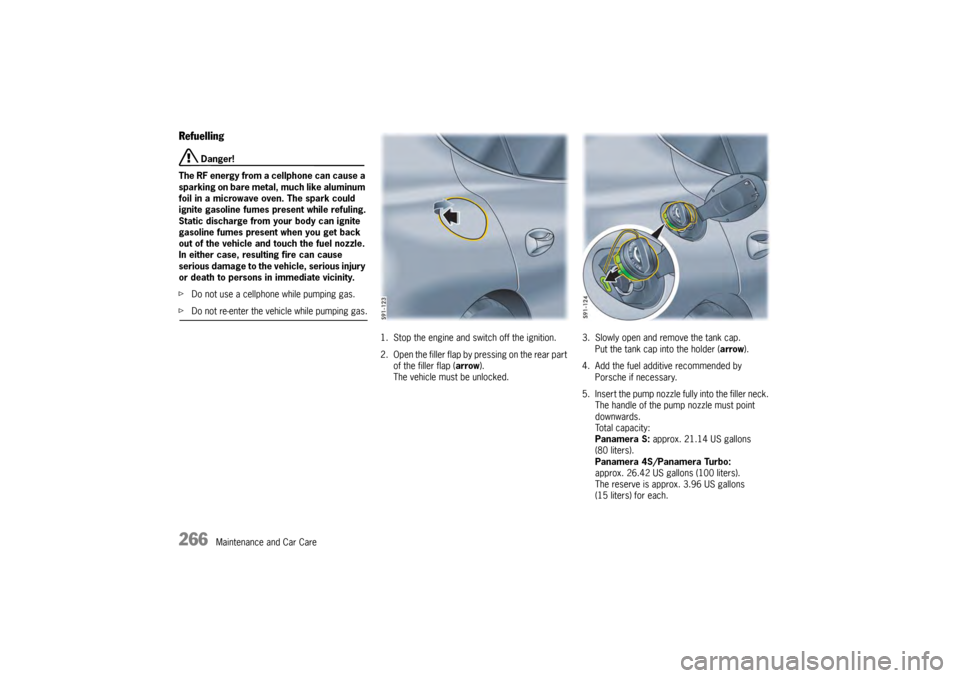
1. Stop the engine and switch off the ignition.
2 . O p e n t h e f i l l e r f l a p b y p re s s i n g o n t h e re a r p a r t of the filler flap ( arrow).
The vehicle must be unlocked. 3. Slowly open and remove the tank cap.
Put the tank cap into the holder ( arrow).
4. Add the fuel additive recommended by Porsche if necessary.
5. Insert the pump nozzle fully into the filler neck.
The handle of the pump nozzle must point
downwards.
Total capacity:
Panamera S: approx. 21.14 US gallons
(80 liters).
Panamera 4S/Panamera Turbo:
approx. 26.42 US gallons (100 liters).
The reserve is approx. 3.96 US gallons
(15 liters) for each.
Page 270 of 343

268
Maintenance and Car Care
Fuel Recommendations Your Porsche is equipped with catalytic
converters and must use UNLEADED FUEL
ONLY .
Your engine is designed to provide optimum
performance and fuel economy using unleaded
premium fuel with an octane rating of 98 RON
(93 CLC or AKI) . Porsche therefore
recommends the use of these fuels in your
vehicle.
Porsche also recognizes that these fuels may not
always be available. Be assured that your vehicle
will operate properly on unleaded premium fuels
with octane numbers of at least 95 RON
(90 CLC or AKI) , since the engine’s “Electronic
Oktane™ knock control” will adapt the ignition
timing, if necessary.
It is important to observe the regular service
intervals, and particularly the oil change intervals,
specified in the “Maintenance” booklet.
T h e u s e o f U N L E A D E D F U E L O N LY i s c r i t i c a l l y
important to the life of the catalytic
converters. Deposits fr om leaded fuels will
ruin the converters and make them
ineffective as an emis sion control device.
Cars with catalytic converters have a smaller fuel
tank opening, and gas station pumps that
dispense unleaded fuel ha ve smaller nozzles. This
will prevent accidental pumping of leaded fuel into
cars with catalytic converters. Unleaded fuels may not be available outside the
continental U.S. and Canada. Therefore, we
recommend you do not take your car to areas or
countries where unleaded fuel may not be
available.
Octane ratings Octane rating indicates a fuel’s ability to resist
detonation. Therefore, buying the correct octane
gas is important to prevent engine “damage”.
The RON octane rating is based on the research
method. The CLC (U.S.
Cost of Living Council
octane rating) or AKI ( anti knock index) octane
rating usually displayed on U.S. fuel pumps is
calculated as research octane number plus motor
octane number, divided by 2, that is written as:
The CLC or AKI octane rating is usually lower than
the RON rating:
For example: 95 RON equals 90 CLC or AKI.
Fuels containing ethanolDo not use any fuels containing more than 10
percent ethanol by volume.
We recommend, however, to change to a different
fuel or station if any of the following problems
occur with your vehicle:
– Deterioration of driveability and performance.
– Substantially reduced fuel economy.
– Vapor lock and non-start problems, especially at high altitude or at high temperature.
– Engine malfunction or stalling.
RON+MON
2 R+M
2
or
Page 280 of 343

278
Minor Repairs
Exercise Extreme Caution when
Working on your Vehicle
Danger!
Ignoring the following instructions may
cause serious personal injury or death.
f The engine compartment of any motor vehicle
is a potentially hazardou s area. If you are not
fully familiar with proper repair procedures, do
not attempt the adjustments described on the
following pages.
f O n l y w o r k o n y o u r v e h i c l e o u t d o o r s o r i n a w e l l
ventilated area.
f Ensure that there are no open flames in the
area of your vehicle at any time when fuel
fumes might be present. Be especially
cautious of devices such as hot water heaters
which ignite a flame intermittently.
f Before working on any part in the engine
compartment, turn the engine off and let it cool
down sufficiently. Hot engine compartment
components can burn skin on contact.
f Be alert and cautious around the engine at all
times while it is running. If you have to work on
the engine while it is running, always put the
parking brake on and put the PDK selector
lever in position P or N.
f In particular, be very careful to ensure that
items of clothing (ties, shirt, sleeves etc.),
jewelry, long hair, hand or fingers cannot get caught in the fan, belts or other moving parts.
The radiator and radiator fans are in the front
of the car.
The fans can start or continue running as a
function of temperature,
even with the engine
switched off.
Carry out work in these areas only with the
engine off and exercise extreme caution.
f Your Porsche is equipped with an electronic
ignition system. When the ignition is on, high
voltage is present in all wires connected with
the ignition system; therefore, exercise
extreme caution when working on any part of
the engine while the ignition is on or the engine
is running.
f Always support your car with safety stands if it
is necessary to work under the car. The jack
supplied with the car is not adequate for this
purpose.
Switch off level control of air suspension and
height adjustment.
Please see the chapter “RAISING THE VEHICLE
WITH A LIFTING PLATFORM, TROLLEY JACK
OR STANDARD JACK” on page 290.
f When working under the car without safety
stands but with the wheels on the ground,
make sure the car is on level ground, the
wheels are blocked, and that the engine
cannot be started.
Withdraw ignition keys (switch ignition off in
vehicles that have Porsche Entry & Drive). f
Do not smoke or allow an open flame around
the battery or fuel.
Keep a fire extinguisher close at hand.
f Incomplete or improper servicing may cause
problems in the operation of the car. If in doubt
about any servicing, have it done by your
authorized Porsche dealer.
Improper maintenance during the warranty
period may affect your Porsche warranty
coverage.
f Supplies of fluids, e.g. engine oil, washer fluid,
brake fluid or coolant, are hazardous to your
health.
Keep these fluids out of children's reach and
dispose of them in accordance with the
appropriate regulations.
f Some countries require additional tools and
special spare parts to be carried in your
vehicle. Please make enquiries before driving
abroad.
Note
The tools required for changing a wheel (e.g. jack,
wheel bolt wrench, assembly aids) are not
supplied as standard with the vehicle. Your
authorized Porsche dealer will be pleased to
advise you.
Page 292 of 343

290
Minor Repairs
Jacking point for lifting platform and jack at the frontRaising the vehicle
with a lifting platform, trolley jack
or standard jack fBefore driving the vehicle onto a lifting
platform, make sure that there is sufficient
space between the lifting platform and
the vehicle.
Jacking point for lifting platform and jack at the rear
Caution!
Serious personal injury or death and/or
serious damage to the engine or vehicle may
occur, if you lift the vehicle improperly.
f Never lift the verhicle at any other place than
the jacking points.
f Never lift the vehicle by the engine,
transmission or axles.
f Do not damage any sensitive components in the vecinity of the jacking points. Raising vehicles with a level control system
Switch off the automatic level control system
before driving onto a lifting platform or before
raising the vehicle using a lifting platform, trolley
jack or standard jack.
Switching off level control
The level control system can only be switched off
when the vehicle is stationary. To increase ground
clearance, the vehicle shou
ld be set to High Level
before switching off level control.
f Please see the chapter “PORSCHE ACTIVE
SUSPENSION MANAGEMENT (PASM)” on
page 208.
1. Switch on ignition.
2. Press and hold button (for approx. 10 seconds) until the message “Control off”
appears on the multi-function display.
Switching on level control
1. Lower the vehicle.
2. Switch on ignition.
3. Press and hold button (for approx. 10 seconds) until the message “Control on”
appears on the multi-function display.
Note
Level control is switched on automatically at
speeds of more than 4 mph (7 km/h).
Page 293 of 343

Minor Repairs
291
Changing a wheel
Danger!
Failure to follow these instructions may result
in serious personal inju ry or death to you or
to bystanders.
Before changing the wheel
f If you have a flat tire, move a safe distance off
the road. Turn the emergency flasher on and
use other warning devices to alert other
motorists.
f Do not park your vehicl e where it may contact
dry grass, brush or other flammable materials.
The hot parts of the exhaust system could set
such materials on fire, thereby causing both
property damage and severe or fatal physical
injury.
f Passengers must not be in the vehicle when it
is jacked up.
f Before you change a wheel, be sure the ground
is level and firm. If necessary, use a board
under the jack to ensure that the jack does not
sink into the ground.
f Set the electric parking brake and block the
wheels opposite the flat tire on the other side
of the vehicle.
While operating the jack
f The jack is only to be used for changing a
wheel. Do not use it as a support to work under
the car. f
The car must be jacked up only at the
illustrated jacking points. Lifting at any other
place may damage the vehicle or may result in
personal injury. Never jack the car up by the
body or the bumpers.
f For safety reasons do not use tire inflating
bottles. Do not use co mmercially available
sealant bottles. Use only the tire inflating bottle
located in the luggage compartment.
Note
The tools required for changing a wheel (e.g. jack,
wheel bolt wrench, assembly aids) are not
supplied as standard with the vehicle. Your
authorized Porsche dealer will be pleased to
advise you.
Sequence of operation Warning!
The jack must be used on ly to raise the car
for wheel changing. The jack must never be
used as a support to work underneath the
vehicle. If the jack is accidentally dislodged,
you or bystanders could suffer severe
personal injury.
f Never jack up other ve hicles or other loads
with the jack.
f Always place the car on stable supports if you
have to work under it. When working under the
vehicle, always use safety stands specifically designed for this purpose. f
Please use a suitable knee rest to protect your
clothing against soiling.
1. Activate the electric parking brake and shift into 1st gear or move the PDK selector lever
to position P .
Remove the ignition key or control unit on
vehicles with Porsche Entry & Drive.
2. Switch on the emergency flasher if necessary.
3. Secure the vehicle against rolling away, e.g. by means of wedges at the wheels on the
opposite side.
This is particularly important on slopes.
4. Slightly loosen the wheel bolts on the wheel to be changed.
5. Lift the vehicle only at the specified jacking points.
6. Raise the vehicle until the wheel lifts off the ground.
f Please see the chapter “RAISING THE VEHICLE
WITH A LIFTING PLATFORM, TROLLEY JACK
OR STANDARD JACK” on page 290.
7. Remove 1 or 2 wheel bolts (see corresponding figure).
Page 295 of 343

Minor Repairs
293
Wheel Bolts fAlways clean the wheel bolts before fitting.
f Wheel bolts must not be greased.
f Replace damaged wheel bolts.
Only use genuine Porsche wheel bolts
assigned especially to this model or wheel
bolts of similar quality that have been
manufactured according to Porsche
specifications and production requirements.
Tightening torque
Tightening torque for wheel bolts: 160 Nm
(118 ftlb.) .
Security wheel boltsThe adapter (wrench socket) for the security
wheel bolts is stored in the tool tray under the
luggage compartment floor.
fIf the wheels have to be removed at the
workshop, do not forget to hand over the
socket for the security wheel bolts along
with the car key.
f To loosen or tighten the wheel bolt with anti-
theft protection, the adapter must be used
between the wheel bolt and the wheel
bolt wrench.
f When positioning the wrench socket, ensure
that it engages fully in the teeth of the
wheel bolt.
Flat Tire 1. Stop the vehicle as far away from the driving lane as possible.
The vehicle must be parked on a firm and flat
surface offering adequate grip.
2. Switch emergency flasher on.
3. Apply the parking brake.
4. Put the vehicle in 1st gear or move the PDK selector lever to position P.
5. Straighten the front wheels.
6. Remove the ignition key, or the control unit on vehicles with Porsche Entry & Drive, in order to
lock the steering and pr event the engine from
being started.
7. Get all passengers to leave the vehicle.
8. Set up the warning triangle at a suitable distance.Filling in tire sealantThe tire sealant and compressor with pressure
tester can be found in the tool tray under the
loadspace floor in the luggage compartment.
The tire sealant can be used to seal small cuts,
especially in the tire tread.
Sealing the tire with the tire sealant is only an
emergency solution so you can drive to the
nearest workshop. Even if the tire is air-tight,