2009 PORSCHE CAYMAN key
[x] Cancel search: keyPage 188 of 284

186
Maintenance, Car Care
Exercise Extreme Caution when
Working on your Vehicle
Danger!
Ignoring the following instructions may
cause serious personal injury or death.
f The engine compartment of any motor vehicle
is a potentially hazardou s area. If you are not
fully familiar with proper repair procedures, do
not attempt the adjustments described on the
following pages.
This caution also applies to the entire vehicle.
f O n l y w o r k o n y o u r v e h i c l e o u t d o o r s o r i n a w e l l
ventilated area.
f Ensure that there are no open flames in the
area of your vehicle at any time when fuel
fumes might be present. Be especially cau-
tious of such devices such as hot water heat-
ers which ignite a flame intermittently.
f Before working on any part in the engine com-
partment, turn the engine off and let it cool
down sufficiently. Hot engine compartment
components can burn skin on contact.
f Be alert and cautious around engine at all
times while the engine is running.
If work has to be performed with the engine
running, always set the parking brake, and
make sure the shift lever is in neutral position
or the PDK selector lever in position P or N . f
In particular, be very careful to ensure that
items of clothing (ties, shirt, sleeves etc.),
jewelry, long hair, hand or fingers cannot get
caught in the engine-compartment blower, fan,
belts or other moving parts.
The radiator and radiator fans are in the front
of the car.
The engine-compartment blower is mounted in
the engine-compartment.
The fans can start or continue running as a
function of temperature, even with the engine
switched off.
Carry out work in these areas only with the en-
gine off, the ignition switched off, and exercise
extreme caution.
f Your Porsche is equipped with an electronic ig-
nition system. When the ignition is on, high
voltage is present in all wires connected with
the ignition system; therefore, exercise ex-
treme caution when working on any part of the
engine while the ignition is on or the engine is
running.
f Always support your car with safety stands if it
is necessary to work under the car.
f When working under the car without safety
stands but with the wheels on the ground,
make sure the car is on level ground, the
wheels are blocked, and that the engine
cannot be started.
Remove the ignition key. f
Do not smoke or allow an open flame around
the battery or fuel.
Keep a fire extinguisher in close reach.
f Incomplete or improper servicing may cause
problems in the operation of the car. If in doubt
about any servicing, have it done by your
authorized Porsche dealer.
Improper maintenance during the warranty
period may affect your Porsche warranty cov-
erage.
f Supplies of fluids, e.g. engine oil, brake fluid or
coolant, are hazardous to your health.
Keep these fluids out of children’s reach and
dispose of them in accordance with the appro-
priate regulations.
f Some countries require additional tools and
special spare parts to be carried in your vehi-
cle.
Please make enquiries before driving abroad.
Page 207 of 284

Maintenance, Car Care
205
Door lock fTo prevent the door lock from freezing during
the cold season, the lo ck cylinder should be
covered during a wash.
f Should the lock freeze, use an ordinary de-icer.
In many cases, a well warmed key can help.
Never use excessive force.Paint To protect the paint on yo ur vehicle in the best
possible way against mechanical and chemical
damage, you should
– preserve it regularly,
– polish it if necessary,
– remove spots and stains, and
– repair damaged paintwork.
f Do not apply care products containing silicone
to the convertible top and windows.
General information
f Never rub a dusty vehicle with a dry cloth,
because the grains of dirt will damage the
paintwork.
f Do not treat matt-painted components with
preservatives or polish es, otherwise the matt
effect will be lost. Preservation
The paint surface becomes dull over time due
to weathering.
f
Preserve paint regularly.
f Apply paint preservative after washing the
vehicle and polish it smooth to preserve the
paintwork.
This keeps the paint shiny and elastic. Dirt is
prevented from adhering to the paint surface and
industrial dust is prevented from penetrating
the paint.
Polishing
Do not resort to using Porsche polish until it be-
comes evident that the no rmal preservatives no
longer produce the desired finish.
Spots and stains
f Remove tar stains, grease, oil spots and dead
insects as soon as possible with Insect Remov-
er. They can cause discoloration if allowed to
remain on the paintwork.
f Wash the affected area immediately after treat-
ing it. Minor paint damage
f
Have minor paint damage, such as scratches,
scores or chips caused by flying stones, re-
paired immediately by your authorized
Porsche dealer before corrosion sets in.
However, if there are already traces of corrosion,
they must first be removed carefully and thorough-
ly. Coat the area with a rust-proofing primer and
finish off with a top coat. The paint code and color
number are found on the data bank in the Mainte-
nance booklet.
f Please see the chapter “VEHICLE DATA BANK”
on Page 264.
Engine compartment The engine compartment and the surface of the
engine are treated with a corrosion-inhibitor at the
factory.
If degreasing solvents are used to clean the en-
gine compartment or the engine is washed down,
the process almost invariably removes the corro-
sion-inhibiting coating. It is then absolutely neces-
sary to have a durable preservative applied to all
surfaces, body seams, joints and assemblies in
the engine compartment. This also applies when
corrosion-inhibitor parts are replaced.
Page 214 of 284

212
Practical Tips, Emergency Service
Exercise Extreme Caution when
Working on your Vehicle
Danger!
Ignoring the following instructions may
cause serious personal injury or death.
f The engine compartment of any motor vehicle
is a potentially hazardou s area. If you are not
fully familiar with proper repair procedures, do
not attempt the adjustments described on the
following pages.
This caution also applies to the entire vehicle.
f O n l y w o r k o n y o u r v e h i c l e o u t d o o r s o r i n a w e l l
ventilated area.
f Ensure that there are no open flames in the
area of your vehicle at any time when fuel
fumes might be present. Be especially cau-
tious of such devices such as hot water heat-
ers which ignite a flame intermittently.
f Before working on any part in the engine com-
partment, turn the engine off and let it cool
down sufficiently. Hot engine compartment
components can burn skin on contact.
f Be alert and cautious around engine at all
times while the engine is running.
If work has to be performed with the engine
running, always set the parking brake, and
make sure the shift lever is in neutral position
or the PDK selector lever in position P or N. f
In particular, be very careful to ensure that
items of clothing (ties, shirt, sleeves etc.),
jewelry, long hair, hand or fingers cannot get
caught in the engine-compartment blower, fan,
belts or other moving parts.
The radiator and radiator fans are in the front
of the car.
The engine-compartment blower is mounted in
the engine-compartment.
The fans can start or continue running as a
function of temperature, even with the engine
switched off.
Carry out work in these areas only with the en-
gine off, the ignition switched off, and exercise
extreme caution.
f Your Porsche is equipped with an electronic ig-
nition system. When the ig nition is on, high volt-
age is present in all wires connected with the
ignition system; therefore, exercise extreme
caution when working on any part of the engine
while the ignition is on or the engine is running.
f Always support your car with safety stands if it
is necessary to work under the car.
Jacks are not suitable for this kind of work.
f When working under the car without safety
stands but with the wheels on the ground,
make sure the car is on level ground, the
wheels are blocked, and that the engine
cannot be started.
Remove the ignition key. f
Do not smoke or allow an open flame around
the battery or fuel.
Keep a fire extinguisher in close reach.
f Incomplete or improper servicing may cause
problems in the operation of the car. If in doubt
about any servicing, have it done by your au-
thorized Porsche dealer.
Improper maintenance during the warranty pe-
riod may affect your Porsche warranty cover-
age.
f Supplies of fluids, e.g. engine oil, brake fluid or
coolant, are hazardous to your health.
Keep these fluids out of children’s reach and
dispose of them in accordance with the appro-
priate regulations.
f Some countries require additional tools and
special spare parts to be carried.
Please make enquiries before driving abroad.
Page 228 of 284
226
Practical Tips, Emergency Service
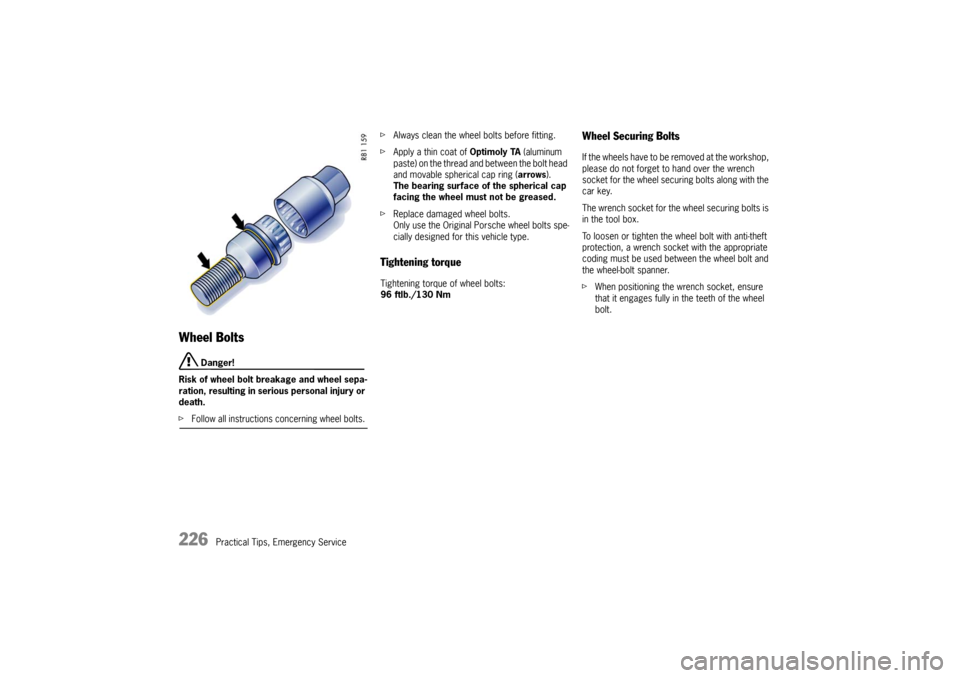
Wheel Bolts
Danger!
Risk of wheel bolt breakage and wheel sepa-
ration, resulting in serious personal injury or
death.
f Follow all instructions concerning wheel bolts. f
Always clean the wheel bolts before fitting.
f Apply a thin coat of Optimoly TA (aluminum
paste) on the thread and between the bolt head
and movable spherical cap ring ( arrows).
The bearing surface of the spherical cap
facing the wheel must not be greased.
f Replace damaged wheel bolts.
Only use the Original Porsche wheel bolts spe-
cially designed for this vehicle type.
Tightening torque Tightening torque of wheel bolts:
96 ftlb./130 Nm
Wheel Securing Bolts If the wheels have to be removed at the workshop,
please do not forget to hand over the wrench
socket for the wheel securing bolts along with the
car key.
The wrench socket for the wheel securing bolts is
in the tool box.
To loosen or tighten the wheel bolt with anti-theft
protection, a wrench sock et with the appropriate
coding must be used be tween the wheel bolt and
the wheel-bolt spanner.
f When positioning the wr ench socket, ensure
that it engages fully in the teeth of the wheel
bolt.
Page 229 of 284

Practical Tips, Emergency Service
227
Changing a wheel
Warning!
Risk of serious personal injury or death. The
car may slip off the jack.
f Make sure that no one is in the vehicle when
jacking up and changing a wheel.
f Always place the car on stable supports if work
has to be carried out under the car.
Risk of damage to the brake discs of the
Porsche Ceramic Composite Brake (PCCB).
f Always screw in both assembly aids when changing a wheel.
Note
The tools required for changing a wheel (e.g. jack,
wheel bolt wrench, assembly aids) are not sup-
plied with the car.
Your authorized Porsche dealer will be pleased to
advise you.
1. Apply the handbrake fully and engage 1st gear or PDK selector-lever position P and remove
the ignition key.
2. Switch on the hazard warning lights if neces- sary.
3. Secure the car against rolling away, e.g. by
means of wedges under the wheels on the op-
posite side.
This is particularly important on slopes. 4. Slightly slacken the whee
l bolts of the wheel to
be changed.
5. Lift the car only at the specified jacking points.
6. Raise the car until the wheel lifts off the ground.
Please see the chapter “LIFTING THE VEHICLE
WITH A LIFTING PLATFORM OR GARAGE LIFT”
on Page 232.
7. Remove 1 or 2 wheel bolts (see respective illustration).
8. Screw in assembly aids instead of the wheel bolts.
Screw in assembly aid for cars without Porsche Ceramic
Composite Brake9. Remove the remaining wheel bolts.
Note on operation
f To remove or mount the spacers:
Please see the chapter “SPACERS” on
Page 233.
Page 237 of 284

Practical Tips, Emergency Service
235
Electrical System In order to avoid damage and faults in electrical or
electronic systems, electrical accessories should
be installed at your authorized Porsche dealer.
fOnly use accessories authorized by Porsche.
Warning!
Risk of short circuit and fire, resulting in
serious personal injury or death.
Replacing fuses or relays with the engine
running or the ignition on could cause elec-
trical shock.
f Disconnect the negative terminal on the
battery during all work on the electrical
system.
Please see the chapter “BATTERY” on Page 239.
RelaysDefective relays should be changed only by an
authorized workshop.
In storage tray between the front seats
(not on vehicles with iPod, USB, AUX interfaces)SocketsElectrical accessories should preferably be
connected to the 12 V sockets.
f Please observe the maximum power
consumption.
Note on operation
The tire filling compressor must be connected to
the cigarette lighter.
In the passenger’s footwellNote on operation
The sockets and thus the connected electrical
accessories function even if the ignition is
switched off or the igni tion key is withdrawn.
If the engine is not running and the accessories
are switched on, the vehicle battery will be dis-
charged.
Do not operate additional accessories for more
than 5 minutes when engine is off. Continuing to
do so may drain the batte ry such that it may go
completely dead.
Maximum power consumpti on for both sock-
ets together: 70 W.
Page 238 of 284

236
Practical Tips, Emergency Service
Alarm system, central lockingThe status of the central locking and alarm system
is not changed by disconnecting the battery.
When the battery is di sconnected, the alarm
system ceases to function.Central locking overload protectionIf the central locking sy stem is operated more
than ten times within a minut e, further operation is
blocked for 30 seconds.
Load switch-off after 2 hours or 7 daysIf the ignition key is removed, loads which are
switched on or are in standby mode (such as the
luggage compartment light and interior light) are
automatically switched off after approx. 2hours.
The Radio/PCM is automatically switched off after
approx. 10 minutes.
If the vehicle is not started or unlocked with the
remote control within 7days , the remote control
standby function is switched off (to save the
vehicle battery).
1. In this case, unlock the driver’s door with the key at the door lock.
Leave the door closed in order to prevent the
alarm system from being triggered.
2. Press button 1 on the remote control.
The remote control is now activated again.
Page 240 of 284

238
Practical Tips, Emergency Service
Emergency unlocking of the front luggage
compartment lidIf the battery is discharged, the front luggage
compartment lid can be opened only with the aid
of a donor battery.
Note
The engine cannot be started with this method.
f Please see the chapter “EMERGENCY
STARTING WITH JUMPER CABLES” on
Page 245.
Unlocking lid
1. Use the key to unlock the vehicle at the door lock.
2. Remove the plastic cover from the fuse box.
3. Pull out positive terminal C (red) in the fuse box
using the plastic gripper A (yellow).
A - Plastic gripper (yellow)
C - Positive terminal (red)4. Use a jumper cable to connect the positive
terminal of the donor battery to the positive
terminal C in the fuse box.
Note
If the vehicle was locked, the alarm horn will sound
when the negative cable is connected.
5. Use the black jumper cable to connect the negative terminal of the donor battery to the
door arrester D.
6. Press button 2 on the remote control for
approx. 2 seconds to unlock the luggage
compartment lid.
The alarm system is switched off.
7. Disconnect the negative cable first, then the positive cable.
8. Push positive terminal C into the fuse box and
push on the plastic fuse box cover.