Page 200 of 310
198
Mobile Roofs 6.Check whether the rear screw connections on
the hardtop are loosened (turn it 2 turns clock-
wise).
7. Together with a second person on the other
side, grasp the hardtop at points E and F.
8. Carefully lift the hardtop up and over the vehi-
cle from behind.
Warning!
Danger of pinching fingers or hands at the
points “F”.
fEvenly lower the hardtop at both sides.
9. First push the hardtop completely into the
guides on the windshield frame.
Then carefully lower the hardtop into the lock-
ing elements at the rear.
Caution!
Danger of damage due to inadvertent opera-
tion of the convertible top with the hardtop
fitted.
fMake sure that the front locking lever G is al-
ways correctly locked.This disables the convertible top drive.
Page 201 of 310
Mobile Roofs
199
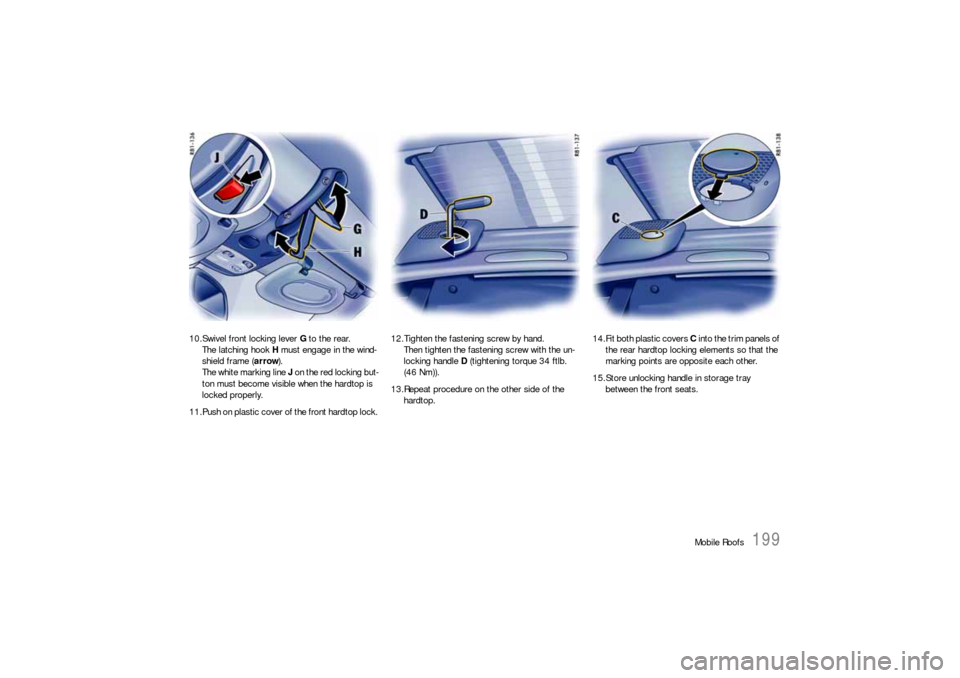
10.Swivel front locking lever G to the rear.
The latching hook H must engage in the wind-
shield frame (arrow).
The white marking line J on the red locking but-
ton must become visible when the hardtop is
locked properly.
11.Push on plastic cover of the front hardtop lock.12.Tighten the fastening screw by hand.
Then tighten the fastening screw with the un-
locking handle D (tightening torque 34 ftlb.
(46 Nm)).
13.Repeat procedure on the other side of the
hardtop. 14.Fit both plastic covers C into the trim panels of
the rear hardtop locking elements so that the
marking points are opposite each other.
15.Store unlocking handle in storage tray
between the front seats.
Page 206 of 310

204
Mobile Roofs
Roof Transport System(Coupé only)
fPlease follow the separate instructions for fit-
ting the Roof Transport System.
fOnly use Roof Transport Systems from the
Porsche Tequipment product range or Roof
Transport Systems which have been tested
and approved for your car by Porsche.
Fitting normal commercially available luggage
racks is not possible.
The Porsche Roof Transport System allows you
to carry various sports and hobby equipment.
Your authorized Porsche dealer will be pleased to
tell you about the various different uses of the
Roof Transport System.
Safety notes!
fCompletely remove the Roof Transport System
before using an automatic car wash – risk of
damage to the vehicle!
fDo not exceed the maximum permitted pay-
load, the maximum permitted gross weight
and the maximum permitted axle loads.
Please see the chapter “WEIGHTS COUPÉ” on
Page 291.
fDistribute load evenly, with heavy items as low
as possible.
Items of luggage must not project beyond the
side of the load area.
fFix and secure every item to the basic carrier
with a rope or lashing strap (do not use elastic
rubber tensioners).
fBefore every journey, and at regular intervals
during long trips, check that Roof Transport
System and load are secure. Re-tighten if nec-
essary and secure additionally by locking.When the Roof Transport System is loaded, the
maximum speed depends on the nature, size and
weight of the load being carried.
Driving, braking and steerin g b e h a v i o r c h a n g e d u e
to the higher center of gravity and the greater
wind-resistant area. You should adapt your driving
style appropriately.
Since fuel consumption and noise are increased
with the Roof Transport System fitted, it should
not remain on the vehicle if not in use.
Page 217 of 310

Maintenance, Car Care
215
Fuel
Warning!
Fuel is highly flammable and harmful to
health.
fFire, open flame and smoking are prohibited
when handling fuel.
fAvoid contact with skin or clothing.
fDo not inhale fuel vapors.
To prevent damage to the emission control
system and engine:
fNever drive the tank completely out of fuel.
fAvoid high cornering speeds after the warning lights have come on.
fPlease see the chapter “FUEL ECONOMY” on
Page 214.
Please see the chapter “EMISSION CONTROL
SYSTEM” on Page 218.
Please see the chapter “LEVEL GAGE” on
Page 122.
Check engine warning light
If the warning lights in the instrument panel and on-
board computer come on and remain on while
driving, it suggests:
– a potential engine control problem and the
need for system service or
– an improperly fastened tank cap or – refueling with engine running.
Opening the filler flapThe filler opening is under the filler flap in the front
right fender.
fWith the vehicle unlocked, press on the front
part of the filler flap (arrow) to open the flap.
The filler flap is centrally locked along with the oth-
er locks. If there is a defect in the automatic unlocking
system:
fOpen the passenger door.
fPull the ring in the right-hand door aperture
(arrow).
Page 260 of 310

258
Practical Tips, Emergency Service
Alarm system, central lockingThe status of the central locking and alarm system
is not changed by disconnecting the battery.
When the battery is disconnected, the alarm
system ceases to function.Central locking overload protectionIf the central locking system is operated more
than ten times within a minute, further operation is
blocked for 30 seconds.
Load switch-off after 2 hours or 7 daysIf the ignition key is removed, loads which are
switched on or are in standby mode (such as the
luggage compartment light, interior light) are
automatically switched off after approx. 2hours.
The Radio/PCM is automatically switched off after
approx. 10 minutes.
If the vehicle is not started or unlocked with the
remote control within 7days, the remote control
standby function is switched off (to save the
vehicle battery).
1. In this case, unlock the driver’s door with the
key at the door lock.
Leave the door closed in order to prevent the
alarm system from being triggered.
2. Press button 1 on the remote control.
The remote control is now activated again.
Page 261 of 310
Practical Tips, Emergency Service
259
Replacing fuses In order to prevent damage to the electrical sys-
tem due to short circuits and overloads, the indi-
vidual circuits are protected by fuses.
The fuse box is located in the driver’s footwell.
A - Plastic gripper
B - Spare fuses 1. Switch off the load with the defective fuse.
2. Pull off plastic cover at the finger hole (arrow).
The fuse plan and instructions for
emergency unlocking of the luggage
compartment lid can be found on the inner
side of the cover.
3. Remove the corresponding fuse from its slot
using the plastic gripper A in order to check it.
A blown fuse can be identified by the melted
metal strip.4. Replace only with fuses of the same rating.
We recommend using genuine Porsche fuses
for replacement.
Note
fIf a fuse blows repeatedly consult an author-
ized Porsche dealer.
fNever try to “repair” fuses: you may cause se-
rious damage to other parts of the electrical
system.
Page 262 of 310

260
Practical Tips, Emergency Service
Emergency unlocking of the luggage
compartment lidIf the battery is discharged, the luggage compart-
ment lid can be opened only with the aid of a donor
battery.
Note
The engine cannot be started with this method.
fPlease see the chapter “EMERGENCY
STARTING WITH JUMPER CABLES” on
Page 267.
Unlocking lid
1. Use the key to unlock the vehicle at the door
lock.
2. Remove the plastic cover from the fuse box.
3. Pull out positive terminal C (red) in the fuse box
using the plastic gripper A (yellow).
A - Plastic gripper (yellow)
C - Positive terminal (red)4. Use a jumper cable to connect the positive
terminal of the donor battery to the positive
terminal C in the fuse box.
Note
If the vehicle was locked, the alarm horn will sound
when the negative cable is connected.
5. Use the black jumper cable to connect the
negative terminal of the donor battery to the
door arrester D.
6. Press button 2 on the remote control for
approx. 2 seconds to unlock the luggage
compartment lid.
The alarm system is switched off.
7. Disconnect the negative cable first, then the
positive cable.
8. Push positive terminal C into the fuse box and
push on the plastic fuse box cover.
Page 272 of 310
270
Practical Tips, Emergency Service
Headlights
Caution!
Risk of damage to headlights due to exces-
sive temperatures and abrasion.
fTo ensure optimum ventilation, do not cover
the gap between headlight and body
(e.g. “stone guards” or films).
fUse soapy water only to clean light lenses and
plastic headlight lenses.
In no case may chemical cleaners or other vol-
atile cleaning fluids be used.
fTo prevent scratches, do not rub with a dry or merely moist cloth, tissue or insect sponges.
Removing headlights1. Unscrew plastic nut A.
Detach the side carpeting.2. Remove rubber plug B from the unlocking
opening.