2009 PORSCHE 911 lock
[x] Cancel search: lockPage 44 of 310

42
Operation, Safety An audio-visual warning system is interconnect-
ed with the driver’s safety belt.
Every time the ignition is turned on, the gong will
sound for about 6 seconds to remind driver and
passenger to buckle up.
In addition, the gong will sound for approx. 90 sec-
onds if vehicle speed exceeds 15 mph/24 km/h.
The safety belt warning lights in the instrument
panel and on-board computer will go off as soon
as the driver has buckled up.
Inertia reel retractor The combination lap/shoulder belt with inertia reel
locking mechanism adjusts automatically to your
size and movements as long as the pull on the belt
is slow.
Rapid deceleration during hard braking or a colli-
sion locks the belt. The belt will also lock when you
drive up or down a steep hill or in a sharp curve,
otherwise, the shoulder belt will not inhibit your
upper body movement.
Fastening the safety beltfAssume a comfortable sitting position.
fPlease see the chapter “SEAT POSITION” on
Page 30.
fThe shoulder belt should always rest on your
upper body. The shoulder belt should never be
worn behind your back or under your arm.
fGrasp belt and pull the belt in a continuous
slow motion across your chest and lap.
fInsert belt tongue into buckle on inboard side
of seat. Push down until it securely locks with
an audible click. Pull the belt to check.
fPull shoulder section to make sure belt fits
snugly across the pelvis.
fBelts should fit snugly across the pelvis and
chest. Make sure there is no slack in the belt. Releasing the safety beltfPush in release button (arrow) on buckle. Belt
tongue will spring out of buckle.
fTo release a latched belt, lean back to take the
body pressure off the belt.
fTo store lap/shoulder belt, allow the belt to re-
tract as you guide the latch to its stowed posi-
tion.
fPlease see the chapter “AUTOMATIC LOCKING
RETRACTOR” on Page 53.
Safety Belt Warning System
Page 55 of 310

Operation, Safety
53
Automatic locking retractorfDo not install a child restraint system in
the Sports bucket seat.
The Sports bucket seat cannot be
equipped with the LATCH system.
The safety belts for the front passenger and rear
seats are equipped with an automatic locking re-
tractor for securing the child restraint system.
When activated, this retractor allows you to se-
curely fasten the child restraint system in place so
that inadvertent movements will not occur.
Danger!
The use of a child restraint system on the
front passenger seat can result in serious
personal injury or death to the child from an
airbag deployment.
To reduce risk of injury from an inflating air-
bag in an accident, Porsche strongly recom-
mends:
fUnder all normal circumstances, forward fa-cing child seats must be placed in the rear.
Before transporting a child on the passenger’s
seat:
fPlease see the chapter “CHILD RESTRAINT
SYSTEMS” on Page 50.
Danger!
Risk of serious personal injury or death to the
child, when excessive force is acting on the
passenger's seat due to the seat belt.
In such cases, the passenger's airbag can be
switched on unintentionally.
fAfter fastening the child restraint system, do
not adjust the seat.
fCheck the condition of the passenger’s airbag
shown by the indicator lamp in the central con-sole.Activating the automatic locking retractor
1. If a child restraint system must be fastened to
the passenger's seat, adjust the passenger's
seat as far away from the airbag as possible.
2. Fasten child seat.
3. Pull the safety belt retractor completely out. At
this point the locking mechanism is activated.
4. Insert the safety belt tongue into the buckle
and make certain that it is properly latched.
Make no more adjustments to the seat.
5. Allow the safety belt to retract until it is tight on
the child restraint system. You may further
tighten the belt by pulling on it to allow more of
it to retract.
Make sure that excessive seat belt forces do
not occur by moving the seat with the child
seat installed.
Releasing the safety belt
1. Unbuckle the safety belt latch.
2. Then make certain that the belt has fully
retracted. At this point the automatic locking
feature will be disengaged.
Seek appropriate advice from your authorized
Porsche dealer about the possible installation
of a Porsche child restraint system.
Page 57 of 310
Operation, Safety
55
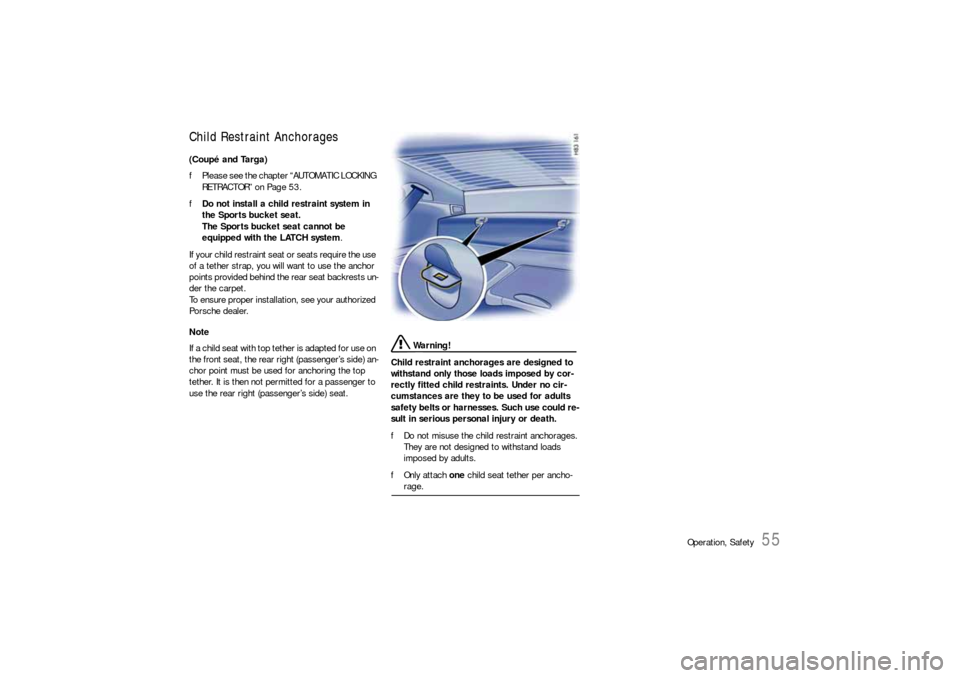
Child Restraint Anchorages (Coupé and Targa)
fPlease see the chapter “AUTOMATIC LOCKING
RETRACTOR” on Page 53.
fDo not install a child restraint system in
the Sports bucket seat.
The Sports bucket seat cannot be
equipped with the LATCH system.
If your child restraint seat or seats require the use
of a tether strap, you will want to use the anchor
points provided behind the rear seat backrests un-
der the carpet.
To ensure proper installation, see your authorized
Porsche dealer.
Note
If a child seat with top tether is adapted for use on
the front seat, the rear right (passenger’s side) an-
chor point must be used for anchoring the top
tether. It is then not permitted for a passenger to
use the rear right (passenger’s side) seat.
Warning!
Child restraint anchorages are designed to
withstand only those loads imposed by cor-
rectly fitted child restraints. Under no cir-
cumstances are they to be used for adults
safety belts or harnesses. Such use could re-
sult in serious personal injury or death.
fDo not misuse the child restraint anchorages.
They are not designed to withstand loads
imposed by adults.
fOnly attach one child seat tether per ancho-rage.
Page 58 of 310

56
Operation, Safety
Rollover Protection System The Rollover Protection System on the Cabriolet
consists of two supplemental safety bars that to-
gether with the front windshield frame help to cre-
ate occupant survival space in case of rollover. Be-
cause of the extreme and unpredictable forces
which can be encountered in a rollover, it is not
possible to guarantee that occupants will be pro-
tected from all contact with exterior objects or the
ground. However, the Rollover Protection System
is designed to maintain the occupant survival
space.
The Rollover Protection System is activated auto-
matically in the event of an accident or extreme
driving situation.
The protective devices are located behind each
rear seat and rapidly deploy within a fraction of a
second. If necessary, the seat-belt tensioners will
be activated.
fPlease see the chapter “BELT TENSIONER” on
Page 41.
They can deploy under:
– Extreme tilting of the vehicle.
– Loss of ground contact (e.g. Going over the
crest of a hill at high speed).
Danger!
Risk of death or serious injury.
fDo not block area of supplemental safety bars
with objects.
In the event of a deployment event, such
objects could potentially prevent such deploy-
ment from occuring, or such objects could
impact the car occupants at high speed.
fDo not tamper with or work on wiring and or
components of Rollover Protection System.
fAll work regarding this system must be carried
out by your authorized Porsche dealer.
fCheck functions and periodic service intervals
according to maintenance schedule (see your
authorized Porsche dealer).
To avoid damage to the convertible top:
fIf the supplemental safety bars are extended
for any reason, do not open or close converti-ble top.Faults in the Rollover Protection System are indi-
cated by the airbag warning light in the instrument
panel.
Extension of the supplemental safety bars is no
longer ensured.
fSee your authorized Porsche dealer immedi-
ately and have the fault remedied.
Lowering the supplemental safety bars
after deployment fHave this work performed by an authorized
Porsche dealer.
Warning light
Page 63 of 310

Operation, Safety
61
ABS Brake System
(Antilock Brake System)The ABS system represents a major contribution
to the enhancement of active safety in your vehi-
cle. This system prevents the wheels from locking
in a panic stop on almost all road surfaces.
With the ABS system in your vehicle, the
following areas are enhanced:
Steering, vehicle remains steerable under all
braking forces when ABS is engaged.
Good directional control, no swerving caused
by locking of wheels under braking conditions.
Shorter stopping distance, stopping distances
are usually reduced because controlled braking is
maximized.
Prevention of wheel lock up, no brake- induced
sliding and thus no localized tire wear from emer-
gency braking.
The crucial advantage of the ABS system over a
conventional brake system is in the area of main-
taining directional control and maneuverability of
the car in emergency situations.
Warning!
The increased control that is provided should
not induce you to take greater risks with your
safety. The limits dictated by the laws of
physics cannot be overcome, even with ABS.
The risk of accidents due to inappropriate
speed cannot be reduced, even by the ABS.
The driver bears the responsibility for all
driving maneuvers.
fAdapt your driving style to the prevailing road
and weather conditions.
fObey all traffic laws.
Other vehicles not equipped with the ABS
system may not be able to maintain control,
especially on wet or poor road surfaces and
thus may be more likely to impact you from
behind.
fTo minimize that risk, use your ABS system to
increase your ability to maneuver to avoid dan-
gerous situations and not merely to try to stop in the shortest distance possible.
Operation of the ABS systemA wheel speed sensor is mounted to each of the
four wheels. If wheel lock-up of either of the front
wheels or the rear wheels is sensed during brak-
ing, the brake pressure is adjusted automatically
until the wheel no longer slips.
If braking forces approach the wheel lock-up point
for all wheels (panic braking) the ABS system will
intervene to provide a rapid rythmic braking. The
proper operation of ABS is perceived by the driver
as a pulsating brake pedal in conjunction with au-
dible noise and perhaps some vibration.
fIf you experience these sensations while driv-
ing or a road surface with questionable trac-
tion, reduce vehicle speed appropriate for the
prevailing road conditions.
fIf full braking should be necessary, press the
brake pedal all the way down throughout the
entire braking procedure, regardless of the pul-
sating pedal. Do not ease up on pressure ap-
plied to the pedal.
The functional readiness of all the main electrical
components of the ABS is checked by an
electronic monitoring system both before and
while you drive.
Page 73 of 310

Operation, Safety
71
A, C - Switch for reading light on driver/passenger side
B- Switch for interior light and footwell lights
D- Orientation lightInterior LightsfPlease see the chapter “LOAD SWITCH-OFF
AFTER 2 HOURS OR 7 DAYS” on Page 258.For vehicles with automatic anti-dazzle
mirrors
fSwitch off the automatic anti-dazzle operation
of the mirrors before you switch on the interior
light.
Otherwise the mirrors may accidentally swivel
into the anti-dazzle position.
Interior lights, reading lightsSwitching off
fPress left half of switch.
Switching to continuous illumination
fPress right half of switch.
Switching on and off automatically
fMove switch to center position.
The interior and footwell lights are switched
on when a door is unlocked or opened or when
the ignition key is withdrawn from the ignition
lock.
The lights are switched off with a delay of
approx. 2 minutes after the doors are closed.
The light goes out immediately as soon as the
ignition is switched on or the vehicle is locked.
Orientation lightA light-emitting diode at the bottom of the interior
mirror improves orientation in the passenger com-
partment when it is dark.
Note on operation
On vehicles with the Sport Chrono Package Plus,
the brightness of the orientation light can be
changed in PCM.
fPlease observe the chapter “Individual
Memory” in the separate PCM operating
instructions.
Page 76 of 310

74
Operation, Safety
O - Initial position
1 - Ignition on
2 - Start engine
3 - Ignition offIgnition/Starter Switch with
anti-theft Steering LockThe ignition lock has a total of four ignition lock po-
sitions.
The ignition key rebounds to the initial position
from every ignition lock position.
fFor your safety, fasten safety belts.
fPlease see the chapter “IMMOBILIZER” on
Page 15.fPlease see the chapter “KEY WITH RADIO RE-
MOTE CONTROL” on Page 16.
Before starting the enginefApply the footbrake.
fManual transmission:
Move the gearshift lever into neutral.
The clutch pedal must be depressed fully
before the starter will engage.
fIn vehicles with PDK transmission:
Move PDK selector lever to position P or N.Switch position 0 Initial position
The ignition key cannot be withdrawn when the
ignition is switched on or when the engine has
been started.
To withdraw the ignition key:
fStop the vehicle.
fIn vehicles with PDK transmission:
Move PDK selector lever to position P.
fSwitch ignition off.
fRemove ignition key.
Switch position 1 Ignition on
fTurn ignition key to position 1.
Ignition is switched on.
Note on operation
All electrical equipment can be switched on.
fPlease see the chapter “WARNINGS ON THE
INSTRUMENT PANEL AND THE ON-BOARD
COMPUTER” on Page 158.
Page 77 of 310

Operation, Safety
75
Switch position 2Start engine
fTurn ignition key to ignition lock position 2.
fPlease see the chapter “STARTING PROCEDU-
RES” on Page 77.Switch position 3Ignition off
fTurn ignition key to ignition lock position 3.
Note on operation
The vehicle battery discharges if the ignition key is
left inserted.
If the vehicle battery is dead, the key can only be
pulled out of the ignition lock if the emergency
operation is performed:
fPlease see the chapter “EMERGENCY OPERA-
TION – PULLING OUT THE IGNITION KEY” on
Page 76.
Locking the steering columnAutomatic locking
The steering column is automatically locked when
the ignition key is withdrawn from the ignition lock.
Warning!
Risk of an accident, resulting in serious per-
sonal injury or death.
The steering wheel will lock and will cause
loss of steering.
fNever remove key from the ignition lock or turn
the key off while the vehicle is moving.
fAlways withdraw the ignition key when leaving the vehicle.Automatic unlocking
The steering column is unlocked when the vehicle
is unlocked with the radio remote control.
Note
fTo avoid discharging the battery, always re-
move the ignition key from the ignition lock.
Please see the chapter “BATTERY” on
Page 261.
Gong If you leave the key in the ignition/steering lock, a
gong will sound when the driver’s door is opened.
This is a reminder to remove the key.