2009 PORSCHE 911 steering
[x] Cancel search: steeringPage 26 of 59
Porsche Torque Vectoring (PTV).
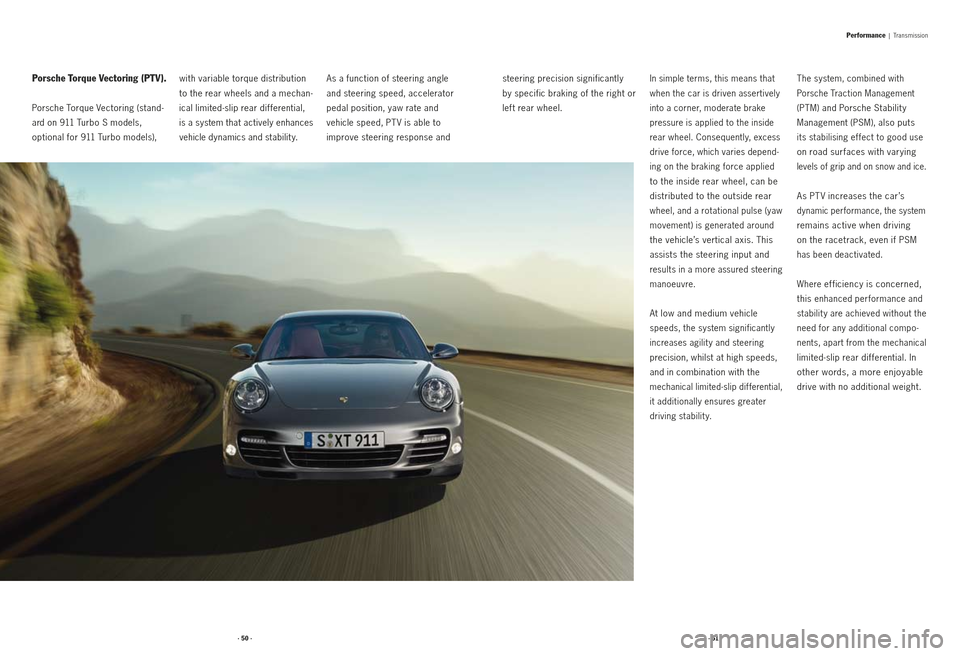
Porsche Torque Vectoring (stand-
ard on 911 Turbo S models,
optional for 911 Turbo models), with variable torque distribution
to the rear wheels and a mechan
-
ical limited-slip rear differential,
is a system that actively enhances
vehicle dynamics and stabilit y. As a function of steering angle
and steering speed, accelerator
pedal position, yaw rate and
vehicle speed, PT V is able to
improve steering response and steering precision significantly
by specific braking of the right or
left rear wheel.
In simple terms, this means that
when the car is driven assertively
into a corner, moderate brake
pressure is applied to the inside
rear wheel. Consequently, excess
drive force, which varies depend -
ing on the braking force applied
to the inside rear wheel, can be
distributed to the outside rear
wheel, and a rotational pulse (yaw
movement) is generated around
the vehicle’s vertical axis. This
assists the steering input and
results in a more assured steering
manoeuvre.
At low and medium vehicle
speeds, the system significantly
increases agilit y and steering
precision, whilst at high speeds,
and in combination with the
mechanical limited-slip differential,
it additionally ensures greater
driving stabilit y. The system, combined with
Porsche Traction Management
(PTM) and Porsche Stabilit y
Management (PSM), also puts
its stabilising ef fect to good use
on road surfaces with varying
levels of grip and on snow and ice.
As PT V increases the car’s
dynamic performance, the system
remains active when driving
on the racetrack, even if PSM
has been deactivated.
Where
efficien cy is concerned,
this
enhanced performance and
stabilit y are achieved without the
need for any additional compo -
nents, apart from the mechanical
limited-slip rear differential. In
other words, a more enjoyable
drive with no additional weight.
Performance | Transmission
· 50 ·· 51 ·
Page 28 of 59

Steering.
Sensitive and direct, the power-
assisted steering also of fers
accurate feedback from the road.
For a sportscar, driver effort is
minimal. In short: all the precision
of a race- designed system, yet
perfect for everyday road use.
One of the key features of the
steering system is the variable-
ratio gearing. Around the
straight-ahead position, the ratio
is less direct, enabling smoother
manoeuvres on the motorway. It
also reduces the risk of excessive
steering inputs which could
destabilise the car at high speed.
Agilit y and feedback, however,
are maintained.
Turn the wheel harder and the
ratio becomes more direct,
enabling bet ter control through
low-speed corners as well as
easier parking manoeuvres.
The turning circle is a modest
10.9 metres.
19-inch 911 Turbo II wheels.
Fit ted as standard to 911 Turbo
models, the 19 -inch 911 Turbo II
wheels seamlessly combine
function and design.
The car has 8.5 J x 19 wheels
at the front combined with
235/35 ZR 19 t yres. At the rear
are 11 J x 19 wheels with
305/30 ZR 19 t yres. The wheels
are forged, of course, to reduce
weight and unsprung masses.
The material is also very strong,
making it possible to achieve a
fine spoke wheel design which
provides bet ter ventilation of the
brakes.
The five-spoke design is st ylish
and distinctive. The linear
t win spokes have a high -sheen
surface finish, contrasting
with the titanium - coloured base
paint. Part of the wheel rim
also has a high -sheen finish.
The 19 -inch 911 Turbo II wheels.
Proof that dynamism can be
expressed visually.
19-inch RS Spyder wheels with
central locking device.
Reminiscent of the classic
RS Spyder design, these forged
aluminium wheels with a
motorsport-derived central locking
device are available on request
for the 911 Turbo models and are
fit ted as standard to the new
911 Turbo S models. By reducing
rotating masses, they deliver
an even more agile driving expe -
rience. Benefiting from innovative
ongoing developments to the
engineering conventionally used
only in a racing environment, the
striking central locking devices
of fer ef fective protection against
corrosion and are easy to clean.
Alternatively, the 19 -inch
911 Turbo II wheels are available
for the 911 Turbo S models at no
extra cost.
Tyre Pressure Monitoring
(TPM).
Tyre Pressure Monitoring,
included as standard equipment,
warns against t yre pressure
loss. The driver is informed via
the on -board computer display.
The driver can check the pres -
sures of all four t yres from the
instrument cluster. Each time
the t yres are re-inflated, or when -
ever a wheel has been changed,
the updated t yre pressures are
displayed quickly – for increased
comfort and safet y.
19 - inch 911 Turbo II wheel
19 - inch RS Spyder wheel with central locking device
Performance | Chassis
· 54 ·· 55 ·
Page 30 of 59

Sport Chrono Package Turbo
with dynamic engine mount
system.
The Sport Chrono Package Turbo
with dynamic engine mount
system is standard on 911 Turbo S
models and available as an
option for 911 Turbo models.
This integrated system provides
simultaneous enhancement for
engine, chassis and transmission.
Key features include a digital
and analogue stopwatch on the
dashboard, a performance dis -
play, a personal memor y function
in the Porsche Communication
Management (PCM), the SPORT
but ton and – in combination with
PDK – the SPORT PLUS but ton,
and an additional display on the
steering wheel which informs the
driver if the SPORT but tons and Launch Control have been acti
-
vated. The 911 Turbo models
additionally of fer the ‘overboost ’
function. This is how it works:
When ‘Sport ’ mode is selected,
the engine management system
creates a much more aggressive
response to pedal inputs. To do
this, it implements an alternative
throt tle map which relates the
pedal position in the foot well to
a wider angle of opening in the
throt tle body. In higher gears, it
uses a hard rev- limiter to protect
the engine under power.
In the 911 Turbo models, under
full acceleration, the maximum
boost pressure in the lower and
medium speed ranges is now
temporarily increased by approx -
imately 0.2 bar. As a result,
engine torque is boosted by 50 Nm to a maximum of 700 Nm for a
limited period. (The 911 Turbo S
models are configured to operate
with a higher boost pressure level,
which means that their maximum
torque is always 700 Nm.)
In addition to the engine, ‘Sport ’
mode is enabled in the standard
Porsche Active Suspension
Management (PASM) suspension.
The dampers become firmer,
enabling faster turn - in as well as
bet ter contact with the road.
In automatic mode of PDK,
the basic gearshif t pat tern is
switched to high-performance
mode. The gear change action is
virtually instantaneous, while the
shift points are timed for maxi -
mum acceleration. Lif t of f the
throt tle – even at high revs – and
the system automatically shif ts
down to apply engine braking. In
manual shif t mode, gear chang -
ing is faster and more dynamic.
Porsche Stabilit y Management
(PSM) is also adapted, with the
intervention threshold raised. As
a result, the car has a more natu -
ral response to lateral and longi -
tudinal forces. Cornering agilit y
is greatly enhanced, when both braking to turn in and applying
power on exit – particularly
in low-speed bends. For even
greater driving pleasure.
For maximum manoeuvrabilit y,
PSM can be partially disabled
while the car is still in ‘Sport ’
mode. PSM simply monitors the
forces acting on the car and
will only intervene in the most
critical scenarios, e.g. when ABS
assistance is required on both
front wheels.
In conjunction with PDK (standard
on 911 Turbo S models), the
Sport Chrono Package Turbo with
dynamic engine mount system
has t wo additional functions that can be activated via the SPORT
PLUS but ton, for a sport y drive
that borders on a motorsport
experience.
The first function is ‘Launch
Control’, which, for example
when per forming laps, helps you
achieve optimum acceleration
from a standing start, a racing
start in other words.
The function works like this:
press the SPORT PLUS but ton
when the transmission is in ‘D’
or ‘M’. Then, with your lef t foot,
press the brake pedal and accel -
erate fully with the right foot.
The car recognises ‘Launch’ mode
from the accelerator kickdown action and adjusts the engine
speed to the optimum level,
which is around 5,000 rpm. At
the same time, boost pressure
is increased to approximately
0.5 bar, engine torque is
increased and the clutch is
applied lightly. ‘Launch Control’
now appears in the steering
wheel display. Now release the
brake as quickly as you can –
and feel the acceleration power
unleashed to the road.
Steering wheel display with PDK and Sport Chrono Package Turbo
Performance | Chassis
· 58 ·· 59 ·
Page 31 of 59

The second function is the
‘motorsport-derived gearshift
strategy’. Using this, Porsche
Doppel
kupplung (PDK) is geared
up for the shortest possible
shif t times and optimum shif t
points for maximum acceleration
– ideal for the racetrack.
A key component of the Sport
Chrono Package Turbo with
dynamic engine mount system is
the stopwatch mounted on the
dashboard. Porsche Communica -
tion Management (PCM, page 86)
has a special performance display
to view, store and evaluate lap
times or other driving times. It
shows the total driving time, lap
distance, lap number and the
lap times recorded so far. You can
view the current fastest lap and
the remaining range until empt y.
Travelled distances can be
recorded and benchmark times
defined. The personal memory function of
the Sport Chrono Package Turbo
can also be used to store person
-
alised set tings for a range of
systems, including the orientation
lighting or air conditioning.
Operation of the dynamic
engine mount system.
Stiffness and softness as required.
That ’s the principle behind the
dynamic engine mount system
now being of fered for the first
time as part of the Sport Chrono
Package Turbo. Essentially, it ’s an
electronically controlled system
for controlling the stif fness of the
engine mounts.
The engine is bolted to the body
using t wo mounts and follows
New ton’s law of inertia, namely
that a body will continue to move
in a uniform straight line unless it is made to change its direction
by a force acting upon it.
Put more simply: when you are
driving into a bend, the vehicle will
follow your steering but, at first,
the mass of the engine won’t. This
means that the rear of the vehicle
is pushed out wards because of
the inert forces from the engine’s
mass acting on it.
The dynamic engine mount
system minimises this effect.
The steering angle longitudinal
and lateral acceleration values
are constantly recorded by
sensors and the stif fness of the
t wo engine mounts is changed
automatically according to the
driving st yle. This is achieved
using a magnetisable (magneto -
rheological) fluid and an electri -
cally generated magnetic field.
The magnetisable particles align
with each other and the fluid’s viscosit y changes. This alters the
stif fness and absorption of the
engine mounts: sof ter for greater
comfort and less vibration when
driving normally, harder for a
more direct driving feel when
driving more sportily.
The dynamic engine mount
system also reduces the vertical
oscillations of the engine when
accelerating under full load. The
result: greater and more uniform
force on the rear axle, increased
traction and bet ter acceleration.
All this means t wo things: percep -
tibly more stable handling under
load change conditions and in fast
corners and a step closer to the
ultimate sport y drive – combined
with enhanced levels of comfort.
Performance | Chassis
· 60 ·· 61 ·
Page 33 of 59

Headlights.
The Bi-Xenon headlight system is
fit ted as standard. The brightness
of the lights is approximately
t wice as great as that of conven-
tional halogen lights. Light output
is improved and the road illu -
minated more uniformly on both dipped and main beam, helping
to minimise driver fatigue.
Also included is dynamic range
control to prevent hazardous
dazzling of oncoming vehicles
due to undulations in the road
or the loading of the car. A head -
light cleaning function is also
incorporated.
Dynamic cornering lights
(standard on 911 Turbo S models,
optional for 911 Turbo models)
of fer particularly ef fective
illumination of the road ahead,
especially through bends. Sen -
sors continuously monitor the
speed, lateral acceleration and
steering lock and, from these
variables, calculate the course
of the bend. This determines
the angle of illumination for the
dipped beam lights, up to a
maximum of 15 degrees. On
t wisting roads, this means the
course of the road and obstacles
can be seen earlier by the driver.
Lighting concept.
The lighting concept also benefits
from the latest technology, in the
form of high -performance LEDs
for the horizontal front indicators
and also for the separate day time
running lights, the taillights and
the third brake light in the rear
wing.
In addition to the distinctive look
that makes the car very recog -
nisable, the lighting also provides
high illuminating power. The brake
lights also respond very quickly,
meaning that following traf fic is
alerted sooner. Plus the lighting
saves energy, is environmentally
sound and has a longer service
life in comparison to conventional
bulbs.When the vehicle is opened or
closed using the key remote, the
‘Welcome Home’ lighting function
automatically switches on the
LED day time running lights.
Two additional lights inside each
door ensure you see and are seen
bet ter when get ting into and out
of the car.
One effective way of relaxing:
breathe steadily.
Safety.
Quickening pulses whilst
simultaneously creating
calm. Yet another apparent
contradiction typical
of the performance of the
911 Turbo concept.
Dynamic cornering lights
Responsibility | Safet y
· 64 ·· 65 ·
Page 37 of 59

Porsche Side Impact Protection
System (POSIP).
POSIP, fit ted as standard, consists
of side impact protection beams
in the doors and t wo side airbags
on each side, namely a thorax
airbag located in the side of each
backrest and a head airbag incor-
porated within each door. Each
airbag has an approximate volume
of 8 litres, ensuring excellent
protection in the event of side
impact.
Additional safet y features include
the headrests which form an
integral part of each seat, an
energy-absorbing steering column,
three-point seat belts with height
adjustment (Coupés only), seat
belt pre-tensioners and force
limiters and energy-absorbing
elements in the dashboard.
Safety in the 911 Turbo
Cabriolets.
One fundamental principle at
Porsche is to provide high levels
of occupant protection, regardless
of whether the vehicle is a closed
or open-top design.
Torsional rigidit y and flexural
strength are exemplary for a t wo -
plus-t wo convertible. Body flexing
is minimal even on the most
poorly surfaced roads, ensuring
bet ter handling and greater
active safety.
Occupants are protected by an
automatically deploying roll- over
system if the vehicle were to overturn. Two spring-loaded roll-
over bars are neatly incorporated
behind each of the rear seats.
The roll- over sensor – part of the
airbag control unit – continuously
monitors the car’s pitch and roll,
contact with the road, as well as
lateral and longitudinal forces.
If the car were to overturn,
the top -padded bars would be
deployed instantly.
Of course, the 911 Turbo
Cabriolets also come as standard
with the Porsche Side Impact
Protection System (POSIP).
Responsibility | Safet y
· 72 ·· 73 ·
Page 41 of 59

Interior.
Efficient ergonomics is the guid-
ing theme for the interior. The
steering wheel of fers 40 mm of
adjustment for both height and
reach. A multifunction steering
wheel – with or without steering
wheel heating – is available on
request. The distinctively designed gear lever (for the six-
speed manual gearbox) and PDK
gear selector are easy to operate.
Porsche Communication Manage
-
ment (PCM) with a touchscreen is
fit ted as standard, as is the inte -
gral GPS navigation module with
hard drive navigation (page 86).
The new 911 Turbo S models come equipped with an integrated
six- disc CD/ DVD autochanger
and cruise control as standard.
The air- conditioning system with
an active carbon filter is fully
automatic. The leather finish on the seats,
dashboard, doors and rear
side panels is pleasing to the
touch. Available exclusively for
911 Turbo S models as standard
is the choice of t wo -tone leather
interior in either Black and Cream
or Black and Titanium Blue.
The centre console and door
storage compartments provide
storage space for personal items.
Below the passenger airbag are
t wo cup holders and below these
is the glove compartment with
CD storage.
Two 12-volt sockets (including the
cigaret te lighter) provide power
for a range of electrical devices.
Instruments.
The classic Porsche grouping of
five round instruments offers a
clear overview of all key informa -
tion.
The digital display in the centre-
left dial (speedometer) provides
main and trip odometer readings.
The central rev counter, featuring
the ‘turbo’ ‘or turbo S’ logo,
includes the standard on-board
computer display. This multi -
pur
pose field contains a perma -
nent digital speedometer as well
as the upshif t display on manual
models. The following optional information can also be displayed:
boost pressure, average speed,
average fuel consumption, t yre
pressure, current radio station,
navigation instructions and
remaining range till empt y. When
‘Sport ’ mode is selected on
the Sport Chrono Package Turbo
in a 911 Turbo model equipped
with dynamic engine mount
system, the temporary increase
in maximum torque is clearly
indicated by an arrow symbol in
the boost pressure display.
The third display, in the centre-
right dial, shows the time and
outside temperature.
Why do you need huge gestures
when the signs are clear?
Comfort.
An expressive design.
Well conceived technology.
A consistently sporty style.
No gimmicks. Why should the
rules for performance be
any different for the interior?
Personality | Comfort
Instruments in the 911 Turbo with PDK
Interior of the 911 Turbo in natural leather Carrera Red
· 80 ·· 81 ·
Page 43 of 59
HomeLink®.
The optional freely programmable
garage door opener is incorpo-
rated into the roof console and
of fers remote control of up to
three garage door, gate, home
lighting and/or alarm systems.
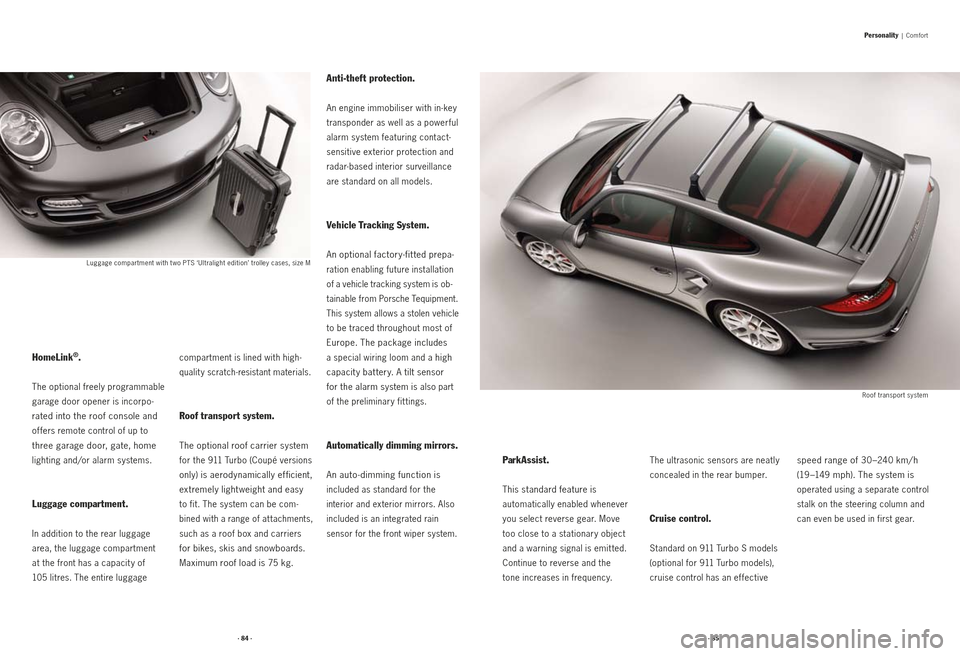
Luggage compartment.
In addition to the rear luggage
area, the luggage compartment
at the front has a capacit y of
105 litres. The entire luggage compartment is lined with high-
qualit y scratch - resistant materials.
Roof transport system.
The optional roof carrier system
for the 911 Turbo (Coupé versions
only) is aerodynamically efficient,
extremely light weight and easy
to fit. The system can be com -
bined with a range of at tachments,
such as a roof box and carriers
for bikes, skis and snowboards.
Maximum roof load is 75 kg.
Anti-theft protection.
An engine immobiliser with in -key
transponder as well as a powerful
alarm system featuring contact-
sensitive exterior protection and
radar-based interior surveillance
are standard on all models.
Vehicle Tracking System.
An optional factory-fit ted prepa -
ration enabling future installation
of a vehicle tracking system is ob -
tainable from Porsche Tequipment.
This system allows a stolen
vehicle
to be traced throughout most of
Europe. The package includes
a special wiring loom and a high
capacit y bat tery. A tilt sensor
for the alarm system is
also part
of the preliminary fit tings.
Automatically dimming mirrors.
An auto -dimming function is
included as standard for the
interior and exterior mirrors. Also
included is an integrated rain
sensor for the front wiper system.
ParkAssist.
This standard feature is
automatically enabled whenever
you select reverse gear. Move
too close to a stationary object
and a warning signal is emit ted.
Continue to reverse and the
tone increases in frequency. The ultrasonic sensors are neatly
concealed in the rear bumper.
Cruise control.
Standard on 911 Turbo S models
(optional for 911 Turbo models),
cruise control has an ef fective
speed range of 30 –240 km/ h
(19–149 mph). The system is
operated using a separate control
stalk on the steering column and
can even be used in first gear.
Luggage compartment with t wo PTS ‘Ultralight edition’ trolley cases, size M
Roof transport system
Personality | Comfort
· 84 ·· 85 ·