2009 PONTIAC VIBE weight
[x] Cancel search: weightPage 219 of 318

Vehicle Capacity Weight:The number of designated
seating positions multiplied
by 150 lbs (68 kg) plus the rated
cargo load. SeeLoading the
Vehicle on page 8-32.
Vehicle Maximum Load on the
Tire
:Load on an individual tire
due to curb weight, accessory
weight, occupant weight, and
cargo weight.
Vehicle Placard
:A label
permanently attached to
a vehicle showing the vehicle’s
capacity weight and the
original equipment tire size
and recommended ination
pressure. See “Tire and
Loading Information Label”
underLoading the Vehicle
on page 8-32.
Ination - Tire Pressure
Tires need the correct amount
of air pressure to operate
effectively.
Notice:Do not let anyone tell
you that under-ination or
over-ination is all right. It is
not. If your tires do not have
enough air (under-ination),
you can get the following:
Too much exing
Too much heat
Tire overloading
Premature or irregular wear
Poor handling
Reduced fuel economy
If your tires have too much air
(over-ination), you can get
the following:
Unusual wear
Poor handling
Rough ride
Needless damage from road
hazardsA vehicle specic Tire and
Loading Information label is
attached to your vehicle. This
label shows your vehicle’s
original equipment tires and the
correct ination pressures for
your tires when they are cold.
The recommended cold tire
ination pressure, shown on the
label, is the minimum amount of
air pressure needed to support
your vehicle’s maximum load
carrying capacity.
For additional information
regarding how much weight
your vehicle can carry, and an
example of the Tire and Loading
Information label, seeLoading
the Vehicle on page 8-32.
How you load your vehicle
affects vehicle handling and
ride comfort. Never load your
vehicle with more weight than
it was designed to carry.
Vehicle Service and Care 9-47
2009 - Pontiac Vibe Owner Manual
Page 249 of 318

4. Clamp the steering wheel in a
straight-ahead position with a
clamping device designed
for towing.
5. Remove the key from the
ignition.
6. Secure the vehicle to the dolly.
7. Release the parking brake.
Towing a Trailer
{CAUTION
The driver can lose control when
pulling a trailer if the correct
equipment is not used or the
vehicle is not driven properly.
For example, if the trailer is too
heavy, the brakes may not work
well or even at all. The driver and
passengers could be seriously
(Continued)
CAUTION (Continued)
injured. The vehicle may also be
damaged; the resulting repairs
would not be covered by the
vehicle warranty. Pull a trailer only
if all the steps in this section have
been followed. Ask your
dealer/retailer for advice and
information about towing a trailer
with the vehicle.
Your vehicle can tow a trailer if it
is equipped with the proper trailer
towing equipment. To identify the
vehicle trailering capacity of your
vehicle, you should read the
information in “Weight of the Trailer”
that appears later in this section.
Trailering is different than just driving
your vehicle by itself. Trailering
means changes in handling,acceleration, braking, durability and
fuel economy. Successful, safe
trailering takes correct equipment,
and it has to be used properly.
That is the reason for this part.
In it are many time-tested, important
trailering tips and safety rules. Many
of these are important for your safety
and that of your passengers.
So please read this section
carefully before you pull a trailer.
Load-pulling components such as
the engine, transmission, wheel
assemblies and tires are forced to
work harder against the drag of
the added weight. The engine
is required to operate at relatively
higher speeds and under greater
loads, generating extra heat.
In addition, the trailer adds
considerably to wind resistance,
increasing the pulling requirements.
Vehicle Service and Care 9-77
2009 - Pontiac Vibe Owner Manual
Page 250 of 318

If You Do Decide To Pull A
Trailer
If you do, here are some important
points:
There are many different laws,
including speed limit restrictions,
having to do with trailering. Make
sure the rig will be legal, not only
where you live but also where you
will be driving. A good source for
this information can be state or
provincial police.
Consider using a sway control.
Ask a hitch dealer about sway
controls.
Do not tow a trailer at all during
the rst 1,000 miles (1 600 km)
the new vehicle is driven. The
engine, axle or other parts could
be damaged.
Then, during the rst 500 miles
(800 km) that trailer is towed, do
not drive over 50 mph (80 km/h)
and do not make starts at full
throttle. This helps the engine
and other parts of the vehicle
wear in at the heavier loads.
Obey speed limit restrictions
when towing a trailer. Do not drive
faster than the maximum posted
speed for trailers, or no more than
55 mph (90 km/h), to save wear
on the vehicle’s parts.
Three important considerations have
to do with weight:
the weight of the trailer
the weight of the trailer tongue
and the total weight on your
vehicle’s tires
Weight of the Trailer
How heavy can a trailer safely be?
It should never weigh more than
1,500 lbs (680 kg). But even
that can be too heavy.
It depends on how you plan to
use your rig. For example, speed,
altitude, road grades, outside
temperature and how much your
vehicle is used to pull a trailer are
all important. It can also depend on
any special equipment that you have
on your vehicle, and the amount of
tongue weight the vehicle can carry.
See “Weight of the Trailer Tongue”
later in this section for more
information.
9-78 Vehicle Service and Care
2009 - Pontiac Vibe Owner Manual
Page 251 of 318
Maximum trailer weight is calculated
assuming only the driver is in the tow
vehicle and it has all the required
trailering equipment. The weight
of additional optional equipment,
passengers and cargo in the tow
vehicle must be subtracted from
the maximum trailer weight.
You can ask your dealer/retailer for
our trailering information or advice,
or you can write us at our Customer
Assistance Offices. SeeCustomer
Assistance Offices on page 12-4for
more information.
Weight of the Trailer Tongue
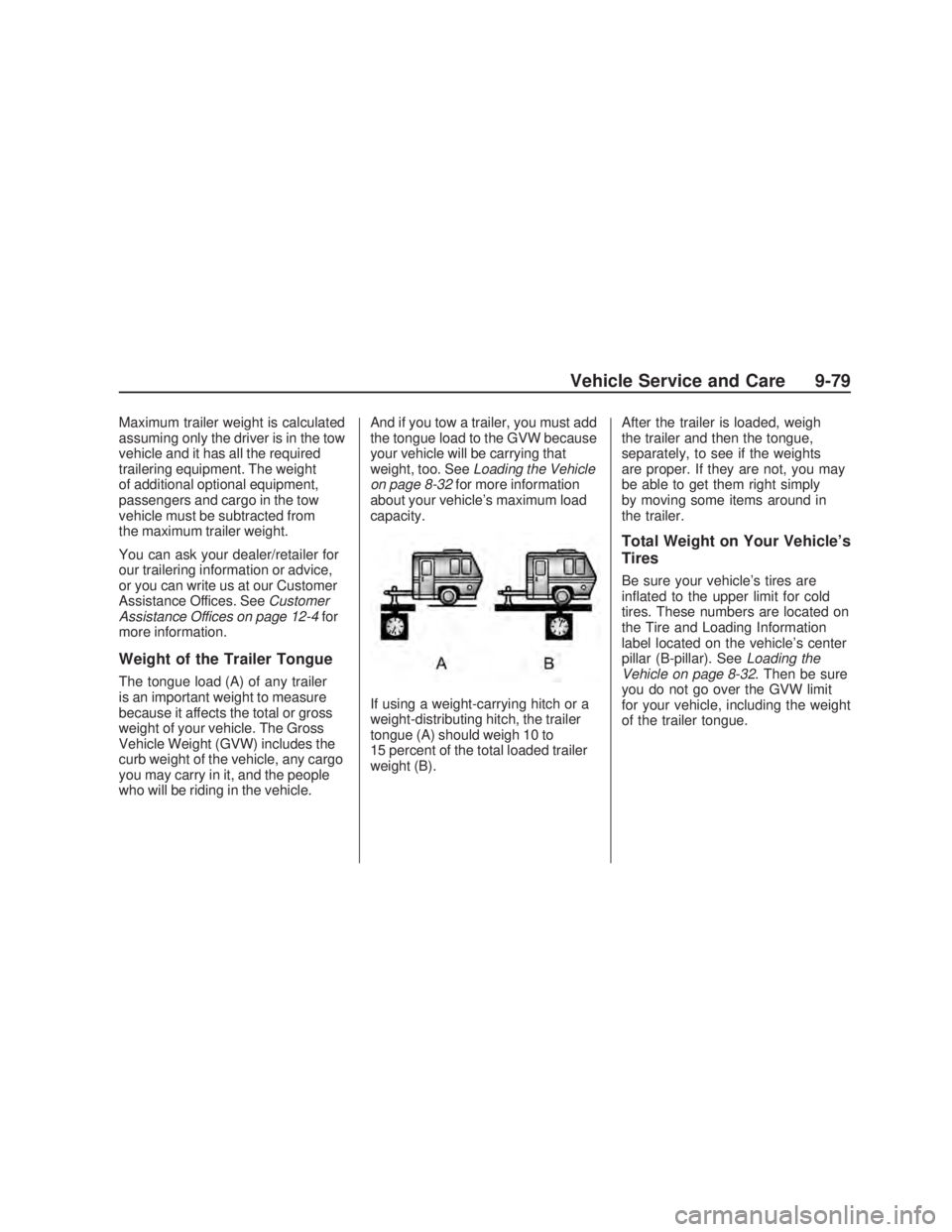
The tongue load (A) of any trailer
is an important weight to measure
because it affects the total or gross
weight of your vehicle. The Gross
Vehicle Weight (GVW) includes the
curb weight of the vehicle, any cargo
you may carry in it, and the people
who will be riding in the vehicle.And if you tow a trailer, you must add
the tongue load to the GVW because
your vehicle will be carrying that
weight, too. SeeLoading the Vehicle
on page 8-32for more information
about your vehicle’s maximum load
capacity.
If using a weight-carrying hitch or a
weight-distributing hitch, the trailer
tongue (A) should weigh 10 to
15 percent of the total loaded trailer
weight (B).After the trailer is loaded, weigh
the trailer and then the tongue,
separately, to see if the weights
are proper. If they are not, you may
be able to get them right simply
by moving some items around in
the trailer.
Total Weight on Your Vehicle’s
Tires
Be sure your vehicle’s tires are
inated to the upper limit for cold
tires. These numbers are located on
the Tire and Loading Information
label located on the vehicle’s center
pillar (B-pillar). SeeLoading the
Vehicle on page 8-32. Then be sure
you do not go over the GVW limit
for your vehicle, including the weight
of the trailer tongue.
Vehicle Service and Care 9-79
2009 - Pontiac Vibe Owner Manual
Page 252 of 318

Hitches
It is important to have the correct
hitch equipment. Crosswinds,
large trucks going by and rough
roads are a few reasons why
you will need the right hitch.
Here are some rules to follow:
Do not let the steel in a hitch
contact the aluminum on your
bumper because it can corrode.
Use something like paint or plastic
tape to separate the steel and
aluminum. The same steel to
aluminum problem can happen
with fasteners too.
Will you have to make any holes
in the body of your vehicle when
you install a trailer hitch? If you
do, then be sure to seal the holes
later when you remove the hitch.
If you do not seal them, deadly
carbon monoxide (CO) from the
exhaust can get into your vehicle.
See “Engine Exhaust” in the
Index. Dirt and water can too.
Safety Chains
You should always attach chains
between your vehicle and your
trailer. Cross the safety chains
under the tongue of the trailer
so that the tongue will not drop
to the road if it becomes separated
from the hitch. Instructions about
safety chains may be provided
by the hitch manufacturer or by
the trailer manufacturer. Follow the
manufacturer’s recommendation for
attaching safety chains and do not
attach them to the bumper. Leave
sufficient slack in the chain for turns.
Never allow safety chains to drag on
the ground.
Trailer Brakes
Does your trailer have its own
brakes?
Be sure to read and follow the
instructions for the trailer brakes so
you will be able to install, adjust and
maintain them properly. If you have
antilock brakes, do not tap into your
vehicle’s brake system. If you do,
both systems will not work well,
or at all.
Driving with a Trailer
Towing a trailer requires a certain
amount of experience. Get to know
the rig before setting out for the open
road. Acquaint yourself with the feel
of handling and braking with the
added weight of the trailer. And
always keep in mind that the vehicle
you are driving is now a good deal
longer and not nearly as responsive
as your vehicle is by itself.
Before you start, check the trailer
hitch, platform and attachments,
safety chains, electrical connector,
lamps, tires and mirror adjustment.
If the trailer has electric brakes, start
your vehicle and trailer moving and
then apply the trailer brake controller
by hand to be sure the brakes
are working. This lets you check
your electrical connection at the
same time.
During your trip, check occasionally
to be sure that the load is secure,
and that the lamps and any
trailer brakes are still working.
9-80 Vehicle Service and Care
2009 - Pontiac Vibe Owner Manual