2009 PONTIAC VIBE trailer
[x] Cancel search: trailerPage 251 of 318
Maximum trailer weight is calculated
assuming only the driver is in the tow
vehicle and it has all the required
trailering equipment. The weight
of additional optional equipment,
passengers and cargo in the tow
vehicle must be subtracted from
the maximum trailer weight.
You can ask your dealer/retailer for
our trailering information or advice,
or you can write us at our Customer
Assistance Offices. SeeCustomer
Assistance Offices on page 12-4for
more information.
Weight of the Trailer Tongue
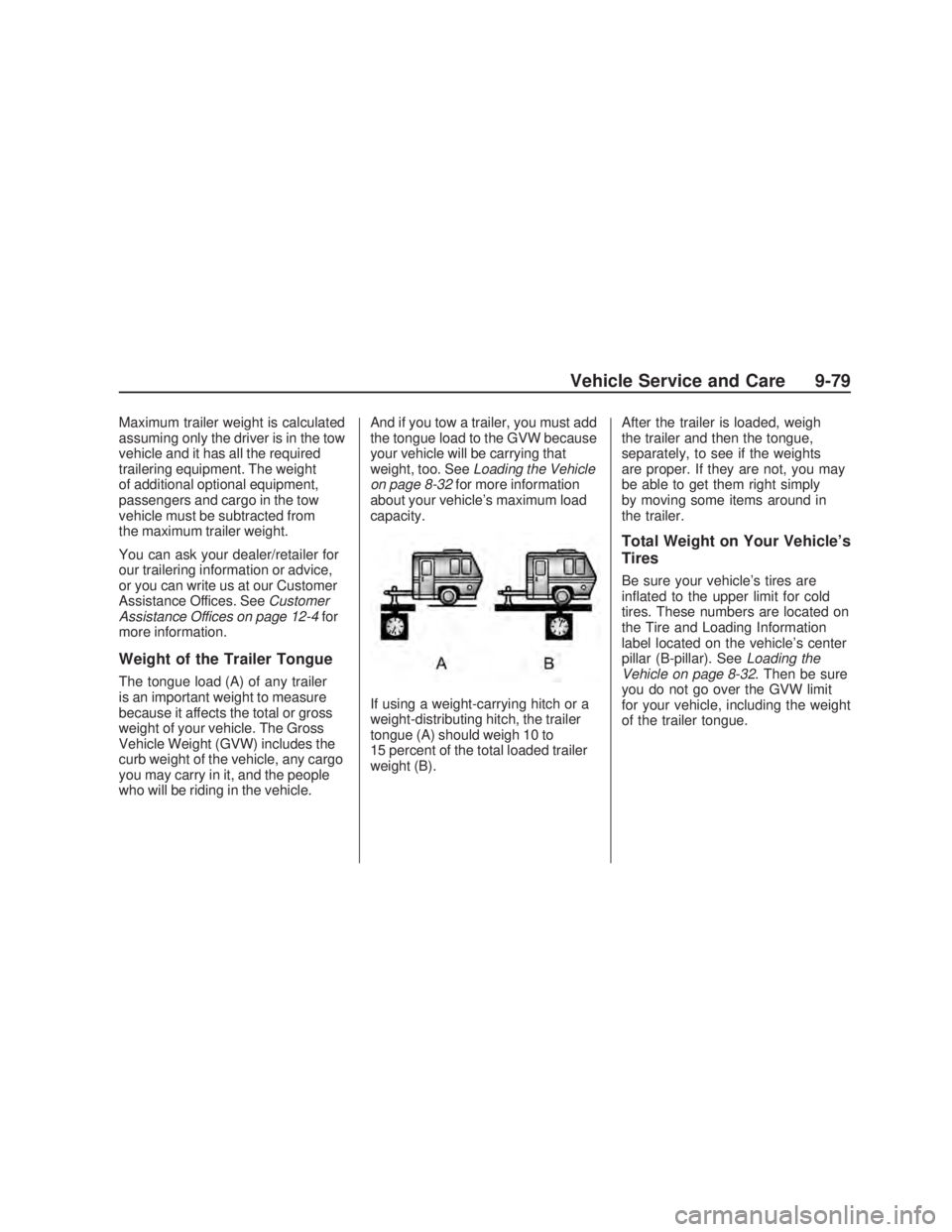
The tongue load (A) of any trailer
is an important weight to measure
because it affects the total or gross
weight of your vehicle. The Gross
Vehicle Weight (GVW) includes the
curb weight of the vehicle, any cargo
you may carry in it, and the people
who will be riding in the vehicle.And if you tow a trailer, you must add
the tongue load to the GVW because
your vehicle will be carrying that
weight, too. SeeLoading the Vehicle
on page 8-32for more information
about your vehicle’s maximum load
capacity.
If using a weight-carrying hitch or a
weight-distributing hitch, the trailer
tongue (A) should weigh 10 to
15 percent of the total loaded trailer
weight (B).After the trailer is loaded, weigh
the trailer and then the tongue,
separately, to see if the weights
are proper. If they are not, you may
be able to get them right simply
by moving some items around in
the trailer.
Total Weight on Your Vehicle’s
Tires
Be sure your vehicle’s tires are
inated to the upper limit for cold
tires. These numbers are located on
the Tire and Loading Information
label located on the vehicle’s center
pillar (B-pillar). SeeLoading the
Vehicle on page 8-32. Then be sure
you do not go over the GVW limit
for your vehicle, including the weight
of the trailer tongue.
Vehicle Service and Care 9-79
2009 - Pontiac Vibe Owner Manual
Page 252 of 318

Hitches
It is important to have the correct
hitch equipment. Crosswinds,
large trucks going by and rough
roads are a few reasons why
you will need the right hitch.
Here are some rules to follow:
Do not let the steel in a hitch
contact the aluminum on your
bumper because it can corrode.
Use something like paint or plastic
tape to separate the steel and
aluminum. The same steel to
aluminum problem can happen
with fasteners too.
Will you have to make any holes
in the body of your vehicle when
you install a trailer hitch? If you
do, then be sure to seal the holes
later when you remove the hitch.
If you do not seal them, deadly
carbon monoxide (CO) from the
exhaust can get into your vehicle.
See “Engine Exhaust” in the
Index. Dirt and water can too.
Safety Chains
You should always attach chains
between your vehicle and your
trailer. Cross the safety chains
under the tongue of the trailer
so that the tongue will not drop
to the road if it becomes separated
from the hitch. Instructions about
safety chains may be provided
by the hitch manufacturer or by
the trailer manufacturer. Follow the
manufacturer’s recommendation for
attaching safety chains and do not
attach them to the bumper. Leave
sufficient slack in the chain for turns.
Never allow safety chains to drag on
the ground.
Trailer Brakes
Does your trailer have its own
brakes?
Be sure to read and follow the
instructions for the trailer brakes so
you will be able to install, adjust and
maintain them properly. If you have
antilock brakes, do not tap into your
vehicle’s brake system. If you do,
both systems will not work well,
or at all.
Driving with a Trailer
Towing a trailer requires a certain
amount of experience. Get to know
the rig before setting out for the open
road. Acquaint yourself with the feel
of handling and braking with the
added weight of the trailer. And
always keep in mind that the vehicle
you are driving is now a good deal
longer and not nearly as responsive
as your vehicle is by itself.
Before you start, check the trailer
hitch, platform and attachments,
safety chains, electrical connector,
lamps, tires and mirror adjustment.
If the trailer has electric brakes, start
your vehicle and trailer moving and
then apply the trailer brake controller
by hand to be sure the brakes
are working. This lets you check
your electrical connection at the
same time.
During your trip, check occasionally
to be sure that the load is secure,
and that the lamps and any
trailer brakes are still working.
9-80 Vehicle Service and Care
2009 - Pontiac Vibe Owner Manual
Page 253 of 318

Following Distance
Stay at least twice as far behind the
vehicle ahead as you would when
driving your vehicle without a trailer.
This can help you avoid situations
that require heavy braking and
sudden turns.
Passing
More distance in front is needed to
pass when towing a trailer. And,
because the tow vehicle and trailer
are longer, you will need to go
farther beyond the passed vehicle
before you can return to your lane.
Backing Up
Hold the bottom of the steering
wheel with one hand. Then, to move
the trailer to the left, just move that
hand to the left. To move the trailer
to the right, move your hand to the
right. Always back up slowly and, if
possible, have someone guide you.
Making Turns
Notice:Making very sharp turns
while trailering could cause
the trailer to come in contact with
the vehicle. The vehicle could
be damaged. Avoid making very
sharp turns while trailering.
When you are turning with a trailer,
make wider turns than normal.
Do this so your trailer will not strike
soft shoulders, curbs, road signs,
trees or other objects. Avoid jerky or
sudden maneuvers. Signal well in
advance.
Turn Signals When Towing a
Trailer
When you tow a trailer, your vehicle
may need a different turn signal
asher and/or extra wiring. Check
with your dealer/retailer. The arrows
on the instrument panel ash
whenever you signal a turn or lane
change. Properly hooked up, the
trailer lamps also ash, telling other
drivers you are about to turn, change
lanes or stop.When towing a trailer, the arrows
on the instrument panel will ash for
turns even if the bulbs on the trailer
are burned out. Thus, you may think
drivers behind you are seeing your
signal when they are not. It is
important to check occasionally to be
sure the trailer bulbs are still working.
Driving On Grades
Reduce speed and shift to a lower
gearbeforeyou start down a long or
steep downgrade. If you do not shift
down, you might have to use your
brakes so much that they would get
hot and no longer work well.
On a long uphill grade, shift down
and reduce your speed to around
45 mph (70 km/h) to reduce the
possibility of the engine and the
transmission overheating.
Vehicle Service and Care 9-81
2009 - Pontiac Vibe Owner Manual
Page 254 of 318

Parking on Hills
{CAUTION
Parking the vehicle on a hill
with the trailer attached can be
dangerous. If something goes
wrong, the rig could start to move.
People can be injured, and both
the vehicle and the trailer can be
damaged. When possible, always
park the rig on a at surface.
To park your rig on a hill:
1. Apply your regular brakes, but
do not shift into P (Park) for an
automatic transmission or into
gear for a manual transmission,
yet. When parking uphill, turn
your wheels away from the curb.
When parking downhill, turn your
wheels into the curb.
2. Have someone place chocks
under the trailer wheels.3. When the chocks are in place,
release the regular brakes until
the chocks absorb the load.
4. Reapply the regular brakes.
Then apply your parking
brake and shift into P (Park)
for an automatic transmission
or R (Reverse) for a manual
transmission.
5. Release the regular brakes.
When You Are Ready to Leave
After Parking on a Hill
1. Apply your regular brakes and
hold the pedal down while you:
start your engine
shift the transmission
into gear
release the parking brake
2. Let up on the brake pedal.
3. Drive slowly until the trailer is
clear of the chocks.
4. Stop and have someone pick up
and store the chocks.
Maintenance When Trailer
Towing
Your vehicle will need service more
often when you are pulling a trailer.
See the Maintenance Schedule
for more on this. Things that are
especially important in trailer
operation are automatic transmission
uid (do not overll), engine oil, drive
belt, cooling system and brake
system. Each of these is covered in
this manual, and the Index will help
nd them quickly. If you are trailering,
it is a good idea to review this
information before starting your trip.
Check periodically to see that all
hitch nuts and bolts are tight.
Engine Cooling When Trailer
Towing
The cooling system could
temporarily overheat during severe
operating conditions. SeeEngine
Overheating on page 9-22.
9-82 Vehicle Service and Care
2009 - Pontiac Vibe Owner Manual
Page 274 of 318

❑Check restraint system. Make
sure the safety belt reminder
light and safety belt assemblies
are working properly. Look for
any other loose or damaged
safety belt system parts. If you
see anything that might keep
a safety belt system from
doing its job, have it repaired.
Have any torn or frayed safety
belts replaced. Also see
Airbag System Check on
page 1-35.
❑Replace passenger compartment
air lter.
❑Inspect fuel tank, cap, cap
gasket, and lines for damage
or leaks (or every 24 months,
whichever occurs rst). Replace
parts as needed.An Emission
Control Service. (See footnote †.)
❑Change manual transmission
uid every 30,000 miles
(48 000 km) only if your vehicle
is used to tow a trailer.35,000 Miles (56 000 km)
❑Change engine oil and lter
(or every 3 months, whichever
occurs rst).An Emission
Control Service.
❑Rotate tires. SeeTire Inspection
and Rotation on page 9-53for
proper rotation pattern and
additional information.
(See footnote +.)
❑Inspect engine air cleaner lter
if you are driving in dusty
conditions. Replace lter if
necessary.
40,000 Miles (64 000 km)
❑Change engine oil and lter
(or every 3 months, whichever
occurs rst).An Emission
Control Service.
❑Rotate tires. SeeTire Inspection
and Rotation on page 9-53for
proper rotation pattern and
additional information.
(See footnote +.)❑Inspect engine air cleaner lter
if you are driving in dusty
conditions. Replace lter if
necessary.
45,000 Miles (72 000 km)
❑Change engine oil and lter
(or every 3 months, whichever
occurs rst).An Emission
Control Service.
❑Rotate tires. SeeTire Inspection
and Rotation on page 9-53for
proper rotation pattern and
additional information.
(See footnote +.)
❑Inspect engine air cleaner lter
if you are driving in dusty
conditions. Replace lter if
necessary.
❑Inspect passenger compartment
air lter.
50,000 Miles (80 000 km)
❑Change engine oil and lter
(or every 3 months, whichever
occurs rst).An Emission
Control Service.
11-6 Service and Maintenance
2009 - Pontiac Vibe Owner Manual
Page 275 of 318

❑Rotate tires. SeeTire Inspection
and Rotation on page 9-53for
proper rotation pattern and
additional information.
(See footnote +.)
❑Inspect engine air cleaner lter
if you are driving in dusty
conditions. Replace lter if
necessary.
55,000 Miles (88 000 km)
❑Change engine oil and lter
(or every 3 months, whichever
occurs rst).An Emission
Control Service.
❑Rotate tires. SeeTire Inspection
and Rotation on page 9-53for
proper rotation pattern and
additional information.
(See footnote +.)
❑Inspect engine air cleaner lter
if you are driving in dusty
conditions. Replace lter if
necessary.
60,000 Miles (96 000 km)
❑Change engine oil and lter
(or every 3 months, whichever
occurs rst).An Emission
Control Service.
❑Rotate tires. SeeTire Inspection
and Rotation on page 9-53for
proper rotation pattern and
additional information.
(See footnote +.)
❑Replace engine air cleaner lter
(or every 24 months, whichever
occurs rst). SeeEngine Air
Cleaner/Filter on page 9-12
for more information.
❑Check restraint system. Make
sure the safety belt reminder
light and safety belt assemblies
are working properly. Look for
any other loose or damaged
safety belt system parts. If you
see anything that might keep
a safety belt system from
doing its job, have it repaired.
Have any torn or frayed safety
belts replaced. Also seeAirbag
System Check on page 1-35.❑Replace passenger compartment
air lter.
❑Inspect engine accessory drive
belts (or every 48 months,
whichever occurs rst). Visually
inspect belt for fraying, excessive
cracks, or obvious damage.
Replace belt if necessary.
An Emission Control Service.
❑Inspect for tappet noise and
engine vibration. Adjust valve
clearance to factory specications
if necessary (or every 48 months,
whichever occurs rst).
An Emission Control Service.
❑Inspect fuel tank, cap, cap gasket,
and lines for damage or leaks
(or every 24 months, whichever
occurs rst). Replace parts as
needed.An Emission Control
Service. (See footnote †.)
❑Change manual transmission uid
every 30,000 miles (48 000 km)
only if your vehicle is used to tow
a trailer.
Service and Maintenance 11-7
2009 - Pontiac Vibe Owner Manual
Page 276 of 318

❑Change automatic transmission
uid every 60,000 miles
(96 000 km) if the vehicle is
mainly driven under one or more
of these conditions:
In heavy city traffic where the
outside temperature regularly
reaches 90°F (32°C) or higher.
In hilly or mountainous terrain.
When doing frequent trailer
towing.
Uses such as found in taxi,
police, or delivery service.
If you do not use your vehicle
under any of these conditions, the
fluid does not require changing.
See Part D: Recommended Fluids
and Lubricants on page 11-18
for the proper uid to use.
65,000 Miles 104 000 km)
❑Change engine oil and lter
(or every 3 months, whichever
occurs rst).An Emission
Control Service.❑Rotate tires. SeeTire Inspection
and Rotation on page 9-53for
proper rotation pattern and
additional information.
(See footnote +.)
❑Inspect engine air cleaner lter
if you are driving in dusty
conditions. Replace lter if
necessary.
70,000 Miles (112 000 km)
❑Change engine oil and lter
(or every 3 months, whichever
occurs rst).An Emission
Control Service.
❑Rotate tires. SeeTire Inspection
and Rotation on page 9-53
for proper rotation pattern
and additional information.
(See footnote +.)
❑Inspect engine air cleaner lter
if you are driving in dusty
conditions. Replace lter if
necessary.
75,000 Miles (120 000 km)
❑Change engine oil and lter
(or every 3 months, whichever
occurs rst).An Emission
Control Service.
❑Rotate tires. SeeTire Inspection
and Rotation on page 9-53for
proper rotation pattern and
additional information.
(See footnote +.)
❑Inspect engine air cleaner lter
if you are driving in dusty
conditions. Replace lter if
necessary.
❑Inspect passenger compartment
air lter.
❑Inspect engine accessory drive
belts (or 12 months since last
inspection).An Emission
Control Service.
80,000 Miles (128 000 km)
❑Change engine oil and lter
(or every 3 months, whichever
occurs rst).An Emission
Control Service.
11-8 Service and Maintenance
2009 - Pontiac Vibe Owner Manual
Page 277 of 318

❑Rotate tires. SeeTire Inspection
and Rotation on page 9-53
for proper rotation pattern
and additional information.
(See footnote +.)
❑Inspect engine air cleaner lter
if you are driving in dusty
conditions. Replace lter if
necessary.
85,000 Miles (136 000 km)
❑Change engine oil and lter
(or every 3 months, whichever
occurs rst).An Emission
Control Service.
❑Rotate tires. SeeTire Inspection
and Rotation on page 9-53
for proper rotation pattern
and additional information.
(See footnote +.)
❑Inspect engine air cleaner lter
if you are driving in dusty
conditions. Replace lter if
necessary.
90,000 Miles (144 000 km)
❑Change engine oil and lter
(or every 3 months, whichever
occurs rst).An Emission
Control Service.
❑Rotate tires. SeeTire Inspection
and Rotation on page 9-53for
proper rotation pattern and
additional information.
(See footnote +.)
❑Replace engine air cleaner lter
(or every 24 months, whichever
occurs rst). SeeEngine Air
Cleaner/Filter on page 9-12
for more information.
❑Check restraint system. Make
sure the safety belt reminder
light and safety belt assemblies
are working properly. Look for
any other loose or damaged
safety belt system parts. If you
see anything that might keepa safety belt system from
doing its job, have it repaired.
Have any torn or frayed
safety belts replaced. Also
seeAirbag System Check on
page 1-35.
❑Replace passenger compartment
air lter.
❑Inspect engine accessory drive
belts (or 12 months since last
inspection).An Emission
Control Service.
❑Inspect fuel tank, cap, cap
gasket, and lines for damage
or leaks (or every 24 months,
whichever occurs rst). Replace
parts as needed.An Emission
Control Service. (See footnote †.)
❑Change manual transmission
uid every 30,000 miles
(48 000 km) only if your vehicle
is used to tow a trailer.
Service and Maintenance 11-9
2009 - Pontiac Vibe Owner Manual