2009 PONTIAC VIBE automatic transmission
[x] Cancel search: automatic transmissionPage 243 of 318

Jump Starting
If your vehicle’s battery has run
down, you may want to use another
vehicle and some jumper cables
to start your vehicle. Be sure to use
the following steps to do it safely.
{CAUTION
Batteries can hurt you. They can
be dangerous because:
They contain acid that can
burn you.
They contain gas that can
explode or ignite.
They contain enough
electricity to burn you.
If you do not follow these steps
exactly, some or all of these
things can hurt you.Notice:Ignoring these steps
could result in costly damage
to your vehicle that would not
be covered by your warranty.
Trying to start your vehicle
by pushing or pulling it will
not work, and it could damage
your vehicle.
1. Check the other vehicle. It must
have a 12-volt battery with a
negative ground system.
Notice:If the other vehicle’s
system is not a 12-volt system
with a negative ground, both
vehicles can be damaged. Only
use vehicles with 12-volt systems
with negative grounds to jump
start your vehicle.
2. Get the vehicles close enough
so the jumper cables can reach,
but be sure the vehicles are not
touching each other. If they are, it
could cause a ground connection
you do not want. You would not
be able to start your vehicle, and
the bad grounding could damage
the electrical systems.To avoid the possibility of the
vehicles rolling, set the parking
brake rmly on both vehicles
involved in the jump start
procedure. Put an automatic
transmission in P (Park) or
a manual transmission in
NEUTRAL before setting
the parking brake.
Notice:If you leave the radio
or other accessories on during
the jump starting procedure, they
could be damaged. The repairs
would not be covered by the
warranty. Always turn off
the radio and other accessories
when jump starting the vehicle.
3. Turn off the ignition on both
vehicles. Unplug unnecessary
accessories plugged into the
cigarette lighter. Turn off the radio
and all lamps that are not needed.
This will avoid sparks and help
save both batteries. And it could
save the radio!
Vehicle Service and Care 9-71
2009 - Pontiac Vibe Owner Manual
Page 247 of 318

Towing
Towing Your Vehicle
To avoid damage, the disabled
vehicle should be towed with all
four wheels off the ground. Consult
your dealer/retailer or a professional
towing service if the disabled vehicle
must be towed. SeeRoadside
Assistance Program on page 12-5.
To tow the vehicle behind another
vehicle for recreational purposes
(such as behind a motorhome),
see “Recreational Vehicle Towing”
following.
Recreational Vehicle
Towing
Recreational vehicle towing means
towing your vehicle behind another
vehicle – such as behind a
motorhome. The two most common
types of recreational vehicle towingare known as “dinghy towing” (towing
your vehicle with all four wheels on
the ground) and “dolly towing”
(towing your vehicle with two wheels
on the ground and two wheels up on
a device known as a “dolly”).
With the proper preparation and
equipment, many vehicles can be
towed in these ways. See “Dinghy
Towing” and “Dolly Towing,”
following.
Here are some important things to
consider before you do recreational
vehicle towing:
What is the towing capacity
of the towing vehicle?
Be sure you read the tow
vehicle manufacturer’s
recommendations.
How far will you tow? Some
vehicles have restrictions on how
far and how long they can tow.
Do you have the proper towing
equipment? See your dealer/
retailer or trailering professional
for additional advice and
equipment recommendations.
Is your vehicle ready to be towed?
Just as you would prepare your
vehicle for a long trip, you will
want to make sure your vehicle
is prepared to be towed. See
“Before Leaving On A Long Trip”
in the Index.
Dinghy Towing
If your vehicle has an automatic
transmission, it cannot be dinghy
towed. See “Dolly Towing” for
more information regarding
towing your vehicle.
If your vehicle has a manual
transmission, it can be dinghy
towed.
Vehicle Service and Care 9-75
2009 - Pontiac Vibe Owner Manual
Page 248 of 318

When dinghy towing, be sure to
follow the posted legal speed limit.
1. Put the shift lever in Neutral.
2. Turn the ignition to
ACC/ACCESSORY to avoid
locking the steering wheel.
Make sure the audio system
is turned off and that nothing is
plugged into the power outlets.
3. Release the parking brake.
After dinghy towing, let the engine
idle for more than three minutes
before driving the vehicle.Do not tow your vehicle from
the rear. Your vehicle could be badly
damaged and the repairs would
not be covered by your warranty.
Dolly Towing
(All-Wheel-Drive Vehicles)
All-wheel-drive vehicles must not
be towed with two wheels on the
ground. To properly tow these
vehicles, they should be placed
on a platform trailer with all four
wheels off of the ground.
Dolly Towing
(Front-Wheel-Drive
Vehicles Only)
To tow your front-wheel-drive
vehicle using a dolly, follow
these steps:
1. Put the front wheels on a dolly.
2. Move the shift lever to P (Park)
for an automatic transmission
or Neutral for a manual
transmission.
3. Set the parking brake.
9-76 Vehicle Service and Care
2009 - Pontiac Vibe Owner Manual
Page 254 of 318

Parking on Hills
{CAUTION
Parking the vehicle on a hill
with the trailer attached can be
dangerous. If something goes
wrong, the rig could start to move.
People can be injured, and both
the vehicle and the trailer can be
damaged. When possible, always
park the rig on a at surface.
To park your rig on a hill:
1. Apply your regular brakes, but
do not shift into P (Park) for an
automatic transmission or into
gear for a manual transmission,
yet. When parking uphill, turn
your wheels away from the curb.
When parking downhill, turn your
wheels into the curb.
2. Have someone place chocks
under the trailer wheels.3. When the chocks are in place,
release the regular brakes until
the chocks absorb the load.
4. Reapply the regular brakes.
Then apply your parking
brake and shift into P (Park)
for an automatic transmission
or R (Reverse) for a manual
transmission.
5. Release the regular brakes.
When You Are Ready to Leave
After Parking on a Hill
1. Apply your regular brakes and
hold the pedal down while you:
start your engine
shift the transmission
into gear
release the parking brake
2. Let up on the brake pedal.
3. Drive slowly until the trailer is
clear of the chocks.
4. Stop and have someone pick up
and store the chocks.
Maintenance When Trailer
Towing
Your vehicle will need service more
often when you are pulling a trailer.
See the Maintenance Schedule
for more on this. Things that are
especially important in trailer
operation are automatic transmission
uid (do not overll), engine oil, drive
belt, cooling system and brake
system. Each of these is covered in
this manual, and the Index will help
nd them quickly. If you are trailering,
it is a good idea to review this
information before starting your trip.
Check periodically to see that all
hitch nuts and bolts are tight.
Engine Cooling When Trailer
Towing
The cooling system could
temporarily overheat during severe
operating conditions. SeeEngine
Overheating on page 9-22.
9-82 Vehicle Service and Care
2009 - Pontiac Vibe Owner Manual
Page 264 of 318

Capacities and Specications
The following approximate capacities are given in English and metric conversions. Please refer toPart D:
Recommended Fluids and Lubricants on page 11-18 for more information.
Application Capacities
English Metric
Air Conditioning Refrigerant R134a For the air conditioning system refrigerant charge
amount, see the refrigerant caution label located
under the hood. See your dealer/retailer for more information.
Cooling System 1.8L L4 Engine 5.8 qt5.5 L
2.4L L4 Engine 6.0 qt5.7 L
Engine Oil with Filter 1.8L L4 Engine 4.4 qt4.2 L
2.4L L4 Engine 4.5 qt4.3 L
Fuel Tank 13.2 gal50 L
Transmission, Automatic (Complete Drain and Rell) 1.8L L4 Engine 3.1 qt2.9 L
2.4L L4 Engine 3.7 qt3.5 L
10-2 Technical Data
2009 - Pontiac Vibe Owner Manual
Page 265 of 318

ApplicationCapacities
English Metric
Transmission, Manual (Complete Drain and Rell) 1.8L L4 Engine 2.0 qt 1.9 L
2.4L L4 Engine 2.6 qt 2.5 L
Wheel Nut Torque 76 lb ft 103 Y
All capacities are approximate. When adding, be sure to ll to the approximate level, as recommended in this
manual.
Engine Specications
Engine VIN CodeTransmission Spark Plug Gap
1.8L L4 8Automatic
Manual 0.043 in (1.10 mm)
2.4L L4 0Automatic
Manual 0.043 in (1.10 mm)
Technical Data 10-3
2009 - Pontiac Vibe Owner Manual
Page 276 of 318

❑Change automatic transmission
uid every 60,000 miles
(96 000 km) if the vehicle is
mainly driven under one or more
of these conditions:
In heavy city traffic where the
outside temperature regularly
reaches 90°F (32°C) or higher.
In hilly or mountainous terrain.
When doing frequent trailer
towing.
Uses such as found in taxi,
police, or delivery service.
If you do not use your vehicle
under any of these conditions, the
fluid does not require changing.
See Part D: Recommended Fluids
and Lubricants on page 11-18
for the proper uid to use.
65,000 Miles 104 000 km)
❑Change engine oil and lter
(or every 3 months, whichever
occurs rst).An Emission
Control Service.❑Rotate tires. SeeTire Inspection
and Rotation on page 9-53for
proper rotation pattern and
additional information.
(See footnote +.)
❑Inspect engine air cleaner lter
if you are driving in dusty
conditions. Replace lter if
necessary.
70,000 Miles (112 000 km)
❑Change engine oil and lter
(or every 3 months, whichever
occurs rst).An Emission
Control Service.
❑Rotate tires. SeeTire Inspection
and Rotation on page 9-53
for proper rotation pattern
and additional information.
(See footnote +.)
❑Inspect engine air cleaner lter
if you are driving in dusty
conditions. Replace lter if
necessary.
75,000 Miles (120 000 km)
❑Change engine oil and lter
(or every 3 months, whichever
occurs rst).An Emission
Control Service.
❑Rotate tires. SeeTire Inspection
and Rotation on page 9-53for
proper rotation pattern and
additional information.
(See footnote +.)
❑Inspect engine air cleaner lter
if you are driving in dusty
conditions. Replace lter if
necessary.
❑Inspect passenger compartment
air lter.
❑Inspect engine accessory drive
belts (or 12 months since last
inspection).An Emission
Control Service.
80,000 Miles (128 000 km)
❑Change engine oil and lter
(or every 3 months, whichever
occurs rst).An Emission
Control Service.
11-8 Service and Maintenance
2009 - Pontiac Vibe Owner Manual
Page 279 of 318
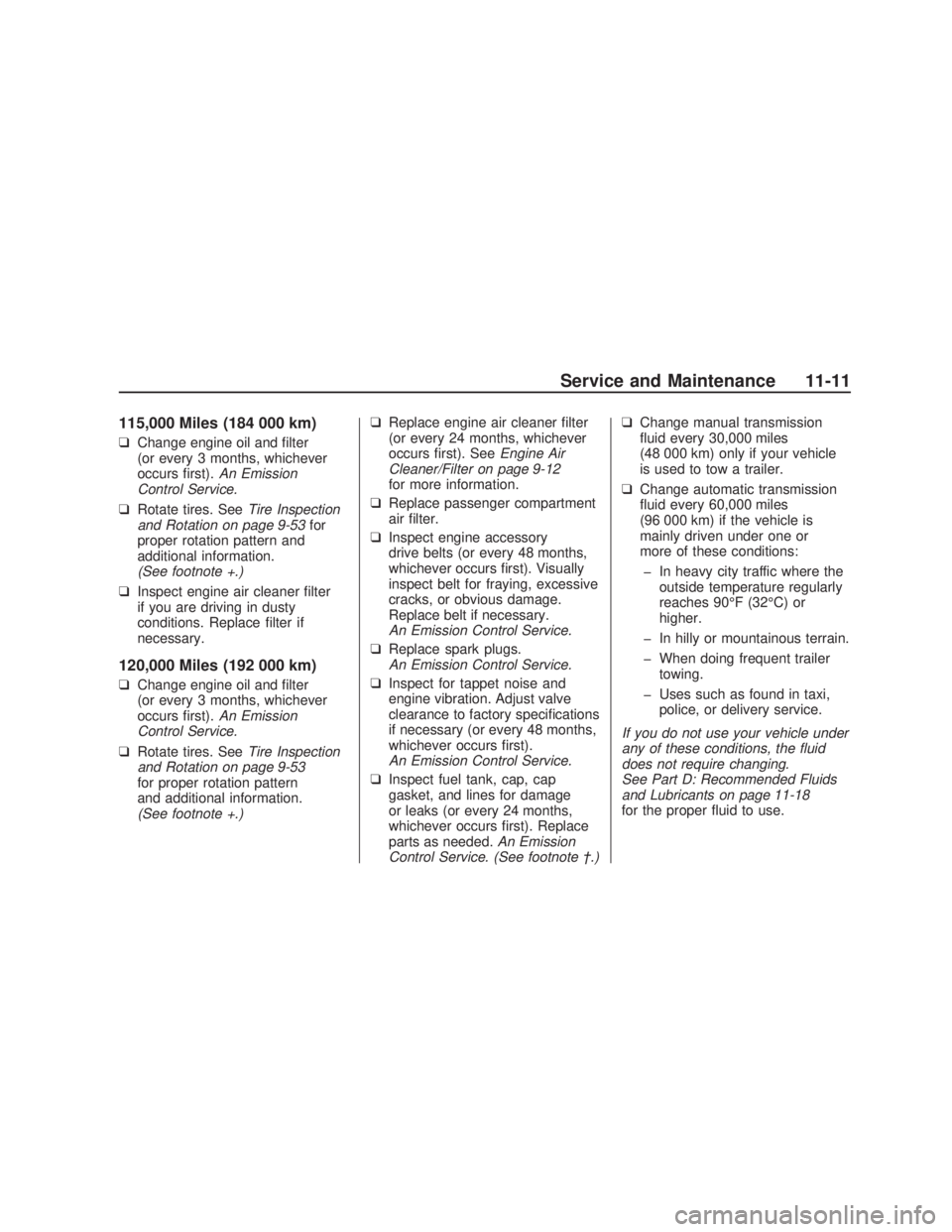
115,000 Miles (184 000 km)
❑Change engine oil and lter
(or every 3 months, whichever
occurs rst).An Emission
Control Service.
❑Rotate tires. SeeTire Inspection
and Rotation on page 9-53for
proper rotation pattern and
additional information.
(See footnote +.)
❑Inspect engine air cleaner lter
if you are driving in dusty
conditions. Replace lter if
necessary.
120,000 Miles (192 000 km)
❑Change engine oil and lter
(or every 3 months, whichever
occurs rst).An Emission
Control Service.
❑Rotate tires. SeeTire Inspection
and Rotation on page 9-53
for proper rotation pattern
and additional information.
(See footnote +.)❑Replace engine air cleaner lter
(or every 24 months, whichever
occurs rst). SeeEngine Air
Cleaner/Filter on page 9-12
for more information.
❑Replace passenger compartment
air lter.
❑Inspect engine accessory
drive belts (or every 48 months,
whichever occurs rst). Visually
inspect belt for fraying, excessive
cracks, or obvious damage.
Replace belt if necessary.
An Emission Control Service.
❑Replace spark plugs.
An Emission Control Service.
❑Inspect for tappet noise and
engine vibration. Adjust valve
clearance to factory specications
if necessary (or every 48 months,
whichever occurs rst).
An Emission Control Service.
❑Inspect fuel tank, cap, cap
gasket, and lines for damage
or leaks (or every 24 months,
whichever occurs rst). Replace
parts as needed.An Emission
Control Service. (See footnote †.)❑Change manual transmission
uid every 30,000 miles
(48 000 km) only if your vehicle
is used to tow a trailer.
❑Change automatic transmission
uid every 60,000 miles
(96 000 km) if the vehicle is
mainly driven under one or
more of these conditions:
In heavy city traffic where the
outside temperature regularly
reaches 90°F (32°C) or
higher.
In hilly or mountainous terrain.
When doing frequent trailer
towing.
Uses such as found in taxi,
police, or delivery service.
If you do not use your vehicle under
any of these conditions, the fluid
does not require changing.
See Part D: Recommended Fluids
and Lubricants on page 11-18
for the proper uid to use.
Service and Maintenance 11-11
2009 - Pontiac Vibe Owner Manual