Page 231 of 318

Wheel Replacement
Replace any wheel that is bent,
cracked or badly rusted or corroded.
If wheel nuts keep coming loose,
the wheel, wheel bolts and wheel
nuts should be replaced. If the
wheel leaks air, replace it (except
some aluminum wheels, which can
sometimes be repaired). See your
dealer/retailer if any of these
conditions exist.
Your dealer/retailer will know the
kind of wheel you need.
Each new wheel should have
the same load-carrying capacity,
diameter, width, offset and be
mounted the same way as the
one it replaces.If you need to replace any of the
wheels, wheel bolts or wheel
nuts, replace them only with new
GM original equipment parts.
This way, you will be sure to have
the right wheel, wheel bolts and
wheel nuts for the vehicle.
{CAUTION
Using the wrong replacement
wheels, wheel bolts, or wheel
nuts on your vehicle can be
dangerous. It could affect the
braking and handling of your
vehicle, make your tires lose
air and make you lose control.
You could have a collision in
which you or others could be
injured. Always use the correct
wheel, wheel bolts, and wheel
nuts for replacement.Notice:The wrong wheel can
also cause problems with bearing
life, brake cooling, speedometer
or odometer calibration, headlamp
aim, bumper height, vehicle
ground clearance, and tire or tire
chain clearance to the body and
chassis.
SeeChanging a Flat Tire on
page 9-62for more information.Used Replacement Wheels
{CAUTION
Putting a used wheel on the
vehicle is dangerous. You cannot
know how it has been used
or how far it has been driven.
It could fail suddenly and cause
a crash. If you have to replace a
wheel, use a new GM original
equipment wheel.
Vehicle Service and Care 9-59
2009 - Pontiac Vibe Owner Manual
Page 249 of 318

4. Clamp the steering wheel in a
straight-ahead position with a
clamping device designed
for towing.
5. Remove the key from the
ignition.
6. Secure the vehicle to the dolly.
7. Release the parking brake.
Towing a Trailer
{CAUTION
The driver can lose control when
pulling a trailer if the correct
equipment is not used or the
vehicle is not driven properly.
For example, if the trailer is too
heavy, the brakes may not work
well or even at all. The driver and
passengers could be seriously
(Continued)
CAUTION (Continued)
injured. The vehicle may also be
damaged; the resulting repairs
would not be covered by the
vehicle warranty. Pull a trailer only
if all the steps in this section have
been followed. Ask your
dealer/retailer for advice and
information about towing a trailer
with the vehicle.
Your vehicle can tow a trailer if it
is equipped with the proper trailer
towing equipment. To identify the
vehicle trailering capacity of your
vehicle, you should read the
information in “Weight of the Trailer”
that appears later in this section.
Trailering is different than just driving
your vehicle by itself. Trailering
means changes in handling,acceleration, braking, durability and
fuel economy. Successful, safe
trailering takes correct equipment,
and it has to be used properly.
That is the reason for this part.
In it are many time-tested, important
trailering tips and safety rules. Many
of these are important for your safety
and that of your passengers.
So please read this section
carefully before you pull a trailer.
Load-pulling components such as
the engine, transmission, wheel
assemblies and tires are forced to
work harder against the drag of
the added weight. The engine
is required to operate at relatively
higher speeds and under greater
loads, generating extra heat.
In addition, the trailer adds
considerably to wind resistance,
increasing the pulling requirements.
Vehicle Service and Care 9-77
2009 - Pontiac Vibe Owner Manual
Page 251 of 318
Maximum trailer weight is calculated
assuming only the driver is in the tow
vehicle and it has all the required
trailering equipment. The weight
of additional optional equipment,
passengers and cargo in the tow
vehicle must be subtracted from
the maximum trailer weight.
You can ask your dealer/retailer for
our trailering information or advice,
or you can write us at our Customer
Assistance Offices. SeeCustomer
Assistance Offices on page 12-4for
more information.
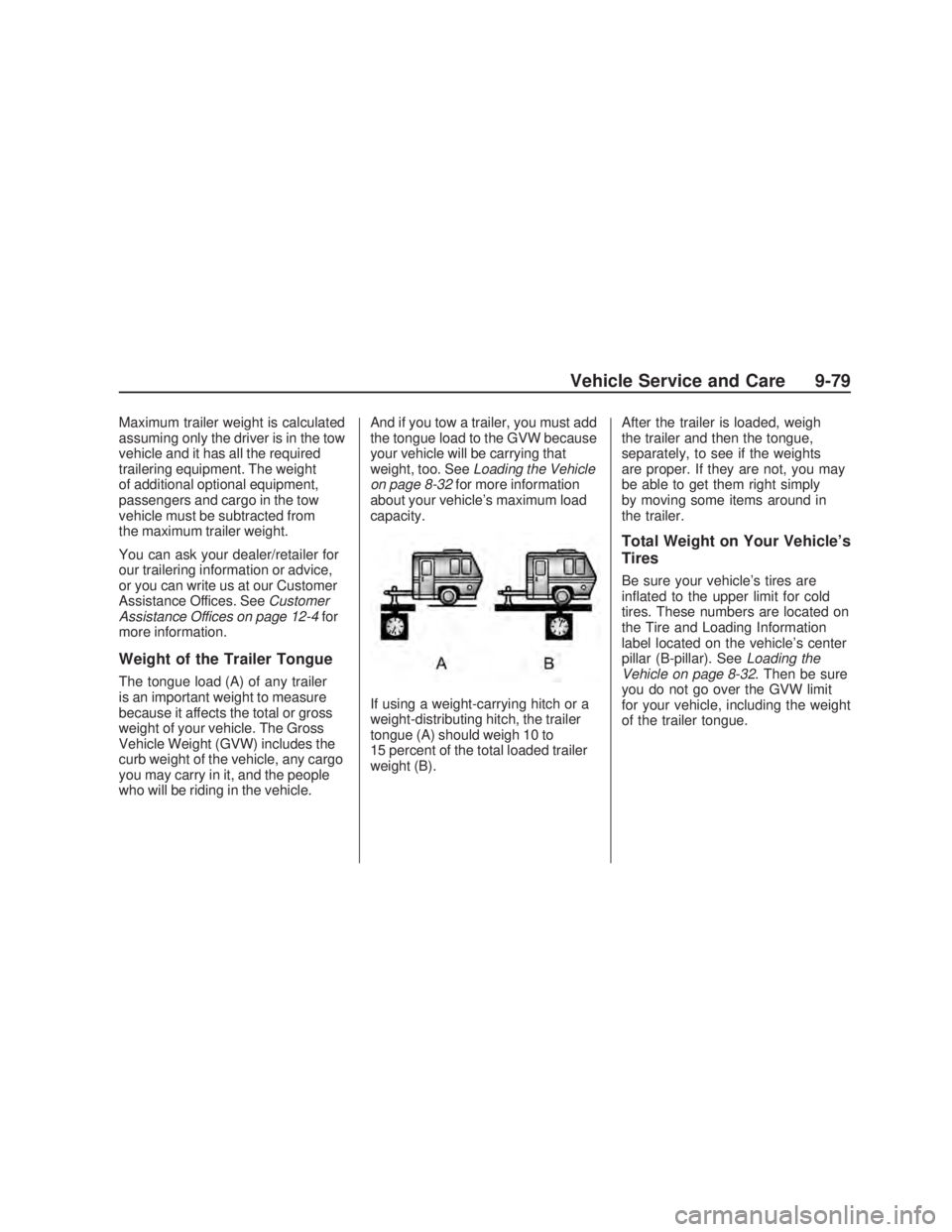
Weight of the Trailer Tongue
The tongue load (A) of any trailer
is an important weight to measure
because it affects the total or gross
weight of your vehicle. The Gross
Vehicle Weight (GVW) includes the
curb weight of the vehicle, any cargo
you may carry in it, and the people
who will be riding in the vehicle.And if you tow a trailer, you must add
the tongue load to the GVW because
your vehicle will be carrying that
weight, too. SeeLoading the Vehicle
on page 8-32for more information
about your vehicle’s maximum load
capacity.
If using a weight-carrying hitch or a
weight-distributing hitch, the trailer
tongue (A) should weigh 10 to
15 percent of the total loaded trailer
weight (B).After the trailer is loaded, weigh
the trailer and then the tongue,
separately, to see if the weights
are proper. If they are not, you may
be able to get them right simply
by moving some items around in
the trailer.
Total Weight on Your Vehicle’s
Tires
Be sure your vehicle’s tires are
inated to the upper limit for cold
tires. These numbers are located on
the Tire and Loading Information
label located on the vehicle’s center
pillar (B-pillar). SeeLoading the
Vehicle on page 8-32. Then be sure
you do not go over the GVW limit
for your vehicle, including the weight
of the trailer tongue.
Vehicle Service and Care 9-79
2009 - Pontiac Vibe Owner Manual