2009 PONTIAC G8 lock
[x] Cancel search: lockPage 286 of 356
Storing a Flat or Spare
Tire and Tools
{CAUTION
Storing a jack, a tire, or other
equipment in the passenger
compartment of the vehicle could
cause injury. In a sudden stop or
collision, loose equipment could
strike someone. Store all these in
the proper place.To store a at or spare tire and
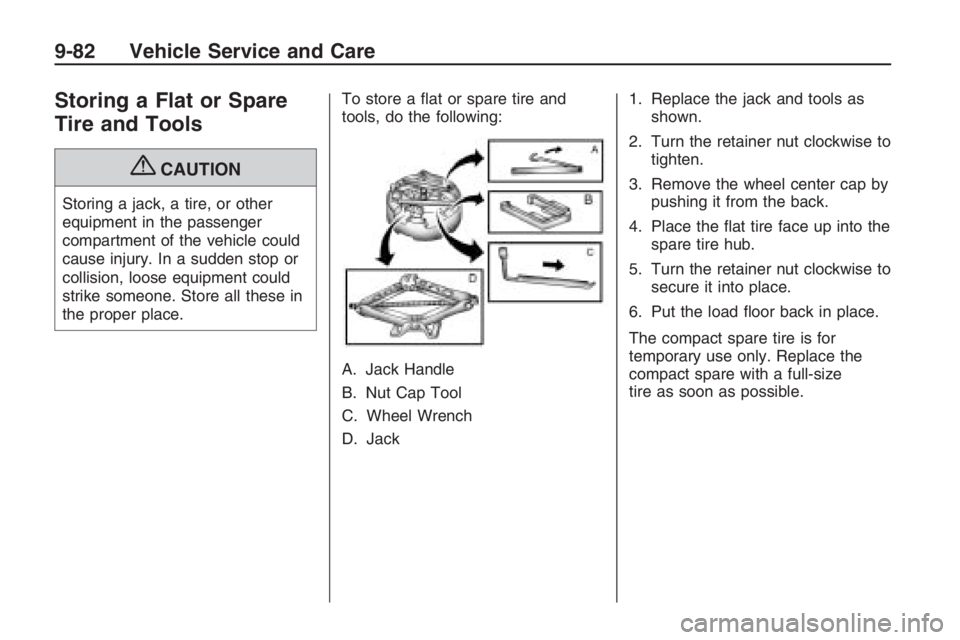
tools, do the following:
A. Jack Handle
B. Nut Cap Tool
C. Wheel Wrench
D. Jack1. Replace the jack and tools as
shown.
2. Turn the retainer nut clockwise to
tighten.
3. Remove the wheel center cap by
pushing it from the back.
4. Place the at tire face up into the
spare tire hub.
5. Turn the retainer nut clockwise to
secure it into place.
6. Put the load oor back in place.
The compact spare tire is for
temporary use only. Replace the
compact spare with a full-size
tire as soon as possible.
9-82 Vehicle Service and Care
Page 290 of 356

Notice:If you leave the radio or
other accessories on during
the jump starting procedure, they
could be damaged. The repairs
would not be covered by the
warranty. Always turn off
the radio and other accessories
when jump starting the vehicle.
4. Turn the ignition to LOCK/OFF
and switch off all lights and
accessories in both vehicles,
except the hazard warning
ashers if needed.
{CAUTION
An electric fan can start up even
when the engine is not running
and can injure you. Keep hands,
clothing and tools away from any
underhood electric fan.
{CAUTION
Using a match near a battery can
cause battery gas to explode.
People have been hurt doing this,
and some have been blinded. Use
a ashlight if you need more light.
Be sure the battery has enough
water. You do not need to add
water to the battery installed in
your new vehicle. But if a battery
has ller caps, be sure the right
amount of uid is there. If it is
low, add water to take care of that
rst. If you don’t, explosive gas
could be present.
Battery uid contains acid that
can burn you. Do not get it on
you. If you accidentally get it in
your eyes or on your skin, ush
the place with water and get
medical help immediately.
{CAUTION
Fans or other moving engine
parts can injure you badly. Keep
your hands away from moving
parts once the engine is running.
5. Connect one end of the red
positive (+) cable to the jump
start positive (+) post (A).
9-86 Vehicle Service and Care
Page 292 of 356

Towing
Towing Your Vehicle
To avoid damage, the disabled
vehicle should be towed with all four
wheels off the ground. Consult your
dealer/retailer or a professional
towing service if the disabled vehicle
must be towed. SeeRoadside
Assistance Program on page 12-6.
Shift Lock Manual
Release
The transmission has an electric
park lock called a shift lock manual
release. The key must be in the
ON/RUN position, and the brake
pedal pressed so the transmission
gear selector can be moved from the
P (Park) position. If the battery
has lost power, the selector cannot
be moved to neutral for towing
unless the shift lock manual release
is disengaged manually.To access the shift lock manual
release:
1. Apply the park brake.
2. Remove the console trim
panel (A) from the console.
2.1. Gently lift the back corners
of the trim panel directly in
front of the cupholders (C)
until the two clips are
released from the console.
2.2. Gently lift the console trim
panel from the rear until the
four clips around the shift
lever are released.
3. Raise the panel (A) no more
than 2–3 inches (50–75 mm)
to avoid disconnecting the wiring
from the switches (B).
4. With the console trim panel
raised, remove the retainer (E)
and the shift lock manual release
cover plate (D).
5. Push and hold the manual
release lever (F) toward the
passenger side of the vehicle.
9-88 Vehicle Service and Care
Page 293 of 356
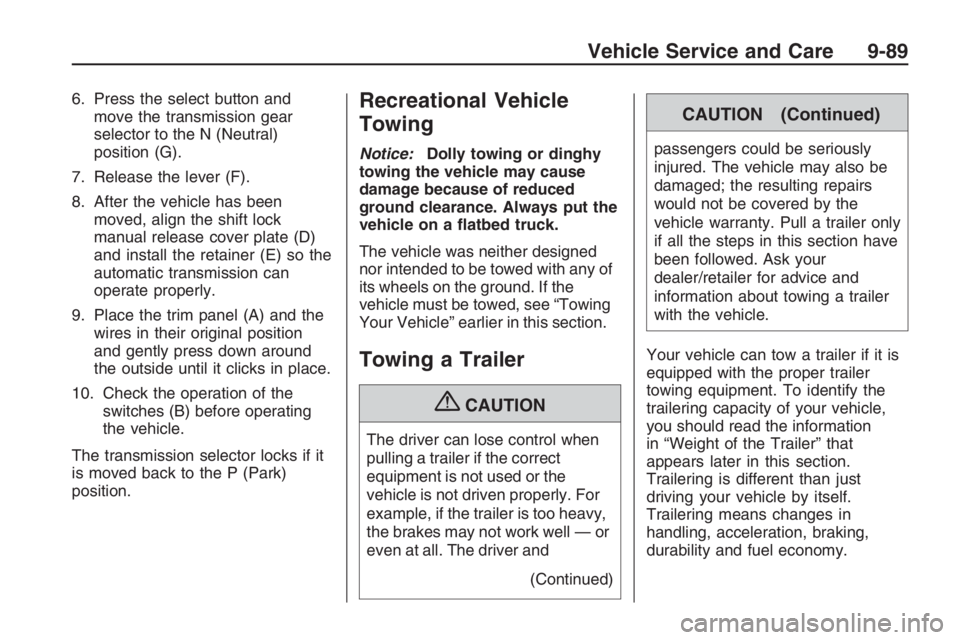
6. Press the select button and
move the transmission gear
selector to the N (Neutral)
position (G).
7. Release the lever (F).
8. After the vehicle has been
moved, align the shift lock
manual release cover plate (D)
and install the retainer (E) so the
automatic transmission can
operate properly.
9. Place the trim panel (A) and the
wires in their original position
and gently press down around
the outside until it clicks in place.
10. Check the operation of the
switches (B) before operating
the vehicle.
The transmission selector locks if it
is moved back to the P (Park)
position.Recreational Vehicle
Towing
Notice:Dolly towing or dinghy
towing the vehicle may cause
damage because of reduced
ground clearance. Always put the
vehicle on a atbed truck.
The vehicle was neither designed
nor intended to be towed with any of
its wheels on the ground. If the
vehicle must be towed, see “Towing
Your Vehicle” earlier in this section.
Towing a Trailer
{CAUTION
The driver can lose control when
pulling a trailer if the correct
equipment is not used or the
vehicle is not driven properly. For
example, if the trailer is too heavy,
the brakes may not work well — or
even at all. The driver and
(Continued)
CAUTION (Continued)
passengers could be seriously
injured. The vehicle may also be
damaged; the resulting repairs
would not be covered by the
vehicle warranty. Pull a trailer only
if all the steps in this section have
been followed. Ask your
dealer/retailer for advice and
information about towing a trailer
with the vehicle.
Your vehicle can tow a trailer if it is
equipped with the proper trailer
towing equipment. To identify the
trailering capacity of your vehicle,
you should read the information
in “Weight of the Trailer” that
appears later in this section.
Trailering is different than just
driving your vehicle by itself.
Trailering means changes in
handling, acceleration, braking,
durability and fuel economy.
Vehicle Service and Care 9-89
Page 296 of 356

Total Weight on Your Vehicle’s
Tires
Be sure your vehicle’s tires are
inated to the upper limit for cold
tires. You will nd these numbers on
the Tire-Loading Information label.
SeeLoading the Vehicle on
page 8-30. Then be sure you do not
go over the GVW limit for your
vehicle, including the weight of the
trailer tongue.
Hitches
It is important to have the correct
hitch equipment. Crosswinds,
large trucks going by and rough
roads are a few reasons why
you will need the right hitch. Here
are some rules to follow:
The rear bumper on your vehicle
is not intended for hitches. Do not
attach rental hitches or other
bumper-type hitches to it. Use
only a frame-mounted hitch that
does not attach to the bumper.
Will you have to make any holes
in the body of your vehicle when
you install a trailer hitch? If you
do, then be sure to seal the holes
later when you remove the hitch.
If you do not seal them, deadly
carbon monoxide (CO) from your
exhaust can get into your vehicle.
SeeEngine Exhaust on
page 8-14. Dirt and water can
also enter the vehicle.
Safety Chains
You should always attach chains
between your vehicle and your
trailer. Cross the safety chains under
the tongue of the trailer so that the
tongue will not drop to the road if it
becomes separated from the hitch.
Instructions about safety chains may
be provided by the hitch
manufacturer or by the trailer
manufacturer. Follow the
manufacturer’s recommendation for
attaching safety chains and do not
attach them to the bumper. Alwaysleave just enough slack so you can
turn with your rig. And, never allow
safety chains to drag on the ground.
Trailer Brakes
Does your trailer have its own
brakes? Be sure to read and follow
the instructions for the trailer
brakes so you will be able to install,
adjust and maintain them properly.
Because you have anti-lock brakes,
do not tap into your vehicle’s brake
system. If you do, both brake
systems will not work well, or at all.
Trailer Wiring Harness
All of the electrical circuits required
for your trailer lighting system can be
accessed at the driver’s side rear
lamp connector. This connector is
located under the carpet on the rear
corner of the trunk compartment.
9-92 Vehicle Service and Care
Page 318 of 356

(e)Make sure the safety belt
reminder light and safety belt
assemblies are working properly.
Look for any other loose or damaged
safety belt system parts. If you see
anything that might keep a safety belt
system from doing its job, have it
repaired. Have any torn or frayed
safety belts replaced. Also see
Airbag System Check on page 1-33.
(f)Lubricate all key lock cylinders,
door hinges and latches, hood
hinges and latches and trunk lid
hinges and latches. More frequent
lubrication may be required when
exposed to a corrosive environment.
Applying silicone grease on
weatherstrips with a clean cloth will
make them last longer, seal
better, and not stick or squeak.
(g)Visually inspect belt for fraying,
excessive cracks, or obvious
damage. Replace belt if necessary.(h)Change automatic transmission
fluid and filter if the vehicle is
mainly driven under one or more of
these conditions:
In heavy city traffic where the
outside temperature regularly
reaches 90°F (32°C) or higher.
In hilly or mountainous terrain.
When doing frequent trailer
towing.
Uses such as found in taxi,
police, or delivery service.
(i)Drain, flush, and refill cooling
system. This service can be
complex; you should have your
dealer/retailer perform this service.
See Engine Coolant on page 9-15
for what to use. Inspect hoses.
Clean radiator, condenser, pressure
cap, and filler neck. Pressure test the
cooling system and pressure cap.(j)A fluid loss in any vehicle system
could indicate a problem. Have the
system inspected and repaired and
the fluid level checked. Add fluid
if needed.
(k)If you drive regularly under dusty
conditions, inspect the filter at
each engine oil change.
(l)If you drive regularly under dusty
conditions, the filter may require
replacement more often.
(m)Drain, flush, and refill brake
hydraulic system at a regular service
interval (IorII) every two years.
This service can be complex;
you should have your dealer/retailer
perform this service. See Brakes
on page 9-25.
11-8 Service and Maintenance
Page 320 of 356

At Least Once a Year
Starter Switch Check
{CAUTION
When you are doing this
inspection, the vehicle could move
suddenly. If the vehicle moves,
you or others could be injured.
1. Before starting this check, be
sure there is enough room
around the vehicle.
2. Firmly apply both the parking
brake and the regular brake.
SeeParking Brake on page 8-11.
Do not use the accelerator
pedal, and be ready to turn off
the engine immediately if it starts.
3. Try to start the engine in
each gear. The vehicle should
start only in P (Park) or
N (Neutral).
If the vehicle starts in any other
position, contact your
dealer/retailer for service.
Automatic Transmission Shift
Lock Control System Check
{CAUTION
When you are doing this
inspection, the vehicle could move
suddenly. If the vehicle moves,
you or others could be injured.
1. Before starting this check, be
sure there is enough room
around the vehicle. It should be
parked on a level surface.
2. Firmly apply the parking brake.
SeeParking Brake on page 8-11.
Be ready to apply the regular
brake immediately if the vehicle
begins to move.
3. With the engine off, turn the
ignition to ON/RUN, but do not
start the engine. Without applying
the regular brake, try to move the
shift lever out of P (Park) with
normal effort. If the shift lever
moves out of P (Park), contact
your dealer/retailer for service.
Ignition Transmission Lock
Check
While parked, and with the parking
brake set, try to turn the ignition
to LOCK/OFF in each shift
lever position.
The ignition should turn to
LOCK/OFF only when the
shift lever is in P (Park).
The ignition key should come out
only in LOCK/OFF.
Contact your dealer/retailer if
service is required.
11-10 Service and Maintenance
Page 322 of 356

Recommended Fluids and Lubricants
Fluids and lubricants identied below by name, part number, or specication can be obtained from your
dealer/retailer.
Usage Fluid/Lubricant
Engine Oil Engine oil which meets GM Standard GM6094M and displays the
American Petroleum Institute Certied for Gasoline Engines starburst
symbol. To determine the proper viscosity for your vehicle’s engine,
see
Engine Oil on page 9-8 .
Engine Coolant 50/50 mixture of clean, drinkable water and use only DEX-COOL
®
Coolant. See
Engine Coolant on page 9-15 .
Hydraulic Brake System Hydraulic Brake Fluid. Use only GM Part No. U.S. 88958860,
in Canada 88901244, Super DOT-4 brake uid.
Windshield Washer Optikleen
®Washer Solvent.
Hydraulic Power Steering System DEXRON®-VI Automatic Transmission Fluid.
Automatic Transmission DEXRON®-VI Automatic Transmission Fluid.
Key Lock Cylinders Multi-Purpose Lubricant, Superlube (GM Part No. U.S. 12346241,
in Canada 10953474).
Hood Latch Assembly, Secondary Latch, Pivots, Spring Anchor, and Release Pawl Lubriplate Lubricant Aerosol (GM Part No. U.S. 12346293,
in Canada 992723) or lubricant meeting requirements of NLGI #2,
Category LB or GC-LB.
Hood and Door Hinges Multi-Purpose Lubricant, Superlube (GM Part No. U.S. 12346241,
in Canada 109435474).
Weatherstrip Conditioning Weatherstrip Lubricant (GM Part No. U.S. 3634770, in Canada 10953518)
or Dielectric Silicone Grease (GM Part No. U.S. 12345579,
in Canada 992887).
11-12 Service and Maintenance