2009 PONTIAC G6 tire pressure
[x] Cancel search: tire pressurePage 182 of 410

TOP TOO COLD
If your vehicle has a retractable hardtop, this message
displays when the retractable hardtop button is
pressed and the hardtop pump motor temperature is
too cold. Wait for the hardtop pump motor to warm up
before using the retractable hardtop. SeeLowering
the Retractable Hardtop on page 2-44andRaising the
Retractable Hardtop on page 2-47for more information.
TRUNK AJAR
This message displays when the trunk is not closed
completely. Make sure that the trunk is closed
completely. SeeTrunk on page 2-12for more
information.
DIC Vehicle Personalization
The following personalization options may appear on your
vehicle’s audio display by pressing the MENU button.
The default settings for the features were set when your
vehicle left the factory, but may have been changed
from their default state since that time.
OIL LIFE RESET:When this option is displayed, you
can reset the engine oil life system. To reset the system,
seeEngine Oil Life System on page 5-24.UNITS:When UNITS appears on the display, press the
enter button to move between METRIC (default in
Canada) or ENGLISH (default in United States).
When you have made your choice, press the MENU
button to record your selection.
If you choose English, all information will be displayed
in English units.
If you choose metric, all information will be displayed in
metric units.
The unit measurement will also change the trip odometer,
temperature, and average fuel economy displays.
TIRE LEARN?:This option is available on vehicles
without the Remote Keyless Entry (RKE) system.
After rotating the tires or after replacing a tire or sensor,
the Tire Pressure Monitor System (TPMS) must
re-learn the tire positions. To re-learn the tire positions,
seeTire Pressure Monitor System on page 5-69.
SeeTire Inspection and Rotation on page 5-76and
DIC Warnings and Messages on page 3-46for more
information.
REMOTE START:If your vehicle has this feature,
the remote start option can be enabled or disabled.
When REMOTE START appears on the display, press
the enter button to move between OFF and ON
(default). When you have made your choice, press the
MENU button to record your selection.
3-50
Page 214 of 410

Skidding
In a skid, a driver can lose control of the vehicle.
Defensive drivers avoid most skids by taking reasonable
care suited to existing conditions, and by not overdriving
those conditions. But skids are always possible.
The three types of skids correspond to the vehicle’s
three control systems. In the braking skid, the wheels are
not rolling. In the steering or cornering skid, too much
speed or steering in a curve causes tires to slip and lose
cornering force. And in the acceleration skid, too much
throttle causes the driving wheels to spin.
If the vehicle does not have a traction system, or if the
traction system is off, an acceleration skid is best handled
by easing your foot off the accelerator pedal. See
Traction Control System (TCS) on page 4-7and
StabiliTrak
®System on page 4-6.
If the vehicle starts to slide, ease your foot off the
accelerator pedal and quickly steer the way you want
the vehicle to go. If you start steering quickly enough,
the vehicle may straighten out. Always be ready for
a second skid if it occurs.Of course, traction is reduced when water, snow, ice,
gravel, or other material is on the road. For safety, slow
down and adjust your driving to these conditions. It is
important to slow down on slippery surfaces because
stopping distance will be longer and vehicle control more
limited.
While driving on a surface with reduced traction, try
your best to avoid sudden steering, acceleration, or
braking, including reducing vehicle speed by shifting to a
lower gear. Any sudden changes could cause the tires to
slide. You may not realize the surface is slippery until
the vehicle is skidding. Learn to recognize warning
clues — such as enough water, ice, or packed snow on
the road to make a mirrored surface — and slow down
when you have any doubt.
If the vehicle has the Antilock Brake System (ABS),
remember: It helps avoid only the braking skid. If the
vehicle does not have ABS, then in a braking skid, where
the wheels are no longer rolling, release enough pressure
on the brakes to get the wheels rolling again. This
restores steering control. Push the brake pedal down
steadily when you have to stop suddenly. As long as the
wheels are rolling, you will have steering control.
4-12
Page 217 of 410

Before Leaving on a Long Trip
To prepare your vehicle for a long trip, consider having
it serviced by your dealer/retailer before departing.
Things to check on your own include:
Windshield Washer Fluid:Reservoir full? Windows
clean — inside and outside?
Wiper Blades:In good shape?
Fuel, Engine Oil, Other Fluids:All levels checked?
Lamps:Do they all work and are lenses clean?
Tires:Are treads good? Are tires inated to
recommended pressure?
Weather and Maps:Safe to travel? Have
up-to-date maps?
Highway Hypnosis
Always be alert and pay attention to your surroundings
while driving. If you become tired or sleepy, nd a
safe place to park your vehicle and rest.
Other driving tips include:
Keep the vehicle well ventilated.
Keep interior temperature cool.
Keep your eyes moving — scan the road ahead
and to the sides.
Check the rearview mirror and vehicle instruments
often.
4-15
Page 223 of 410
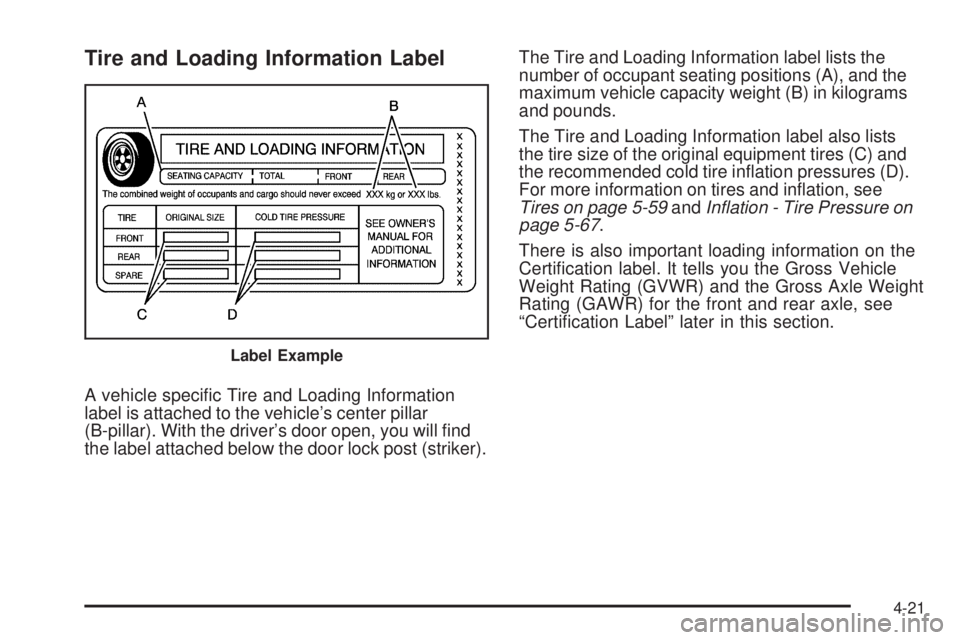
Tire and Loading Information Label
A vehicle specic Tire and Loading Information
label is attached to the vehicle’s center pillar
(B-pillar). With the driver’s door open, you will nd
the label attached below the door lock post (striker).The Tire and Loading Information label lists the
number of occupant seating positions (A), and the
maximum vehicle capacity weight (B) in kilograms
and pounds.
The Tire and Loading Information label also lists
the tire size of the original equipment tires (C) and
the recommended cold tire ination pressures (D).
For more information on tires and ination, see
Tires on page 5-59andInflation - Tire Pressure on
page 5-67.
There is also important loading information on the
Certication label. It tells you the Gross Vehicle
Weight Rating (GVWR) and the Gross Axle Weight
Rating (GAWR) for the front and rear axle, see
“Certication Label” later in this section.
Label Example
4-21
Page 240 of 410

Center High-Mounted Stoplamp (CHMSL)
(Retractable Hardtop
and Coupe)..............................................5-53
Taillamps, Turn Signal, Sidemarker, Stoplamps
and Back-up Lamps (Sedan)........................5-54
Taillamps, Turn Signal, Sidemarker,
Stoplamps and Back-up Lamps (Coupe).......5-55
Taillamps, Turn Signal, Sidemarker,
Stoplamps and Back-up Lamps
(Retractable Hardtop).................................5-56
License Plate Lamp......................................5-57
Replacement Bulbs.......................................5-57
Windshield Wiper Blade Replacement..............5-58
Tires..............................................................5-59
Winter Tires.................................................5-60
Tire Sidewall Labeling...................................5-61
Tire Terminology and Denitions.....................5-64
Ination - Tire Pressure.................................5-67
High-Speed Operation...................................5-68
Tire Pressure Monitor System.........................5-69
Tire Pressure Monitor Operation.....................5-71
Tire Inspection and Rotation...........................5-76
When It Is Time for New Tires.......................5-77Buying New Tires.........................................5-78
Different Size Tires and Wheels......................5-80
Uniform Tire Quality Grading..........................5-80
Wheel Alignment and Tire Balance..................5-82
Wheel Replacement......................................5-83
Tire Chains..................................................5-84
If a Tire Goes Flat........................................5-85
Changing a Flat Tire.....................................5-86
Removing the Spare Tire and Tools................5-87
Removing the Flat Tire and Installing the
Spare Tire................................................5-89
Storing a Flat or Spare Tire and Tools............5-94
Compact Spare Tire....................................5-101
Appearance Care..........................................5-102
Interior Cleaning.........................................5-102
Fabric/Carpet..............................................5-103
Leather......................................................5-104
Instrument Panel, Vinyl, and Other Plastic
Surfaces.................................................5-104
Care of Safety Belts....................................5-104
Weatherstrips.............................................5-105
Washing Your Vehicle..................................5-105
Cleaning Exterior Lamps/Lenses....................5-105
Section 5 Service and Appearance Care
5-2
Page 297 of 410
Tires
Your new vehicle comes with high-quality tires
made by a leading tire manufacturer. If you ever
have questions about your tire warranty and where
to obtain service, see your vehicle Warranty booklet
for details. For additional information refer to the tire
manufacturer.
{CAUTION:
Poorly maintained and improperly used
tires are dangerous.
Overloading your tires can cause
overheating as a result of too much
exing. You could have an air-out and a
serious accident. SeeLoading the
Vehicle on page 4-20.
CAUTION: (Continued)
CAUTION: (Continued)
Underinated tires pose the same danger
as overloaded tires. The resulting accident
could cause serious injury. Check all tires
frequently to maintain the recommended
pressure. Tire pressure should be
checked when your tires are cold. See
Inflation - Tire Pressure on page 5-67.
Overinated tires are more likely to be
cut, punctured, or broken by a sudden
impact — such as when you hit a pothole.
Keep tires at the recommended pressure.
Worn, old tires can cause accidents.
If your tread is badly worn, or if your tires
have been damaged, replace them.
SeeHigh-Speed Operation on page 5-68for
ination pressure adjustment for high speed
driving.
5-59
Page 298 of 410

Low-Prole Performance Tire
If your vehicle has P225/50R18 or P225/50R17
size tires, they are classied as low-prole
performance tires. These tires are designed for very
responsive driving on wet or dry pavement. You
may also notice more road noise with low-prole
performance tires and that they tend to wear faster.
Notice:If the vehicle has low-prole tires, they
are more susceptible to damage from road
hazards or curb impact than standard prole
tires. Tire and/or wheel assembly damage can
occur when coming into contact with road
hazards like, potholes, or sharp edged objects,
or when sliding into a curb. The vehicle
warranty does not cover this type of damage.
Keep tires set to the correct ination pressure
and, when possible avoid contact with curbs,
potholes, and other road hazards.
Winter Tires
If your vehicle has P225/50R18 size tires, they are
classied as low-prole performance tires. These tires
are designed for very responsive driving on wet or dry
pavement. If you expect to drive on snow or ice coveredroads often, you may want to get winter tires for your
vehicle. The low-prole performance tires may not
offer the traction you would like or the same level
of performance as winter tires on snow or ice
covered roads.
Winter tires, in general, are designed for increased
traction on snow and ice covered roads. With winter tires,
there may be decreased dry road traction, increased road
noise and shorter tire tread life. After switching to winter
tires, be alert for changes in vehicle handling and braking.
See your retailer for details regarding winter tire
availability and proper tire selection. Also, seeBuying
New Tires on page 5-78
If you choose to use winter tires:
Use tires of the same brand and tread type on all
four wheel positions.
Use only radial ply tires of the same size, load range,
and speed rating as your original equipment tires.
Winter tires with the same speed rating as your original
equipment tires may not be available for H, V, W and ZR
speed rated tires. If you choose winter tires with a lower
speed rating, never exceed the tire’s maximum speed
capability.
5-60
Page 300 of 410
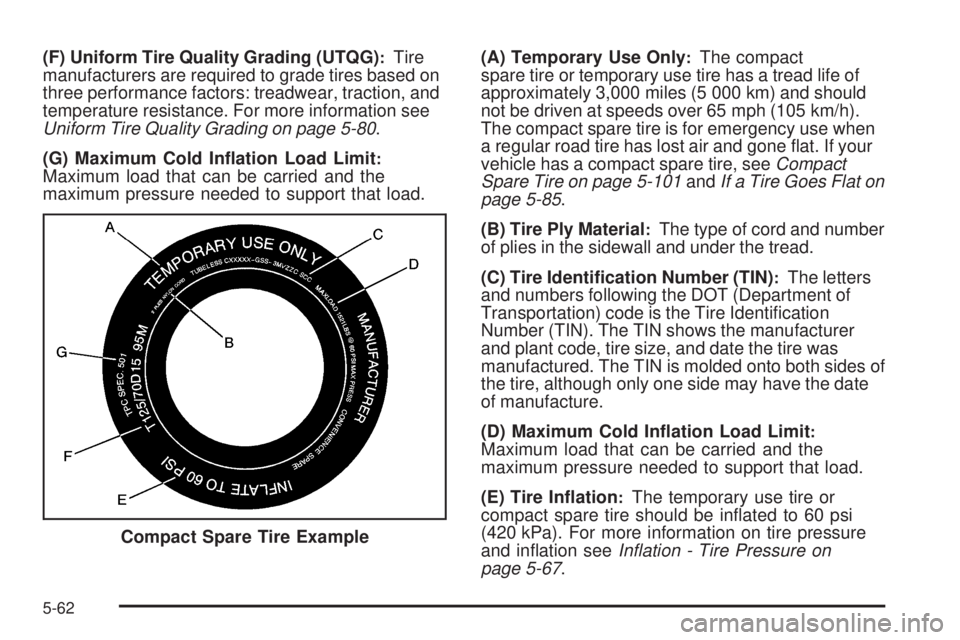
(F) Uniform Tire Quality Grading (UTQG):Tire
manufacturers are required to grade tires based on
three performance factors: treadwear, traction, and
temperature resistance. For more information see
Uniform Tire Quality Grading on page 5-80.
(G) Maximum Cold Ination Load Limit
:Maximum load that can be carried and the
maximum pressure needed to support that load.(A) Temporary Use Only
:The compact
spare tire or temporary use tire has a tread life of
approximately 3,000 miles (5 000 km) and should
not be driven at speeds over 65 mph (105 km/h).
The compact spare tire is for emergency use when
a regular road tire has lost air and gone at. If your
vehicle has a compact spare tire, seeCompact
Spare Tire on page 5-101andIf a Tire Goes Flat on
page 5-85.
(B) Tire Ply Material
:The type of cord and number
of plies in the sidewall and under the tread.
(C) Tire Identication Number (TIN)
:The letters
and numbers following the DOT (Department of
Transportation) code is the Tire Identication
Number (TIN). The TIN shows the manufacturer
and plant code, tire size, and date the tire was
manufactured. The TIN is molded onto both sides of
the tire, although only one side may have the date
of manufacture.
(D) Maximum Cold Ination Load Limit
:Maximum load that can be carried and the
maximum pressure needed to support that load.
(E) Tire Ination
:The temporary use tire or
compact spare tire should be inated to 60 psi
(420 kPa). For more information on tire pressure
and ination seeInflation - Tire Pressure on
page 5-67. Compact Spare Tire Example
5-62