2009 Peugeot 107 Dag engine
[x] Cancel search: enginePage 62 of 99
6
56
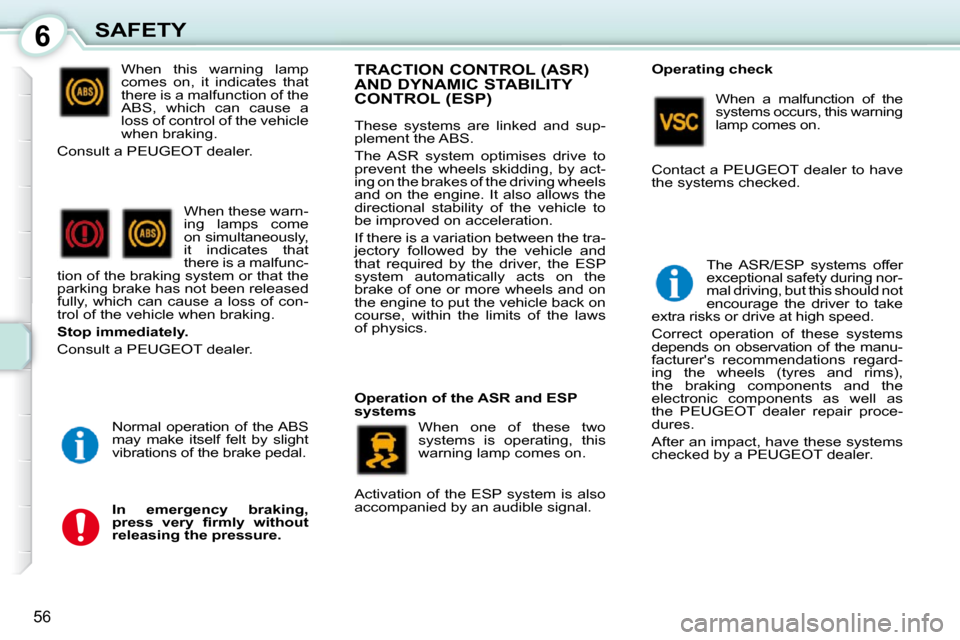
SAFETY When this warning lamp
comes on, it indicates that
there is a malfunction of the
ABS, which can cause a
loss of control of the vehicle
when braking.
Consult a PEUGEOT dealer.
When these warn-
ing lamps come
on simultaneously,
it indicates that
there is a malfunc-
tion of the braking system or that the
parking brake has not been released
fully, which can cause a loss of con-
trol of the vehicle when braking.
Stop immediately.
Consult a PEUGEOT dealer.
Normal operation of the ABS
may make itself felt by slight
vibrations of the brake pedal.
In emergency braking,
press very fi rmly without
releasing the pressure. TRACTION CONTROL (ASR)
AND DYNAMIC STABILITY
CONTROL (ESP)
These systems are linked and sup-
plement the ABS.
The ASR system optimises drive to
prevent the wheels skidding, by act-
ing on the brakes of the driving wheels
and on the engine. It also allows the
directional stability of the vehicle to
be improved on acceleration.
If there is a variation between the tra-
jectory followed by the vehicle and
that required by the driver, the ESP
system automatically acts on the
brake of one or more wheels and on
the engine to put the vehicle back on
course, within the limits of the laws
of physics.
Operating check
Operation of the ASR and ESP
systems When one of these two
systems is operating, this
warning lamp comes on. When a malfunction of the
systems occurs, this warning
lamp comes on.
The ASR/ESP systems offer
exceptional safety during nor-
mal driving, but this should not
encourage the driver to take
extra risks or drive at high speed.
Correct operation of these systems
depends on observation of the manu-
facturer's recommendations regard-
ing the wheels (tyres and rims),
the braking components and the
electronic components as well as
the PEUGEOT dealer repair proce-
dures.
After an impact, have these systems
checked by a PEUGEOT dealer.
Activation of the ESP system is also
accompanied by an audible signal. Contact a PEUGEOT dealer to have
the systems checked.
Page 70 of 99

7
62
DRIVING Driver information
The symbol which corresponds to the
selection, R , N , E or M and the number
of the gear engaged 1 to 5 , are dis-
played on the instrument panel screen.
2 TRONIC GEARBOX
The fi ve-speed " 2 Tronic
" gearbox
offers a choice between the comfort
of automatic operation or the pleas-
ure of manual gear changing .
Driving mode
Select the driving mode by moving
the gear lever.
R everse "R": This gear will be en-
gaged when stationary or at a speed
below approximately 4 mph (6 km/h).
The engagement of reverse gear is
accompanied by an audible signal.
N eutral "N":
Position the lever to the right in N , to
start the engine .
E asy "E": automatic gear changing.
M anual ( +/- ) "M": manual gear changing.
Starting the engine
With the parking brake applied, press
the brake pedal then select position N
to start the engine.
With your foot on the brake, select
position R , E or M .
Release the parking brake, take your
foot off the brake pedal, then accel-
erate.
Notes: with the engine run-
ning, in these three posi-
tions, an audible signal is
heard when the driver's
door is opened.
You can change from position E to
position M and vice versa at any
time.
Page 71 of 99
7
63
DRIVING
EASY mode (automatic mode)
Select position E using the gear
lever.
The gear engaged is displayed on
the instrument panel screen.
The gearbox continuously selects
the most suitable gear.
If you press the accelerator pedal
beyond the point of resistance, the
2 Tronic gearbox changes down to
permit sharper acceleration.
Manual mode
Place the gear lever in position M ,
then change up or down through the
gears by pressing:
- rearwards, "+" to change up,
- forwards, "-" to change down.
The gear engaged is displayed on
the instrument panel screen.
If the engine speed is too low, the
gearbox automatically changes down
to prevent stalling.
In the event of overheating of the
clutch, position N is selected auto-
matically and the symbol N fl ashes
accompanied by an audible signal. Operating fault
Stopping the engine
Before switching off the engine, you
can change to position N to be in
neutral.
In all cases, it is essential that you
apply the parking brake to immobilise
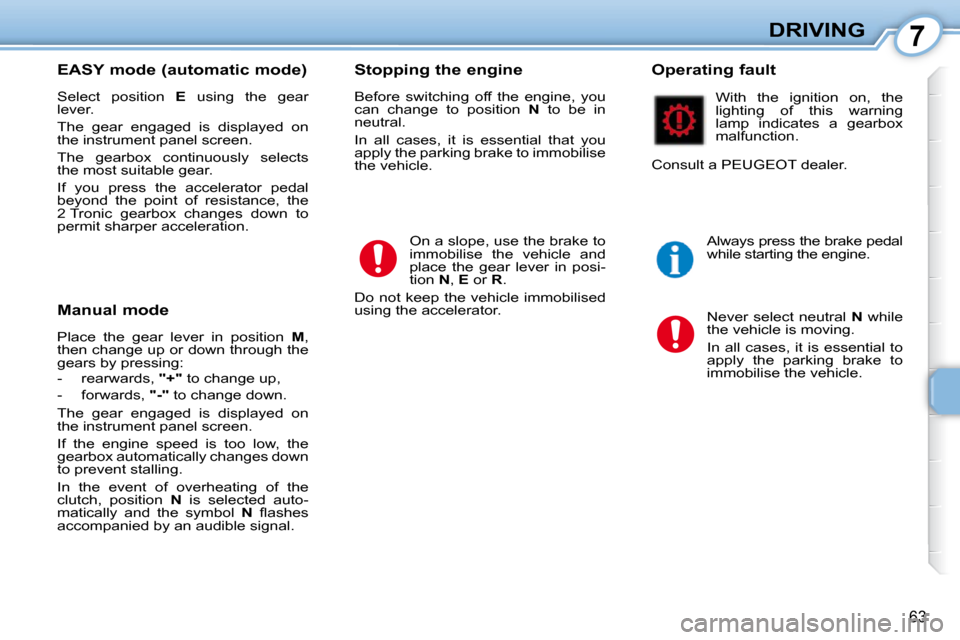
the vehicle. With the ignition on, the
lighting of this warning
lamp indicates a gearbox
malfunction.
On a slope, use the brake to
immobilise the vehicle and
place the gear lever in posi-
tion N , E or R .
Do not keep the vehicle immobilised
using the accelerator. Always press the brake pedal
while starting the engine.
Never select neutral
N while
the vehicle is moving.
In all cases, it is essential to
apply the parking brake to
immobilise the vehicle.
Consult a PEUGEOT dealer.
Page 73 of 99
8
66
CHECKS
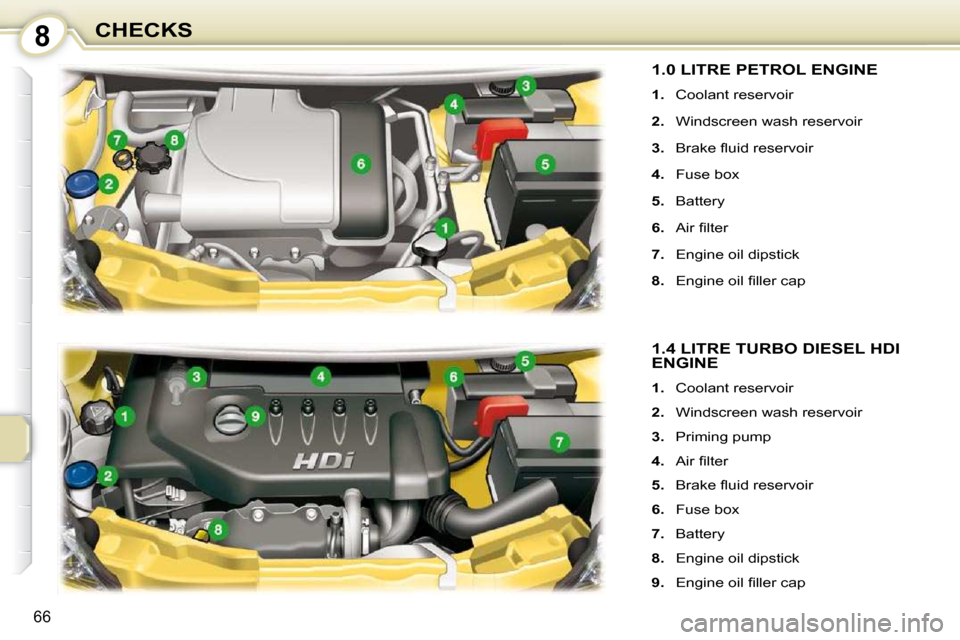
1.0 LITRE PETROL ENGINE
1. Coolant reservoir
2. Windscreen wash reservoir
3. Brake fl uid reservoir
4. Fuse box
5. Battery
6. Air fi lter
7. Engine oil dipstick
8. Engine oil fi ller cap
1.4 LITRE TURBO DIESEL HDI ENGINE
1. Coolant reservoir
2. Windscreen wash reservoir
3. Priming pump
4. Air fi lter
5. Brake fl uid reservoir
6. Fuse box
7. Battery
8. Engine oil dipstick
9. Engine oil fi ller cap
Page 74 of 99
8
67
CHECKS
CHECKING THE LEVELS
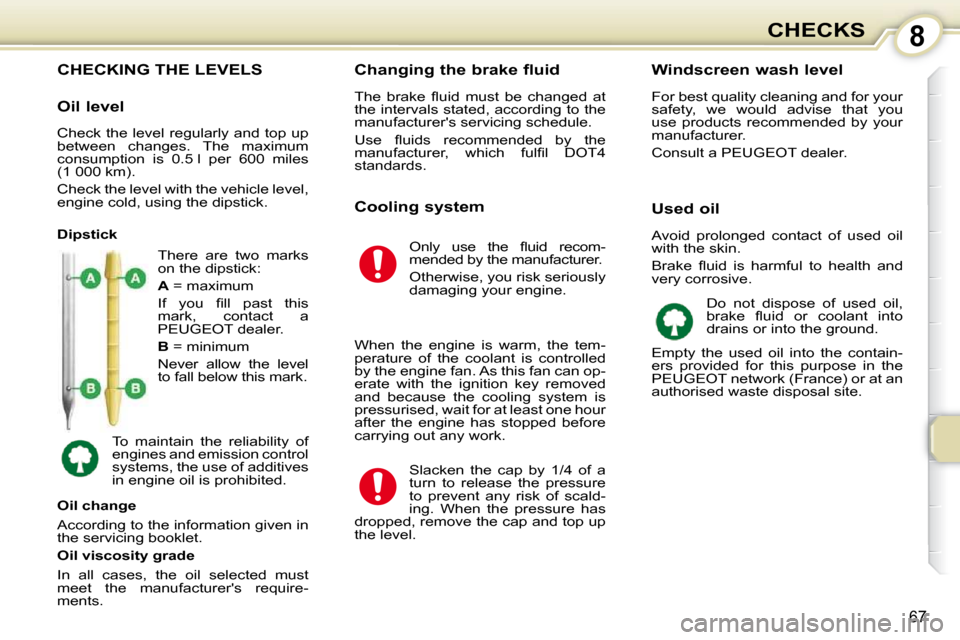
There are two marks
on the dipstick:
A = maximum
If you fi ll past this
mark, contact a
PEUGEOT dealer.
B = minimum
Never allow the level
to fall below this mark.
Dipstick
Oil change
According to the information given in
the servicing booklet. Changing the brake fluid
The brake fl uid must be changed at
the intervals stated, according to the
manufacturer's servicing schedule.
Use fl uids recommended by the
manufacturer, which fulfi l DOT4
standards.
Windscreen wash level
For best quality cleaning and for your
safety, we would advise that you
use products recommended by your
manufacturer.
Consult a PEUGEOT dealer.
Oil viscosity grade
In all cases, the oil selected must
meet the manufacturer's require-
ments. Cooling system
Used oil
Avoid prolonged contact of used oil
with the skin.
Brake fl uid is harmful to health and
very corrosive.
To maintain the reliability of
engines and emission control
systems, the use of additives
in engine oil is prohibited. Slacken the cap by 1/4 of a
turn to release the pressure
to prevent any risk of scald-
ing. When the pressure has
dropped, remove the cap and top up
the level. Only use the fl uid recom-
mended by the manufacturer.
Otherwise, you risk seriously
damaging your engine.
Do not dispose of used oil,
brake fl uid or coolant into
drains or into the ground.
Empty the used oil into the contain-
ers provided for this purpose in the
PEUGEOT network (France) or at an
authorised waste disposal site.
Oil level
Check the level regularly and top up
between changes. The maximum
consumption is 0.5 l per 600 miles
(1 000 km).
Check the level with the vehicle level,
engine cold, using the dipstick.
When the engine is warm, the tem-
perature of the coolant is controlled
by the engine fan. As this fan can op-
erate with the ignition key removed
and because the cooling system is
pressurised, wait for at least one hour
after the engine has stopped before
carrying out any work.
Page 75 of 99
8
68
CHECKS
CHECKS Oil filter
Change the fi lter regularly, in accord-
ance with the servicing schedule. Only use products recom-
mended by PEUGEOT or
products of equivalent qual-
ity and specifi cation.
In order to optimise the operation of
units as important as the braking sys-
tem, PEUGEOT selects and offers
specifi c products.
In order to avoid damaging the elec-
trical units, high pressure washing
to clean the engine compartment is
strictly prohibited.
To check the main levels and certain
components, in accordance with the
manufacturer's servicing schedule,
refer to the pages of the Maintenance
and Warranty Guide which corre-
spond to your vehicle's engine.
Battery
At the start of winter, have your bat-
tery checked by a PEUGEOT dealer.
Air filter and passenger
compartment filter
Have the fi lter elements replaced regu-
larly.
If you drive in dusty conditions,
change them twice as often.
Brake pads
Brake pad wear depends on the style
of driving, in particular for vehicles
which are used in town, over short
distances.
Disc and drum wear
For any information relating to disc
and drum surface wear, contact a
PEUGEOT dealer. Manual gearbox
Have the level checked in accord-
ance with the manufacturer's servicing
schedule.
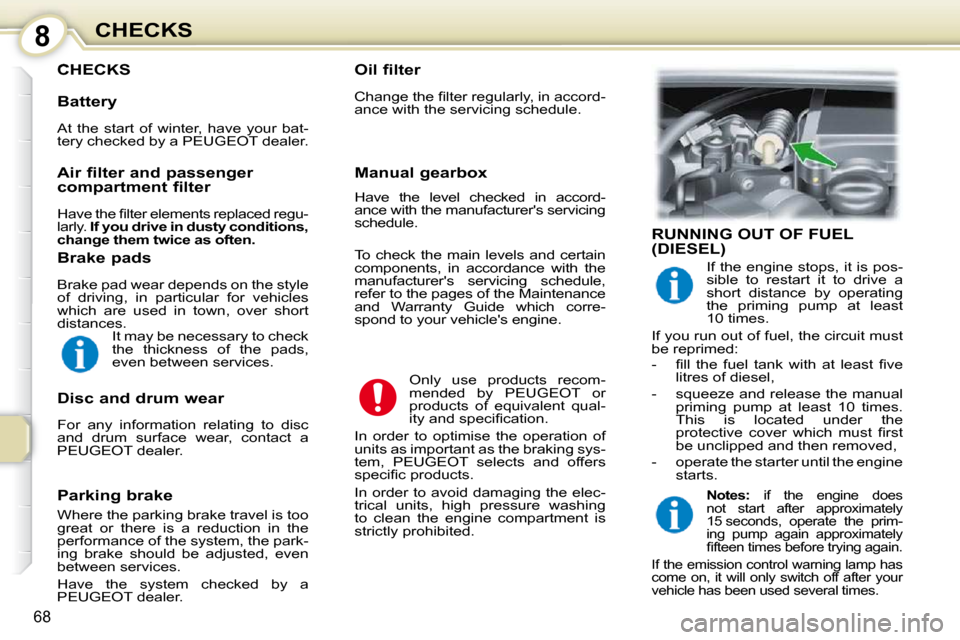
RUNNING OUT OF FUEL (DIESEL)
It may be necessary to check
the thickness of the pads,
even between services.
If the engine stops, it is pos-
sible to restart it to drive a
short distance by operating
the priming pump at least
10 times.
If you run out of fuel, the circuit must
be reprimed:
- fi ll the fuel tank with at least fi ve litres of diesel,
- squeeze and release the manual priming pump at least 10 times.
This is located under the
protective cover which must fi rst
be unclipped and then removed,
- operate the starter until the engine starts.
Notes: if the engine does
not start after approxima tely
15 seconds, operate the prim-
ing pump again approximately
fi fteen times before trying again.
If the emission control warning lamp has
come on, it will only switch off after your
vehicle has been used several times. Parking brake
Where the parking brake travel is too
great or there is a reduction in the
performance of the system, the park-
ing brake should be adjusted, even
between services.
Have the system checked by a
PEUGEOT dealer.
Page 83 of 99
9
74
PRACTICAL INFORMATION
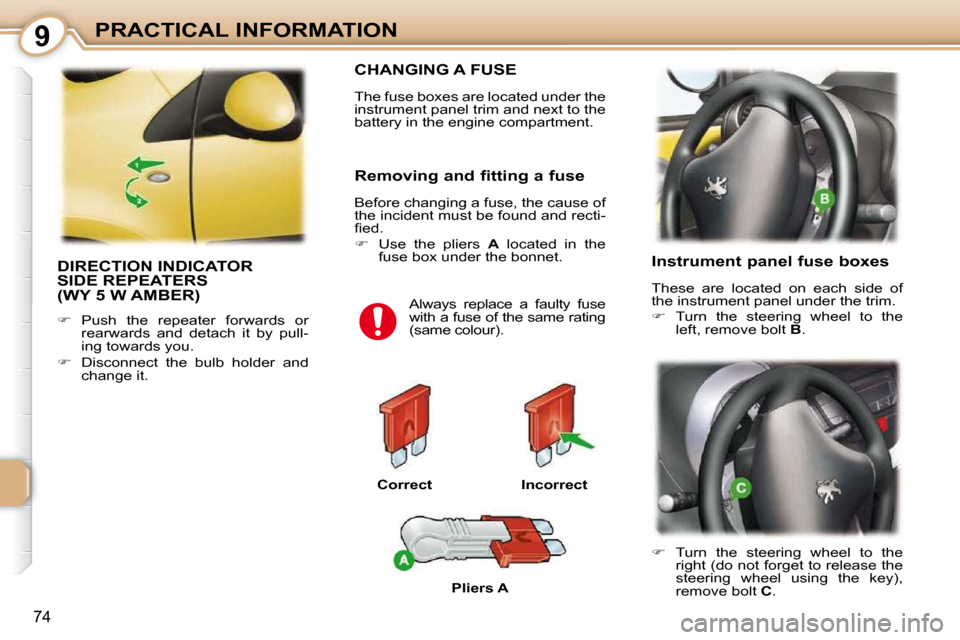
DIRECTION INDICATOR SIDE REPEATERS (WY 5 W AMBER)
Push the repeater forwards or
rearwards and detach it by pull-
ing towards you.
Disconnect the bulb holder and
change it.
CHANGING A FUSE
The fuse boxes are located under the
instrument panel trim and next to the
battery in the engine compartment.
Correct
Removing and fitting a fuse
Before changing a fuse, the cause of
the incident must be found and recti-
fi ed.
Use the pliers A located in the
fuse box under the bonnet.
Incorrect
Pliers A Instrument panel fuse boxes
These are located on each side of
the instrument panel under the trim.
Turn the steering wheel to the
left, remove bolt B .
Turn the steering wheel to the
right (do not forget to release the
steering wheel using the key),
remove bolt C .
Always replace a faulty fuse
with a fuse of the same rating
(same colour).
Page 84 of 99
9
74
PRACTICAL INFORMATION
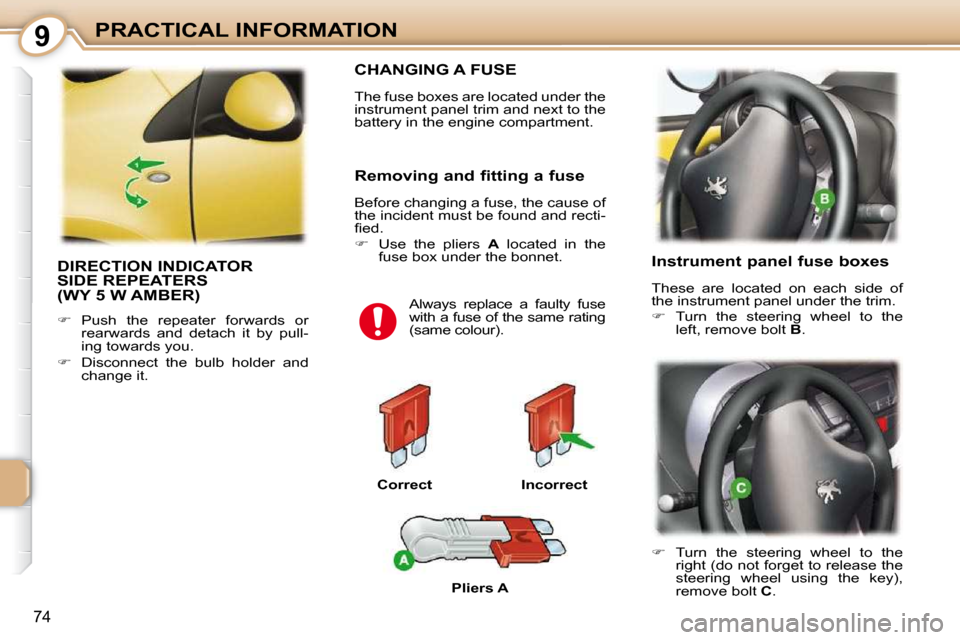
DIRECTION INDICATOR SIDE REPEATERS (WY 5 W AMBER)
Push the repeater forwards or
rearwards and detach it by pull-
ing towards you.
Disconnect the bulb holder and
change it.
CHANGING A FUSE
The fuse boxes are located under the
instrument panel trim and next to the
battery in the engine compartment.
Correct
Removing and fitting a fuse
Before changing a fuse, the cause of
the incident must be found and recti-
fi ed.
Use the pliers A located in the
fuse box under the bonnet.
Incorrect
Pliers A Instrument panel fuse boxes
These are located on each side of
the instrument panel under the trim.
Turn the steering wheel to the
left, remove bolt B .
Turn the steering wheel to the
right (do not forget to release the
steering wheel using the key),
remove bolt C .
Always replace a faulty fuse
with a fuse of the same rating
(same colour).