2009 OPEL AGILA belt
[x] Cancel search: beltPage 35 of 153

3-9Seats, restraints and interior
Child restraints
Child restraint systems 3
When a child restraint system is
being used, pay attention to the
following usage and installation
instructions and also those supplied
with the child restraint system.
The country in which you are driving
could require the use of child restraint
systems at specific seats. Follow all
local and national regulations.Selecting the right system
Your child should be transported
facing rearwards in the vehicle for as
long as possible. It is appropriate to
change the system when the child’s
head can no longer be properly
supported at eye height. The child’s
cervical vertebrae are still very weak
and in an accident they suffer less
stress in the semi-prone rearward
position than when sitting upright.
„Children under 12 years or under
150 cm tall should only travel in an
appropriate child safety seat.
„Never carry a child whilst travelling
in the vehicle. The child will
become too heavy to hold in the
event of a collision.
„When transporting children, use a
child restraint system that is
suitable for the child's weight, age
and height.
„Ensure that the child restraint
system to be installed is compatible
with the vehicle type.
„Ensure that the mounting location
of the child restraint system within
the vehicle is correct.„Only allow children to enter and exit
the vehicle at the side facing away
from the traffic.
„When the child restraint system is
not in use, secure the seat with a
seat belt or remove it from the
vehicle.
„A child restraint system which has
been subjected to stress in an
accident must be replaced.
„Opel produce a range of child
restraint systems. We recommend
you consult an Opel Service
Partner.
9 Warning
When using a child restraint
system on the front passenger’s
seat, the airbag systems for the
front passenger’s seat must be
deactivated; if not, the triggering
of the airbags poses a risk of fatal
injury to the child.
This is especially the case if rear-
facing child restraint systems are
used on the front passenger’s
seat.
Page 36 of 153

3-10 Seats, restraints and interior
Child restraint installation locations
X = Seat position not suitable for children in this mass group.
U = Suitable for ’universal’ category child restraints, attached with the vehicle seat belt, approved for use in this mass group. Mass group Front passenger’s seat Outboard rear
seatsCentre rear seat
airbags
activatedairbags
deactivated
Group 0: up to 10 kg
or approx. 10 months X U
1)
1)Only if front passenger’s seat airbag systems are deactivated 3 3 3-17.
Seat height 3 must be in its uppermost position 3 3-3.
Group 0 and 0+: Front passenger’s seat must be in its rearmost position 3 3-2.
Group I: When attaching child restraints by means of three-point seat belts, seat belt must run forwards from the anchorage point 3 3-8.
U2)
2)Seat location with ISOFIX mountings available 3 3-11.
X
Group 0+: up to 13 kg
or approx. 18 months X U
1) U2)X
Group I: 9 to 18 kg
or approx. 1 to 4 years X U
1) U2)X
Group II: 15 to 25 kg
or approx. 3 to 7 years X X U X
Group III: 22 to 36 kg
or approx. 6 to 12 years X X U X
Page 39 of 153

3-13Seats, restraints and interior
Airbag system
The airbag system consists of several
individual systems.
When triggered, the driver’s and front
passenger’s airbags inflate to form
safety cushions for the driver and
front passenger.
When triggered, the side airbag
inflates to form a safety cushion for
the driver and/or front passenger in
the respective door area.
When triggered, the curtain airbag
inflates to provide a safety barrier in
the head area on the respective side
of the vehicle.
No impairment of view will occur, as
airbags inflate and deflate so quickly
that they are often not noticed in an
accident.„The airbag system and belt
tensioner control electronics can be
found in the centre console area. In
order to avoid malfunctions, do not
store magnetic objects in this area.
„Do not stick or place anything on
the steering wheel, instrument
panel, front seatbacks in the vicinity
of the airbags and seat areas or
cover them with other materials.
„Each airbag can be triggered only
once. Once triggered, an airbag
must be replaced immediately.
Seek the assistance of a workshop.
„Do not perform any modifications to
the components of the airbag
system, as this will render the
vehicle unroadworthy.
„We recommend having the
steering wheel, the instrument
panel, all panelling parts, the door
seals, handles and the front seats
removed by a workshop.
Control indicator for airbag systems
35-9.
Front airbag system
The front airbag system is identified
by the words AIRBAG and SRS
AIRBAG on the steering wheel and
above the glove box respectively.
9 Warning
The systems can be triggered
abruptly and cause injury if they
are handled improperly.
Page 40 of 153

3-14 Seats, restraints and interior
The front airbag system will be
triggered depending on the severity
of the accident, and within the range
shown in the illustration.
The ignition must be switched on.When triggered, the airbags inflate in
milliseconds. Forward movement of
the driver and front passenger is
checked and the risk of injuries to the
upper body and head are thereby
substantially reduced.9 Warning
The front airbag system provides
optimum protection when the
seat, seat belt, seatback and
head restraint are correctly
adjusted as described 33-1 to
3-5.
Do not place objects, children or
pets in the area in which the
airbags inflate.
Page 41 of 153
3-15Seats, restraints and interior
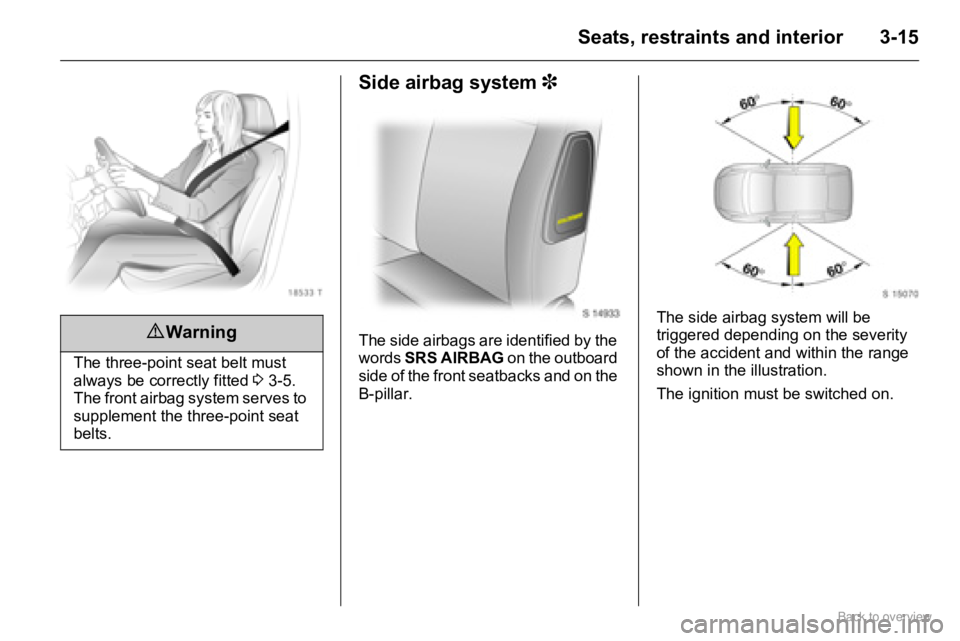
Side airbag system 3
The side airbags are identified by the
words SRS AIRBAG on the outboard
side of the front seatbacks and on the
B-pillar.The side airbag system will be
triggered depending on the severity
of the accident and within the range
shown in the illustration.
The ignition must be switched on.9 Warning
The three-point seat belt must
always be correctly fitted 33-5.
The front airbag system serves to
supplement the three-point seat
belts.
Page 43 of 153
3-17Seats, restraints and interior
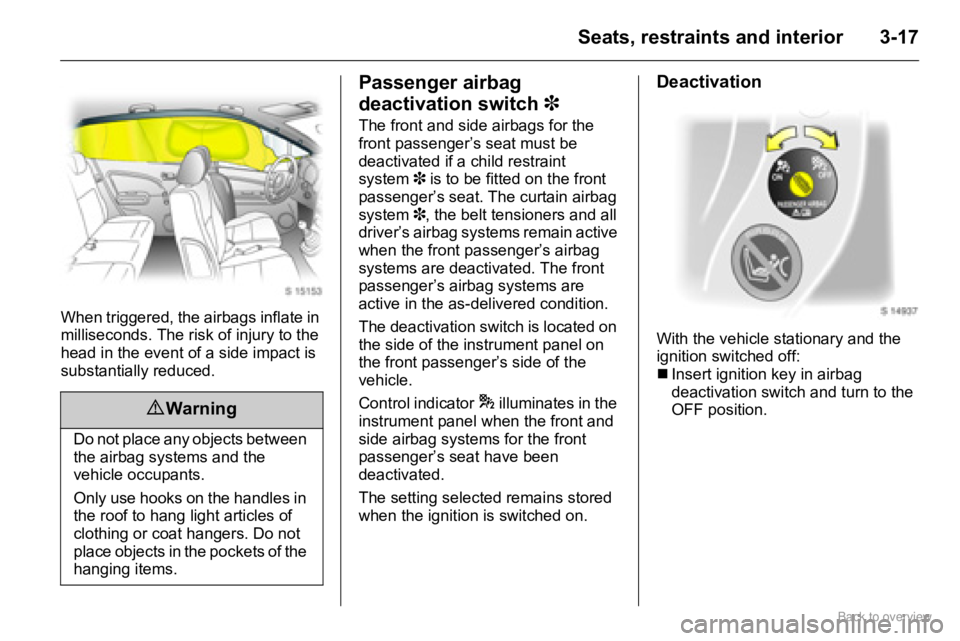
When triggered, the airbags inflate in
milliseconds. The risk of injury to the
head in the event of a side impact is
substantially reduced.
Passenger airbag
deactivation switch 3
The front and side airbags for the
front passenger’s seat must be
deactivated if a child restraint
system3 is to be fitted on the front
passenger’s seat. The curtain airbag
system3, the belt tensioners and all
driver’s airbag systems remain active
when the front passenger’s airbag
systems are deactivated. The front
passenger’s airbag systems are
active in the as-delivered condition.
The deactivation switch is located on
the side of the instrument panel on
the front passenger’s side of the
vehicle.
Control indicator* illuminates in the
instrument panel when the front and
side airbag systems for the front
passenger’s seat have been
deactivated.
The setting selected remains stored
when the ignition is switched on.
Deactivation
With the vehicle stationary and the
ignition switched off:
„Insert ignition key in airbag
deactivation switch and turn to the
OFF position.
9 Warning
Do not place any objects between
the airbag systems and the
vehicle occupants.
Only use hooks on the handles in
the roof to hang light articles of
clothing or coat hangers. Do not
place objects in the pockets of the
hanging items.
Page 59 of 153

5-9Instruments and controls
X Driver’s seat belt
Will illuminate in red when ignition is
switched on if driver’s seat belt is not
engaged.
If vehicle speed exceeds 15 km/h
(9 mph) and driver’s seat belt is not
engaged, the control indicator will
flash for approx. 90 seconds along
with a warning chime and then
illuminate until driver’s seat belt is
fastened correctly.
Seat belts 3 3-5.
v Airbag systems, belt
tensioners
Will flash in red several times when
the ignition is switched on, then
extinguish.
If it does not flash when the ignition is
switched on, stays lit, illuminates or
flashes whilst driving, there is a fault
with the airbag systems or with the
belt tensioners. The systems might
not therefore be triggered in the event
of an accident. Seek the assistance
of a workshop immediately.
Belt tensioners 3 3-6, airbags 3 3-13.
p Charging system
Will illuminate in red when ignition is
switched on. Extinguishes after
engine is started.
If it stays lit after the ignition is
switched on or illuminates during
driving: stop vehicle and switch off
engine. The battery is not being
charged and the engine cooling may
be interrupted. The brake servo unit
may cease to be effective. Interrupt
your journey immediately.
Remove ignition key and check drive
belt condition and tensioning before
seeking the assistance of a
workshop.
s Service transmission 3
Will illuminate briefly in yellow when
the ignition is switched on.
If it flashes, there is a fault in the
automatic transmission. Seek the
assistance of a workshop
immediately.
Automatic transmission 39-3.
R Brake system
Will illuminate in red when ignition is
switched on. Extinguishes after
engine is started.
Illuminates when engine is running if
parking brake is applied and/or fluid
level for brake hydraulics is too low.
Further information 3 9-9,
brake fluid level 3 10-6.
u Anti-lock Brake System
(ABS)
Will illuminate briefly in yellow when
ignition is switched on.
At the same time, the system
performs a self-check. When the
control indicator extinguishes, the
system is ready for operation.
Caution
If it illuminates when the parking
brake is not applied: stop vehicle;
interrupt your journey immediately.
Seek the assistance of a workshop.
Page 63 of 153

5-13Instruments and controls
If it illuminates when the engine is
running; there may be a fault in the
engine electronics: interrupt your
journey and seek the assistance of a
workshop.
If regeneration of the diesel particle
filter is not successful or possible (3
5-13 “8 Diesel particle filter 3“), the
control indicator may illuminate and
the vehicle goes into limp home
mode: interrupt your journey and
seek the assistance of a workshop
immediately.
Further information 3 9-7.
Y Low fuel
If it illuminates during driving; fuel
level is low: fill up fuel tank as soon
as possible.
Never let the tank run dry!
Erratic fuel supply can cause catalytic
converter to overheat 3 9-8.
Diesel engines: The engine stops and
control indicator Z illuminates if the
fuel level is too low (3 5-11 “Z
Exhaust emissions”). If the tank has
been run dry, bleed the fuel system 3
10-7.Refuelling 3 9-12, fuel tank capacity
3 12-5.
8 Diesel particle filter 3
Will illuminate briefly in yellow when
the ignition is switched on.
If it illuminates during driving, the
diesel particle filter requires cleaning.
As soon as the road and traffic
situation permits it, increase speed to
more than 75 km/h (50 mph) for
approx. 30 minutes. The control
indicator extinguishes as soon as
cleaning is complete.
If regeneration of the diesel particle
filter is not successful or possible (3
5-12 “A Service vehicle soon 3“),
control indicator A may illuminate
and the vehicle goes into limp home
mode: interrupt your journey and
seek the assistance of a workshop
immediately.
Further information 3 9-7.
O Turn signal lamps
The appropriate control indicator will
flash in green when the turn signal is
on. Rapid flash; failure of a turn signal
bulb or the corresponding fuse.
Both control indicators flash when the
hazard warning lamps are active.
Turn signal lamps 3 6-2, bulb
replacement 3 10-7, fuses 3 10-11.
Warning chimes
While driving:
„when operating the turn signals.
„if driver’s seat belt is not engaged
and vehicle speed exceeds approx.
15 km/h (9 mph).
When the vehicle is parked and
driver’s door is opened:
„with exterior lamps switched on
(and ignition key removed).
„when the key is in the ignition
switch.
Seat belt warning chime 33-7.
Driving hints 3 9-1.