2009 NISSAN VERSA HATCHBACK wheel alignment
[x] Cancel search: wheel alignmentPage 33 of 55
30
(9) Replacement of four (4) or more tires from the same
vehicle will not be accepted for ride disturbance
complaints i.e. vibration, out of round, out of balance,
pulling, noise, due to the unlikely event of multiple
tires with uniformity problems.
(10) Claims for weather/ozone cracking after 5 years from
the date of manufacture.
(11) Any tire which has been run with low air pressure or
while fl at.
(12) Tires used in commercial service.
(13) Tires on vehicles regularly operated outside the United
States.
(14) Claims made by anyone other than the original retail
purchaser of the vehicle.
(15) Tires with the D.O.T. identifi cation number removed
or rendered illegible.
(16) Any tire not presented and available for Toyo’s inspec-
tion.
(17) Any tire for which mileage and tire rotation records
are not available or verifi able.
(18) Any tires worn beyond the wear bars (less than
2/32
nds of an inch of tread remaining) .
(19) Tires not supplied as original equipment on new
vehicles (refer to Owner’s Manual for coverage) .
(20) “T” Type temporary spare tires used at speeds over
50 miles per hour, exhibiting such damage.
(21) Dealer service charges are not covered for routine or
required maintenance of the tires such as alignments,
rotation or balancing.
(22) The cost of applicable federal, state and local taxes
and fees.
(23) Retreaded passenger and light truck tires are not
warranted.
TOYO TIRE LIMITED WARRANTY
(5) Check infl ation pressure before use. Failure to have
proper infl ation pressure when using your spare tire
can result in serious personal injury or death. Maintain
infl ation pressure of 35 psi for the temporary full size
spare and 60 psi for the “T” Type, high pressure,
temporary spare tire. When infl ating or adding air to
a “T” Type temporary spare tire, be very careful since
the smaller tire volume can gain pressure much more
rapidly than a normal full size tire.
(6) Placing (mounting) your temporary use tire on a wheel
which is not specifi cally designed for use with the
temporary use tire or placing another type tire on
your temporary use wheel can be dangerous. Your
vehicle’s handling characteristics can be seriously
affected. You could have an accident resulting in
serious personal injury or death. Consult your vehicle
Owner’s Manual for proper use of your “temporary
use” spare tire.
(7) The “T” Type high pressure temporary spare tire
should not be used with any other wheel nor should
standard tires, snow tires, wheel covers or trim rings
be used on the high pressure spare tire wheel.
(8) Do not operate your vehicle with more than one
temporary spare in use (this does not apply to a full
size spare) and only at limited speeds and distances
as indicated on the sidewall of the tire.
(9) The “T” Type temporary spare tire may lower ground
clearance when used. Avoid driving over large ob-
stacles and other road hazards. Check your vehicle
Owner’s Manual for other special clearance precau-
tions when using the “T” Type temporary spare tire
provided in your vehicle.
(10) Follow the maintenance recommendations and safety
warnings contained in the Owner’s Manual and in
the Important Tire Safety Information section of this
booklet.
WHAT IS NOT COVERED BY THIS
LIMITED WARRANTY(1) Mileage is not warranted.
(2) Damage due to road hazards, whether repairable or
not (such as cut, snag, bruise, impact break, bulge,
puncture, improper use of tire chains, stone drill, chip,
scale) . These types of damages or air loss always
require tire removal and inspection by a qualifi ed tire
professional.
(3) Irregular tread wear or rapid tread wear due to failure
to rotate the tires at recommended intervals or from
vehicle misalignment.
(4) Damage resulting from improper repair materials or
procedures such as rope type plugs. Toyo does not
warrant any inspection or repair process. The repair
is entirely the responsibility of the repairer and should
be made in accordance with procedures as specifi ed
by the Rubber Manufacturers Association (RMA) .
(5) Damage from incorrect mounting or dismounting of
the tire, incorrect wheel size, water or other material
trapped inside the tire during mounting or failure to
balance the tires.
(6) Damage or uneven tread wear from incorrect infl ation,
overloading, fi re, theft, defective mechanical condi-
tions such as brakes, shocks, rims, wreck or collision,
misuse, misapplication, negligence, willful damage or
abuse, vandalism, tire alteration, tire spinning, racing
or competition purposes.
(7) Damage, corrosion or rubber deterioration due to
the use of oil-based chemicals, water-based sealers,
balancing substances, or fl ammable gases.
(8) Uniformity problems such as ride, balance and vibra-
tion complaints after the fi rst 25% of tread wear.
(Continued on page 31)
Page 37 of 55
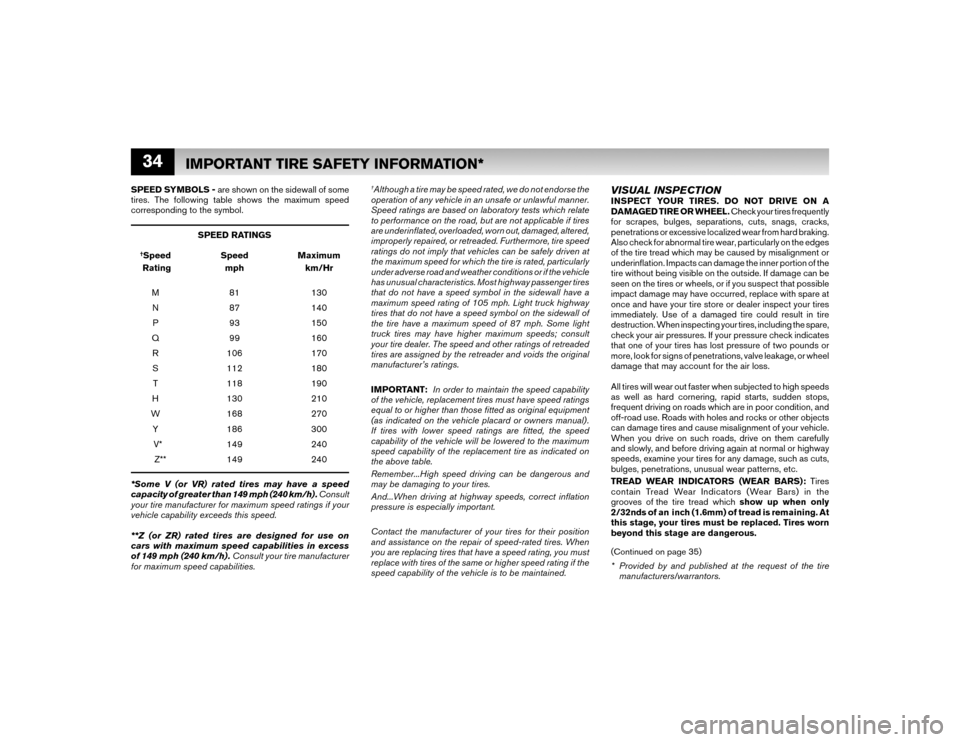
34SPEED SYMBOLS - are shown on the sidewall of some
tires. The following table shows the maximum speed
corresponding to the symbol.
SPEED RATINGS †
Speed Speed Maximum
Rating mph km/Hr
M 81 130
N 87 140
P 93 150
Q 99 160
R 106 170
S 112 180
T 118 190
H 130 210
W 168 270
Y 186 300
V* 149 240
Z** 149 240
*Some V (or VR) rated tires may have a speed
capacity of greater than 149 mph (240 km/h) . Consult
your tire manufacturer for maximum speed ratings if your
vehicle capability exceeds this speed.
**Z (or ZR) rated tires are designed for use on
cars with maximum speed capabilities in excess
of 149 mph (240 km/h) . Consult your tire manufacturer
for maximum speed capabilities.
†Although a tire may be speed rated, we do not endorse the
operation of any vehicle in an unsafe or unlawful manner.
Speed ratings are based on laboratory tests which relate
to performance on the road, but are not applicable if tires
are underinfl ated, overloaded, worn out, damaged, altered,
improperly repaired, or retreaded. Furthermore, tire speed
ratings do not imply that vehicles can be safely driven at
the maximum speed for which the tire is rated, particularly
under adverse road and weather conditions or if the vehicle
has unusual characteristics. Most highway passenger tires
that do not have a speed symbol in the sidewall have a
maximum speed rating of 105 mph. Light truck highway
tires that do not have a speed symbol on the sidewall of
the tire have a maximum speed of 87 mph. Some light
truck tires may have higher maximum speeds; consult
your tire dealer. The speed and other ratings of retreaded
tires are assigned by the retreader and voids the original
manufacturer’s ratings.
IMPORTANT: In order to maintain the speed capability
of the vehicle, replacement tires must have speed ratings
equal to or higher than those fi tted as original equipment
(as indicated on the vehicle placard or owners manual) .
If tires with lower speed ratings are fi tted, the speed
capability of the vehicle will be lowered to the maximum
speed capability of the replacement tire as indicated on
the above table.
Remember...High speed driving can be dangerous and
may be damaging to your tires.
And...When driving at highway speeds, correct infl ation
pressure is especially important.
Contact the manufacturer of your tires for their position
and assistance on the repair of speed-rated tires. When
you are replacing tires that have a speed rating, you must
replace with tires of the same or higher speed rating if the
speed capability of the vehicle is to be maintained.
VISUAL INSPECTIONINSPECT YOUR TIRES. DO NOT DRIVE ON A
DAMAGED TIRE OR WHEEL. Check your tires frequently
for scrapes, bulges, separations, cuts, snags, cracks,
penetrations or excessive localized wear from hard braking.
Also check for abnormal tire wear, particularly on the edges
of the tire tread which may be caused by misalignment or
underinfl ation. Impacts can damage the inner portion of the
tire without being visible on the outside. If damage can be
seen on the tires or wheels, or if you suspect that possible
impact damage may have occurred, replace with spare at
once and have your tire store or dealer inspect your tires
immediately. Use of a damaged tire could result in tire
destruction. When inspecting your tires, including the spare,
check your air pressures. If your pressure check indicates
that one of your tires has lost pressure of two pounds or
more, look for signs of penetrations, valve leakage, or wheel
damage that may account for the air loss.
All tires will wear out faster when subjected to high speeds
as well as hard cornering, rapid starts, sudden stops,
frequent driving on roads which are in poor condition, and
off-road use. Roads with holes and rocks or other objects
can damage tires and cause misalignment of your vehicle.
When you drive on such roads, drive on them carefully
and slowly, and before driving again at normal or highway
speeds, examine your tires for any damage, such as cuts,
bulges, penetrations, unusual wear patterns, etc.
TREAD WEAR INDICATORS (WEAR BARS): Tires
contain Tread Wear Indicators (Wear Bars) in the
grooves of the tire tread which show up when only
2/32nds of an inch (1.6mm) of tread is remaining. At
this stage, your tires must be replaced. Tires worn
beyond this stage are dangerous.
* Provided by and published at the request of the tire
manufacturers/warrantors.
IMPORTANT TIRE SAFETY INFORMATION*
(Continued on page 35)
Page 38 of 55
35
HAZARDSObjects in the road that threaten a tire should be safely
avoided. These objects are potholes, glass, metal, rocks,
wood debris and the like. Unavoidable contact should
prompt a thorough tire inspection.
You may not always recall hitting an object that can damage
or injure your tires. If while driving your vehicle experiences
any unusual vibrations, ride disturbance or noise and/or
you suspect that possible damage to the tires or vehicle
has occurred, DO NOT JAM OR LOCK YOUR BRAKES!
Rather reduce your speed and drive with caution until you
can safely pull off the road. Stop and inspect the tires. If
the tire is underinfl ated or damaged, defl ate, remove the
tire and rim assembly and replace it with your spare. If you
cannot detect a cause, have the vehicle towed to the nearest
vehicle or tire dealer to have the vehicle inspected.REPAIRING, MOUNTING AND
DEMOUNTING OF TIRESDo not attempt to repair, mount or demount a
tire yourself. Tire changing can be dangerous and
must be done by professionally trained persons using
proper tools and procedures as specifi ed by the Rubber
Manufacturers Association (RMA) . Follow these
mounting recommendations. Your tires should be
mounted on wheels of correct size and type and which are
in good, clean condition. Bent, chipped or rusted wheels
may cause tire damage. The inside of the tire must be free
from foreign materials. Have your dealer check the
wheels before mounting new tires. Mismatched tires
and rims can explode during mounting. Also, mismatched
tires and rims can result in dangerous tire failure on the
road. If a tire is mounted by error on the wrong-sized rim,
do not remount it on the proper rim - scrap it. It may be damaged internally (which is not externally visible) by being
dangerously stretched and could fail on the highway.
Old valves may leak. When new tubeless tires are mounted,
have new valves of the correct type installed. Tubeless tires
must be mounted only on wheels designed for tubeless
tires, i.e., wheels which have safety humps or ledges.
Never perform a temporary repair, use an innertube or
inject sealant as a permanent substitute for a proper
repair. Only qualifi ed persons should repair tires.
Be sure that all your valves have suitable valve caps. This
will keep valve cores clean and clear and guard against
leakage.
REPAIRS - WHENEVER POSSIBLE, SEE A TIRE
DEALER AT ONCE. Some tire manufacturers do not
warrant any inspection or repair process. The repair is
entirely the responsibility of the repairer. Punctures in the
tread of a passenger tire which do not exceed 1/4 of an inch
(6mm) in diameter can usually be repaired by following the
Rubber Manufacturer's Association (RMA) Passenger and
Light Truck Repair procedures. Contact the manufacturer of
your tires for its position and assistance as to the acceptable
location for a proper repair and the repair of speed rated
tires. Do not use plug repairs. They may cause further
damage to the tire. They are not always air tight and
the plug may fail. Do not exceed posted speed limits on
any repaired tire. Certain tire manufacturers speed ratings
are voided if the tire is repaired.
Although a tire was properly repaired, internal structural
damage resulting from the puncture may have occurred. Sometime later the damage may cause the tire to be
removed from service.
If the tire has a puncture in the tread which exceeds 1/4 inch
(6mm) , the tire must be replaced. If any tire has sustained a
puncture, have the tire inspected internally by a tire dealer
for possible damage that may have occurred.
Improper mounting and infl ation procedures can cause an
explosion of the tire/rim assembly. Only specially trained
persons should perform these tasks. Contact your tire store
or dealer for assistance.
CAUTION - Never, under any circumstance,
introduce a fl ammable substance into a tire.
WHEEL ALIGNMENT AND BALANCINGWheel alignment and balancing are important for safety
and maximum mileage from your tires. Check how your
tires are wearing at least once a month. If your tires are
wearing unevenly, such as the inside shoulder of the tire
wearing faster than the rest of the tread, or if you detect
excessive vibration, your vehicle may be out of alignment
or balance. These conditions not only shorten the life of
your tires, but adversely affect the handling characteristics
of your vehicle which could be dangerous. If you detect
irregular wear or vibration, have your alignment and
balance checked immediately. Tires which have been run
underinfl ated will show more wear on the shoulders than
in the center of the tread.
* Provided by and published at the request of the tire
manufacturers/warrantors.
IMPORTANT TIRE SAFETY INFORMATION*
(Continued on page 36)