2009 NISSAN VERSA HATCHBACK tire pressure
[x] Cancel search: tire pressurePage 34 of 55

31
CONSUMER’S OBLIGATIONThe consumer is responsible for proper tire care and
maintenance:
(1) It is recommended tires be rotated every 3,500 miles
or less for high performance (low profi le) tires or every
7,500 miles or less for standard passenger and light
truck tires. More frequent rotation may be necessary
if, upon inspection, irregular or erratic tread wear is
beginning to appear. As a general rule, front and rear
tire tread depth differential should be kept to 2/32
nds
of an inch or less. Keep a record of the rotation.
(2) The consumer must maintain the recommended air
pressure in the tires according to vehicle manufacturer’s
recommendation. Check infl ation pressures on all your
tires, including the spare tire, when tires are cold, at
least once a month before driving. Maintaining proper
infl ation pressure is the single most important thing you
can do to ensure optimum tread life and tire durability.
To avoid injury, NEVER reinfl ate a tire that has been
run severely underinfl ated.
(3) The consumer must maintain the vehicle’s alignment
in accordance with vehicle manufacturer’s specifi ca-
tions.
(4) The load capacity of the tires must not be exceeded.
(5) The tire’s maximum speed capability must not be
exceeded.
(6) Follow the maintenance recommendations and safety
warnings contained in the Owner’s Manual and in
the Important Tire Safety Information section of this
booklet.
TO MAKE A CLAIM UNDER THIS
LIMITED WARRANTYIn the event that you make a claim under the terms of the
warranty, we ask the consumer to:(1) Present your tires and your vehicle to an authorized Toyo
dealer. Call consumer relations at (800) 442-8696
(Pacifi c Time) or (888) 444-8696 (Eastern Time) for
assistance locating the nearest Toyo tire dealer or visit
our web site at www.toyo.com for our dealer locator.
(2) Complete and sign the Toyo Limited Warranty Claim
form provided by the dealer and leave the tire with the
dealer for warranty processing.
NOTE: Check with your vehicle dealership. They may also
assist you with your tire service requirements or in obtaining
tire warranty service from the tire manufacturer.
The consumer is entitled to an adjustment in accordance with
the warranty that was in effect when the tire was installed
on the vehicle as original equipment. The adjustment policy
provides for replacement with a comparable new Toyo tire
if a Toyo tire becomes unserviceable due to an adjustable
condition verifi ed by Toyo’s inspection of the tire. Free
replacement or a pro rata charge depends on the remaining
usable tread when tire is presented for adjustment.
LIMITATIONS AND EXCLUSIONSTHIS LIMITED WARRANTY APPLIES ONLY TO THE 50
UNITED STATES, AND THE DISTRICT OF COLUMBIA.
THIS WARRANTY IS THE ONLY WRITTEN WARRANTY
PROVIDED BY TOYO. No Toyo employee, representative
or dealer has the authority to make or imply any representa-
tion, promise or agreement, which in any way varies the
terms of this limited warranty.
LIMITATION AND EXCLUSION ON DAMAGES: TOYO
SHALL NOT BE LIABLE FOR ANY INCIDENTAL OR
CONSEQUENTIAL DAMAGES FOR BREACH OF THIS
LIMITED WARRANTY OR ANY IMPLIED WARRANTY,
(including, for example loss of time, loss of use of vehicle,
towing charges, road service or inconveniences) . Some
states do not allow the exclusion or limitation of incidental
or consequential damages, so the above exclusions may
not apply to you.
YOUR RIGHTS UNDER STATE LAWThis limited warranty gives you specifi c legal rights; and
you may also have other rights, which vary from state to
state.THE WARRANTORThe warrantor of Toyo Tires is Toyo Tire (U.S.A.) Corporation,
6261 Katella Ave., Suite 2B, Cypress, California 90630.FOR ASSISTANCEContact your authorized Toyo Tire retailer or call Toyo
Tire Consumer Relations at (800) 442-8696 (Pacifi c Time)
or (888) 444-8696 (Eastern Time) Monday through Friday
8:00 am to 4:45 pm.IMPORTANT SAFETY AND
MAINTENTANCE INFORMATION!Any tire, no matter how well constructed, can fail as a result
of punctures, impact damage, improper infl ation or other
conditions resulting from use. Tire failures may create a risk
of property damage or personal injury. To reduce the risk
of tire failure, we strongly recommend the following: WARNING!
SERIOUS INJURY MAY RESULT FROM:(1) Tire failure due to underinfl ation, vehicle overloading
or use in excess of legal speeds – follow Owner’s
Manual and tire data placard in your vehicle.
(2) Explosion of tire/rim assembly due to improper
mounting – only specially trained persons should
mount tires.
Refer to the tire data placard, the Owner’s Manual
and Important Tire Safety Information and instruc-
tions contained in this booklet.
TOYO TIRE LIMITED WARRANTY
Page 36 of 55

33
Any tire, no matter how well constructed, may fail due
to improper maintenance or service factors. This could
create a risk of property damage and serious or fatal injury.
Disregarding any of the safety precautions and instructions
contained in this manual may result in tire failure or explosion
causing serious personal injury or death. For your safety,
comply with the following:TIRE INFLATIONKeep tires infl ated to the pressures recommended on
the tire data placard. (See your OWNER’S MANUAL for
location.) These infl ation pressures must be maintained as
a minimum. However, do not exceed the maximum pressure
rating indicated on the tire sidewall.
CHECK INFLATION PRESSURES ON ALL YOUR TIRES,
INCLUDING THE SPARE, WHEN TIRES ARE COLD, AT
LEAST ONCE A MONTH BEFORE DRIVING.
Failure to maintain correct infl ation may result in improper
vehicle handling and may cause rapid and irregular tire
wear, sudden tire destruction, loss of vehicle control and
serious personal injury. Therefore, infl ation pressures
should be checked at least once a month and always prior
to long distance trips.
Pressures should be checked when tires are cold. The
tires are cold when your vehicle has been driven less
than a mile at moderate speed after being stopped for
three or more hours.
CHECKING PRESSURE WHEN
TIRES ARE HOTIf you must add air when your tires are hot, add four pounds
per square inch (psi) (28kPa) above the recommended
cold air pressure. Recheck the infl ation pressure when
the tire is cold.
For Example Only:
Gauge reading of hot tire: 32psi
If recommended pressure is: 30psi
Desired gauge reading of hot tire 30 + 4psi = 34psi
Check cold pressures as soon as possible, at least by
the next day. Never “bleed” air from hot tires as your tire
will be underinfl ated. Use an accurate tire gauge to check
pressures. Never allow children to air up tires.
DRIVING ON ANY TIRE THAT DOES NOT HAVE THE
CORRECT INFLATION PRESSURE IS DANGEROUS.
For replacement tires, the correct infl ation pressure will
be provided by your tire dealer. If not, refer to the vehicle
decal.
Underinfl ation produces extreme fl exing of the sidewalls and
builds up heat which may result in sudden tire destruction
and serious personal injury. Overinfl ation can cause the tire
to be more susceptible to impact damage.LOAD LIMITSDO NOT OVERLOAD. DRIVING ON ANY OVERLOADED
TIRE IS DANGEROUS. Never load your tires beyond the
load carrying limits molded into the sidewall of the tires or
the maximum vehicle load limit as shown on the vehicle
tire data placard, whichever is less. Overloading causes
heat to build up which can lead to sudden tire failure and
serious personal injury.
SPEED LIMITS AND SPEED RATED
TIRESHIGH SPEED DRIVING CAN BE DANGEROUS.
Never operate your vehicle in excess of lawful speeds or
the maximum speeds justifi ed by the driving conditions.
Excessive speeds or racing can cause heat buildup in a tire
leading to possible failure and serious personal injury.
Correct infl ation pressure is especially important.
However, at high speeds, even with the correct infl ation
pressure, a road hazard, for example, is more diffi cult to
avoid and if contact is made, there is a greater chance of
causing tire damage than at the lower speed. Moreover,
driving at high speed reduces the reaction time available
to avoid accidents and bring your vehicle to a safe stop. If
you see any damage to a tire or wheel, replace it with your
spare tire and see your tire dealer at once.
Tire speed ratings do not imply that a vehicle can be safely
driven at the maximum speed for which the tire is rated. In
addition, some damages or improper repairs may cause
a speed-rated tire to lose its speed rating. Exceeding the
tire’s maximum speed rating will cause the tire to build up
excessive heat which can cause tire damage that could
result in sudden tire destruction and rapid air loss. Failure to
control a vehicle with sudden air loss can lead to an accident.
In any case, you should not exceed reasonable speeds as
indicated by the legal limits and driving conditions.
* Provided by and published at the request of the tire
manufacturers/warrantors.
IMPORTANT TIRE SAFETY INFORMATION*
(Continued on page 34)
Page 37 of 55
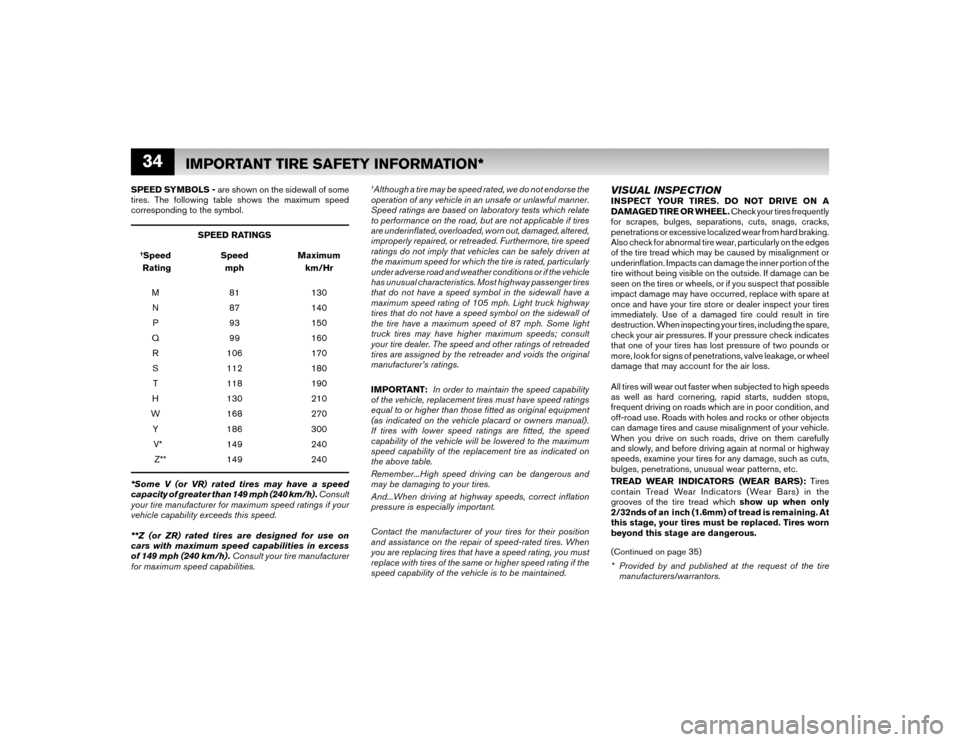
34SPEED SYMBOLS - are shown on the sidewall of some
tires. The following table shows the maximum speed
corresponding to the symbol.
SPEED RATINGS †
Speed Speed Maximum
Rating mph km/Hr
M 81 130
N 87 140
P 93 150
Q 99 160
R 106 170
S 112 180
T 118 190
H 130 210
W 168 270
Y 186 300
V* 149 240
Z** 149 240
*Some V (or VR) rated tires may have a speed
capacity of greater than 149 mph (240 km/h) . Consult
your tire manufacturer for maximum speed ratings if your
vehicle capability exceeds this speed.
**Z (or ZR) rated tires are designed for use on
cars with maximum speed capabilities in excess
of 149 mph (240 km/h) . Consult your tire manufacturer
for maximum speed capabilities.
†Although a tire may be speed rated, we do not endorse the
operation of any vehicle in an unsafe or unlawful manner.
Speed ratings are based on laboratory tests which relate
to performance on the road, but are not applicable if tires
are underinfl ated, overloaded, worn out, damaged, altered,
improperly repaired, or retreaded. Furthermore, tire speed
ratings do not imply that vehicles can be safely driven at
the maximum speed for which the tire is rated, particularly
under adverse road and weather conditions or if the vehicle
has unusual characteristics. Most highway passenger tires
that do not have a speed symbol in the sidewall have a
maximum speed rating of 105 mph. Light truck highway
tires that do not have a speed symbol on the sidewall of
the tire have a maximum speed of 87 mph. Some light
truck tires may have higher maximum speeds; consult
your tire dealer. The speed and other ratings of retreaded
tires are assigned by the retreader and voids the original
manufacturer’s ratings.
IMPORTANT: In order to maintain the speed capability
of the vehicle, replacement tires must have speed ratings
equal to or higher than those fi tted as original equipment
(as indicated on the vehicle placard or owners manual) .
If tires with lower speed ratings are fi tted, the speed
capability of the vehicle will be lowered to the maximum
speed capability of the replacement tire as indicated on
the above table.
Remember...High speed driving can be dangerous and
may be damaging to your tires.
And...When driving at highway speeds, correct infl ation
pressure is especially important.
Contact the manufacturer of your tires for their position
and assistance on the repair of speed-rated tires. When
you are replacing tires that have a speed rating, you must
replace with tires of the same or higher speed rating if the
speed capability of the vehicle is to be maintained.
VISUAL INSPECTIONINSPECT YOUR TIRES. DO NOT DRIVE ON A
DAMAGED TIRE OR WHEEL. Check your tires frequently
for scrapes, bulges, separations, cuts, snags, cracks,
penetrations or excessive localized wear from hard braking.
Also check for abnormal tire wear, particularly on the edges
of the tire tread which may be caused by misalignment or
underinfl ation. Impacts can damage the inner portion of the
tire without being visible on the outside. If damage can be
seen on the tires or wheels, or if you suspect that possible
impact damage may have occurred, replace with spare at
once and have your tire store or dealer inspect your tires
immediately. Use of a damaged tire could result in tire
destruction. When inspecting your tires, including the spare,
check your air pressures. If your pressure check indicates
that one of your tires has lost pressure of two pounds or
more, look for signs of penetrations, valve leakage, or wheel
damage that may account for the air loss.
All tires will wear out faster when subjected to high speeds
as well as hard cornering, rapid starts, sudden stops,
frequent driving on roads which are in poor condition, and
off-road use. Roads with holes and rocks or other objects
can damage tires and cause misalignment of your vehicle.
When you drive on such roads, drive on them carefully
and slowly, and before driving again at normal or highway
speeds, examine your tires for any damage, such as cuts,
bulges, penetrations, unusual wear patterns, etc.
TREAD WEAR INDICATORS (WEAR BARS): Tires
contain Tread Wear Indicators (Wear Bars) in the
grooves of the tire tread which show up when only
2/32nds of an inch (1.6mm) of tread is remaining. At
this stage, your tires must be replaced. Tires worn
beyond this stage are dangerous.
* Provided by and published at the request of the tire
manufacturers/warrantors.
IMPORTANT TIRE SAFETY INFORMATION*
(Continued on page 35)
Page 40 of 55

37
TRAILER TOWINGIf you anticipate towing a trailer, you should see a tire dealer
for advice concerning the correct size of tire and pressure.
Tire size and pressure will depend on the type and size
of the trailer and hitch utilized, but in no case must the
maximum cold infl ation pressure or the tire load rating be
exceeded. Check the tire decal and your Owner’s Manual
for further recommendations on trailer towing.TIRE ALTERATIONSDo not perform any alterations on your tires. Alterations may
prevent proper performance, leading to tire damage, which
can result in an accident. Tires which become unserviceable
due to alterations such as truing, whitewall inlays, addition
of balancing or sealant liquids, may be excluded from
warranty coverage. Consult your tire warranty.HIGH PRESSURE TEMPORARY SPARE
TIRES1) The high-pressure spare tire in your Nissan vehicle is
designed for temporary use only and must not be used
continually as a regular tire. The standard tire should
be repaired and/or replaced as soon as possible.
2) Avoid driving over obstacles that may damage the tire
through impact or cutting, such as potholes, glass,
metal, etc.
3) Speed must not exceed 50MPH (80km/h) for non-
speed-rated temporary spare tires.4) Temporary spare tires have a limited treadlife which
can vary depending on road conditions and your
driving habits. The spare tire should be returned to
the trunk as soon as the standard tire can be repaired
or replaced.
5) Because the high-pressure spare tire was specifi cally
designed for your car, it should not be used on any
other vehicle.
6) Do not use snow chains on your high-pressure spare.
This could cause damage to your vehicle.
7) Check the tire’s cold infl ation pressure monthly and
maintain at 60psi (4.2kg/cm
2) even when not in
use.
8) The high-pressure spare tire should not be used with
any other rim nor should standard tires, wheel covers,
or trim rings be used on the high-pressure spare tire
rim which was originally installed.
9) When the tread wear indicator appears on the tire,
replace it only with the same type spare tire.
10) Do not enter an automatic carwash with a temporary
spare tire fi tted.
11) Do not make a sharp turn or apply the brakes suddenly
when driving on a high-pressure temporary spare.
Note: When using any temporary type spare tire, be sure to
follow the vehicle Owner’s Manual instructions.
TIRE STORAGEAll tires should be stored in a cool dry place indoors so that
there is no danger of water collecting inside them.
When tires are stored they should be stored in a cool place
away from sources of heat and ozone such as hot pipes
and electric generators. Be sure that surfaces on which
tires are stored are clean and free from grease, gasoline
or other substances which could deteriorate the rubber.
(Tires exposed to these materials during storage or driving
could be subject to sudden failure.)
To Avoid Damage to your Tires and
Possible Accident:
• Check tire pressure at least once a month when
tires are cold and before long trips.
• Do not underinfl ate/overinfl ate.
• Do not overload.
• Drive at moderate speeds, observe legal limits.
• Avoid driving over potholes, obstacles, curbs or
edges of pavement.
• Avoid excessive wheel spinning.
• If you see any damage to a tire, replace with spare
and see the tire manufacturer’s dealer or your
Nissan dealership.
For further information, the Consumer Tire Guide on
passenger tire care, safety and mileage performance is
available in the United States by writing the Tire Industry
Safety Council, Box 1801, Washington, D.C. 20013.
* Provided by and published at the request of the tire
manufacturers/warrantors.
IMPORTANT TIRE SAFETY INFORMATION*