2009 MITSUBISHI COLT ignition
[x] Cancel search: ignitionPage 204 of 273

Downloaded from www.Manualslib.com manuals search engine The regulations concerning towing may differ from
country to country. It is recommended that you
obey the regulations of the area where you are driv-
ing your vehicle.Towing the vehicle by a tow truckCAUTIONl This vehicle must not be towed by a tow
truck using sling lift type equipment
(Type A) as illustrated. Using a sling lift
will damage the bumper and front end.
l If the transmission is malfunctioning or
damaged, transport the vehicle with the
driving wheels on a carriage (Type C, D
or E) as illustrated.
l If your vehicle has an automated manual
transmission, place the allshift lever in
the “N” (Neutral) position before stop-
ping the engine.
l [
For vehicles with the Traction Control
System (TCL)/Active Stability Control
system (ASC)]
If the vehicle is towed with the ignition
switch in the “ON” position and only the
front wheels or only the rear wheels
raised off the ground, the Traction Con-
trol System (TCL) may operate, resulting
in an accident.
Towing with rear wheels off the ground (Type B)
Place the gearshift lever (manual transmission) or
the allshift lever (automated manual transmission)
in the “N” (Neutral) position. With a vehicle that
has an automated manual transmission, confirm
that the transmission is in the “N” (Neutral) posi-
tion by checking that “N” is shown by the allshift
indicator display and by pushing the vehicle.
Turn the ignition key to the “ACC” position and se-
cure the steering wheel in a straight-ahead position
with a rope or tiedown strap. Never place the igni-
tion key in the “LOCK” position when towing.
If, with a vehicle that has an automated manual trans-
mission, the engine will not start and the transmis-
sion is not in the “N” (Neutral) position, press the
brake pedal, turn the ignition switch to the “ON” po-
sition, and move the allshift lever to the “N” (Neu-
tral) position.
Towing with front wheels off the ground (Type C)
Release the parking brake.
Place the gearshift lever (manual transmission) or
the allshift lever (automated manual transmission)
in the “N” (Neutral) position. With a vehicle that
has an automated manual transmission, confirm
that the transmission is in the “N” (Neutral) posi-
tion by checking that “N” is shown by the allshift
indicator display and by pushing the vehicle.
If, with a vehicle that has an automated manual trans-
mission, the engine will not start and the transmis-
sion is not in the “N” (Neutral) position, press the
brake pedal, turn the ignition switch to the “ON” po-
sition, and move the allshift lever to the “N” (Neu-
tral) position.
Emergency towing
If towing service is not available in an emergency,
your vehicle may be temporarily towed by a rope
secured to the towing hook.
If your vehicle is to be towed by another vehicle or
if your vehicle tows another vehicle, pay careful at-
tention to the following points:
For emergencies
6-19
6
Page 205 of 273

Downloaded from www.Manualslib.com manuals search engine CAUTIONlIf your vehicle has an automated manual
transmission, place the allshift lever in
the “N” (Neutral) position before stop-
ping the engine.
If your vehicle is to be towed by another vehicle
1.Take out the towing hook and wheel nut
wrench (if so equipped). (Refer to “Tools
jack and tyre repair kit” on page 6-06.)
2. Press by hand the side of the cover (A) that
has a “
” mark, then remove the cover.
3. Use the wheel nut wrench (B) to securely
mount the towing hook (C).
If your vehicle does not have a wheel nut
wrench, securely tighten the towing hook (C)
by hand.
4. Secure the tow rope to the front towing hook.
CAUTIONl Do not tow the vehicle with the rope at an
excessive diagonal angle.
NOTE
l To avoid deforming or otherwise damaging
the vehicle body when hooking the rope onto
the towing hook, observe the following in-
structions: • Mount the towing hook securely.
• Do not attach the rope to any part of the
vehicle other than the towing hook.
• Do not drive in a way that subjects the
towing hook to significant physical shock.
5. Keep the engine running.
If the engine is not running, turn the ignition
key to the “ACC” or “ON” position to un-
lock the steering wheel.CAUTIONl When the engine is not running, the
brake booster and power steering do not
operate. This means higher brake depres-
sion force and higher steering effort are
required. Therefore, vehicle operation is
more difficult than usual.
l Do not leave the key in the “LOCK” posi-
tion. The steering wheel will lock, causing
loss of control.
6. Place the gearshift lever (manual transmis-
sion) or the allshift lever (automated manual
transmission) in the “N” (Neutral) position.
With a vehicle that has an automated manual
transmission, confirm that the transmission is
in the “N” (Neutral) position by checking
that “N” is shown by the allshift indicator dis-
play and by pushing the vehicle.
If, with a vehicle that has an automated man-
ual transmission, the engine will not start and
the transmission is not in the “N” (Neutral)
position, press the brake pedal, turn the igni-
tion switch to the “ON” position, and move
the allshift lever to the “N” (Neutral) position.
7. Turn on the hazard warning lamps if required by law. (Follow the local driving laws and
regulations.)
8. During towing make sure that close contact
is maintained between the drivers of both ve-
hicles, and that the vehicles travel at low
speed.
For emergencies
6-20
6
Page 216 of 273

Downloaded from www.Manualslib.com manuals search engine The catalytic converter itself gets hot quickly, and
may be damaged if overheated. The following
points should be noted in order to prevent the igni-
tion of unburned petrol within the catalytic convert-
er.
l Use UNLEADED PETROL ONLY of the
type recommended in “Fuel selection” on
page 02.
l Do not drive with an extremely low fuel lev-
el; running out of fuel could cause damage to
the catalytic converter.
l Do not attempt to start the engine by pushing
the vehicle. If the battery is weak or dis-
charged, use another battery to start the en-
gine.
l Do not idle the engine with any spark plug
wires disconnected or removed such as per-
forming diagnostic tests.
l Do not idle the engine for prolonged periods
during very rough idle or malfunctioning op-
erating conditions.
l Do not race the engine when turning off the
ignition switch. This will cause the catalytic
converter to be damaged due to contact with
unburnt fuel.
l Stop driving the vehicle if you think the per-
formance is noticeably low, or if the engine
has a malfunction such as with the ignition,
etc.
If it is impractical to stop driving immediate-
ly, reduce the speed and drive for only a
short time. We recommend you to have your
vehicle inspected as soon as possible.l In unusual situations involving grossly mal-
functioning engine operation, a burnt smell
may indicate severe and abnormal catalyst
overheating.
If this occurs, the vehicle should be stopped
in a safe place, the engine switched off and
the vehicle allowed to cool. Once the engine
is cool, a service, including a tune-up to man-
ufacturer’s specifications, should be obtained
immediately.Bonnet E01000302470
To open
Pull the release lever towards you to unlock the bon-
net.
Raise the bonnet while pressing the safety lock.
NOTE l Only open the bonnet when the wipers are in
the parked position. Failure to do so may
cause paint/body damage.
Maintenance
8-03
8
Page 223 of 273

Downloaded from www.Manualslib.com manuals search engine BatteryE01001202160
The condition of the battery is very important for
quick starting of the engine and proper functioning
of the vehicle’s electrical system. Regular inspec-
tion and care are especially important in cold weath-
er.
Checking battery electrolyte level
The inside of the battery is divided into several com-
partments.
Checking the electrolyte level in each cell after re-
moving the cap.If the part marked (A) inside each cell is below the
surface of the electrolyte (B), the electrolyte level
is normal. Top up the electrolyte with distilled wa-
ter if necessary. Do not overfill the cell; spillage dur-
ing driving could cause damage.
Check the electrolyte level at least once every 4
weeks, depending on the operating conditions.
If the battery is not used, it will discharge by itself
with time.
Check it once every 4 weeks and charge with low
current as necessary.
During cold weather
The capacity of the battery is reduced at low tem-
peratures. This is an inevitable result of its chemi-
cal and physical properties. This is why a very cold
battery, particularly one that is not fully charged,
will only deliver a fraction of the starter current
which is normally available.
We recommend you to have the battery checked be-
fore the start of cold weather and, if necessary,
have it charged or replaced.
This does not only ensure reliable starting, but a bat-
tery which is kept fully charged also has a longer life.
Disconnection and connectionCAUTIONl Do not disconnect the battery terminals
for at least one minute after the ignition
switch is turned “OFF”. If the battery ter-
minals are disconnected immediately af-
ter the ignition switch is turned “OFF”,
the automated manual transmission may
be damaged.
To disconnect the battery cable, stop the engine,
first disconnect the negative (-) terminal and then
the positive (+) terminal.
When connecting the battery, first connect the posi-
tive (+) terminal and then the negative (-) terminal.
NOTE l Open the terminal cover (A) before discon-
necting or connecting the positive (+) termi-
nal of the battery.
l Loosen the nut (B), and then disconnect the
battery cable from the positive (+) terminal.
Maintenance
8-10
8
Page 233 of 273

Downloaded from www.Manualslib.com manuals search engine Passenger compartment fuse location (LHD)Passenger compartment fuse location (RHD)
No.SymbolElectrical systemCa-
pacity1Ignition switch40 A2Electric window system40 A3Radiator fan40 A4Automated manual trans-
mission40 A5Demister30 A6Heated seat30 ANo.SymbolElectrical systemCa-
pacity7———8Heater40 A9Radio10 A10Room lamp10 A11Heated door mirror7.5 A12Electronic control module7.5 A13Windscreen wiper20 A14Tail lamp (right)7.5 A15Tail lamp (left)7.5 A16Engine20 A17Fuel pump15 A18Horn10 A19Headlamp high-beam
(left)10 A20Headlamp high-beam
(right)10 A21———22———23Outside rear-view mirrors7.5 A24Rear fog lamp7.5 A25Accessory socket15 A
Maintenance
8-20
8
Page 234 of 273

Downloaded from www.Manualslib.com manuals search engine No.SymbolElectrical systemCa-
pacity26Rear window wiper15 A27———28———29———30———31Hazard warning flasher10 A32———33Door locks15 A34Front fog lamps15 A35Headlamp low beam (left)10 A36Headlamp low beam
(right)10 A37Reversing lamp7.5 A38Engine control7.5 A39Ignition coil10 A40Gauge7.5 A41Relay7.5 A42STOPStop lamps15 A43Air conditioning7.5 A44———
l Some fuses may not be installed on your ve-
hicle, depending on the vehicle model or spec-
ifications.
l The table above shows the main equipment
corresponding to each fuse.
Identification of fuseCapacityColour7.5 ABrown10 ARed15 ABlue20 AYellow30 AGreen40 AOrange (fuse type)/Green (fusi- ble link type)
Fuse replacement
1.Before replacing a fuse, always turn off the
electrical circuit concerned and place the ig-
nition switch in the “LOCK” position.
2. Remove the fuse puller from the cover. (Re-
fer to “To remove the cover” on pages 8-22,
8-22.)
3. Referring to the fuse load capacity table,
check the fuse pertaining to the problem.
A- Fuse is OK B- Blown fuse
NOTE l If any system does not function but the fuse
corresponding to that system is normal, there
may be a fault in the system elsewhere. We
recommend you to have your vehicle checked.
Maintenance
8-21
8 LHD RHD
Page 265 of 273
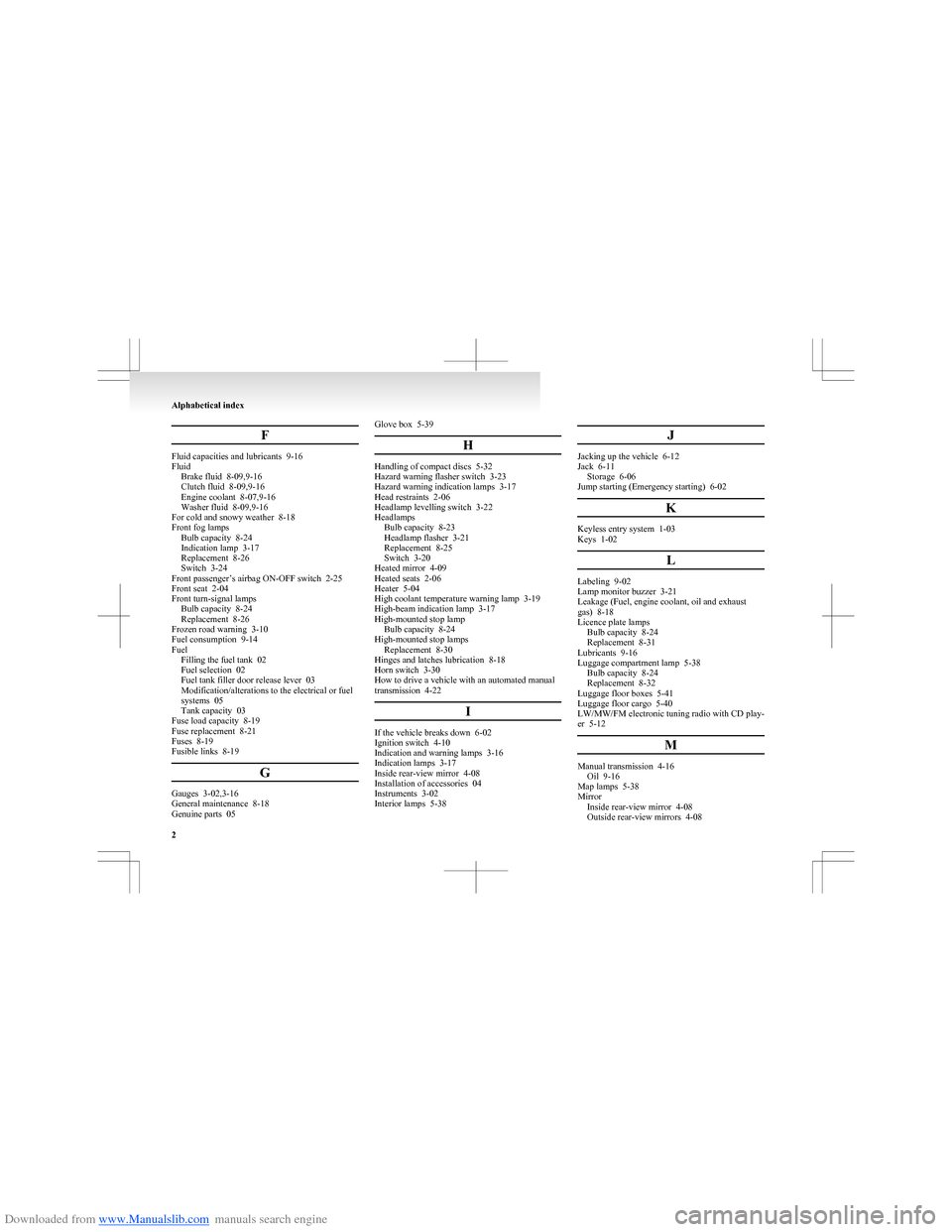
Downloaded from www.Manualslib.com manuals search engine F
Fluid capacities and lubricants 9-16
Fluid Brake fluid 8-09,9-16
Clutch fluid 8-09,9-16
Engine coolant 8-07,9-16
Washer fluid 8-09,9-16
For cold and snowy weather 8-18
Front fog lamps Bulb capacity 8-24
Indication lamp 3-17
Replacement 8-26
Switch 3-24
Front passenger’s airbag ON-OFF switch 2-25
Front seat 2-04
Front turn-signal lamps Bulb capacity 8-24
Replacement 8-26
Frozen road warning 3-10
Fuel consumption 9-14
Fuel Filling the fuel tank 02
Fuel selection 02
Fuel tank filler door release lever 03
Modification/alterations to the electrical or fuel
systems 05
Tank capacity 03
Fuse load capacity 8-19
Fuse replacement 8-21
Fuses 8-19
Fusible links 8-19
G
Gauges 3-02,3-16
General maintenance 8-18
Genuine parts 05
Glove box 5-39
H
Handling of compact discs 5-32
Hazard warning flasher switch 3-23
Hazard warning indication lamps 3-17
Head restraints 2-06
Headlamp levelling switch 3-22
Headlamps Bulb capacity 8-23
Headlamp flasher 3-21
Replacement 8-25
Switch 3-20
Heated mirror 4-09
Heated seats 2-06
Heater 5-04
High coolant temperature warning lamp 3-19
High-beam indication lamp 3-17
High-mounted stop lamp Bulb capacity 8-24
High-mounted stop lamps Replacement 8-30
Hinges and latches lubrication 8-18
Horn switch 3-30
How to drive a vehicle with an automated manual
transmission 4-22
I
If the vehicle breaks down 6-02
Ignition switch 4-10
Indication and warning lamps 3-16
Indication lamps 3-17
Inside rear-view mirror 4-08
Installation of accessories 04
Instruments 3-02
Interior lamps 5-38
J
Jacking up the vehicle 6-12
Jack 6-11 Storage 6-06
Jump starting (Emergency starting) 6-02
K
Keyless entry system 1-03
Keys 1-02
L
Labeling 9-02
Lamp monitor buzzer 3-21
Leakage (Fuel, engine coolant, oil and exhaust
gas) 8-18
Licence plate lamps Bulb capacity 8-24
Replacement 8-31
Lubricants 9-16
Luggage compartment lamp 5-38 Bulb capacity 8-24
Replacement 8-32
Luggage floor boxes 5-41
Luggage floor cargo 5-40
LW/MW/FM electronic tuning radio with CD play-
er 5-12
M
Manual transmission 4-16Oil 9-16
Map lamps 5-38
Mirror Inside rear-view mirror 4-08
Outside rear-view mirrors 4-08
Alphabetical index
2