2009 MITSUBISHI COLT Main
[x] Cancel search: MainPage 130 of 273

Downloaded from www.Manualslib.com manuals search engine Brake assist systemE00627000262
The brake assist system is a device assisting drivers
who cannot depress the brake pedal firmly when it
is necessary to do so (such as in emergency stop sit-
uations) and provides greater braking force.
If the brake pedal is depressed suddenly, the brakes
will be applied with more force than usual.CAUTIONl The brake assist system is not a device de-
signed to exercise braking force greater
than its capacity. Make sure to always
keep a sufficient distance between vehi-
cles in front of you without relying too
much on the brake assist system.
NOTE
l Once the brake assist system is operational,
it maintains great braking force even if the
brake pedal is lightly released.
To stop its operation, completely remove
your foot from the brake pedal.
l The brake assist system may become opera-
tional when the brake pedal is fully de-
pressed even if it has not been depressed sud-
denly.
l When the brake assist system is in use, you
may feel as if the depressed brake pedal is
soft, the pedal moves in small motions in con-
junction with the sound of the ABS opera-
tion, or the vehicle body and the steering
wheel vibrate. This occurs when the brake as-
sist system is operating normally and does
not indicate faulty operation. Continue to
firmly depress the brake pedal.
l You may hear an operation noise when the
brake pedal is depressed suddenly while sta-
tionary. This does not indicate a malfunction
and the brake assist system is operating nor-
mally.Anti-lock brake system (ABS) E00607100791
Environmental conditions can have an effect on
braking. During sudden braking when there is
snow, ice, oil, water etc. on the road surface, a skid
may occur. In this situation, steering control and
braking effectiveness is reduced and the stopping
distance is increased. The vehicle may also go into
an uncontrolled spin.
The ABS helps prevent the wheels from locking dur-
ing braking, thus maintaining directional stability,
ensuring controllability and providing optimum
braking force.
Driving hints l When using the anti-lock brake system (sud-
den braking), steering is slightly different
from normal driving conditions. Use the steer-
ing wheel carefully.
l Always maintain the same distance from the
vehicle in front of you as you would for a ve-
hicle not equipped with ABS.
Compared with vehicles not fitted with ABS,
your vehicle may require a longer stopping
distance in the following cases: • Driving on gravel or snow-covered roads.
• Driving with tyre chains installed.
• Driving on roads where the road surface
is pitted or has other differences in sur-
face height.
• Driving on bumpy roads or other poor driv-
ing surfaces.
Starting and driving
4-27
4
Page 131 of 273

Downloaded from www.Manualslib.com manuals search engine lOperation of ABS is not restricted to situa-
tions where brakes are applied suddenly.
This system may also operate to prevent
wheel lock when you are driving over man-
holes, steel road-work plates, or the vehicle
is driven over steps or level differences in
the road, road markings, or other surfaces
which are difficult for the wheels to grip.
l When the ABS is activated, you may feel the
brake pedal pulsating and hear a characteris-
tic noise. Also at this time, it may feel as if
the pedal attempts to resist being depressed.
In this situation, to let the ABS work for
you, just hold the brake pedal down more
firmly. Do not pump the brake. This will
result in reduced braking performance.CAUTIONl Even the ABS cannot prevent the natural
laws of physics from acting on the vehi-
cle. It cannot for instance avoid accidents
that may result from excessive speed on
bends or following another vehicle too
closely or aquaplaning. It should remain
the driver’s task to observe safety precau-
tions to judge speeds and brake applica-
tions correctly in such conditions.
l Be sure to use tyres of the same type and
size on 4 wheels.
If tyre types or sizes are mixed, ABS may
not function properly.CAUTIONl Never install a limited-slip differential,
which is not MITSUBISHI MOTORS gen-
uine parts, as the ABS may not function
properly.
We recommend to consult a
MITSUBISHI MOTORS Authorized
Service Point.ABS warning lamp E00607200835
The ABS warning lamp comes on and a buzzer
sounds in the event of a malfunction in the anti-
lock brake system. It will also come on as a self-
check for a few seconds when the ignition switch is
turned to the “ON” position, and the lamp goes off
after a few seconds. Always make sure that the
lamp goes out before beginning to drive.
CAUTIONl If the warning lamp stays on or does not
illuminate when you start the vehicle, it in-
dicates that the ABS is not functioning
and that only the standard brake system
is in operation. (In this condition the stand-
ard hydraulic brake system will still func-
tion.) We recommend you to consult a
MITSUBISHI MOTORS Authorized
Service Point.If the warning lamp illuminates while
driving E00607301035
If only the ABS warning lamp illuminates
l Avoid hard braking and high-speed driving.
Stop the vehicle in a safe place.
Restart the engine and check to see whether
the lamp goes out after a few minutes driv-
ing; if it then remains off during driving,
there is no problem.
However, if the lamp does not go out, or if it
lights up again when the vehicle is driven,
we recommend you to consult a
MITSUBISHI MOTORS Authorized Service
Point.
Starting and driving
4-28
4
Page 133 of 273

Downloaded from www.Manualslib.com manuals search engine When the system is normal, the electric power steer-
ing warning lamp comes on when the ignition
switch is turned to the “ON” position and goes off
after a few seconds.CAUTIONl If the electric power steering warning
lamp comes on while the vehicle is mov-
ing, the steering action may become heavy.If the warning lamp illuminates while
driving E00613600049
1.Park your vehicle in a safe place and stop the
engine.
2. Turn the ignition switch to the “ON” posi-
tion. If the electric power steering warning
lamp comes on then goes off after a few sec-
onds, there is no abnormality. However, if
the lamp does not go off, or if it comes on
again when the vehicle is driven, we recom-
mend you to have the power steering inspec-
ted by a MITSUBISHI MOTORS Author-
ized Service Point.
Traction control system (TCL)/
Active stability control system (ASC)* E00611700176
The Traction control system (TCL)/Active stability
control system (ASC) takes overall control of the
anti-lock brake system, Traction Control System
and Active Stability Control system to help main-
tain the vehicle’s control and traction. Please read
this section in conjunction with the page on the anti-
lock brake system, Traction Control System and Ac-
tive Stability Control system.
Anti-lock brake system (ABS) ® p. 4-27
Traction control system (TCL) ® p. 4-30
Active stability control system (ASC) ® p. 4-31CAUTIONl Do not over-rely on the Traction Control
System (TCL)/Active Stability Control
system (ASC). Even when the Traction
Control System (TCL)/Active Stability
Control system (ASC) is operating, there
are limits to the system and its ability to
maintain control and traction. Reckless
driving may lead to accidents. Always
drive carefully, taking account of the
road conditions.
l Be sure to use the same specified type and
size of tyre on all 4 wheels. Otherwise,
there is a possibility that the Traction Con-
trol System (TCL)/Active Stability Con-
trol system (ASC) will not work properly.NOTE
l Immediately after the vehicle starts moving
after engine start up, a whining sound of a mo-
tor will be heard from the engine compart-
ment. If the brake pedal is depressed at that
moment, you can feel the brake pedal pulsat-
ing.
This whining sound and pulsation are due to
the self-diagnosis operation of the Traction
Control System (TCL)/ Active Stability Con-
trol system (ASC) and do not indicate a mal-
function.
l Some vibration will be felt in the vehicle
body and a whining sound of a motor will be
heard from the engine compartment when
the Traction Control System (TCL)/ Active
Stability Control system (ASC) functions.
This is a normal result of the Traction Con-
trol System (TCL)/Active Stability Control
system (ASC) operation, and does not indi-
cate a malfunction.
l The Traction Control System (TCL)/Active
Stability Control system (ASC) does not op-
erate while the ABS warning lamp is illumi-
nated.Traction control system (TCL) E00611800089
On slippery surfaces, Traction Control System
(TCL) prevents the drive wheels from excessive
spinning, thus helping the vehicle to start moving
from a stop. It also provides sufficient driving
force and steering performance as the vehicle turns
at accelerated speeds.
Starting and driving
4-30
4
Page 134 of 273

Downloaded from www.Manualslib.com manuals search engine CAUTIONlWhen driving a vehicle on a snowy or icy
road, be sure to install snow tyres and
drive the vehicle at moderate speeds.
NOTE
l When moving out of mud or fresh snow, press-
ing the accelerator pedal may not allow the
engine speed to increase.
Active stability control system (ASC) E00612000091
The Active Stability Control system (ASC) is de-
signed to help maintain the vehicle’s control in slip-
pery conditions, or during rapid steering manoeu-
vres. It works by controlling the engine output and
brake on each wheel.
NOTE l The Active Stability Control system (ASC)
functions at speeds of approximately
10 km/h (6 mph) or higher.
Traction control system (TCL)/Active
stability control system (ASC) indica-
tion lamp E00612100119
The Traction Control System (TCL) and Active Sta-
bility Control system (ASC) share the same indica-
tion lamp.
The indication lamp should illuminate when the ig-
nition switch is turned to the “ON” position, and
should go off after a few seconds. Always make
sure that the lamp goes off before begining to drive.
If the indication lamp stays on or does not illumi-
nate when the ignition switch is turned to the “ON”
position, we recommend you to consult a
MITSUBISHI MOTORS Authorized Service Point.
indication lamp blinks when the Traction Control
System (TCL) or Active Stability Control system
(ASC) is operating.
CAUTIONl When indication lamp blinks, the Trac-
tion Control System (TCL) or Active Sta-
bility Control system (ASC) is operating,
which means that the road is slippery or
that your vehicle’s wheels are slipping ex-
cessively. If this happens, drive slower
with less accelerator input.CAUTIONl If a malfunction occurs in the device, the indication lamp will continuously illu-
minate. Park your vehicle in a safe place
and stop the engine. Then, start the en-
gine again and check whether the indica-
tion lamp goes out.
If the
indication lamp remains on even
after your vehicle is driven a short dis-
tance after starting the engine, we recom-
mend you to consult a MITSUBISHI
MOTORS Authorized Service Point.
l If the vehicle is towed with the ignition
switch in the “ON” position and only the
front wheels or only the rear wheels
raised off the ground, the Traction Con-
trol System (TCL) may operate, resulting
in an accident. When towing the vehicle
with the front wheels raised, keep the ig-
nition switch in the “LOCK” or “ACC”
position. When towing the vehicle with
the rear wheels raised, keep the ignition
switch in the “ACC” position.
Refer to “Towing” on page 6-18.
Starting and driving
4-31
4
Page 136 of 273
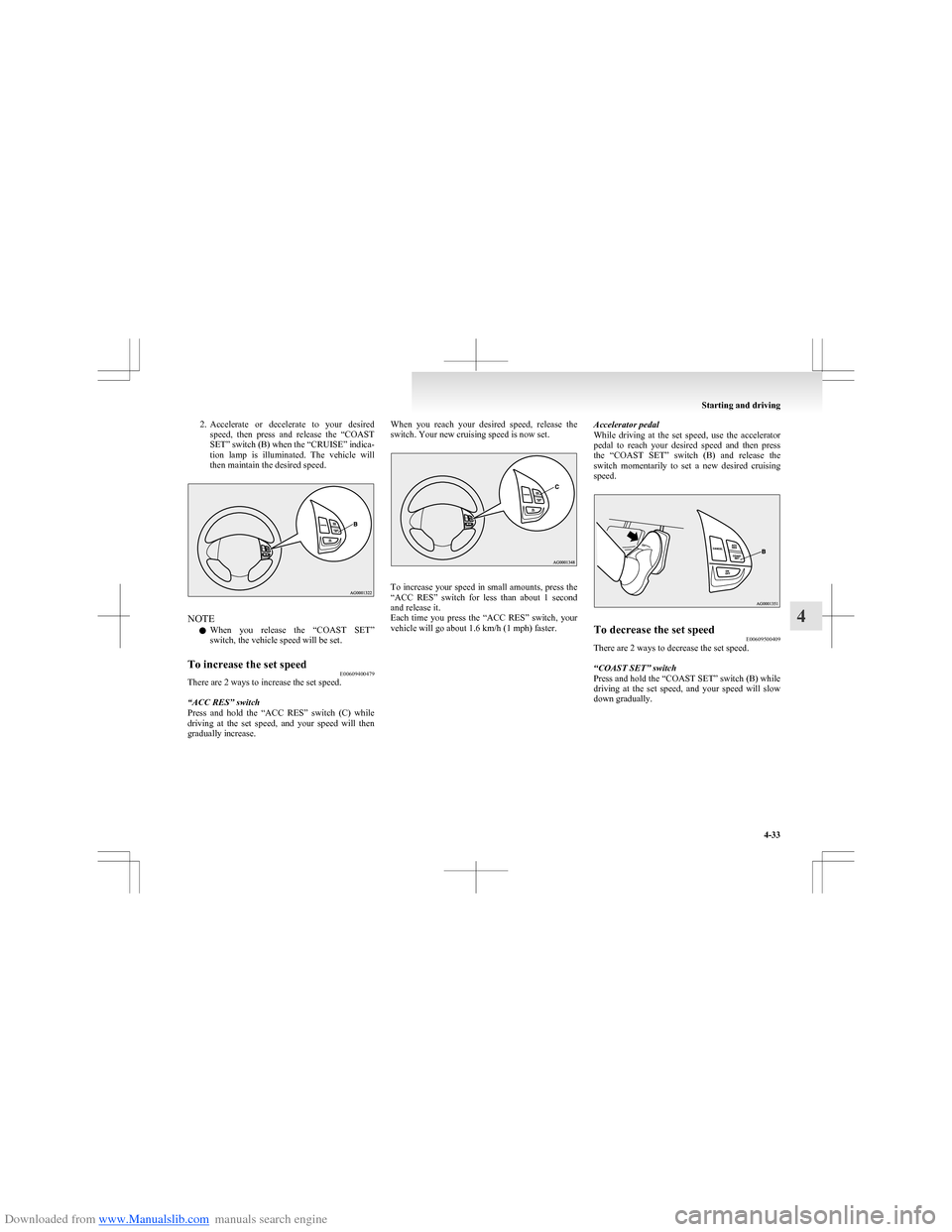
Downloaded from www.Manualslib.com manuals search engine 2.Accelerate or decelerate to your desired
speed, then press and release the “COAST
SET” switch (B) when the “CRUISE” indica-
tion lamp is illuminated. The vehicle will
then maintain the desired speed.
NOTE
l When you release the “COAST SET”
switch, the vehicle speed will be set.
To increase the set speed E00609400479
There are 2 ways to increase the set speed.
“ACC RES” switch
Press and hold the “ACC RES” switch (C) while
driving at the set speed, and your speed will then
gradually increase.
When you reach your desired speed, release the
switch. Your new cruising speed is now set.
To increase your speed in small amounts, press the
“ACC RES” switch for less than about 1 second
and release it.
Each time you press the “ACC RES” switch, your
vehicle will go about 1.6 km/h (1 mph) faster.
Accelerator pedal
While driving at the set speed, use the accelerator
pedal to reach your desired speed and then press
the “COAST SET” switch (B) and release the
switch momentarily to set a new desired cruising
speed.To decrease the set speed E00609500409
There are 2 ways to decrease the set speed.
“COAST SET” switch
Press and hold the “COAST SET” switch (B) while
driving at the set speed, and your speed will slow
down gradually.
Starting and driving
4-33
4
Page 144 of 273

Downloaded from www.Manualslib.com manuals search engine Foot/Face position
Air flows to the upper part of the passenger com-
partment, and flows to the leg area.* : Optional equipment
NOTE
l When the dial is set to position (1), air flows
mostly to the upper part of the passenger com-
partment. In position (2), air flows mostly to
the leg area.
Foot position
Air flows mainly to the leg area.* : Optional equipmentFoot/Demister position
Air flows to the leg area, the windscreen and the
door windows.* : Optional equipment
NOTE
l With the dial set to position (1), air flows
mostly to the leg area. In position (2), air
flows mostly to the windscreen.
For pleasant driving
5-03
5
Page 145 of 273

Downloaded from www.Manualslib.com manuals search engine Demister position
Air flows mainly to the windscreen and the door
windows.Demister/Face position
Air flows to the windscreen, the door windows and
the upper part of the passenger compartment.
NOTE
l With the dial set to position (1), air flows
mostly to the windscreen. In position (2), air
flows mostly to the upper part of the passen-
ger compartment.
Heater* E00700500090
The heater can only be used while the engine is run-
ning.Control panel E00700600495
A- Temperature control dial
B- Blower speed selection dial
C- Rear window demister switch ® p. 3-29
D- Mode selection dial E- Air selection switch
Blower speed selection dial E00700700210
Select the blower speed by turning the blower
speed selection dial clockwise or anticlockwise.
The blower speed will gradually increase as the di-
al is turned to the right.
For pleasant driving
5-04
5
Page 152 of 273

Downloaded from www.Manualslib.com manuals search engine 3.Select your desired blower speed by turning
the blower speed selection dial.
4. Select your desired temperature by turning
the temperature control dial.
5. Push the air conditioning switch (B).
For quick demisting
1. Set the mode selection dial to the position
shown in the illustration.
2. Set your blower to the maximum speed.
3. Set the temperature to the highest position.
NOTE l While the mode selection dial is set to the po-
sition shown in the illustration, the air condi-
tioning will operate automatically and the out-
side air position will also be selected automat-
ically. (In this case, the air conditioning indi-
cator will not change)
l To demist effectively, direct the air flow
from the side ventilators towards the door win-
dows.
l Do not set the temperature control dial to the
max. cool position. Cool air will blow
against the window glasses and form mist on
them.
l For Clear Tec models, if the mode selection
dial is set to the demister position shown in
the illustration (within ±15° of the center),
the Auto Stop & Go (AS&G) system will not
operate and the engine will not stop automat-
ically even if the vehicle is stopped. This is
to ensure that good visibility is maintained.Important operation tips for the
air conditioning E00708300948
l Park the vehicle in the shade.
Parking in the hot sun will make the vehicle
inside extremely hot, and it will require more
to cool the interior.
If it is necessary to park in the sun, open the
windows for the first few minutes of air con-
ditioning operation to expel the hot air.
l Close the windows when the air conditioning
is in use.
The entry of outside air through open win-
dows will reduce the cooling efficiency.
l Too much cooling is not good for the health.
The inside air temperature should only be 5
to 6 °C below the outside air temperature.
l When operating the system, make sure the
air intake, which is located in front of the
windscreen, is free of obstructions such as
leaves and snow. Leaves collected in the air-
intake plenum may reduce air flow and plug
the plenum water drains.
Air conditioning system refrigerant
and lubricant recommendations
If the air conditioning seems less effective than usu-
al, the cause might be a refrigerant leak. We recom-
mend you to have the system inspected.
The air conditioning system in your vehicle must
be charged with the refrigerant HFC-134a and the
lubricant SUN-PAG56.
Use of any other refrigerant or lubricant will cause
severe damage which will result in the need to re-
place your vehicle’s entire air conditioning system.
The release of refrigerant into the atmosphere
should be prevented.
For pleasant driving
5-11
530°