2009 MITSUBISHI COLT ECU
[x] Cancel search: ECUPage 60 of 273

Downloaded from www.Manualslib.com manuals search engine To install1.Insert the child restraint system’s connectors
(A) into the slit (B) in accordance with the in-
structions provided by the child restraint sys-
tem’s manufacturer.
A- Connector B- Slit
C- Vehicle seatback
D- Vehicle seat cushion E- Lower anchorage
2.Remove the head restraint from the location
in which you wish to install a child restraint.
3. Latch the tether strap hook (F) of the child
seat to the tether anchorage bar (G) and tight-
en the top tether strap hook so it is securely
fastened.
4. Push and pull the child restraint system in all
directions to be sure it is firmly secured.
WARNINGl If there is any foreign material in or
around the connectors, remove it before
installing the child restraint system. Also,
make sure the seat belt is away from, not
looped through or otherwise interfering
with, the child restraint system. If foreign
matter is not removed and/or the seat
belt interferes with the child restraint sys-
tem, the child restraint system will not be
secured properly and could move for-
ward in the event of sudden braking or a
collision, seriously injuring the child and
possibly other vehicle occupants.WARNINGl When the vehicle is moving do not adjust
the seat where the child restraint system
is installed.
To remove
Remove the child restraint in accordance with the
instructions provided by the child restraint sys-
tem’s manufacturer.
Installing a child restraint system to a
3-point type seat belt (with emergency
locking mechanism) E00408700529Front passenger seat
Installation:
1.Fasten the seat belt to secure the child re-
straint system.
Make sure you hear a “click” when you in-
sert the latch plate in the buckle.
2. Remove all slack by using the locking clip.
3. Push and pull the child restraint in all direc-
tions to be sure it is secure.
Seat and seat belts
2-21
2
Page 106 of 273

Downloaded from www.Manualslib.com manuals search engine Safe driving techniquesE00600300390
Driving safety and protection against injury cannot
be fully ensured. However, we recommend that
you pay extra attention to the following:
Seat belts
Before starting the vehicle, make sure that you and
your passengers have fastened your seat belts.
Floor matsWARNINGl Keep floor mats clear of the pedals by cor-
rectly laying floor mats that are suitable
for the vehicle.
To prevent the floor mats from slipping
out position, securely retain them using
the hook etc.
Note that laying a floor mat over a pedal
or laying one floor mat on top of another
can obstruct pedal operation and lead to
a serious accident.Carrying children in the vehicle
l Never leave your vehicle unattended with the
key and children inside the vehicle. Children
may play with the driving controls and this
could lead to an accident.
l Make sure that infants and small children are
properly restrained in accordance with the
laws and regulations, and for maximum pro-
tection in case of an accident.
l Prevent children from playing in the luggage
compartment. It is quite dangerous to allow
them to play there while the vehicle is moving.
Loading luggage
When loading luggage, be careful not to load
above the height of seats. This is dangerous not on-
ly because rearward vision will be obstructed, but
also the luggage may be projected into the passen-
ger compartment under hard braking.
Starting and driving
4-03
4
Page 110 of 273
Downloaded from www.Manualslib.com manuals search engine ParkingE00600601521
Parking on a hill
To prevent the vehicle from rolling, follow these
procedures:
Parking on a downhill slope
Turn the front wheels towards the kerb and move
the vehicle forward until the kerb side wheel gently
touches the kerb.
Apply the parking brake and place the gearshift lev-
er into the “R” (Reverse) position (with manual
transmission) or the allshift lever into the “R” (Re-
verse) position (with automated manual transmis-
sion).
If necessary, apply chocks to wheels.
Parking on an uphill slope
Turn the front wheels away from the kerb and
move the vehicle back until the kerb side wheel gen-
tly touches the kerb.
Apply the parking brake and place the gearshift lev-
er into the 1 st
position (with manual transmission)
or the allshift lever into the “S” (Stand by) position
(with automated manual transmission).
If necessary, apply chocks to wheels.
NOTE l If your vehicle has an automated manual trans-
mission, place the allshift lever in the “S”
(Stand by) position or “R” (Reverse) position
before stopping the engine.
If you move the allshift lever after stopping
the engine, a gearshift will not take place.Parking with the engine running
Never leave the engine running while you take a
short sleep/rest. Also, never leave the engine run-
ning in a closed or poorly ventilated place.WARNINGl Leaving the engine running risks injury
or death from accidentally moving the
gearshift lever (manual transmission) or
the allshift lever (automated manual trans-
mission) or the accumulation of toxic ex-
haust fumes on the passenger compart-
ment.
Where you park
Your front bumper can be damaged if you scrape it
over kerbs or parking stop blocks. Be careful when
travelling up or down steep slopes where your bump-
er can scrape the road.
WARNINGl Do not park your vehicle in areas where
combustible materials such as dry grass
or leaves can come in contact with a hot
exhaust, since a fire could occur.
When leaving the vehicle
Always remove the key from the ignition switch
and lock all doors and the tailgate when leaving the
vehicle unattended.
Always try to park your vehicle in a well lit area.
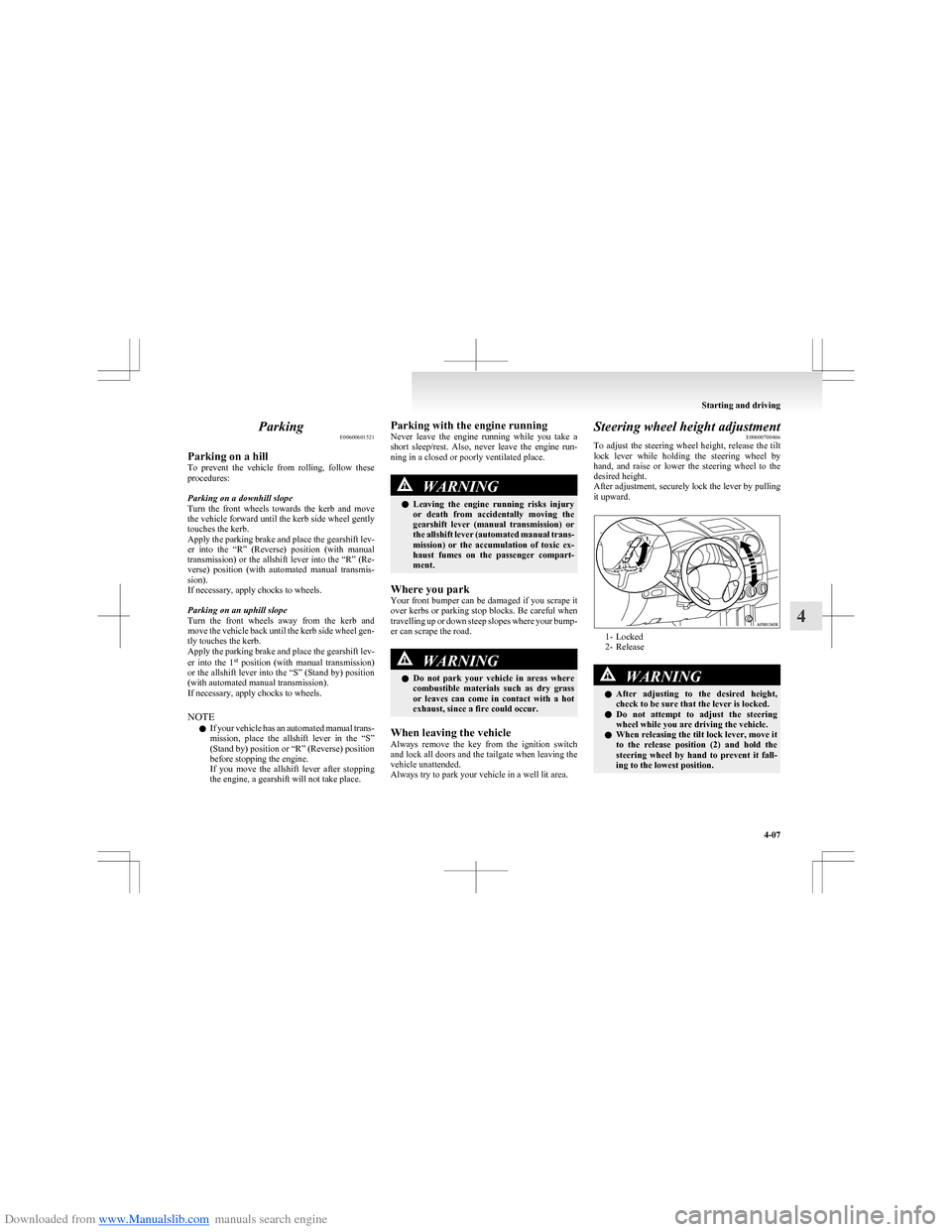
Steering wheel height adjustment E00600700466
To adjust the steering wheel height, release the tilt
lock lever while holding the steering wheel by
hand, and raise or lower the steering wheel to the
desired height.
After adjustment, securely lock the lever by pulling
it upward.
1- Locked
2- Release
WARNINGl After adjusting to the desired height,
check to be sure that the lever is locked.
l Do not attempt to adjust the steering
wheel while you are driving the vehicle.
l When releasing the tilt lock lever, move it
to the release position (2) and hold the
steering wheel by hand to prevent it fall-
ing to the lowest position.
Starting and driving
4-07
4
Page 127 of 273

Downloaded from www.Manualslib.com manuals search engine WARNINGlHard engine braking can cause the tyres
to slip on the road surface, possibly lead-
ing to a serious accident.Waiting E00613300059
1.With the allshift lever in the “S” (Stand by)
position, firmly depress the brake pedal.
2. If necessary, apply the parking brake.
CAUTIONl On an uphill slope, the transmission’s
creep effect may not stop the vehicle from
rolling backward if the brakes are not ap-
plied. There is no creep effect while
2 nd
gear is selected. When stopping, be
sure to depress the brake pedal and se-
curely apply the parking brake.
l Do not attempt to hold the vehicle in
place on an uphill road in 1st
gear by de-
pressing on the accelerator pedal. The
transmission could malfunction if you do.
3. When you are stationary for a long period
(for example, when stuck in a traffic jam),
place the allshift lever in the “N” (Neutral)
position.
CAUTIONl Continue to pay attention to the vehicle
while stationary. If you allow your atten-
tion to wander and the allshift lever is in
any position other than “N” (Neutral),
the vehicle could move suddenly and un-
expectedly.
4. When you are ready to start moving again,
first confirm that the allshift lever is in the
“S” (Stand by) position or “R” (Reverse) po-
sition and that an “A”, “1”, or “R” is shown
on the multi-information display.
NOTE l During vehicle operation, the transmission au-
tomatically shifts down when the vehicle
speed decreases. It selects 1st
gear just before
the vehicle reaches a standstill.
CAUTIONl The actions described below cause rapid
clutch wear and can cause clutch dam-
age. Do not perform them. •Depressing the brake and accelerator
pedals at the same time.
• Holding the vehicle in place on an up-
hill road by depressing the accelerator
pedal (and not depressing the brake
pedal) with 1 st
gear selected.Parking
E00613400034
1. Bring the vehicle to a complete stop.
2.While depressing the brake pedal, securely
apply the parking brake.
3. Move the allshift lever into the “S” (Stand
by) position when parking on an uphill
grade, into the “R” (Reverse) position when
parking on a downhill grade. And confirm
that there is an “A”, “1” or “R” in the multi-
information display.or
4. Stop the engine.
Starting and driving
4-24
4
Page 129 of 273

Downloaded from www.Manualslib.com manuals search engine WARNINGlDo not leave any objects near the brake
pedal or let a floor mat slide under it; do-
ing so could prevent the full pedal stroke
that would be necessary in an emergency.
Make sure that the pedal can be operated
freely at all times. Make sure the floor
mat is securely held in place.
Brake pads and linings
l With new brake pads or linings, avoid where
possible sudden full application of the brakes
for the first 200 km (124 miles) of driving.
l The disc brakes are provided with a warning
device which emits a shrieking metallic
sound while braking if the brake pads have
reached their wear limit.
If you hear this sound, have the brake pads re-
placed immediately.
WARNINGl Driving with worn brake pads will make
it harder to stop, and can cause an acci-
dent.Emergency stop signal system E00626000021
This is a device that reduces the possibility of rear
end collisions by the rapid and automatic blinking
of the hazard warning lamps to alert vehicles ap-
proaching from behind during sudden braking.
When the emergency stop signal system operates,
the hazard warning indication lamp in the instru-
ment cluster blinks rapidly at the same time.CAUTIONl If the ABS warning lamp or TCL/ASC in-
dication lamp is illuminated, the emergen-
cy stop signal system may not operate. Re-
fer to “ABS warning lamp” on page
4-28.
Refer to “Traction control system (TCL)/
Active stability control system (ASC) indi-
cation lamp” on page 4-31.
NOTE
l [
Activating condition for the emergency stop
signal system]
It activates when all of the following condi-
tions are met. •The vehicle speed is approximately
55 km/h (34 mph) or higher.
• The brake pedal has been depressed, and
the system judges that it was sudden brak-
ing from the vehicle deceleration and the
operating condition of the anti-lock brake
system (ABS).
[ Deactivating condition for the emergency
stop signal system]
It deactivates when one of the following con-
ditions is met. • The brake pedal is released.
• The hazard warning flasher switch is
pressed.
• The system judges that it was not sudden
braking from the vehicle deceleration and
the operating condition of the anti-lock
brake system (ABS).
Starting and driving
4-26
4
Page 182 of 273

Downloaded from www.Manualslib.com manuals search engine NOTEl Fit the stoppers (C) on the bottom of the lug-
gage floor lid into the groove (D) in the sup-
port.Luggage floor boxes E00718700554
The box for storing articles is located inside the lug-
gage compartment.
3-door models5-door models
1- Luggage floor box (Front)
2- Luggage floor box (Rear)
NOTE l For vehicles with the luggage floor lid (5-
door models), securely retain the lid before
raising the luggage floor boards. Refer to
“ Luggage floor lid (5-door models)” on page
5-40.
To use
Raise the luggage floor board.
3-door models5-door models
For pleasant driving
5-41
5
Page 193 of 273

Downloaded from www.Manualslib.com manuals search engine 3.On vehicles with manual transmission, turn
the ignition key to the “LOCK” position,
move the gearshift lever to the “R” (Reverse)
position.
On vehicles with automated manual transmis-
sion, move the allshift lever to the “R” (Re-
verse) position, turn the ignition key to the
“LOCK” position.
With an automated manual transmission ve-
hicle, confirm that that “R” is shown by the
allshift indicator display.
4. Turn on the hazard warning flashers and set
up a warning triangle, flashing signal lamp,
etc., at an adequate distance from the vehi-
cle, and have all your passengers leave the ve-
hicle.
5. Take out the tyre sealant bottle and the com-
pressor.
NOTE l In cold conditions (when the ambient temper-
ature is 0 °C or lower). Warm the bottle in-
side the vehicle.
6. Shake the tyre sealant bottle (C) well.7. Take the valve cap (D) off the tyre valve (E).
8. Unwind the bottle hose (F) from around the
bottle (G).
9. Pull out the compressor’s hose (H) from the
bottom of the compressor and securely attach
it to the valve (I) of the bottle.
10. Install the bottle (J) onto the compressor (K).
NOTE
l When installing the bottle, align the projec-
tion (L) on the bottle with the indentation
(M) in the compressor.
11. Securely attach the bottle hose (F) to the tyre
valve (N).
For emergencies
6-08
6
Page 199 of 273

Downloaded from www.Manualslib.com manuals search engine CAUTIONlThe compact spare tyre should not be
used on any other wheels, nor should
standard tyres, snow tyres, wheel covers
or trim rings be used with the compact
spare wheel. If such use is attempted, dam-
age to these items or other vehicle compo-
nents may occur.
l Upon installation of the compact spare
tyre, the overall vehicle height is lowered
slightly as the tyre is smaller in diameter
than the standard tyre. When passing
over the projections on the road, take
care not to drive the vehicle with the
same feeling as used in driving with the
standard tyre on.
l Do not install more than one compact
spare wheel at the same time.
l When the tread wear indicators appear,
the tyre must be replaced.
Refer to “Wheel condition” on page 8-13.To remove
1.For vehicles with luggage floor lid, open the
luggage floor cargo lid.
Refer to “Luggage floor lid” on page 5-40.
2. Lift the carpet, then remove the luggage
floor boards (A).
3. Remove the clamp (B) which secures the
spare wheel by turning it anticlockwise. Take
out the spare wheel.
To install
To install the spare wheel, tighten the clamp by turn-
ing it clockwise until the spare wheel cannot move.
For emergencies
6-14
6