2009 MERCEDES-BENZ E-CLASS SALOON light
[x] Cancel search: lightPage 309 of 373

Overview: changing bulbs/bulb types
You can replace the following bulbs: Halogen headlamps Bulb type
:
Dipped-beam headlamps 45
: H7 55 W
; Main-beam headlamp: H7 55 W
= Side lamp/parking lamp: W 5 W
? Turn signal lamp 45
: PY 21 W Bi-xenon headlamps* Bulb type
:
Cornering light*: H7 55 W
; Infrared light* (Night View Assist Plus*):
H11 55 W Changing bulbs
Dipped-beam headlamps (halogen
headlamps) Due to their location, have the bulbs in the
left-hand headlamp changed at a qualified
specialist workshop, e.g. a Mercedes-Benz
Service Centre.
X Switch off the lights.
X Open the bonnet.
X Turn housing cover :anti-clockwise and
remove it.
X Turn bulb holder ;anti-clockwise and
remove it.
X Remove the bulb from bulb holder ;.
X Insert the new bulb into bulb holder ;.
45 Due to their location, have the bulbs in the left-hand headlamp changed at a qualified specialist workshop,
e.g. a Mercedes-Benz Service Centre. 306
Changing bulbsPractical advice
* optional
212_AKB; 2; 4, en-GB
mkalafa,
Version: 2.11.8.1 2009-05-05T14:17:16+02:00 - Seite 306
Dateiname: 6515346702_buchblock.pdf; erzeugt am 07. May 2009 14:17:18; WK
Page 310 of 373

X
Insert bulb holder ;and turn it clockwise.
X Align housing cover :and turn it clock-
wise.
Main-beam headlamps (halogen head-
lamps)/cornering lamp* (Intelligent
Light System*) X
Switch off the lights.
X Open the bonnet.
X Turn housing cover :anti-clockwise and
remove it.
X Turn bulb holder ;anti-clockwise and
remove it.
X Remove the bulb from bulb holder ;.
X Insert the new bulb into bulb holder ;.
X Insert bulb holder ;and turn it clockwise.
X Align housing cover :and turn it clock-
wise.
Side lamp/parking lamp (halogen head-
lamps) X
Switch off the lights.
X Open the bonnet.
X Turn housing cover :anti-clockwise and
remove it.
X Pull out bulb holder ;.
X Remove the bulb from bulb holder ;.
X Insert the new bulb into bulb holder ;.
X Insert bulb holder ;.
X Align housing cover :and turn it clock-
wise.
Infrared light* (Night View Assist
Plus*) X
Switch off the lights.
X Open the bonnet.
X Turn housing cover :anti-clockwise and
remove it.
X Turn bulb ;anti-clockwise and remove it.
X Insert new bulb ;and turn it clockwise.
X Align housing cover :and turn it clock-
wise. Changing bulbs
307Practical advice
* optional
212_AKB; 2; 4, en-GB
mkalafa
,V ersion: 2.11.8.1
2009-05-05T14:17:16+02:00 - Seite 307 Z
Dateiname: 6515346702_buchblock.pdf; erzeugt am 07. May 2009 14:17:19; WK
Page 311 of 373

Turn signal lamp (halogen headlamps)
Due to their location, have the bulbs in the
left-hand headlamp changed at a qualified
specialist workshop, e.g. a Mercedes-Benz
Service Centre.
X Switch off the lights.
X Open the bonnet.
X Turn bulb holder :anti-clockwise and
remove it.
X Turn the bulb anti-clockwise, applying
slight pressure, and remove it from bulb
holder :.
X Insert the new bulb into bulb holder :and
turn it clockwise.
X Insert bulb holder :and turn it clockwise. Replacing the wiper blades
Windscreen wiper blades
G
Risk of accident
The windscreen will no longer be wiped prop-
erly if the wiper blades are worn. This could
prevent you from observing the traffic condi-
tions, thereby causing an accident. Replace
the wiper blades twice a year, ideally in spring
and autumn. G
Risk of accident
The wiper arms could start moving and cause
an injury if you leave the windscreen wipers
switched on. Remove the key from the ignition lock before
replacing the wiper blades.
! To avoid damaging the windscreen wiper
blades, make sure that you touch only the
wiper arm of the windscreen wiper.
To remove X
Remove the key from the ignition lock or
turn the key to position 0(KEYLESS GO).
X Fold the wiper arm away from the wind-
screen until it engages.
X Set the wiper blade at right angles to the
wiper arm. X
Remove the wiper blade from the retainer
on the wiper arm in the direction of the
arrow.
Fitting !
The two wiper blades are different
lengths. If you swap the wiper blades they
may scratch the windscreen. Make sure
that the longer wiper blade is fitted on the
driver's side.
X Compare the lengths of the two new wiper
blades.
X Slide the longer of the two new wiper
blades into the retainer on the wiper arm
on the driver's side in the opposite direc-
tion to the arrow.
X Repeat the same procedure on the front-
passenger's side with the shorter of the two
new wiper blades. 308
Replacing the
wiper bladesPractical advice
212_AKB; 2; 4, en-GB
mkalafa, Version: 2.11.8.1 2009-05-05T14:17:16+02:00 - Seite 308
Dateiname: 6515346702_buchblock.pdf; erzeugt am 07. May 2009 14:17:19; WK
Page 314 of 373
G
Risk of injury
Comply with the manufacturer's safety
instructions shown on the sticker on the elec-
tric air pump.
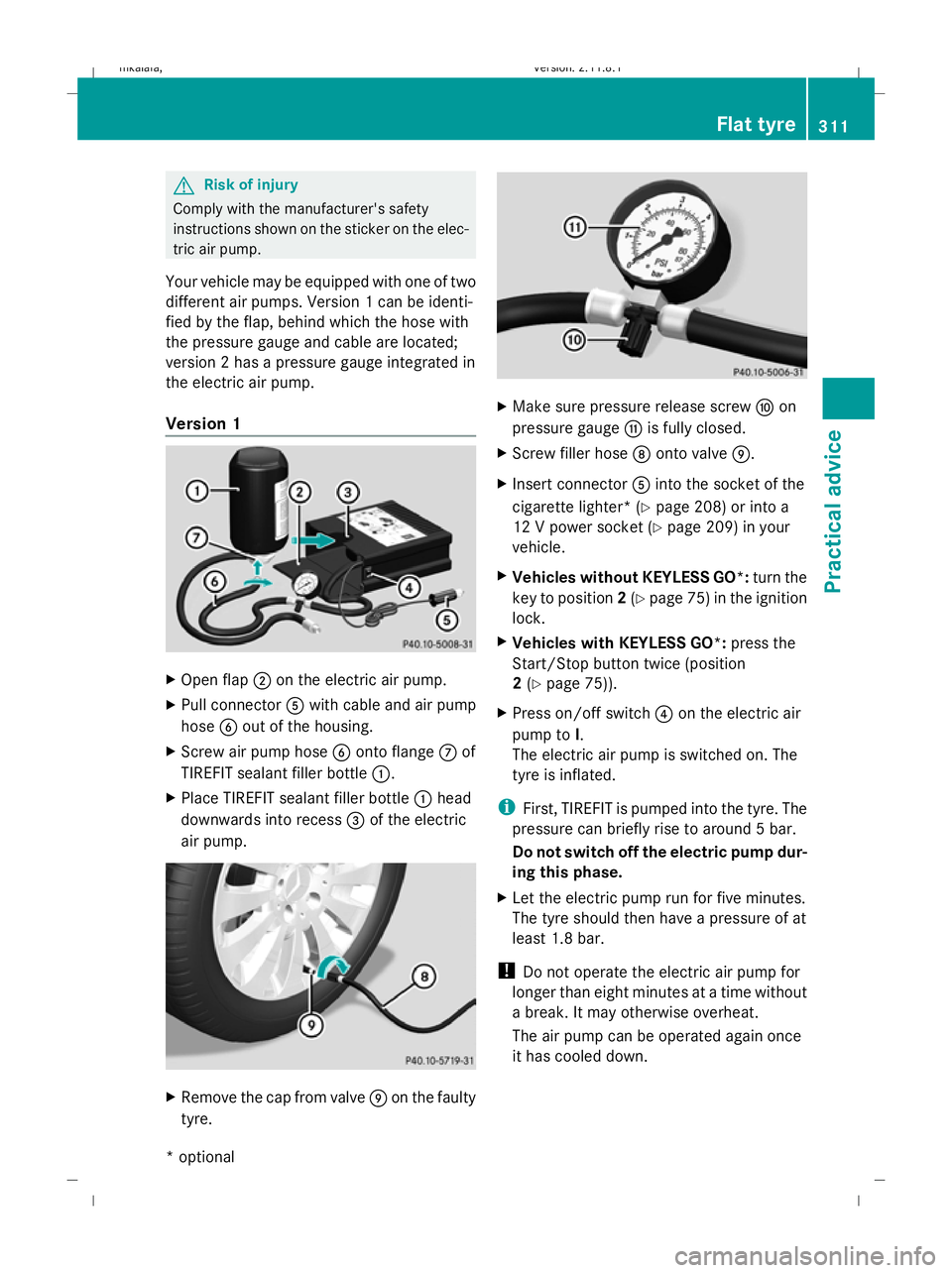
Your vehicle may be equipped with one of two
different air pumps. Version 1 can be identi-
fied by the flap, behind which the hose with
the pressure gauge and cable are located;
version 2 has a pressure gauge integrated in
the electric air pump.
Version 1 X
Open flap ;on the electric air pump.
X Pull connector Awith cable and air pump
hose Bout of the housing.
X Screw air pump hose Bonto flange Cof
TIREFIT sealant filler bottle :.
X Place TIREFIT sealant filler bottle :head
downwards into recess =of the electric
air pump. X
Remove the cap from valve Eon the faulty
tyre. X
Make sure pressure release screw Fon
pressure gauge Gis fully closed.
X Screw filler hose Donto valve E.
X Insert connector Ainto the socket of the
cigarette lighter* (Y page 208) or into a
12 V power socket ( Ypage 209) in your
vehicle.
X Vehicles without KEYLESS GO*: turn the
key to position 2(Y page 75) in the ignition
lock.
X Vehicles with KEYLESS GO*: press the
Start/Stop button twice (position
2 (Y page 75)).
X Press on/off switch ?on the electric air
pump to I.
The electric air pump is switched on. The
tyre is inflated.
i First, TIREFIT is pumped into the tyre. The
pressure can briefly rise to around 5 bar.
Do not switch off the electric pump dur-
ing this phase.
X Let the electric pump run for five minutes.
The tyre should then have a pressure of at
least 1.8 bar.
! Do not operate the electric air pump for
longer than eight minutes at a time without
a break. It may otherwise overheat.
The air pump can be operated again once
it has cooled down. Flat tyre
311Practical advice
* optional
212_AKB; 2; 4, en-GB
mkalafa
,V ersion: 2.11.8.1
2009-05-05T14:17:16+02:00 - Seite 311 Z
Dateiname: 6515346702_buchblock.pdf; erzeugt am 07. May 2009 14:17:21; WK
Page 316 of 373
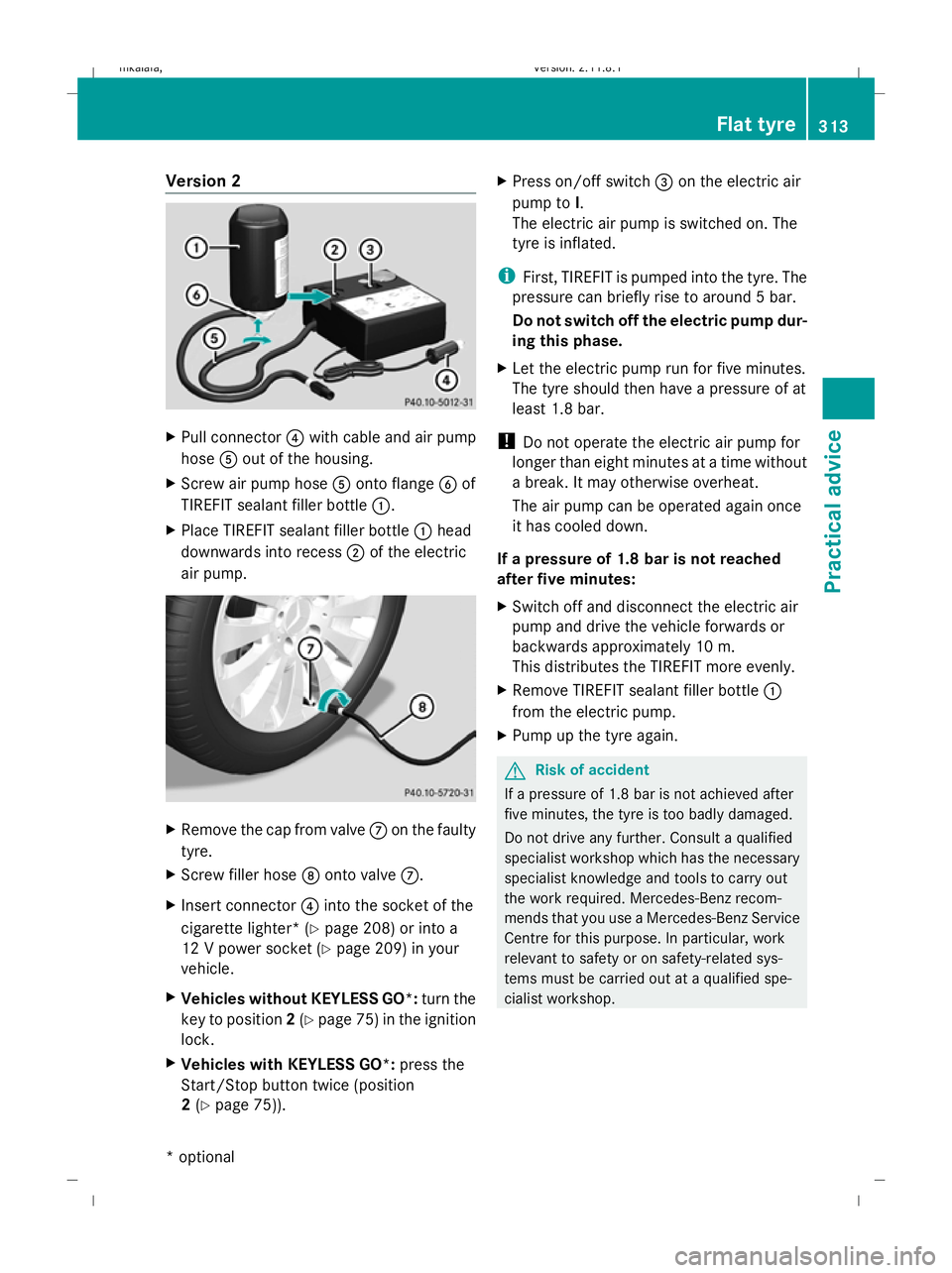
Version 2
X
Pull connector ?with cable and air pump
hose Aout of the housing.
X Screw air pump hose Aonto flange Bof
TIREFIT sealant filler bottle :.
X Place TIREFIT sealant filler bottle :head
downwards into recess ;of the electric
air pump. X
Remove the cap from valve Con the faulty
tyre.
X Screw filler hose Donto valve C.
X Insert connector ?into the socket of the
cigarette lighter* (Y page 208) or into a
12 V power socket ( Ypage 209) in your
vehicle.
X Vehicles without KEYLESS GO*: turn the
key to position 2(Y page 75) in the ignition
lock.
X Vehicles with KEYLESS GO*: press the
Start/Stop button twice (position
2 (Y page 75)). X
Press on/off switch =on the electric air
pump to I.
The electric air pump is switched on. The
tyre is inflated.
i First, TIREFIT is pumped into the tyre. The
pressure can briefly rise to around 5 bar.
Do not switch off the electric pump dur-
ing this phase.
X Let the electric pump run for five minutes.
The tyre should then have a pressure of at
least 1.8 bar.
! Do not operate the electric air pump for
longer than eight minutes at a time without
a break. It may otherwise overheat.
The air pump can be operated again once
it has cooled down.
If a pressure of 1.8 bar is not reached
after five minutes:
X Switch off and disconnect the electric air
pump and drive the vehicle forwards or
backwards approximately 10 m.
This distributes the TIREFIT more evenly.
X Remove TIREFIT sealant filler bottle :
from the electric pump.
X Pump up the tyre again. G
Risk of accident
If a pressure of 1.8 bar is not achieved after
five minutes, the tyre is too badly damaged.
Do not drive any further. Consult a qualified
specialist workshop which has the necessary
specialist knowledge and tools to carry out
the work required. Mercedes-Benz recom-
mends that you use a Mercedes-Benz Service
Centre for this purpose. In particular, work
relevant to safety or on safety-related sys-
tems must be carried out at a qualified spe-
cialist workshop. Flat tyre
313Practical advice
* optional
212_AKB; 2; 4, en-GB
mkalafa,
Version: 2.11.8.1 2009-05-05T14:17:16+02:00 - Seite 313 Z
Dateiname: 6515346702_buchblock.pdf; erzeugt am 07. May 2009 14:17:21; WK
Page 318 of 373
G
Risk of accident
Have the collapsible emergency spare
wheel *replaced with a new wheel as soon as
possible at a qualified specialist workshop
which has the necessary specialist knowledge
and tools to carry out the work required.
Mercedes-Benz recommends that you use a
Mercedes-Benz Service Centre for this pur-
pose. In particular, work relevant to safety or
on safety-related systems must be carried out
at a qualified specialist workshop.
Preparing the vehicle i
Vehicles without a spare wheel* are not
equipped with a vehicle tool kit at the fac-
tory. For more information on which tools
are required to perform a wheel change on
your vehicle, e.g. wheel chock, jack, cen-
tring pin or wheel wrench, consult a
Mercedes-Benz Service Centre.
X Prepare the vehicle as described
(Y page 309).
X If a trailer is coupled, uncouple it.
X Place the wheels in the straight-ahead posi-
tion.
X Remove the following items from the stow-
age well under the boot/luggage compart-
ment floor:
R the "Minispare" emergency spare
wheel*
R the vehicle tool kit
R the folding wheel chock
R the jack
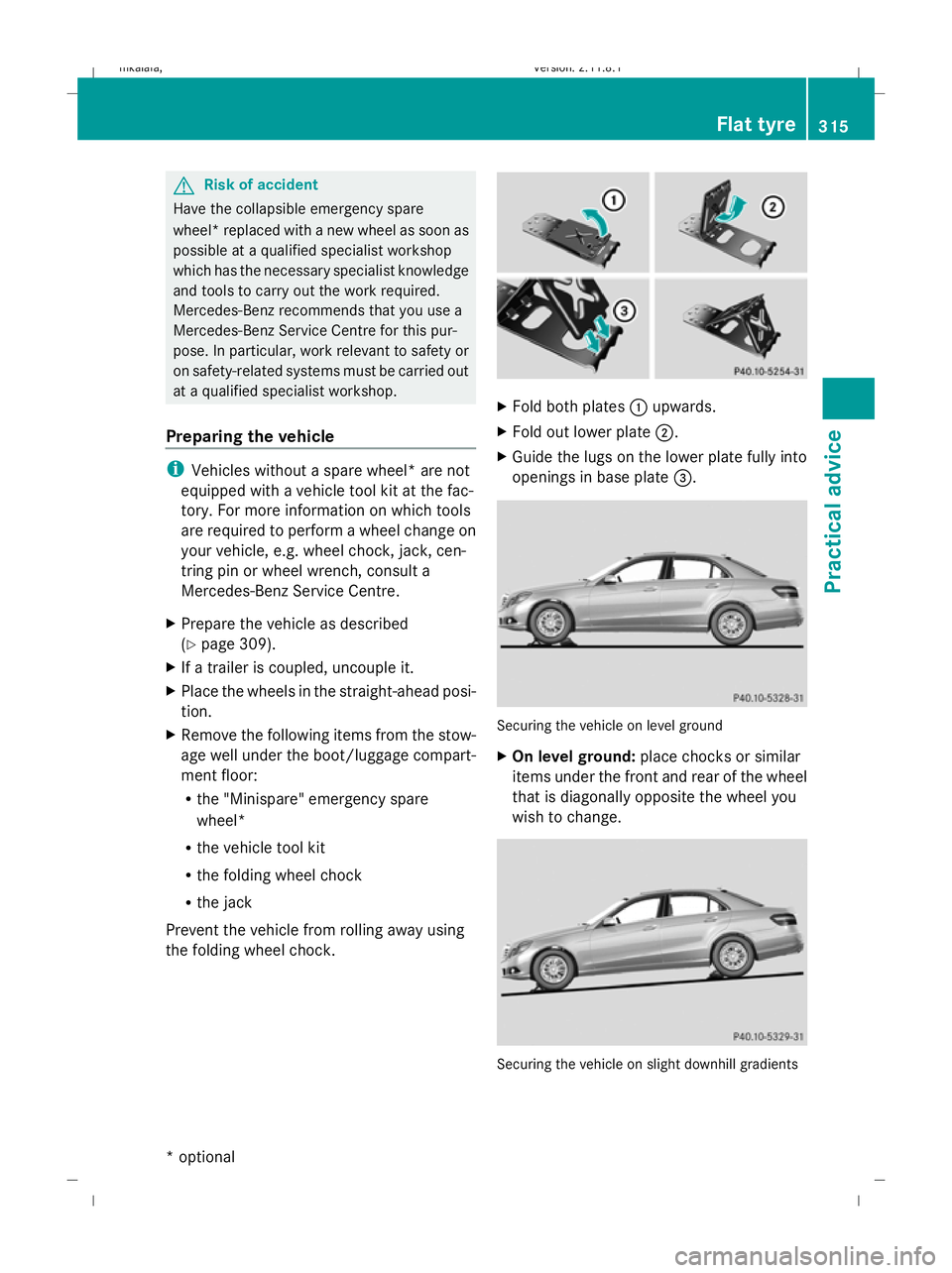
Prevent the vehicle from rolling away using
the folding wheel chock. X
Fold both plates :upwards.
X Fold out lower plate ;.
X Guide the lugs on the lower plate fully into
openings in base plate =. Securing the vehicle on level ground
X
On level ground: place chocks or similar
items under the front and rear of the wheel
that is diagonally opposite the wheel you
wish to change. Securing the vehicle on slight downhill gradients Flat tyre
315Practical advice
* optional
212_AKB; 2; 4, en-GB
mkalafa,
Version: 2.11.8.1 2009-05-05T14:17:16+02:00 - Seite 315 Z
Dateiname: 6515346702_buchblock.pdf; erzeugt am 07. May 2009 14:17:22; WK
Page 338 of 373

R
at very low temperatures
R in urban traffic
R on short trips
R when towing a trailer
R in mountainous terrain
i Only for certain countries: the respective
current consumption and emission values
of your vehicle can be found in the COC
papers (EC CERTIFICATE OF CONFORM-
ITY). These documents are supplied when
the vehicle is delivered.
The consumption figures for vehicles falling
under the EURO4 standard have been
determined in accordance with EU Direc-
tive 80 /1268 /EEC while figures for vehi-
cles falling under the EURO5 standard have
been determined in accordance with Reg-
ulation (EC) No. 715 / 2007, in each case
based on the currently applicable version.
The values do not refer to a specific vehicle.
Deviations from these values may occur
under normal operating conditions.
! Do not use any special additives, as they
can cause malfunctions and engine dam-
age. Damage resulting from the use of such
additives is not covered by the Mercedes-
Benz implied warranty. H
Environmental note
CO 2(carbon dioxide) is the gas which scien-
tists believe to be principally responsible for
global warming (the greenhouse effect). Your
vehicle's CO 2emissions are directly related to
fuel consumption and therefore depend on:
R efficient use of the fuel by the engine
R driving style
R other non-technical factors, such as envi-
ronmental influences or road conditions
You can minimise your vehicle's CO 2emis-
sions by driving carefully and having it serv-
iced regularly. AdBlue
®
i For BlueTEC vehicles only.
AdBlue ®
is a non-flammable, non-toxic, col-
ourless and odourless water-soluble fluid.
! Only use AdBlue ®
compliant with ISO
22241. The use of special additives is not
permitted.
! Surfaces, such as carpets or paintwork,
which come into contact with AdBlue ®
while refilling should be rinsed immediately
with plenty of water. Immediately after
spilling, remove AdBlue ®
using a damp
cloth and cold water. If AdBlue ®
has
already crystallised, use a sponge and hot
water to clean it off. AdBlue ®
residues crys-
tallise after a certain period of time and soil
the affected surfaces.
High outside temperatures If AdBlue
®
is heated to above 50 † for an
extended period of time, e.g. as a result of
direct sunlight on the AdBlue ®
tank,
AdBlue ®
may decompose. Ammonia vapours
develop as a result. G
Risk of injury
Ammonia vapours may escape if the
AdBlue ®
tank cap is opened at high tempera-
tures. Ammonia vapours have a pungent
odour and are particularly irritating to the
skin, to mucous membranes and to the eyes.
You may experience a burning sensation in
your eyes, nose and throat, as well as cough-
ing and watering of the eyes.
Do not inhale ammonia vapours.
Low outside temperatures AdBlue
®
freezes at a temperature of approx-
imately –11 †. The vehicle is equipped with
an AdBlue ®
preheating system at the factory.
Winter operation is therefore also guaranteed
at temperatures below –11 †. Service products and capacities
335Technical data
212_AKB; 2; 4, en-GB
mkalafa,V ersion: 2.11.8.1
2009-05-05T14:17:16+02:00 - Seite 335 Z
Dateiname: 6515346702_buchblock.pdf; erzeugt am 07. May 2009 14:17:32; WK
Page 353 of 373

Tyres
Tyres of the same dimensions Saloon
i
BA: Both axles E 200 CDI
BlueEFFICIENCY /
E 200 CGI
BlueEFFICIENCY /
E 220 CDI
BlueEFFICIENCY / E 250 CGI
BlueEFFICIENC
Y /
E 300 69
/
E 350 CGI
BlueEFFICIENCY /
E 250 CDI
BlueEFFICIENCY /
E 350 CDI
BlueEFFICIENCY /
E 350 BlueTEC 16" BA Summer tyres
205/60 R16 92W –
Winter tyres
205/60 R16 92H
M+S
i –
Light-alloy wheels
7.0J x 16 H2 ET 38 –
16" BA Summer tyres
225/55 R16 95W 225/55 R16 95W
Winter tyres
225/55 R16 95H
M+S
i 225/55 R16 95H
M+S
i Light-alloy wheels
7.5J x 16 H2 ET 45.5 or
8.0J x 16 H2 ET 46 7.5J x 16 H2 ET 45.5 or
8.0J x 16 H2 ET 46
69
Only for certain countries. 350
Tyres and wheelsTechnical data
212_AKB; 2; 4, en-GB
mkalafa,
Version: 2.11.8.1 2009-05-05T14:17:16+02:00 - Seite 350
Dateiname: 6515346702_buchblock.pdf; erzeugt am 07. May 2009 14:17:35; WK