Page 125 of 490

124
2-1. Driving procedures
08_IS350/250_U_(L/O_0808)
NOTICE
■When driving the vehicleWith automatic transmission vehicles
●Do not use the accelerator pedal or depress accelerator and brake pedals
together to hold the vehicle on a hill.With manual transmission vehicles
●Do not rest your foot on the clutch pedal while driving.
Doing so may cause clutch trouble.
●Do not use any gears other than the first gear when starting off and moving for-
ward.
Doing so may damage the clutch.
●Do not use the clutch to hold the vehicle when stopping on an uphill grade.
■When parking the vehicle
With automatic transmission vehicles, always put the shift lever in P. Failure to do so
may cause the vehicle to move or the vehicle may accelerate suddenly if the accel-
erator pedal is accidentally depressed.
■Avoiding damage to vehicle parts
●Do not turn the steering wheel fully in either direction and hold it there for a long
time.
Doing so may damage the power steering motor.
●When driving over bumps in the road, drive as slowly as possible to avoid damag-
ing the wheels, underside of the vehicle, etc.
Page 127 of 490
126
2-1. Driving procedures
08_IS350/250_U_(L/O_0808)
Engine (ignition) switch
Performing the following operations when carrying the electronic key on
your person starts the engine or changes “ENGINE START STOP” switch
modes.
■ Starting the engine
Automatic transmission
Check that the parking brake is set.
Check that the shift lever is set in P.
Sit in the driver’s seat and firmly depress the brake pedal.
The “ENGINE START STOP” switch indicator turns green.
Press the “ENGINE START
STOP” switch.
The engine will crank until it
starts or for up to 30 seconds,
whichever is less.
Continue depressing the brake
pedal until the engine is com-
pletely started.
The engine can be started from
any mode.
STEP1
STEP2
STEP3
STEP4
Page 129 of 490
128
2-1. Driving procedures
08_IS350/250_U_(L/O_0808)
■Changing “ENGINE STAR T STOP” switch mode
Modes can be changed by pressing the “ENGINE START STOP”
switch with the brake pedal (vehicles with an automatic transmission)
or clutch pedal (vehicles with a manual transmission) released. (The
mode changes each time the switch is pressed.)
OFF*
Emergency flashers can be
used.
ACCESSORY mode
Some electrical components
such as the audio system can be
used.
The “ENGINE START STOP”
switch indicator turns amber.
IGNITION ON mode
All electrical components can
be used.
The “ENGINE START STOP”
switch indicator turns amber.
*: If the shift lever is in a positionother than P when turning off
the engine, the “ENGINE
START STOP” switch will be
turned to ACCESSORY mode,
not to OFF. (vehicles with an
automatic transmission)
Page 130 of 490

129
2-1. Driving procedures
2
When driving
08_IS350/250_U_(L/O_0808)
■If the engine does not start
The engine immobilizer system may not have been deactivated. (
�P. 7 7 )
■When the steering lock cannot be released
■When the “ENGINE START STOP” switch indicator flashes in amber
The system may be malfunctioning. Have the vehicle inspected by your Lexus
dealer immediately.
■Auto power off function
If the vehicle is left in ACCESSORY mode for more than an hour with the shift lever
in P (vehicles with an automatic transmission), the “ENGINE START STOP” switch
will automatically turn OFF.
■Electronic key battery depletion
�P. 3 0
■When the electronic key battery is fully discharged
�P. 3 4 5
■Conditions affecting operation
�P. 2 8
■Note for the entry function
�P. 3 1The “ENGINE START STOP” switch indica-
tor will flash in green and a message will be
shown on the multi-information display. Press
the “ENGINE START STOP” switch again
while turning the steering wheel left and right.
Page 132 of 490
131
2-1. Driving procedures
2
When driving
08_IS350/250_U_(L/O_0808)
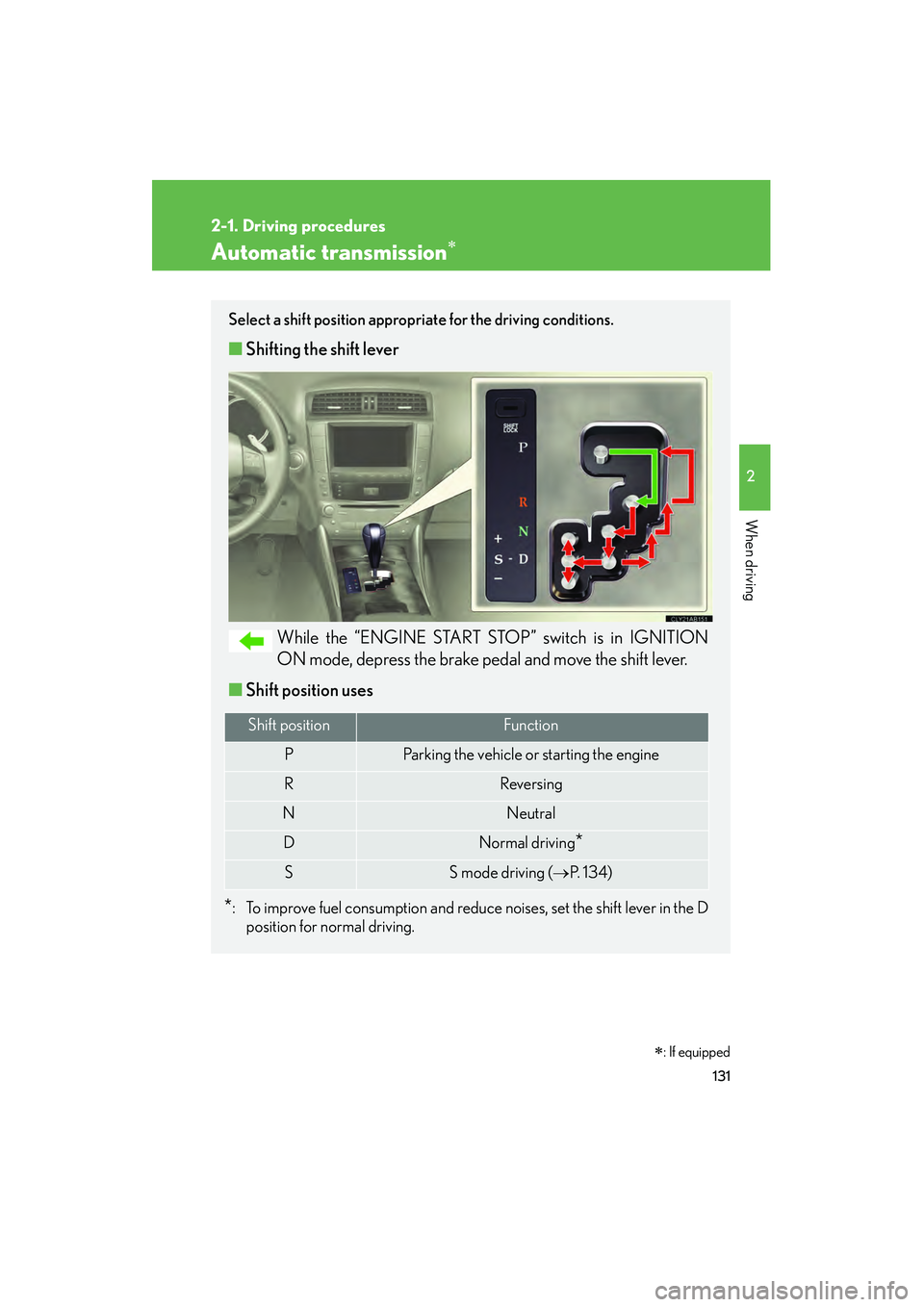
Automatic transmission�
Select a shift position appropriate for the driving conditions.
■Shifting the shift lever
While the “ENGINE START STOP” switch is in IGNITION
ON mode, depress the brake pedal and move the shift lever.
■ Shift position uses
*: To improve fuel consumption and reduce noises, set the shift lever in the D
position for normal driving.
Shift positionFunction
PParking the vehicle or starting the engine
RReversing
NNeutral
DNormal driving*
SS mode driving (�P. 1 3 4 )
�: If equipped
Page 137 of 490
136
2-1. Driving procedures
08_IS350/250_U_(L/O_0808)
■If does not come on even after shifting the shift lever to S
This may indicate a malfunction in the automatic transmission system. Have the
vehicle inspected by your Lexus dealer immediately.
(In this situation, the vehicle will operate as if the shift lever is in D.)
■AI-SHIFT
The AI-SHIFT automatically shifts the gear to the optimal position according to the
driver performance and driving conditions.
The AI-SHIFT automatically operates when the shift lever is in the D position. How-
ever, operating the “-” shift paddle switch will restrict the function’s operation. (Shift-
ing the shift lever to the S position cancels the function.)
CAUTION
■When driving on slippery road surfaces
Be careful of downshifting and sudden acceleration, as this could result in the vehi-
cle skidding to the side or spinning.
Page 141 of 490
140
2-1. Driving procedures
08_IS350/250_U_(L/O_0808)
Parking brake
NOTICE
■Before driving
Fully release the parking brake.
Driving the vehicle with the parking brake set will lead to brake components over-
heating, which may affect braking performance and increase brake wear.
Vehicles with an automatic transmissionSets the parking brake
*
(Depressing the pedal again
releases the parking brake.)
*: Fully depress the parkingbrake pedal with your left
foot while depressing the
brake pedal with your right
foot.
Vehicles with a manual transmission
Sets
the parking brake
Fully set the parking brake while depressing the brake pedal.
Releases the parking brake
Slightly raise the lever and lower it completely while pressing the button.
Canada U.S.A.
Canada
U.S.A.
Page 150 of 490
149
2-2. Instrument cluster
2
When driving
08_IS350/250_U_(L/O_0808)
■Indicators
The indicators inform the driver of the operating state of the vehi-
cle’s various systems.
Turn signal indicator
(
�P. 1 3 9 )(vehicles with
an automatic
transmission)
“ECT SNOW” indicator
(
�P. 1 3 2 )
Headlight high beam indi-
cator (
�P. 1 5 6 )(vehicles with
a manual
transmission)
“ETCS SNOW” indicator
(
�P. 1 3 8 )
(U.S.A.)
Headlight indicator
(
�P. 1 5 6 )(vehicles with
an automatic
transmission)
“ECT PWR” indicator
(
�P. 1 3 2 )
(Canada)
Tail light indicator
(
�P. 1 5 6 )
Cruise control indicator
(
�P. 166)
Front fog light indicator
(
�P. 1 5 9 ) (if equipped)
“AFS OFF” indicator light
(
�P. 1 5 7 )
(vehicles with an automatic trans-
mission)
Shift position and shift range indica-
tors (
�P. 131)
(if equipped)
Intuitive parking assist
indicator (
�P. 1 8 0 )
Slip indicator (�P. 1 8 7 )
VSC off indicator
(
�P. 1 8 8 )
SRS airbag on-off indica-
tor (
�P. 9 5 )
*
*
*
*