2009 KIA Spectra child
[x] Cancel search: childPage 59 of 291
349
1
2
3
4
5
6
7
8
9
Knowing your vehicle
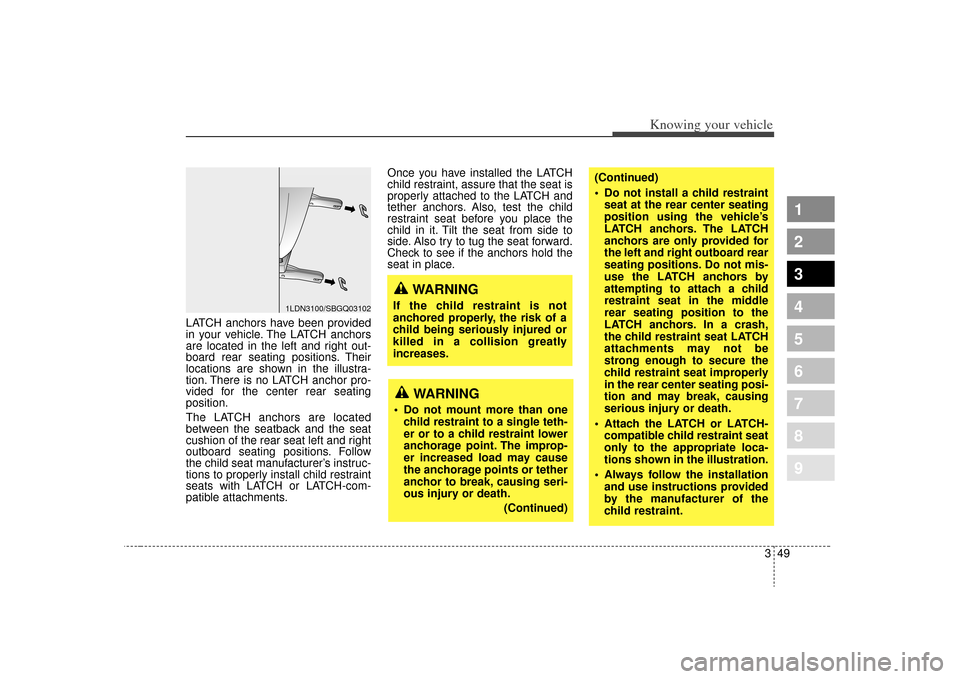
LATCH anchors have been provided
in your vehicle. The LATCH anchors
are located in the left and right out-
board rear seating positions. Their
locations are shown in the illustra-
tion. There is no LATCH anchor pro-
vided for the center rear seating
position.
The LATCH anchors are located
between the seatback and the seat
cushion of the rear seat left and right
outboard seating positions. Follow
the child seat manufacturer’s instruc-
tions to properly install child restraint
seats with LATCH or LATCH-com-
patible attachments.Once you have installed the LATCH
child restraint, assure that the seat is
properly attached to the LATCH and
tether anchors. Also, test the child
restraint seat before you place the
child in it. Tilt the seat from side to
side. Also try to tug the seat forward.
Check to see if the anchors hold the
seat in place.
WARNING
If the child restraint is not
anchored properly, the risk of a
child being seriously injured or
killed in a collision greatly
increases.
1LDN3100/SBGQ03102
WARNING
Do not mount more than one
child restraint to a single teth-
er or to a child restraint lower
anchorage point. The improp-
er increased load may cause
the anchorage points or tether
anchor to break, causing seri-
ous injury or death.
(Continued)
(Continued)
Do not install a child restraintseat at the rear center seating
position using the vehicle’s
LATCH anchors. The LATCH
anchors are only provided for
the left and right outboard rear
seating positions. Do not mis-
use the LATCH anchors by
attempting to attach a child
restraint seat in the middle
rear seating position to the
LATCH anchors. In a crash,
the child restraint seat LATCH
attachments may not be
strong enough to secure the
child restraint seat improperly
in the rear center seating posi-
tion and may break, causing
serious injury or death.
Attach the LATCH or LATCH- compatible child restraint seat
only to the appropriate loca-
tions shown in the illustration.
Always follow the installation and use instructions provided
by the manufacturer of the
child restraint.
Page 64 of 291
Knowing your vehicle54
3
1
2
3
4
5
6
7
8
9
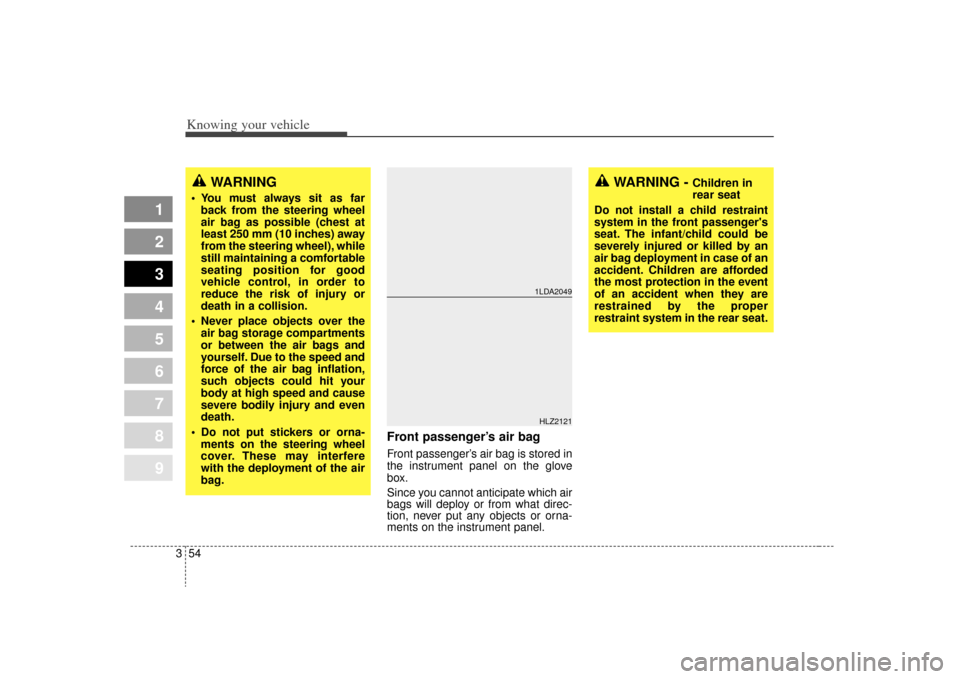
Front passenger’s air bagFront passenger’s air bag is stored in
the instrument panel on the glove
box.
Since you cannot anticipate which air
bags will deploy or from what direc-
tion, never put any objects or orna-
ments on the instrument panel.
WARNING
You must always sit as far
back from the steering wheel
air bag as possible (chest at
least 250 mm (10 inches) away
from the steering wheel), while
still maintaining a comfortable
seating position for good
vehicle control, in order to
reduce the risk of injury or
death in a collision.
Never place objects over the air bag storage compartments
or between the air bags and
yourself. Due to the speed and
force of the air bag inflation,
such objects could hit your
body at high speed and cause
severe bodily injury and even
death.
Do not put stickers or orna- ments on the steering wheel
cover. These may interfere
with the deployment of the air
bag.
1LDA2049HLZ2121
WARNING -
Children in
rear seat
Do not install a child restraint
system in the front passenger's
seat. The infant/child could be
severely injured or killed by an
air bag deployment in case of an
accident. Children are afforded
the most protection in the event
of an accident when they are
restrained by the proper
restraint system in the rear seat.
Page 65 of 291
355
1
2
3
4
5
6
7
8
9
Knowing your vehicle
WARNING
- Front passen-ger seating
The front seat passenger air bag is much larger than the
steering wheel air bag and
inflates with considerably
more force. It can seriously
hurt or kill a passenger who is
not in the proper position and
wearing the safety belt proper-
ly. The front passengers
should always move their seat
as far back as practical and sit
back in their seat.
It is essential that the front passengers always wear their
safety belts when vehicle is in
motion, even when the vehicle
is moving in a parking lot or
up a driveway into garage.
(Continued)
(Continued)
If the driver brakes the vehicleheavily in urgent situations,
unbelted occupants will be
thrown forward. If the front
passenger is not wearing the
safety belts, they will be
directly in front of the air bag
when deployment occurs. In
that situation, serious injury
or death is possible.
Never allow front passenger to put their hands, feet or face
on or close to the instrument
panel. In the event of air bag
deployment, such a misposi-
tioned occupant would be
likely to suffer severe injury or
death.
Never allow children, pregnant women or weak persons to sit
in the front passenger seat.
They may be seriously injured
by the air bag inflation when
air bag deploys.
(Continued)
(Continued)
Do not use child restraint sys-tems on the front passenger's
seat, as inflation may cause
death or severe personal
injury.
Do not put objects or stickers on the instrument panel. Do
not apply any accessory to the
front windshield. Do not install
aftermarket mirrors or acces-
sories on the factory-installed
rearview mirror. Any of these
could interfere with the
deployment of the air bag or
could hit your body at high
speed and cause severe bodi-
ly injury and even death.
Page 67 of 291
357
1
2
3
4
5
6
7
8
9
Knowing your vehicle
WARNING
- Side and cur-tain air bags
In order for side and curtain air bags to provide the best
protection, both front seat
occupants and both outboard
rear occupants should sit in
an upright position with the
safety belts properly fastened.
Importantly, children should
sit in a proper child restraint
system in the rear seat.
When children are seated in the rear outboard seats, they
must be seated in the proper
child restraint system. Make
sure to put the child restraint
system as far away from the
door side as possible, and
secure the child restraint sys-
tem in a locked position.
(Continued)
(Continued)
If a small child is seated onthe rear outboard seat cush-
ion, it is probable that they will
below the deployment level of
the side curtain airbag and
thus not protected by that
airbag.
Do not allow the passengers to lean their heads or bodies
onto doors, put their arms on
the doors, stretch their arms
out of the window, or place
objects between the doors
and passengers when they are
seated on seats equipped with
side air bags.
Never try to open or repair any components of the side cur-
tain air bag system. This
should only be done by an
authorized Kia dealer.
Failure to follow the above men-
tioned instructions can result in
severe injury or death to the
vehicle occupants in an acci-
dent.
The curtain air bag deployment
occurs only on the side of the vehi-
cle affected by the impact.
The side air bags (side and curtain air bags) are not designed to
deploy during collisions from the
front or rear of the vehicle or in
most rollover situations.
The curtain air bags are designed to deploy only during certain side-
impact collisions, depending on the
crash severity, angle, speed and
impact.
Page 75 of 291
365
1
2
3
4
5
6
7
8
9
Knowing your vehicle
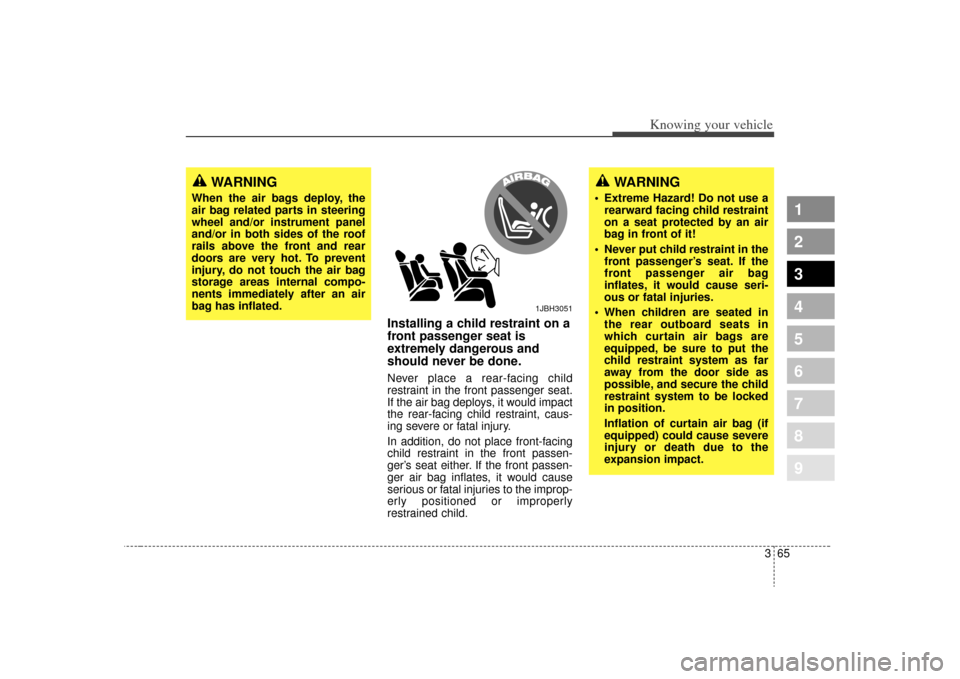
Installing a child restraint on a
front passenger seat is
extremely dangerous and
should never be done.Never place a rear-facing child
restraint in the front passenger seat.
If the air bag deploys, it would impact
the rear-facing child restraint, caus-
ing severe or fatal injury.
In addition, do not place front-facing
child restraint in the front passen-
ger’s seat either. If the front passen-
ger air bag inflates, it would cause
serious or fatal injuries to the improp-
erly positioned or improperly
restrained child.
WARNING
Extreme Hazard! Do not use arearward facing child restraint
on a seat protected by an air
bag in front of it!
Never put child restraint in the front passenger’s seat. If the
front passenger air bag
inflates, it would cause seri-
ous or fatal injuries.
When children are seated in the rear outboard seats in
which curtain air bags are
equipped, be sure to put the
child restraint system as far
away from the door side as
possible, and secure the child
restraint system to be locked
in position.
Inflation of curtain air bag (if
equipped) could cause severe
injury or death due to the
expansion impact.
WARNING
When the air bags deploy, the
air bag related parts in steering
wheel and/or instrument panel
and/or in both sides of the roof
rails above the front and rear
doors are very hot. To prevent
injury, do not touch the air bag
storage areas internal compo-
nents immediately after an air
bag has inflated.
1JBH3051
Page 78 of 291
Knowing your vehicle68
3
1
2
3
4
5
6
7
8
9
Airbag warning labelAirbag warning labels which are now
required by the Canadian Motor
Vehicle Safety Standards (CMVSS)
are attached to alert driver and pas-
sengers of potential risk of airbag
system.
Note that these government warn-
ings focus on the risk to children, Kia
also wants you to be aware of the
risks which adults are exposed to.
Those have been described in previ-
ous pages.
OLD037901N/OLD028069N/1LDE2069
(if equipped)
Page 81 of 291
371
1
2
3
4
5
6
7
8
9
Knowing your vehicle
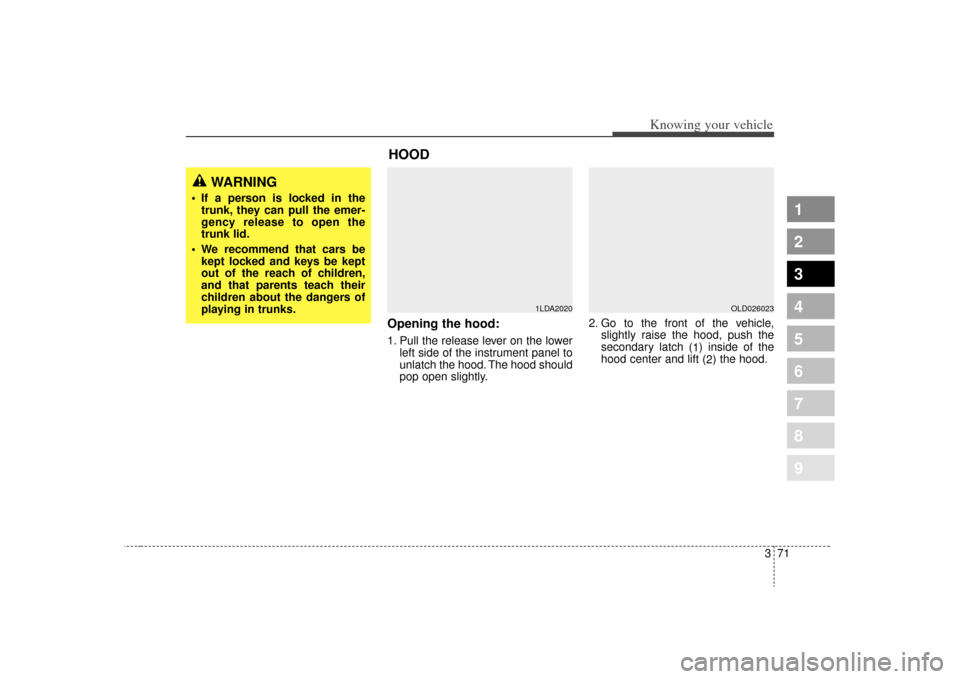
Opening the hood:1. Pull the release lever on the lowerleft side of the instrument panel to
unlatch the hood. The hood should
pop open slightly. 2. Go to the front of the vehicle,
slightly raise the hood, push the
secondary latch ( 1) inside of the
hood center and lift ( 2) the hood.
WARNING
If a person is locked in the
trunk, they can pull the emer-
gency release to open the
trunk lid.
We recommend that cars be kept locked and keys be kept
out of the reach of children,
and that parents teach their
children about the dangers of
playing in trunks.
HOOD
1LDA2020
OLD026023
Page 139 of 291
413
1
2
3
4
5
6
7
8
9
Driving your vehicle
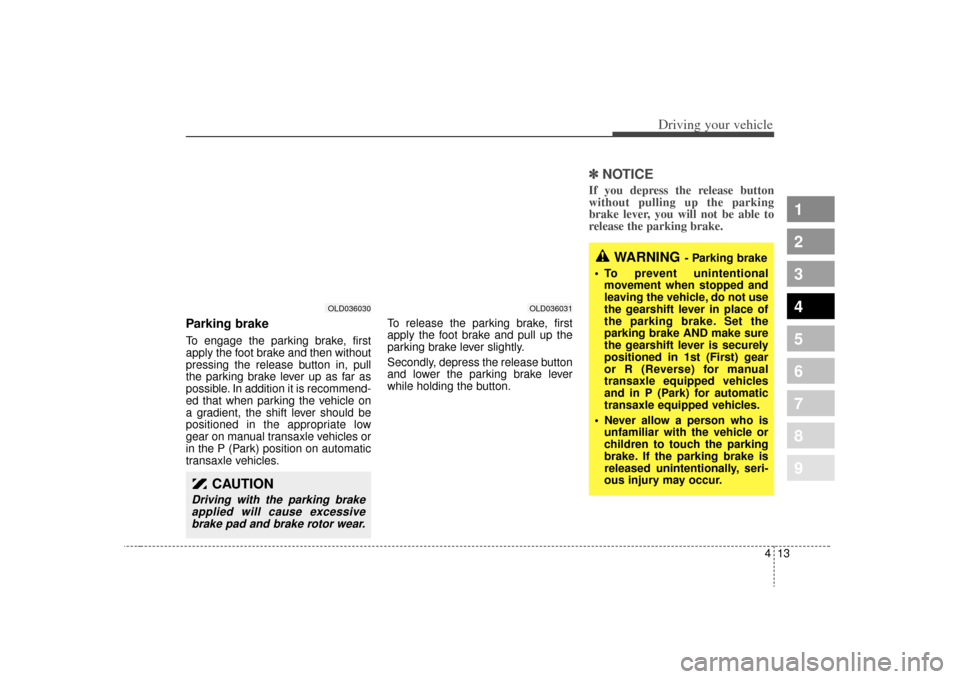
Parking brake To engage the parking brake, first
apply the foot brake and then without
pressing the release button in, pull
the parking brake lever up as far as
possible. In addition it is recommend-
ed that when parking the vehicle on
a gradient, the shift lever should be
positioned in the appropriate low
gear on manual transaxle vehicles or
in the P (Park) position on automatic
transaxle vehicles.To release the parking brake, first
apply the foot brake and pull up the
parking brake lever slightly.
Secondly, depress the release button
and lower the parking brake lever
while holding the button.
✽ ✽
NOTICEIf you depress the release button
without pulling up the parking
brake lever, you will not be able to
release the parking brake.
WARNING
- Parking brake
To prevent unintentional movement when stopped and
leaving the vehicle, do not use
the gearshift lever in place of
the parking brake. Set the
parking brake AND make sure
the gearshift lever is securely
positioned in 1st (First) gear
or R (Reverse) for manual
transaxle equipped vehicles
and in P (Park) for automatic
transaxle equipped vehicles.
Never allow a person who is unfamiliar with the vehicle or
children to touch the parking
brake. If the parking brake is
released unintentionally, seri-
ous injury may occur.
OLD036031
OLD036030
CAUTION
Driving with the parking brakeapplied will cause excessivebrake pad and brake rotor wear.