2009 KIA Spectra Bag
[x] Cancel search: BagPage 49 of 291
339
1
2
3
4
5
6
7
8
9
Knowing your vehicle
Restraint of infants and small
children To increase their safety, infants and
young children should always be
restrained by a restraint system
approved for their age and size.
Never allow a child to stand or kneel
on the seat of a moving vehicle.
Never allow a safety belt to be placed
around both a child and an adult or
around two children at the same
time.
It is best for children to be seated in
the rear seats.Many companies manufacture child
restraint systems (often called child
seats) for infants and small children.
An acceptable child restraint system
must always satisfy the Safety
Standards of your country. Make
sure that any child-restraint system
you use in your vehicle is labelled as
complying with those safety stan-
dards.
The child-restraint system should be
chosen to fit both the size of the child
and the size of the vehicle seat. Be
sure to follow any instructions provid-
ed by the child-restraint system man-
ufacturer when installing the child-
restraint system.
WARNING
- Infants and
young children
Infants and young children are at much greater risk of serious
injury or death in an accident
or sudden stop if they are unre-
strained or restrained improp-
erly. Follow all instructions in
this section of your Kia manual
and the instructions that came
on and with an improved child
safety restraint system. The
child restraint must be correct-
ly installed in the vehicle, and
the child must be correctly
installed in the child restraint.
All children under 12 are safest in the back seat.
Never install a child or infant seat in the front passenger
position. The baby will be
injured or killed by the air bag
if it deploys in an accident.
Never allow a child to stand or
kneel on the seat of a moving
vehicle. Insist the child sit down
in an approved restraint system.
WARNING
- Children on laps
Never hold a child on your lap or
in your arms in a moving vehi-
cle.
Even a very strong person can-
not hold onto a child in the
event of even a minor collision.
Page 51 of 291
341
1
2
3
4
5
6
7
8
9
Knowing your vehicle
Child restraint system
(if equipped)For small children and babies, the
use of a child seat or infant seat is
required by law. This child seat or
infant seat should be of appropriate
size for the child and should be
installed in accordance with the man-
ufacturer's instructions. It is strongly
recommended that the seat be
placed in the vehicle's rear seat
since this can make an important
contribution to safety.
Children riding in the car should sit
on the rear seat and must always be
properly restrained to minimize the
risk of injury in an accident, sudden
stop or sudden maneuver. According
to accident statistics, children are
safer when properly restrained in the
rear seats than in the front seat.
Child restraint systems are designed
to be secured in vehicle seats by lap
belts or the lap belt portion of a
lap/shoulder belt, or by a LATCH sys-
tem (if equipped).You are required by law to use safe-
ty restraints for children. If small chil-
dren ride in your vehicle you must
put them in a child restraint system
(safety seat).
Children could be injured or killed in
a crash if their restraints are not
properly secured. For small children
and babies, a child seat or infant seat
must be used. Before buying a par-
ticular child restraint system, make
sure it fits your car and seat belts,
and fits your child. Follow all the
instructions provided by the manu-
facturer when installing the child
restraint system.
ADAIR BAG
WARNING
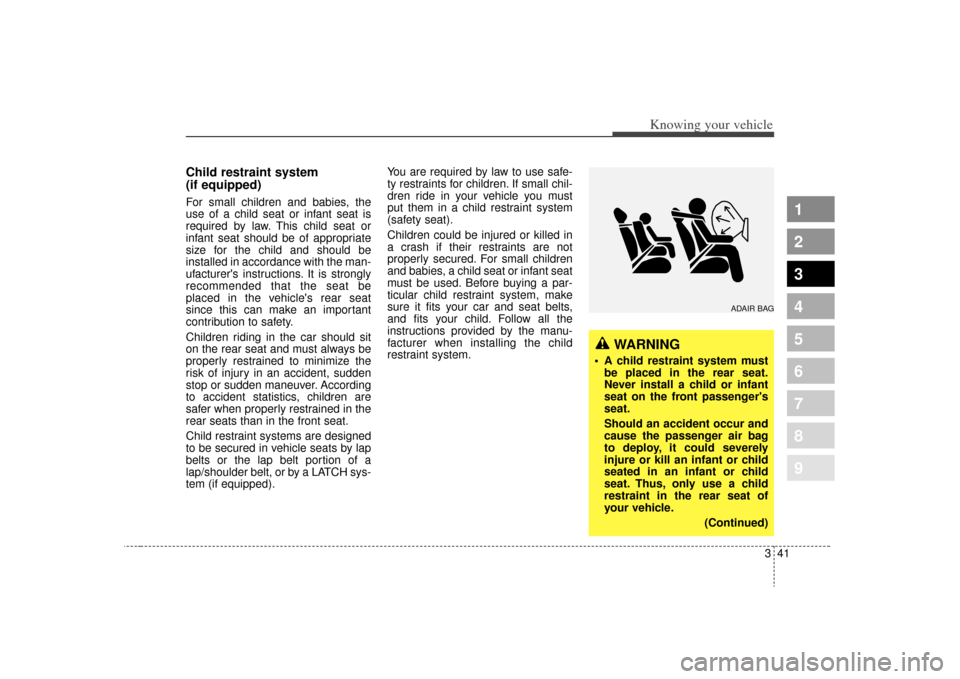
A child restraint system must
be placed in the rear seat.
Never install a child or infant
seat on the front passenger's
seat.
Should an accident occur and
cause the passenger air bag
to deploy, it could severely
injure or kill an infant or child
seated in an infant or child
seat. Thus, only use a child
restraint in the rear seat of
your vehicle.
(Continued)
Page 53 of 291
343
1
2
3
4
5
6
7
8
9
Knowing your vehicle
Installing a child restraint system For safety reasons, we recommend
that the child restraint system be
used in the rear seats.Never place
a rear-facing child restraint in the
front passenger seat, because of
the danger that an inflating pas-
senger side air bag could impact
the rear-facing child restraint and
kill the child.
Since all passenger’s (except dri-
ver’s) safety belts move freely under
normal conditions and only lock
under extreme or emergency condi-
tions (emergency lock mode), you
must manually change these safety
belts to the auto lock mode to secure
a child restraint.✽ ✽ NOTICEThe driver’s safety belt incorporates
the emergency lock mode only.
WARNING
Do not install any child
restraint system in the front
passenger seat. Should an
accident occur and cause the
passenger air bag to deploy, it
could severely injure or kill an
infant or child seated in an
infant or child seat. Therefore,
only use a child restraint sys-
tem in the rear seat of your
vehicle.
If the child restraint seat is not anchored properly, the risk of
a child being seriously injured
or killed in a collision greatly
increases.
WARNING
Before installing the childrestraint system, read the
instructions supplied by the
child restraint system manu-
facturer.
If the seat belt does not oper- ate as described, have the
system checked immediately
by your authorized Kia dealer.
Failure to observe this manual instructions regarding child
restraint system and the
instructions provided with the
child restraint system could
increase the chance and/or
severity of injury in an acci-
dent.
Page 60 of 291

Knowing your vehicle50
3
1
2
3
4
5
6
7
8
9
AIR BAG - SUPPLEMENTAL RESTRAINT SYSTEM
8LDN3511A/OMG035047/1LDA2049/OMG035049/OMG035051/OMG035052/OMG038053/OMG038055
1
2
3
54
(1) Driver’s air bag
(2) Front passenger’s air bag
(3) Side air bag*
(4) Curtain air bag*
(5) SRS Control Module
(6) Side impact sensor*
* : if equipped
6
Page 61 of 291
351
1
2
3
4
5
6
7
8
9
Knowing your vehicle
What your air bag system
doesDriver’s air bag and front passen-
ger’s air bag are designed to supple-
ment the protection offered by the
safety belt in certain frontal colli-
sions. Likewise, side air bag and cur-
tain air bags are designed to supple-
ment the protection offered by the
safety belt in side collisions. Safety
belts are designed to reduce the
injury of the driver or passengers in
case of impact or collision. No safety
belt or air bag system can complete-
ly eliminate injuries that may cause
in collisions or impacts. To help
reduce impact on driver or passen-
gers in any collision, safety belts
must be correctly worn.
What your air bag system
does not doThe air bag system is designed to
supplement the protection offered by
the safety belt system.IT IS NOT A
SUBSTITUTE FOR THE SAFETY
BELT.
The importance of using
safety beltsThere are four very important rea-
sons to use safety belts even with an
air bag supplemental restraint sys-
tem. They:
help keep you in the proper posi- tion (away from the air bag) when it
inflates.
reduce the risk of harm in rollover, side impact (vehicles not equipped
with side and curtain air bags) or
rear impact collisions, because an
air bag is not designed to inflate in
such situations and even a side
curtain air bag is designed to
inflate only in certain side impact
collisions.
reduce the risk of harm in frontal or side collisions which are not
severe enough to actuate the air
bag supplemental restraint system.
reduce the risk of being ejected from your vehicle.
Page 62 of 291
Knowing your vehicle52
3
1
2
3
4
5
6
7
8
9
WARNING
- Air bags &
safety belts
Even in vehicles with air bags, you and your passengers
must always wear the safety
belts provided in order to min-
imize the risk and severity of
injury in the event of a colli-
sion or rollover.
Always wear your safety belt. It can help keep you away
from the air bags during heavy
braking just before a collision.
It may also reduce the risk of
occupant ejection.
If occupants are not wearing safety belts or correctly seat-
ed, they cannot be protected,
and thus face serious injury or
death.
(Continued)
(Continued)
Driver’s and front passenger’sair bag are designed to inflate
only in certain frontal colli-
sions, and side and curtain air
bags (if equipped) are
designed to inflate in certain
side impacts. Frontal air bag
will generally not provide pro-
tection in side impacts (vehi-
cles not equipped with side
and curtain air bags) or rear
impacts, rollovers, less severe
frontal collisions. They will not
provide protection from later
impacts in a multi-impact col-
lision.
(Continued)
(Continued)
If your vehicle has been sub-jected to flood conditions (e.g.
soaked carpeting/standing
water on the floor of the vehi-
cle, etc.) or if your vehicle has
become flood damaged in any
way, do not attempt to start
the vehicle or put the key in
the ignition before discon-
necting the battery.
Disregarding this precaution
may cause air bag deploy-
ment, which could result in
serious personal injury or
death. If your vehicle is sub-
jected to flooded conditions,
before starting the vehicle,
have the vehicle towed to an
authorized Kia dealer for
inspection and necessary
repairs.
Page 63 of 291
353
1
2
3
4
5
6
7
8
9
Knowing your vehicle
Air bag system components The main components of your SRS
are:
To indicate that your vehicle isequipped with air bags, the corre-
sponding air bag covers are
marked with “SRS AIR BAG”.
- Driver’s air bag
- Passenger’s air bag
- Side air bag
- Curtain air bag
A diagnostic system that continual- ly monitors the system operation.
An indicator light to warn you of a possible problem with the system.
Emergency power backup in case your car’s electrical system is dis-
connected in a crash.
Driver’s air bagYour vehicle is equipped with a
Supplemental Restraint (Air Bag)
System and lap/shoulder belts at
both the driver and passenger seat-
ing position.
The driver’s air bag is stored in the
center of the steering wheel.
CAUTION
If the SRS air bag warning lightdoes not illuminate when theignition key is turned to the"ON" position, if it remains illu-minated after blinking forapproximately 6 seconds, or if itilluminates while the vehicle isbeing driven, have an author-ized Kia dealer inspect yourvehicle as soon as possible.
HLZ2120OLD026048
Page 64 of 291
Knowing your vehicle54
3
1
2
3
4
5
6
7
8
9
Front passenger’s air bagFront passenger’s air bag is stored in
the instrument panel on the glove
box.
Since you cannot anticipate which air
bags will deploy or from what direc-
tion, never put any objects or orna-
ments on the instrument panel.
WARNING
You must always sit as far
back from the steering wheel
air bag as possible (chest at
least 250 mm (10 inches) away
from the steering wheel), while
still maintaining a comfortable
seating position for good
vehicle control, in order to
reduce the risk of injury or
death in a collision.
Never place objects over the air bag storage compartments
or between the air bags and
yourself. Due to the speed and
force of the air bag inflation,
such objects could hit your
body at high speed and cause
severe bodily injury and even
death.
Do not put stickers or orna- ments on the steering wheel
cover. These may interfere
with the deployment of the air
bag.
1LDA2049HLZ2121
WARNING -
Children in
rear seat
Do not install a child restraint
system in the front passenger's
seat. The infant/child could be
severely injured or killed by an
air bag deployment in case of an
accident. Children are afforded
the most protection in the event
of an accident when they are
restrained by the proper
restraint system in the rear seat.