Page 26 of 321
Knowing your vehicle14
3Power windows The ignition switch must be in the ON
position for power windows to operate.
Each door has a power window switch
that controls that door’s window.
However, the driver has a power window
lock switch which can block the operation
of the passenger windows.
If you notice buffeting and pulsation
(wind shock) with either side windows
opened, you should open the opposite
window slightly to reduce the condition.
CAUTION
To prevent the power window
system from the possibility ofdamage, do not open or close twowindows at the same time. This will also ensure the longevity ofthe fuse.
Never try to operate the main switch on the driver's door andthe individual door windowswitch in opposing directions atthe same time. If this is done, thewindow will stop and cannot be opened or closed.
WARNING
Make sure hands and face are safely out of the way before clos-
ing a window.
Do not allow children to play with the power windows. Keep the dri-
ver’s door power window lock
switch in the LOCK position
(depressed). Serious injury can
result from unintentional window
operation by the child.
Do not extend face or arms out- side through the window opening
while driving.
Always double check to make sure all arms, hands and other
obstructions are safely out of the
way before closing a window
Page 28 of 321
Knowing your vehicle16
3
Power window lock switch The driver can disable the power win-
dow switches on a passenger door by
depressing the power window lock
switch located on the driver’s door to
LOCK (pressed).
When the power window lock switch is ON, the driver’s master control cannot
operate the passenger door power
windows either.
Power window timer (if equipped)The power windows can be operated for
approximately 30 seconds after the igni-
tion key is removed or turned to the ACC
or LOCK position. However, if the front
doors are opened, the power windows
cannot be operated even within 30 sec-
onds after the ignition key is removed.
WARNING
The automatic window reversal feature (window lowers 5.9 inches
[150 mm] when a resistance is
detected) will only operate when
the automatic power window up
operation feature is used.
Automatic window reversal will
not operate if the window is
raised using the first detent posi-
tion (
➄) on the power window
switch. Always double check to
make sure all faces, arms, hands
and other obstructions are safely
out of the way before operating
the power window.
If an object less than 0.16 inch (4 mm) in diameter is caught
between the window glass and
the upper window channel, the
automatic reversal may not detect
the resistance and will not oper-
ate. Therefore, always check for
any obstructions before raising
any window.
Page 30 of 321
Knowing your vehicle18
3For a seating position more comfortable
to the driver and front passenger, adjust
the seat forward, backward, up and
down.
WARNING
Loose objects in the driver’s foot
area could interfere with the oper-
ation of the foot pedals, possibly
causing an accident. Loose
objects might interfere with the
seat slide mechanism. Do not
place anything under the front
seats.
The power seats are operable with the ignition OFF.
Therefore, children should never
be left unattended in the car.
WARNING
- Driver’s seat
Never attempt to adjust the seatwhile the vehicle is moving. This
could result in loss of control,
and an accident causing death,
serious injury, or property dam-
age.
with the normal position of the
seatback. Storing items against a
seatback or in any other way
interfering with proper locking of
a seatback could result in serious
or fatal injury in a sudden stop or
collision.
seatback upright and the lap por-
tion of the safety belt, or lap belt,
snug and low across the hips.
This position puts your safety
belts in the best position to pro-
tect you in case of an accident.
In order to avoid unnecessary air bag injuries including the possi-
bility of severe injury or death,
always sit as far back as possible
from the steering wheel so that
your chest is away at least 10
inches (250 mm) away from the
steering wheel.
CAUTION
Power seats are driven by electric motor. Stop operating when theadjustment is completed.
Excessive operation may damagethe electrical equipment.
When in operation, the power seats consume large amounts ofelectrical power. To preventunnecessary charging system drain, don’t adjust the powerseats longer than necessarywhile the engine is not running.
Do not operate two or more power seat control buttons at the sametime. Doing so may result inpower seat motor or electricalcomponent malfunction.
Page 32 of 321
Knowing your vehicle20
3
WARNING
Driving or riding in a vehicle with a
front seatback reclined could lead
to serious or fatal injury in an acci-
dent. If a front seat is reclined dur-
ing an accident, the occupant’s hips
may slide under the lap portion of
the safety belt applying great force
to the unprotected abdomen or
neck or a passenger may be ejected
in a rollover. Serious or fatal inter-
nal injuries could result. Keep the
seatbacks in a comfortably upright
position whenever the vehicle is in
motion.
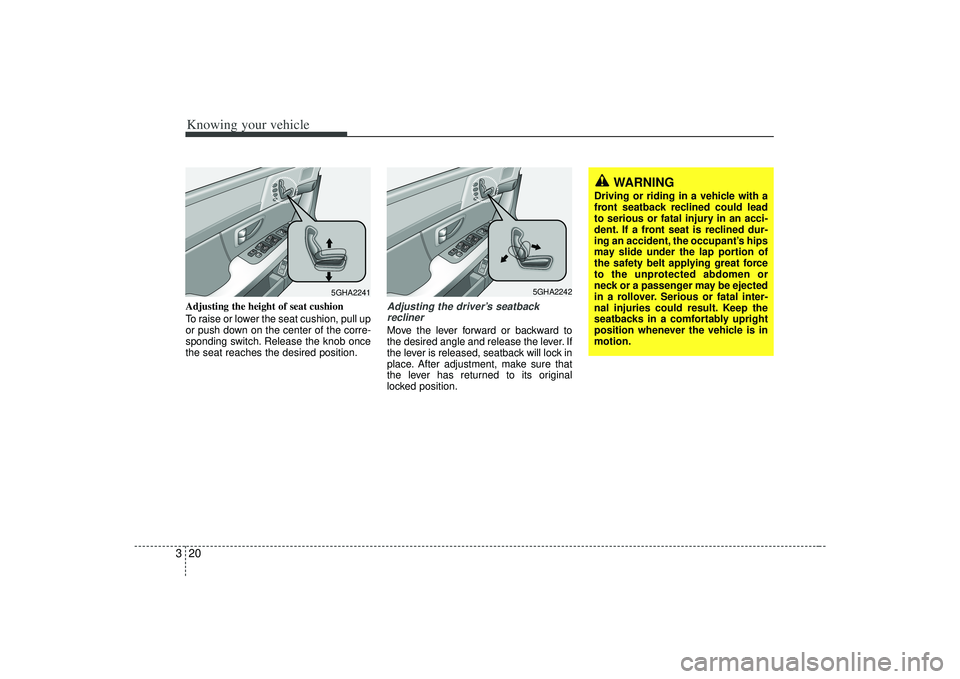
Adjusting the height of seat cushion
To raise or lower the seat cushion, pull up
or push down on the center of the corre-
sponding switch. Release the knob once
the seat reaches the desired position.
Adjusting the driver’s seatback
reclinerMove the lever forward or backward to
the desired angle and release the lever. If
the lever is released, seatback will lock in
place. After adjustment, make sure that
the lever has returned to its original
locked position.
5GHA2241
5GHA2242
Page 34 of 321
Knowing your vehicle22
3
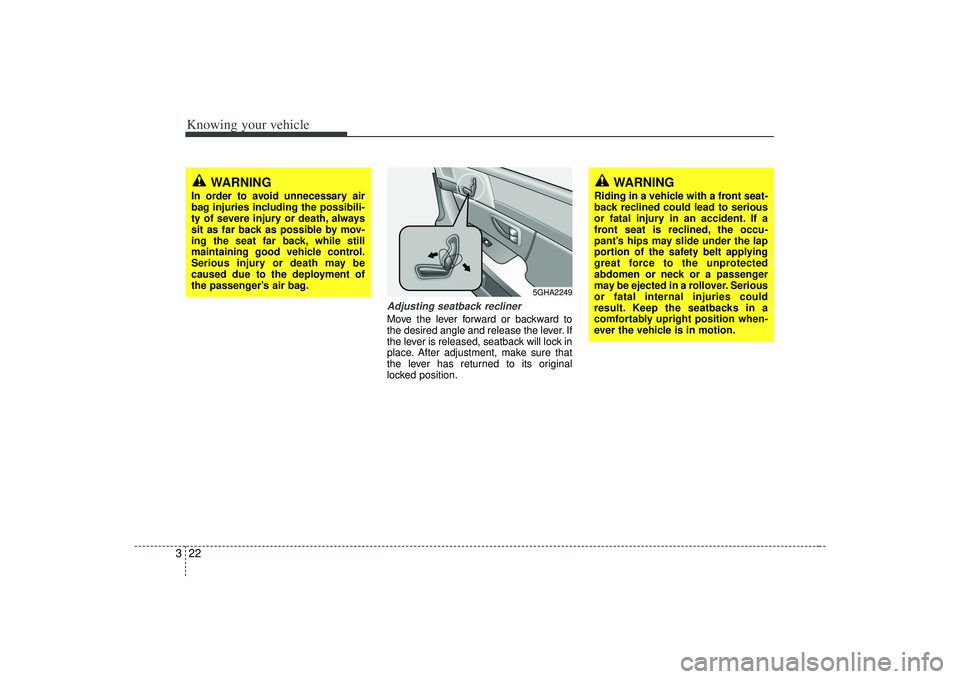
Adjusting seatback reclinerMove the lever forward or backward to
the desired angle and release the lever. If
the lever is released, seatback will lock in
place. After adjustment, make sure that
the lever has returned to its original
locked position.
WARNING
In order to avoid unnecessary air
bag injuries including the possibili-
ty of severe injury or death, always
sit as far back as possible by mov-
ing the seat far back, while still
maintaining good vehicle control.
Serious injury or death may be
caused due to the deployment of
the passenger’s air bag.
5GHA2249
WARNING
Riding in a vehicle with a front seat-
back reclined could lead to serious
or fatal injury in an accident. If a
front seat is reclined, the occu-
pant’s hips may slide under the lap
portion of the safety belt applying
great force to the unprotected
abdomen or neck or a passenger
may be ejected in a rollover. Serious
or fatal internal injuries could
result. Keep the seatbacks in a
comfortably upright position when-
ever the vehicle is in motion.
Page 36 of 321
Knowing your vehicle24
3
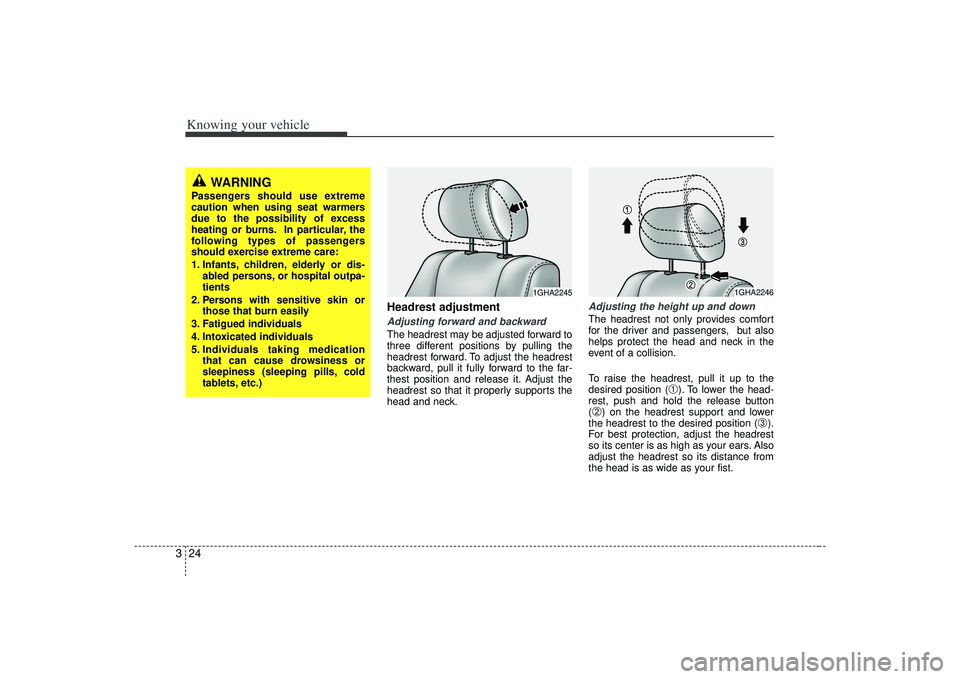
Headrest adjustmentAdjusting forward and backwardThe headrest may be adjusted forward to
three different positions by pulling the
headrest forward. To adjust the headrest
backward, pull it fully forward to the far-
thest position and release it. Adjust the
headrest so that it properly supports the
head and neck.
Adjusting the height up and downThe headrest not only provides comfort
for the driver and passengers, but also
helps protect the head and neck in the
event of a collision.
To raise the headrest, pull it up to the
desired position (
➀). To lower the head-
rest, push and hold the release button
(
➁) on the headrest support and lower
the headrest to the desired position (
➂).
For best protection, adjust the headrest
so its center is as high as your ears. Also
adjust the headrest so its distance from
the head is as wide as your fist.
1GHA2245
WARNING
Passengers should use extreme
caution when using seat warmers
due to the possibility of excess
heating or burns. In particular, the
following types of passengers
should exercise extreme care:
1. Infants, children, elderly or dis- abled persons, or hospital outpa-
tients
2. Persons with sensitive skin or those that burn easily
3. Fatigued individuals
4. Intoxicated individuals
5. Individuals taking medication that can cause drowsiness or
sleepiness (sleeping pills, cold
tablets, etc.)
1GHA2246
Page 37 of 321
325
Knowing your vehicle
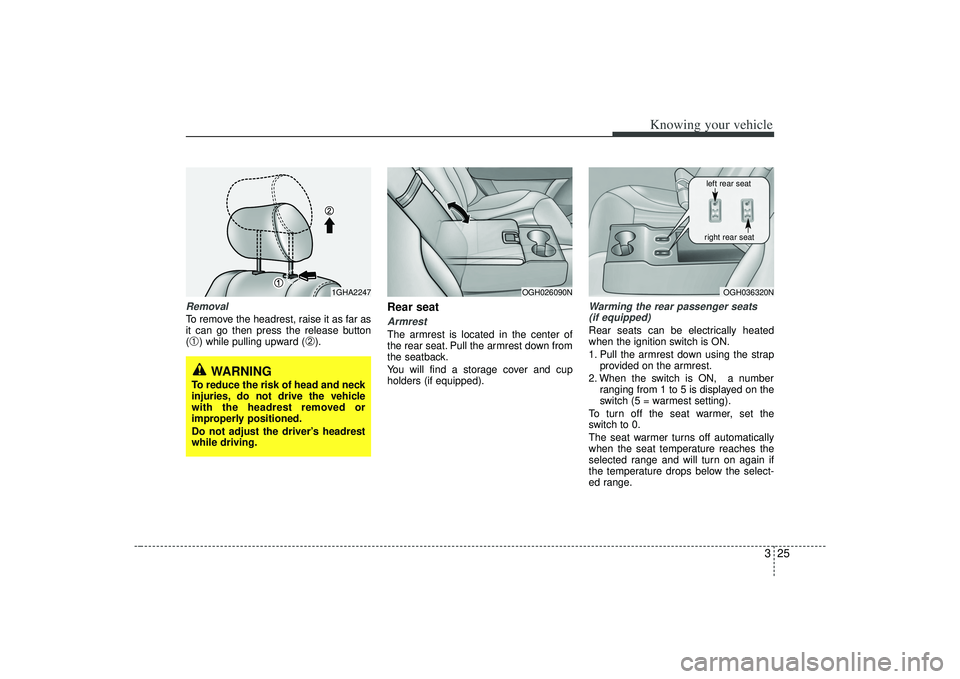
RemovalTo remove the headrest, raise it as far as
it can go then press the release button
(➀) while pulling upward (
➁).
Rear seatArmrestThe armrest is located in the center of
the rear seat. Pull the armrest down from
the seatback.
You will find a storage cover and cup
holders (if equipped).
Warming the rear passenger seats (if equipped)Rear seats can be electrically heated
when the ignition switch is ON.
1. Pull the armrest down using the strap provided on the armrest.
2. When the switch is ON, a number ranging from 1 to 5 is displayed on the
switch (5 = warmest setting).
To turn off the seat warmer, set the
switch to 0.
The seat warmer turns off automatically
when the seat temperature reaches the
selected range and will turn on again if
the temperature drops below the select-
ed range.
WARNING
To reduce the risk of head and neck
injuries, do not drive the vehicle
with the headrest removed or
improperly positioned.
Do not adjust the driver’s headrest
while driving.
1GHA2247
OGH026090N
OGH036320N
left rear seat
right rear seat
Page 38 of 321
Knowing your vehicle26
3
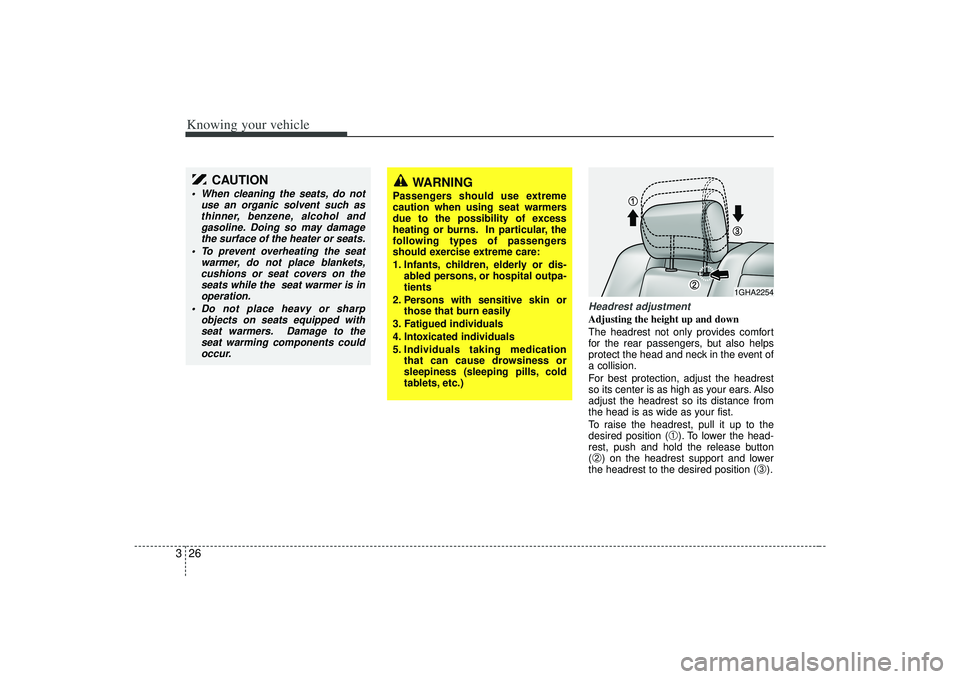
Headrest adjustmentAdjusting the height up and down
The headrest not only provides comfort
for the rear passengers, but also helps
protect the head and neck in the event of
a collision.
For best protection, adjust the headrest
so its center is as high as your ears. Also
adjust the headrest so its distance from
the head is as wide as your fist.
To raise the headrest, pull it up to the
desired position (
➀). To lower the head-
rest, push and hold the release button
(
➁) on the headrest support and lower
the headrest to the desired position (
➂).
WARNING
Passengers should use extreme
caution when using seat warmers
due to the possibility of excess
heating or burns. In particular, the
following types of passengers
should exercise extreme care:
1. Infants, children, elderly or dis- abled persons, or hospital outpa-
tients
2. Persons with sensitive skin or those that burn easily
3. Fatigued individuals
4. Intoxicated individuals
5. Individuals taking medication that can cause drowsiness or
sleepiness (sleeping pills, cold
tablets, etc.)
1GHA2254
CAUTION
When cleaning the seats, do not use an organic solvent such asthinner, benzene, alcohol and gasoline. Doing so may damagethe surface of the heater or seats.
To prevent overheating the seat warmer, do not place blankets,cushions or seat covers on the seats while the seat warmer is inoperation.
Do not place heavy or sharp objects on seats equipped withseat warmers. Damage to theseat warming components couldoccur.