Page 377 of 502
Trailer and Trailer Tongue Weight
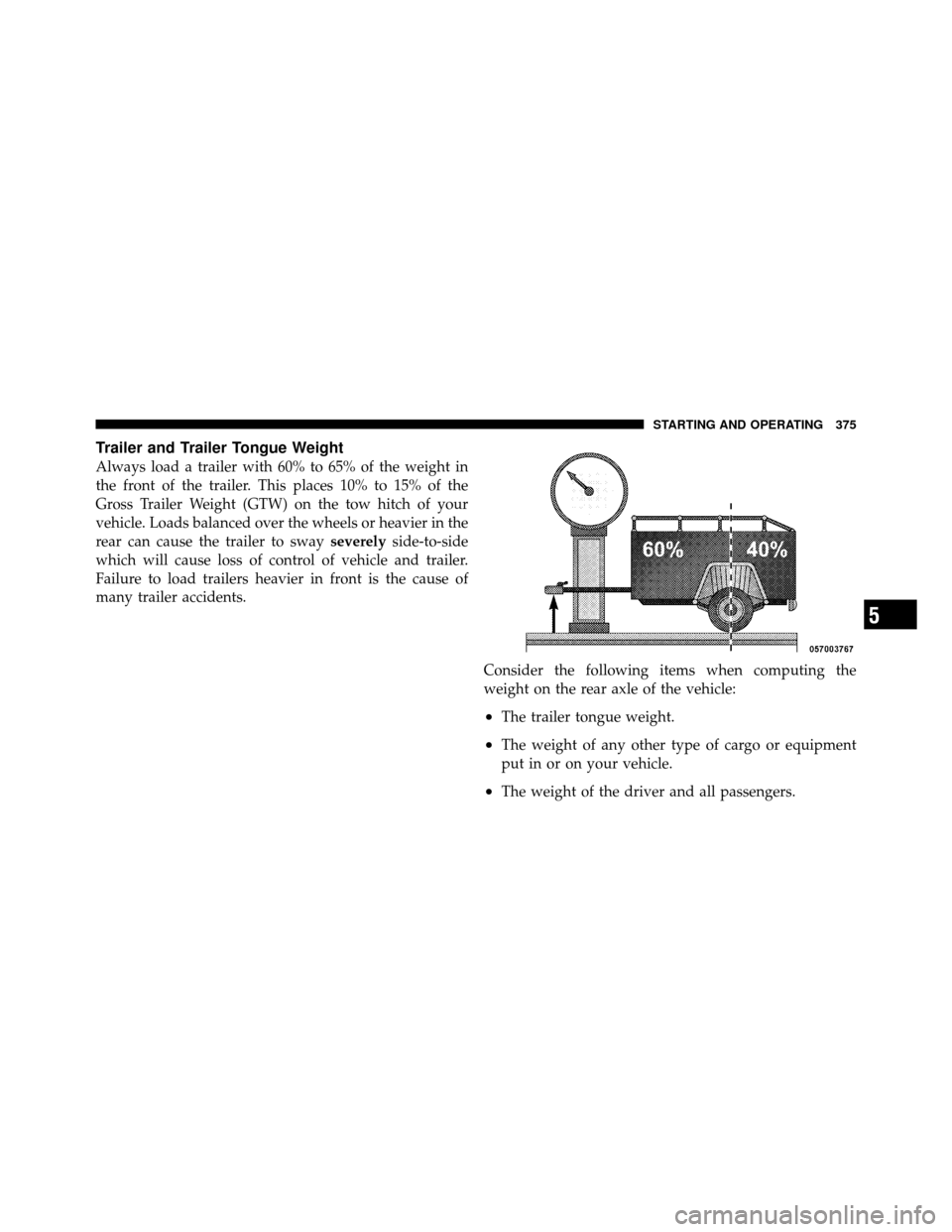
Always load a trailer with 60% to 65% of the weight in
the front of the trailer. This places 10% to 15% of the
Gross Trailer Weight (GTW) on the tow hitch of your
vehicle. Loads balanced over the wheels or heavier in the
rear can cause the trailer to swayseverelyside-to-side
which will cause loss of control of vehicle and trailer.
Failure to load trailers heavier in front is the cause of
many trailer accidents.
Consider the following items when computing the
weight on the rear axle of the vehicle:
•The trailer tongue weight.
•The weight of any other type of cargo or equipment
put in or on your vehicle.
•The weight of the driver and all passengers.
5
STARTING AND OPERATING 375
Page 378 of 502
NOTE:Remember that everything put into or on the
trailer adds to the load on your vehicle. Also, additional
factory-installed options, or authorized dealer-installed
options, must be considered as part of the total load on
your vehicle. Refer to the Tire and Loading Information
placard in the “Tire Safety Information” section of this
manual for the maximum combined weight of occupants
and cargo for your vehicle.
Towing Requirements
To promote proper break-in of your new vehicle drive-
train components, the following guidelines are recom-
mended:
NOTE: Trailer towing requires special rear axle lubri-
cant. Refer to “Fluids, Lubricants, and Genuine Parts” in
Section 7 for the correct fluid type.
CAUTION!
•Avoid towing a trailer for the first 500 miles
(805 km) of vehicle operation. Doing so may dam-
age your vehicle.
WARNING!
Improper towing can lead to an injury accident.
Follow these guidelines to make your trailer towing
as safe as possible:
•Make certain that the load is secured in the trailer
and will not shift during travel. When trailering
cargo that is not fully secured, dynamic load shifts
can occur that may be difficult for the driver to
control. You could lose control of your vehicle and
have an accident.
(Continued)
376 STARTING AND OPERATING
Page 379 of 502
WARNING! (Continued)
•When hauling cargo or towing a trailer, do not
overload your vehicle or trailer. Overloading can
cause a loss of control, poor performance or dam-
age to the brakes, axle, engine, transmission, steer-
ing, suspension, chassis structure or tires.
•Safety chains must always be used between your
vehicle and trailer. Always connect the chains to
the frame or hook retainers of the vehicle hitch.
Cross the chains under the trailer tongue and
allow enough slack for turning corners.(Continued)
WARNING! (Continued)
•Vehicles with trailers should not be parked on a
grade. When parking, apply the parking brake on
the tow vehicle. Put the tow vehicle automatic
transmission in PARK. With a manual transmis-
sion, shift the transmission into first gear. And
with four-wheel-drive vehicles, make sure the
transfer case is not in N (Neutral). Always, block
or�chock� the trailer wheels.
•GCWR must not be exceeded.
•Total weight must be distributed between the tow
vehicle and the trailer such that the following four
ratings are not exceeded:
1. GVWR
2. GTW
3. GAWR
(Continued)
5
STARTING AND OPERATING 377
Page 380 of 502

WARNING! (Continued)
4. Tongue weight rating for the trailer hitch utilized
(This requirement may limit the ability to always
achieve the 10% to 15% range of tongue weight as a
percentage of total trailer weight).
Towing Requirements — Tires
Do not attempt to tow a trailer while using a compact
spare tire.
Proper tire inflation pressures are essential to the safe
and satisfactory operation of your vehicle. Refer to
“Tires–General Information” in this section for proper
tire inflation procedures.
Check the trailer tires for proper tire inflation pres-
sures before trailer usage.
Check for signs of tire wear or visible tire damage
before towing a trailer. Refer to “Tires–General Infor-
mation” in this section for the proper inspection pro-
cedure.
When replacing tires, refer to “Tires–General Informa-
tion” in this section for proper tire replacement proce-
dures. Replacing tires with a higher load carrying
capacity will not increase the vehicle’s GVWR and
GAWR limits.
Towing Requirements — Trailer Brakes
Do not interconnect the hydraulic brake system or
vacuum system of your vehicle with that of the trailer.
This could cause inadequate braking and possible
personal injury.
378 STARTING AND OPERATING
Page 392 of 502
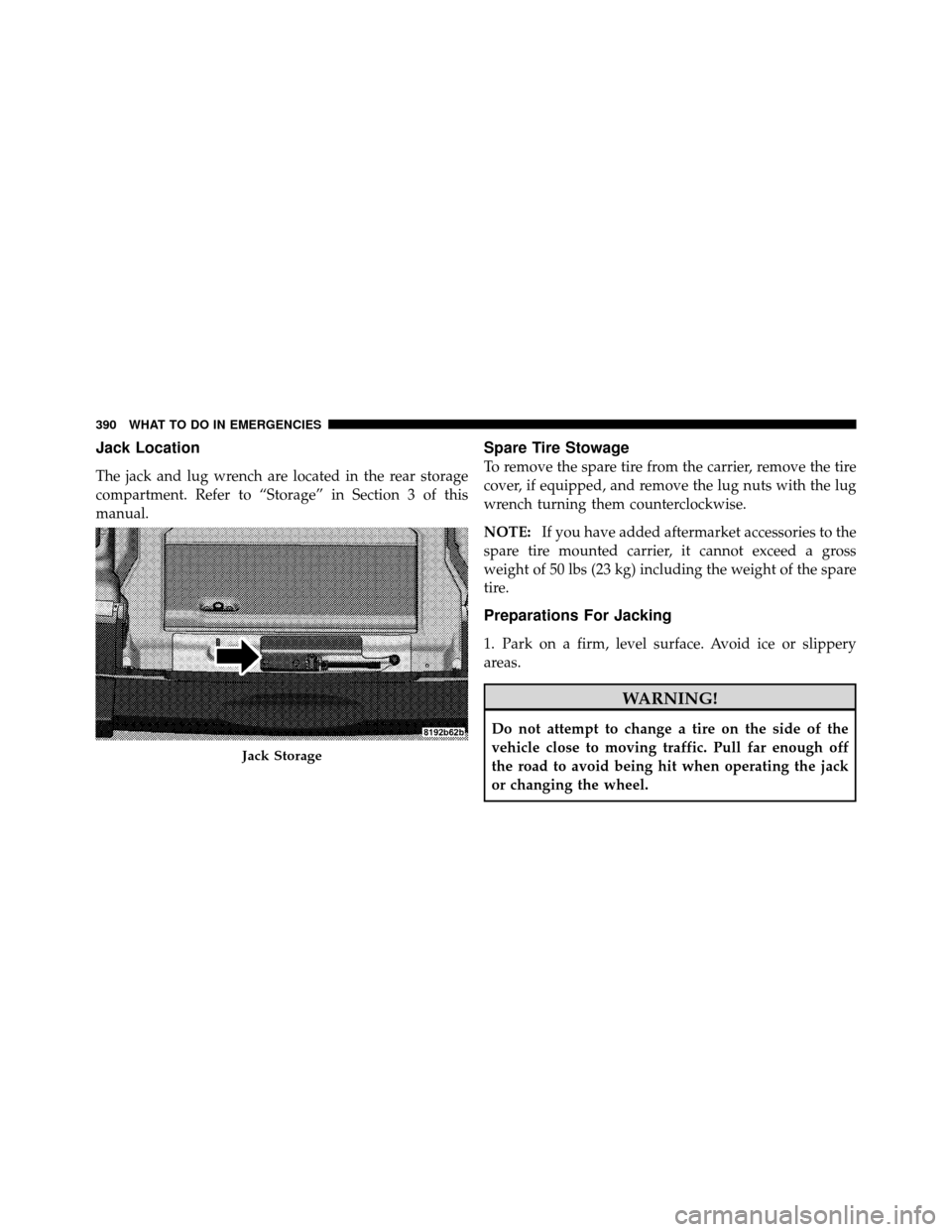
Jack Location
The jack and lug wrench are located in the rear storage
compartment. Refer to “Storage” in Section 3 of this
manual.
Spare Tire Stowage
To remove the spare tire from the carrier, remove the tire
cover, if equipped, and remove the lug nuts with the lug
wrench turning them counterclockwise.
NOTE:If you have added aftermarket accessories to the
spare tire mounted carrier, it cannot exceed a gross
weight of 50 lbs (23 kg) including the weight of the spare
tire.
Preparations For Jacking
1. Park on a firm, level surface. Avoid ice or slippery
areas.
WARNING!
Do not attempt to change a tire on the side of the
vehicle close to moving traffic. Pull far enough off
the road to avoid being hit when operating the jack
or changing the wheel.
Jack Storage
390 WHAT TO DO IN EMERGENCIES
Page 489 of 502

Fog Lights........................... 96,445
Fold and Tumble Rear Seat .................. 88
Folding Rear Seat ........................ 91
Folding Windshield ...................... 186
Four Wheel Drive ....................... 291
Shifting ............................. 293
Four Wheel Drive Operation ................ 291
Four-Way Hazard Flasher .................. 388
Front Axle (Differential) ................... 427
Fuel ................................. 356
Filler Cap (Gas Cap) .................... 361
Gasoline ............................ 356
Gauge .............................. 200
Materials Added ....................... 359
Octane Rating ........................ 356
Requirements ......................... 447
Tank Capacity ........................ 447
Fuel System Caution ................... 359,362
Fuses ................................ 436 Gas Cap (Fuel Filler Cap)
............361,363,402
Gasoline (Fuel) ......................... 356
Gasoline, Reformulated ................... 357
Gasoline/Oxygenate Blends ................ 357
Gauges Coolant Temperature ................... 204
Fuel ............................... 200
Odometer ........................... 207
Speedometer ......................... 200
Tachometer .......................... 204
Gear Ranges ........................ 282,288
General Information .................... 17,356
Glass Cleaning .......................... 432
Gross Axle Weight Rating ...............364,366
Gross Vehicle Weight Rating .............363,366
GVWR ............................... 363
Hands-Free Phone (uconnect�) ............... 82
HardTop ............................. 115
10
INDEX 487
Page 498 of 502

Inflation Pressures..................... 343
Jacking ........................... 389,392
Load Capacity ..................... 338,339
Pressure Monitor System (TPMS) ........... 351
Pressure Warning Light .................. 206
Quality Grading ....................... 479
Radial .............................. 346
Replacement ......................... 348
Rotation ............................ 350
Safety .............................. 333
Sizes ............................... 335
Spare Tire ........................... 390
Spinning ............................ 346
Tread Wear Indicators ................... 347
To Open Hood .......................... 93
Tongue Weight/Trailer Weight .............. 375
Torque Converter Clutch .................. 291
Tow Hooks, Emergency ................... 396
Towing ............................ 365,397Disabled Vehicle
....................... 397
Guide .............................. 369
Recreational .......................... 382
Weight .............................. 369
Trac-Lok Rear Axle ...................... 295
Traction Control ......................... 319
Traction Control Light .................... 211
Trailer Sway Control (TSC) ................. 332
Trailer Towing .......................... 365
Cooling System Tips .................... 382
Hitches .......................... 356,368
Minimum Requirements ................. 376
Trailer and Tongue Weight ............... 375
Wiring .............................. 380
Trailer Towing Guide ..................... 369
Trailer Weight .......................... 369
Transfer Case ........................... 426
Four-Wheel-Drive Operation .............. 291
Maintenance ......................... 426
496 INDEX
Page:
< prev 1-8 9-16 17-24