Page 285 of 502
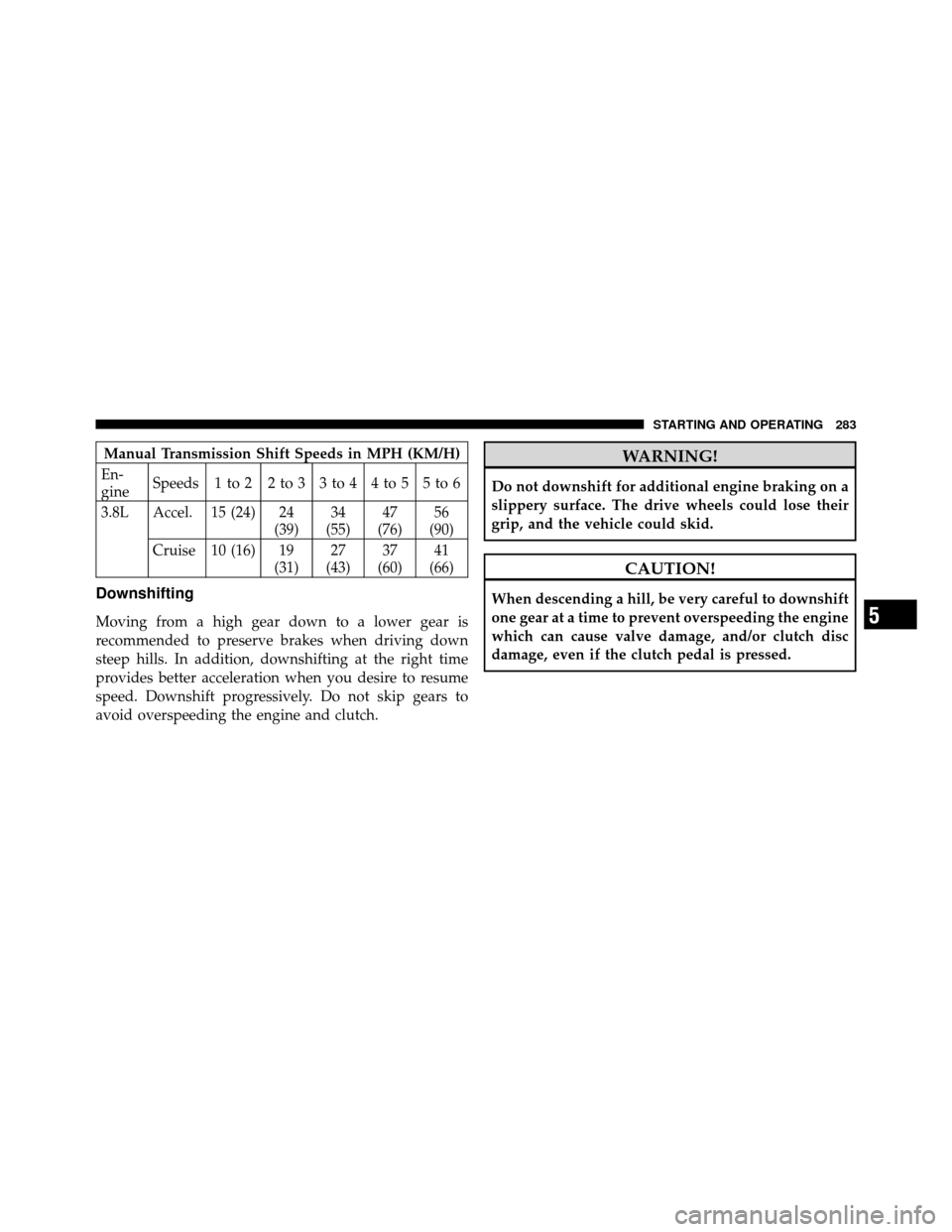
Manual Transmission Shift Speeds in MPH (KM/H)
En-
gine Speeds 1 to 2 2 to 3 3 to 4 4 to 5 5 to 6
3.8L Accel. 15 (24) 24 (39)34
(55) 47
(76) 56
(90)
Cruise 10 (16) 19 (31)27
(43) 37
(60) 41
(66)
Downshifting
Moving from a high gear down to a lower gear is
recommended to preserve brakes when driving down
steep hills. In addition, downshifting at the right time
provides better acceleration when you desire to resume
speed. Downshift progressively. Do not skip gears to
avoid overspeeding the engine and clutch.
WARNING!
Do not downshift for additional engine braking on a
slippery surface. The drive wheels could lose their
grip, and the vehicle could skid.
CAUTION!
When descending a hill, be very careful to downshift
one gear at a time to prevent overspeeding the engine
which can cause valve damage, and/or clutch disc
damage, even if the clutch pedal is pressed.
5
STARTING AND OPERATING 283
Page 287 of 502

AUTOMATIC TRANSMISSION — IF EQUIPPED
CAUTION!
Damage to the transmission may occur if the follow-
ing precautions are not observed:
•Shift into PARK only after the vehicle has come to
a complete stop.
•Shift into or out of REVERSE only after the
vehicle has come to a complete stop and the engine
is at idle speed.
•Do not shift from REVERSE, PARK, or NEUTRAL
into any forward gear when the engine is above
idle speed.
•Before shifting into any gear, make sure your foot
is firmly on the brake pedal.
WARNING!
It is dangerous to move the shift lever out of PARK or
NEUTRAL if the engine speed is higher than idle
speed. If your foot is not firmly on the brake pedal,
the vehicle could accelerate quickly forward or in
reverse. You could lose control of the vehicle and hit
someone or something. Only shift into gear when the
engine is idling normally and when your foot is
firmly on the brake pedal.
Key Ignition Park Interlock
This vehicle is equipped with a Key Ignition Park Inter-
lock which requires the shift lever to be placed in PARK
prior to rotating the key to the LOCK position. The key
can only be removed from the ignition when the ignition
is in the LOCK position and once removed the shift lever
is locked in PARK.
5
STARTING AND OPERATING 285
Page 288 of 502

Brake/Transmission Interlock System
This vehicle is equipped with a Brake Transmission Shift
Interlock System (BTSI) that holds the shift lever in the
PARK position when the ignition switch is in the LOCK
position. To move the shift lever out of the PARK
position, the ignition switch must be turned to any other
switch position (ACC, ON, or START) (engine running or
not) and the brake pedal must be pressed.
Brake/Transmission Interlock Manual Override
Your vehicle may be equipped with a shift lock manual
override. The manual override may be used in the event
that the shift lever should fail to move from PARK with
the key in the ON position and the brake pedal pressed.
To operate the shift lock manual override, perform the
following steps:
1. Turn the key to the ON position but do not start the
engine.
2. Firmly set the parking brake.3. Using a flat-bladed screwdriver, carefully remove the
shift lock manual override cover which is located on the
PRNDL bezel, above the PARK position.
4. Press and maintain firm pressure on the brake pedal.
5. Using the screwdriver, reach into the manual override
opening. Press and hold the shift lock lever down.
Brake/Transmission Interlock Manual Override
286 STARTING AND OPERATING
Page 289 of 502
6. Press the shifter release button and shift into NEU-
TRAL.
7. The vehicle may then be started in NEUTRAL.
Have your vehicle inspected by your local authorized
dealer if the shift lock manual override has been used.
Automatic Transmission with Overdrive
Shifting from DRIVE to PARK or REVERSE (or from P or
R to D) should be done only after the accelerator pedal is
released and the vehicle is stopped. Be sure to keep your
foot on the brake when moving the shift lever between
these gears.
Shift Lever
5
STARTING AND OPERATING 287
Page 290 of 502
Gear Ranges
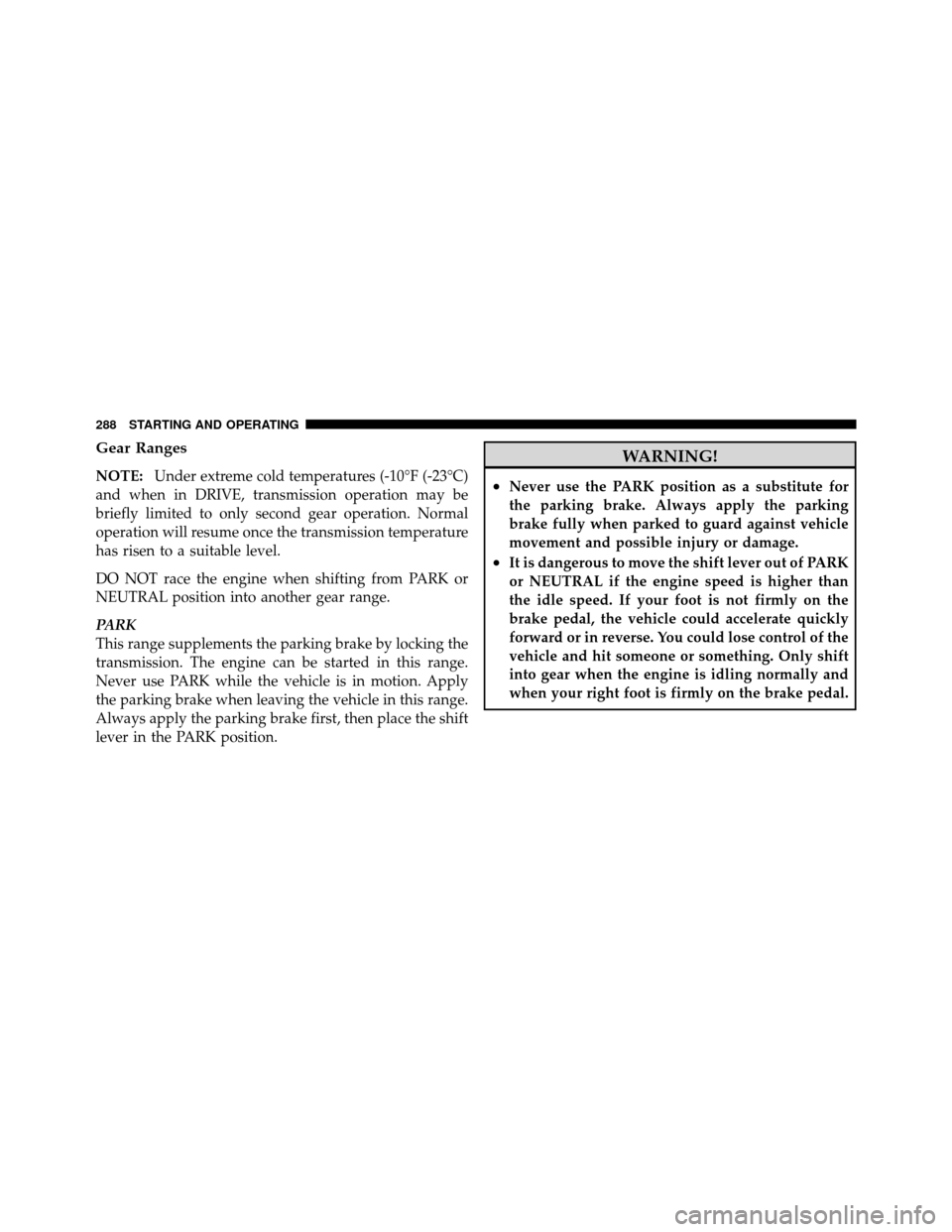
NOTE:Under extreme cold temperatures (-10°F (-23°C)
and when in DRIVE, transmission operation may be
briefly limited to only second gear operation. Normal
operation will resume once the transmission temperature
has risen to a suitable level.
DO NOT race the engine when shifting from PARK or
NEUTRAL position into another gear range.
PARK
This range supplements the parking brake by locking the
transmission. The engine can be started in this range.
Never use PARK while the vehicle is in motion. Apply
the parking brake when leaving the vehicle in this range.
Always apply the parking brake first, then place the shift
lever in the PARK position.
WARNING!
•Never use the PARK position as a substitute for
the parking brake. Always apply the parking
brake fully when parked to guard against vehicle
movement and possible injury or damage.
•It is dangerous to move the shift lever out of PARK
or NEUTRAL if the engine speed is higher than
the idle speed. If your foot is not firmly on the
brake pedal, the vehicle could accelerate quickly
forward or in reverse. You could lose control of the
vehicle and hit someone or something. Only shift
into gear when the engine is idling normally and
when your right foot is firmly on the brake pedal.
288 STARTING AND OPERATING
Page 291 of 502

REVERSE
This range is for moving the vehicle backward. Use only
after the vehicle has come to a complete stop.
NEUTRAL
This range is used when vehicle is standing for pro-
longed periods with engine running. Engine may be
started in this range. Set the parking brake if you must
leave the vehicle.
NOTE:Towing, coasting, or driving the vehicle for any
other reason with the shift lever in NEUTRAL can result
in severe transmission damage. Refer to “Recreational
Towing” in Section 5 and “Towing a Disabled Vehicle” in
Section 6 of this manual. OVERDRIVE
This range is used for most city and highway driving.
The transmission contains an electronically-controlled
fourth gear Overdrive, and will automatically shift from
DRIVE to OVERDRIVE if the following conditions are
present:
•The shift lever is in DRIVE.
•The O/D OFF switch has not been activated.
•Vehicle speed is above approximately 30 mph
(48 km/h).
When frequent transmission shifting occurs while using
Overdrive, such as when operating the vehicle under
heavy load conditions (for example, in hilly terrain,
strong head winds, or trailer towing), turning off over-
drive will improve performance and extend transmission
life by reducing excessive shifting and heat buildup.5
STARTING AND OPERATING 289
Page 293 of 502

CAUTION!
•Before moving the shift lever out of PARK, you
must turn the ignition from LOCK so the steering
wheel and shift lever are released. Otherwise,
damage to the steering column or shift lever could
result.
•Never race the engine with the brakes on and the
vehicle in gear, and never hold the vehicle on an
incline without applying the brakes. These prac-
tices can overheat and damage the transmission.
•When “rocking” a stuck vehicle by moving be-
tween DRIVE and REVERSE, do not spin the
wheels faster than 15 mph (24 km/h), or drivetrain
damage may result.
Torque Converter Clutch
A feature designed to improve fuel economy has been
added to the automatic transmission of this vehicle. A
clutch within the torque converter engages automatically
at calibrated speeds. This may result in a slightly differ-
ent feeling or response during normal operation in high
gear. When the vehicle speed drops or during accelera-
tion, the clutch automatically and smoothly disengages.
FOUR–WHEEL DRIVE OPERATION (COMMAND-
TRAC I�OR ROCK-TRAC�) — IF EQUIPPED
Operating Instructions/Precautions
The transfer case provides four mode positions:
•2H (Two-wheel drive high range)
•4H (Four-wheel drive high range)
•N (Neutral)
5
STARTING AND OPERATING 291
Page 295 of 502

NOTE:Do not attempt to shift when only the front or
rear wheels are spinning. The transfer case is not
equipped with a synchronizer, and the front and rear
driveshaft speeds must be equal for a shift to take place.
Shifting while only the front or rear wheels are spinning
can cause damage to the transfer case.
When operating your vehicle in 4L, the engine speed will
be approximately three times (four times for Rubicon
models) that of the 2H or 4H positions at a given road
speed. Take care not to overspeed the engine.
Proper operation of four-wheel drive vehicles depends
on tires of equal size, type, and circumference on each
wheel. Any difference will adversely affect shifting and
cause damage to the transfer case.
Because four-wheel drive provides improved traction,
there is a tendency to exceed safe turning and stopping
speeds. Do not go faster than road conditions permit.WARNING!
You or others could be injured if you leave the
vehicle unattended with the transfer case in the N
(Neutral) position without first fully engaging the
parking brake. The transfer case N (Neutral) position
disengages both the front and rear driveshaft from
the powertrain, and will allow the vehicle to move
regardless of the transmission position. The parking
brake should always be applied when the driver is
not in the vehicle.
Shift Positions
For additional information on the appropriate use of each
transfer case mode position, see the information below:
2H Position
This range is used for normal street and highway driving
on hard-surfaced roads.
5
STARTING AND OPERATING 293