Page 60 of 502

•Turn on the interior lights, which remain on as long as
the battery has power or until the ignition key is
removed.
•Unlock the doors automatically.
Maintaining Your Airbag System
WARNING!
•Modifications to any part of the airbag system
could cause it to fail when you need it. You could
be injured if the airbag system is not there to
protect you. Do not modify the components or
wiring, including adding any kind of badges or
stickers to the steering wheel hub trim cover or the
upper right side of the instrument panel. Do not
modify the front bumper or vehicle body struc-
ture.(Continued)
WARNING! (Continued)
•You need proper knee impact protection in a
collision. Do not mount or locate any aftermarket
equipment on or behind the knee bolsters.
•It is dangerous to try to repair any part of the
airbag system yourself. Be sure to tell anyone who
works on your vehicle that it has an airbag system.
Airbag Warning Light
You will want to have the airbag system ready to inflate for
your protection in an impact. The airbag system is designed
to be maintenance free. If any of the following occurs, have
an authorized dealer service the system promptly:
•Does not come on during the six to eight seconds after
the ignition switch is first turned on.
•Remains on after the six to eight second interval.
•Comes on for any period of time while driving.
58 THINGS TO KNOW BEFORE STARTING YOUR VEHICLE
Page 78 of 502

Airbag Warning Light
The light should come on and remain on for six to eight
seconds as a bulb check when the ignition switch is first
turned ON. If the light is not lit during starting, see your
authorized dealer. If the light stays on, flickers, or comes
on while driving, have the system checked by an autho-
rized dealer.
Defroster
Check operation by selecting the defrost mode and place
the blower control on high speed. You should be able to
feel the air directed against the windshield. See your
authorized dealer for service if your defroster is
inoperable.
Periodic Safety Checks You Should Make Outside
the Vehicle
Tires
Examine tires for excessive tread wear and uneven wear
patterns. Check for stones, nails, glass, or other objectslodged in the tread. Inspect the tread and sidewall for
cuts and cracks. Check the wheel nuts for tightness.
Check the tires (including spare) for proper pressure.
Lights
Have someone observe the operation of exterior lights
while you work the controls. Check turn signal and high
beam indicator lights on the instrument panel.
Door Latches
Check for positive closing, latching, and locking.
Fluid Leaks
Check area under vehicle after overnight parking for fuel,
engine coolant, oil, or other fluid leaks. Also, if gasoline
fumes are detected or if fuel, power steering fluid, or
brake fluid leaks are suspected, the cause should be
located and corrected immediately.
76 THINGS TO KNOW BEFORE STARTING YOUR VEHICLE
Page 104 of 502
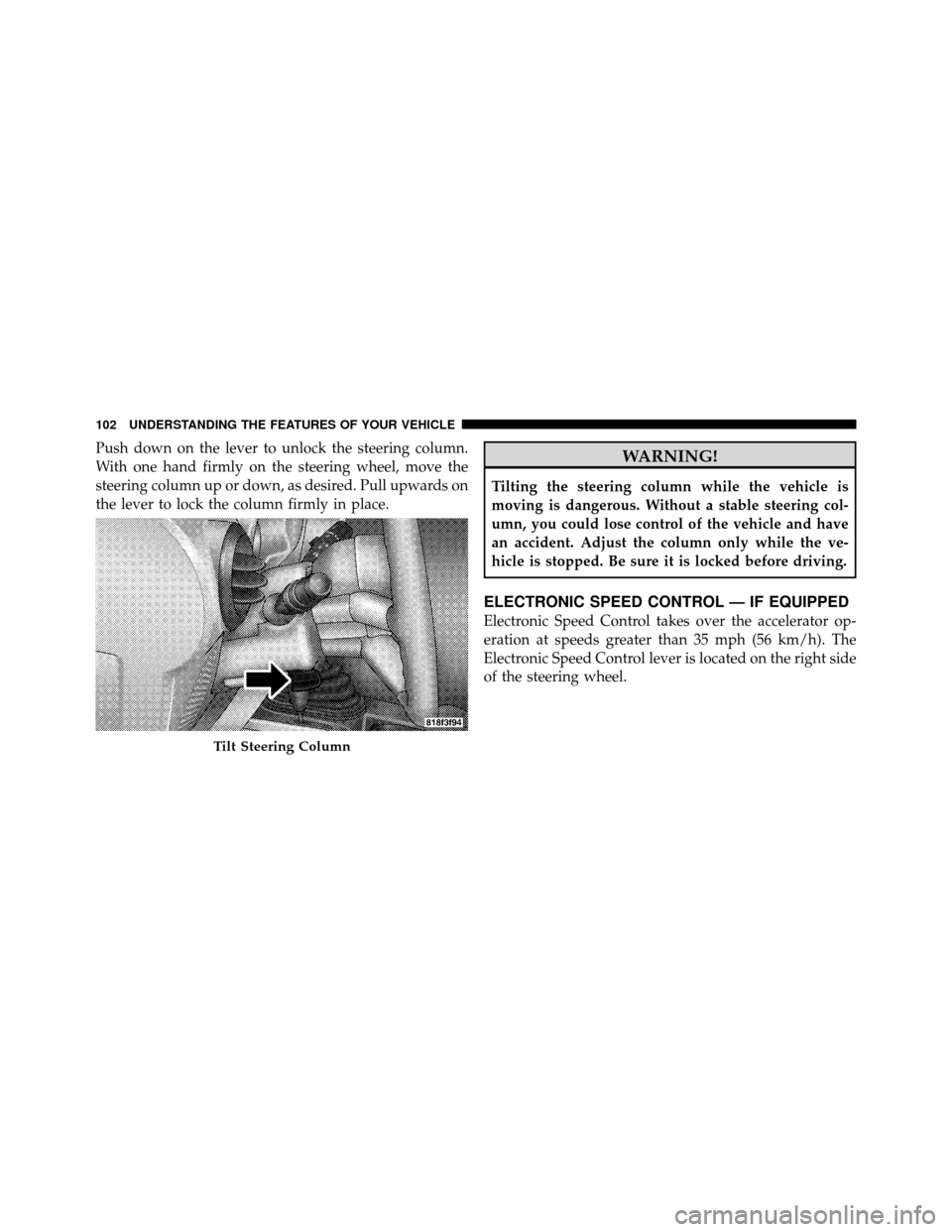
Push down on the lever to unlock the steering column.
With one hand firmly on the steering wheel, move the
steering column up or down, as desired. Pull upwards on
the lever to lock the column firmly in place.WARNING!
Tilting the steering column while the vehicle is
moving is dangerous. Without a stable steering col-
umn, you could lose control of the vehicle and have
an accident. Adjust the column only while the ve-
hicle is stopped. Be sure it is locked before driving.
ELECTRONIC SPEED CONTROL — IF EQUIPPED
Electronic Speed Control takes over the accelerator op-
eration at speeds greater than 35 mph (56 km/h). The
Electronic Speed Control lever is located on the right side
of the steering wheel.
Tilt Steering Column
102 UNDERSTANDING THE FEATURES OF YOUR VEHICLE
Page 276 of 502

▫Automatic Transmission With Overdrive .... 287
�
Four–Wheel Drive Operation (Command-Trac I�
Or Rock-Trac�) — If Equipped
............. 291
▫ Operating Instructions/Precautions ....... 291
▫ Shift Positions ...................... 293
▫ Shifting Procedure ................... 294
� Trac-Lok� Rear Axle — If Equipped ........ 295
� Axle Lock (Tru–Lok�) — Rubicon Models .... 296
� Rear Axle Lock (Four-Wheel Drive
Non-Rubicon Models) — If Equipped ........ 297
� Electronic Sway Bar Disconnect —
If Equipped .......................... 298
� On-Road Driving Tips .................. 300
� Off-Road Driving Tips .................. 300 ▫
Side Step Removal — If Equipped ........ 300
▫ The Basics Of Off-Road Driving .......... 301
▫ When To Use 4L (Low) Range ........... 302
▫ Simultaneous Brake And
Throttle Operation ................... 302
▫ Driving In Snow, Mud And Sand ......... 303
▫ Crossing Obstacles
(Rocks And Other High Points) .......... 304
▫ Hill Climbing ....................... 307
▫ Driving Through Water ................ 309
▫ After Driving Off-Road ................ 312
� Power Steering ....................... 313
▫ Power Steering Fluid Check ............. 314
� Parking Brake ........................ 315
274 STARTING AND OPERATING
Page 293 of 502

CAUTION!
•Before moving the shift lever out of PARK, you
must turn the ignition from LOCK so the steering
wheel and shift lever are released. Otherwise,
damage to the steering column or shift lever could
result.
•Never race the engine with the brakes on and the
vehicle in gear, and never hold the vehicle on an
incline without applying the brakes. These prac-
tices can overheat and damage the transmission.
•When “rocking” a stuck vehicle by moving be-
tween DRIVE and REVERSE, do not spin the
wheels faster than 15 mph (24 km/h), or drivetrain
damage may result.
Torque Converter Clutch
A feature designed to improve fuel economy has been
added to the automatic transmission of this vehicle. A
clutch within the torque converter engages automatically
at calibrated speeds. This may result in a slightly differ-
ent feeling or response during normal operation in high
gear. When the vehicle speed drops or during accelera-
tion, the clutch automatically and smoothly disengages.
FOUR–WHEEL DRIVE OPERATION (COMMAND-
TRAC I�OR ROCK-TRAC�) — IF EQUIPPED
Operating Instructions/Precautions
The transfer case provides four mode positions:
•2H (Two-wheel drive high range)
•4H (Four-wheel drive high range)
•N (Neutral)
5
STARTING AND OPERATING 291
Page 304 of 502

your vehicle’s steering, handling and traction. Control-
ling your vehicle is one of the keys to successful off-road
driving, so always keep a firm grip on the steering wheel
and maintain a good driving posture. Avoid sudden
accelerations, turns or braking. In most cases, there are no
road signs, posted speed limits or signal lights. Therefore,
you will need to use your own good judgment on what is
safe and what is not. When on a trail, you should always
be looking ahead for surface obstacles and changes in
terrain. The key is to plan your future driving route while
remembering what you are currently driving over.
CAUTION!
Never park your vehicle over dry grass or other
combustible materials. The heat from your vehicle
exhaust system could cause a fire.
WARNING!
Always wear your seat belt and firmly tie down
cargo. Unsecured cargo can become projectiles in an
off-road situation.
When to Use 4L (Low) Range
When off-road driving, shift into 4L (Low) for additional
traction and control on slippery or difficult terrain,
ascending or descending steep hills, and to increase low
speed pulling power. This range should be limited to
extreme situations such as deep snow, mud, steep in-
clines, or sand where additional low speed pulling power
is needed. Vehicle speeds in excess of 25 mph (40 km/h)
should be avoided when in 4L (Low) range.
Simultaneous Brake and Throttle Operation
Many off-road driving conditions require the simulta-
neous use of the brake and throttle (two-footed driving).
When climbing rocks, logs, or other stepped objects,
302 STARTING AND OPERATING
Page 305 of 502

using light brake pressure with light throttle will keep the
vehicle from jerking or lurching. This technique is also
used when you need to stop and restart a vehicle on a
steep incline.
Driving In Snow, Mud and Sand
Snow
In heavy snow or for additional control and traction at
slower speeds, shift the transmission into a low gear and
the transfer case into 4L (Low) if necessary. Do not shift to
a lower gear than necessary to maintain headway. Over-
revving the engine can spin the wheels and traction will
be lost. If you start to slow to a stop, try turning your
steering wheel no more than a 1/4 turn quickly back and
forth, while still applying throttle. This will allow the
tires to get a fresh�bite�and help maintain your momen-
tum.
CAUTION!
On icy or slippery roads, do not downshift at high
engine RPM or vehicle speeds, because engine brak-
ing may cause skidding and loss of control.
Mud
Deep mud creates a great deal of suction around the tires
and is very difficult to get through. You should use
second gear (manual transmission), or DRIVE (automatic
transmission), with the transfer case in the 4L (Low)
position to maintain your momentum. If you start to slow
to a stop, try turning your steering wheel no more than a
1/4 turn quickly back and forth for additional traction.
Mud holes pose an increased threat of vehicle damage
and getting stuck. They are normally full of debris from
previous vehicles getting stuck. As a good practice before
5
STARTING AND OPERATING 303
Page 306 of 502

entering any mud hole, get out and determine how deep
it is, if there are any hidden obstacles and if the vehicle
can be safely recovered if stuck.
Sand
Soft sand is very difficult to travel through with full tire
pressure. When crossing soft, sandy spots in a trail,
maintain your vehicle’s momentum and do not stop. The
key to driving in soft sand is using the appropriate tire
pressure, accelerating slowly, avoiding abrupt maneu-
vers and maintaining the vehicle’s momentum. If you are
going to be driving on large soft sandy areas or dunes,
reduce your tire pressure to a minimum of 15 psi
(103 kPa) to allow for a greater tire surface area. Reduced
tire pressure will drastically improve your traction and
handling while driving on the soft sand, but you must
return the tires to normal air pressure before driving on
pavement or other hard surfaces. Be sure you have a way
to reinflate the tires prior to reducing the pressure.
CAUTION!
Reduced tire pressures may cause tire unseating and
total loss of air pressure. To reduce the risk of tire
unseating, while at a reduced tire pressure, reduce
your speed and avoid sharp turns or abrupt maneu-
vers.
Crossing Obstacles (Rocks and Other High
Points)
While driving off-road, you will encounter many types of
terrain. These varying types of terrain bring different
types of obstacles. Before proceeding, review the path
ahead to determine the correct approach and your ability
to safely recover the vehicle if something goes wrong.
Keeping a firm grip on the steering wheel, bring the
vehicle to a complete stop and then inch the vehicle
304 STARTING AND OPERATING