Page 286 of 457

for a safe recovery. If necessary join two tow straps
together using a 1 1/2 in (4 cm) hard wood dowel. This
will keep the straps from becoming knotted and is safer
than using a clevis pin if the strap breaks. Next have the
tow vehicle backup, leaving 2 to 3 ft (61 to 91 cm) worth
of slack in the strap. Then the tow vehicle, using light
throttle, should accelerate tightening the strap providing
the pulling force needed to free the vehicle. The vehicle
being recovered should assist in the recovery, at the time
of the snap, by slowly spinning the tires in the same
direction as the pulling vehicle. After the vehicle becomes
free, the driver of the previously stuck vehicle should
signal they are free and should hit their brakes stopping
both vehicles. The driver of the pulling vehicle should let
off the throttle without using the brakes, once signaled by
the other driver. This sequence is important to avoid
having the recovered vehicle hit the pulling vehicle.WARNING!
Never use tow straps with end hooks or link two
straps with a clevis pin. These heavy metal objects
could become projectiles if a strap breaks, which
could cause severe injury. Never leave more than 2 to
3 ft (61 to 91 cm) of slack in the strap. More slack than
this greatly increases the risk of injury and vehicle
damage. Always keep everyone at least 30 ft (9 m)
away from a strapping or winching situation.
After Driving Off-Road
Off-road operation puts more stress on your vehicle than
does most on-road driving. After driving off-road, it is
always a good idea to check for damage.
•Completely inspect the underbody of your vehicle.
Check tires, body structure, steering, suspension, and
exhaust system for damage.
284 STARTING AND OPERATING
Page 338 of 457
Curb Weight
The curb weight of a vehicle is defined as the total weight
of the vehicle with all fluids, including vehicle fuel, at full
capacity conditions, and with no occupants or cargo
loaded into the vehicle. The front and rear curb weight
values are determined by weighing your vehicle on a
commercial scale before any occupants or cargo are
added.
Overloading
The load carrying components (springs, tires, wheels,
etc.) of your vehicle will provide satisfactory service as
long as you do not exceed the GVWR.
The best way to figure out the total weight of your
vehicle is to weigh it when it is fully loaded and ready for
operation. Weigh it on a commercial scale to ensure that
it is not over the GVWR.Overloading can cause potential safety hazards and
shorten useful service life. Heavier suspension compo-
nents do not necessarily increase the vehicle’s GVWR.
Loading
To load your vehicle properly, first figure out its empty
weight. Store heavier items down low and be sure you
distribute their weight as evenly as possible. Stow all
loose items securely before driving. Improper weight
distribution can have an adverse effect on the way your
vehicle steers and handles, and the way the brakes
operate.
CAUTION!
Do not load your vehicle any heavier than the
GVWR. If you do, parts on your vehicle can break, or
it can change the way your vehicle handles. This
could cause you to lose control. Also, overloading can
shorten the life of your vehicle.
336 STARTING AND OPERATING
Page 344 of 457
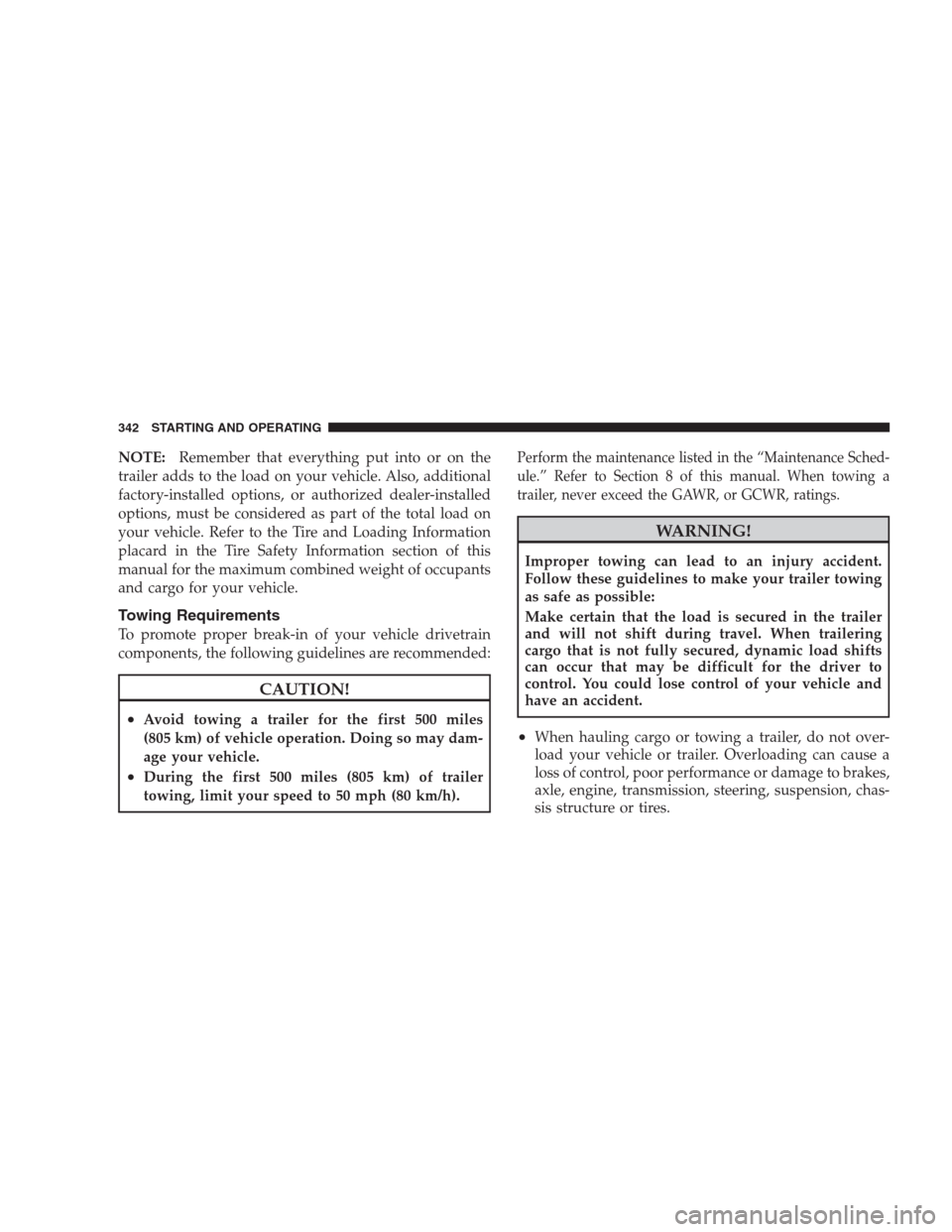
NOTE:Remember that everything put into or on the
trailer adds to the load on your vehicle. Also, additional
factory-installed options, or authorized dealer-installed
options, must be considered as part of the total load on
your vehicle. Refer to the Tire and Loading Information
placard in the Tire Safety Information section of this
manual for the maximum combined weight of occupants
and cargo for your vehicle.
Towing Requirements
To promote proper break-in of your vehicle drivetrain
components, the following guidelines are recommended:
CAUTION!
•Avoid towing a trailer for the first 500 miles
(805 km) of vehicle operation. Doing so may dam-
age your vehicle.
•During the first 500 miles (805 km) of trailer
towing, limit your speed to 50 mph (80 km/h).
Perform the maintenance listed in the “Maintenance Sched-
ule.” Refer to Section 8 of this manual. When towing a
trailer, never exceed the GAWR, or GCWR, ratings.
WARNING!
Improper towing can lead to an injury accident.
Follow these guidelines to make your trailer towing
as safe as possible:
Make certain that the load is secured in the trailer
and will not shift during travel. When trailering
cargo that is not fully secured, dynamic load shifts
can occur that may be difficult for the driver to
control. You could lose control of your vehicle and
have an accident.
•When hauling cargo or towing a trailer, do not over-
load your vehicle or trailer. Overloading can cause a
loss of control, poor performance or damage to brakes,
axle, engine, transmission, steering, suspension, chas-
sis structure or tires.
342 STARTING AND OPERATING
Page 364 of 457
CAUTION!
•If the vehicle being towed requires steering, the
ignition switch must be in the ACC position, not
in the LOCK position.
•Do not attempt to use sling type equipment when
towing. When securing the vehicle to a flat bed
truck, do not attach to front or rear suspension
components. Damage to your vehicle may result
from improper towing.
Without The Ignition Key
Special care must be taken when the vehicle is towed
with the ignition in the LOCK position. A dolly should be
used under the front wheels if the rear wheels are raised.
Proper towing equipment is necessary to prevent dam-
age to the vehicle.
Battery power is required to release the brake/
transmission interlock system. There is a removable plug
in the right side of the shift lever housing that allows you
to insert your finger to override the system. The ignition
key must be in the ON position to use the override lever.
362 WHAT TO DO IN EMERGENCIES
Page 414 of 457
18,000 Miles (30,000 km) or
18 Months Maintenance
Service Schedule
❏Change the engine oil and engine oil
filter.
❏Rotate tires.
Odometer Reading Date
Repair Order # Dealer Code
Signature Authorized Chrysler Dealer
24,000 Miles (40,000 km) or 24 Months Maintenance Service
Schedule
❏Change the engine oil and engine oil filter.
❏Rotate tires.
❏If using your vehicle for any of the following: Dusty or off-road conditions. Inspect the
engine air cleaner filter; replace if necessary.
❏Inspect the brake linings; replace if necessary.
❏Replace the air conditioning filter.
❏Inspect the CV joints.
❏Inspect exhaust system.
❏Inspect the front suspension, tie rod ends and boot seals; replace if necessary.
Odometer Reading Date
Repair Order # Dealer Code
Signature Authorized Chrysler Dealer
412 MAINTENANCE SCHEDULES
8
M
A
I
N
T
E
N
A
N
C
E
S
C
H
E
D
U
L
E
S
Page 416 of 457
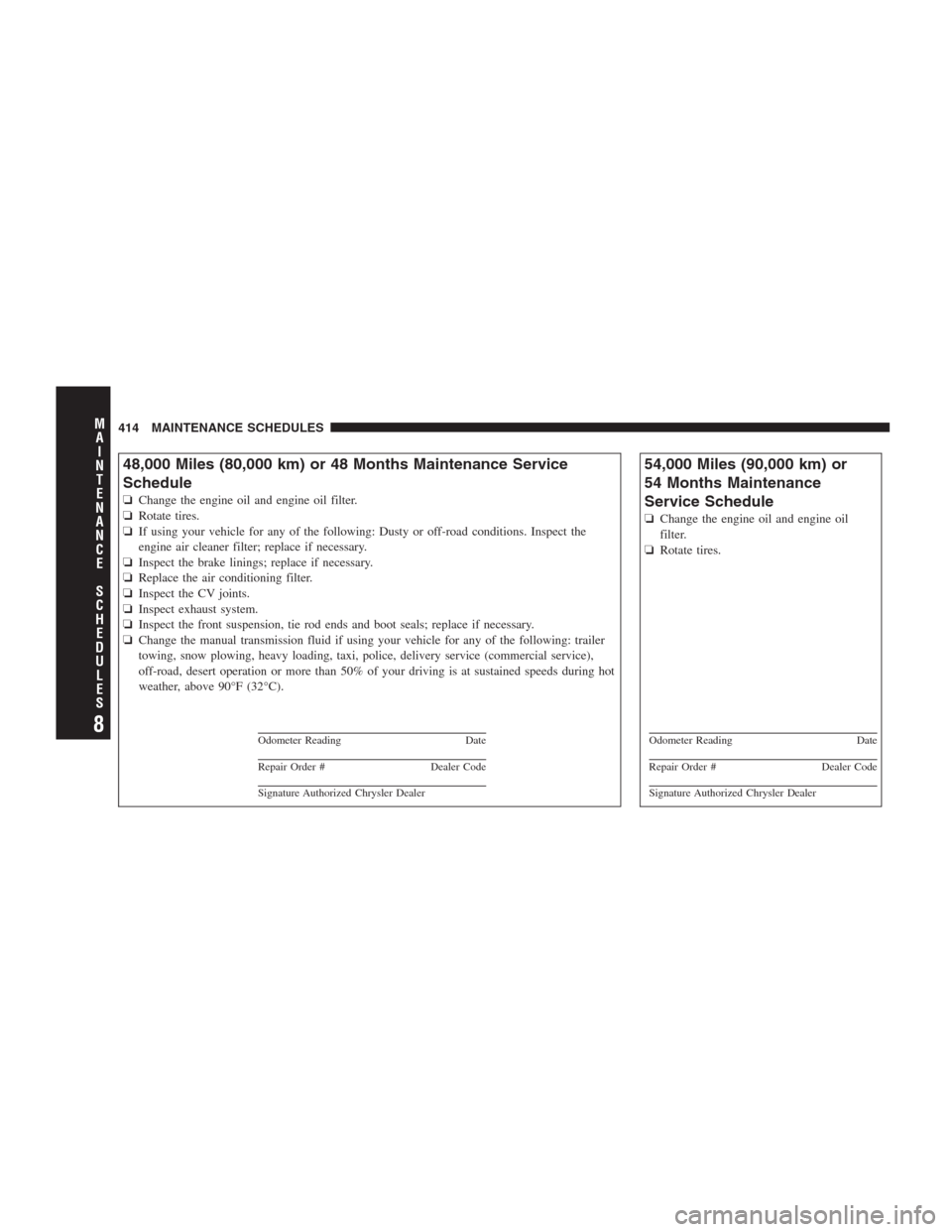
48,000 Miles (80,000 km) or 48 Months Maintenance Service
Schedule
❏Change the engine oil and engine oil filter.
❏Rotate tires.
❏If using your vehicle for any of the following: Dusty or off-road conditions. Inspect the
engine air cleaner filter; replace if necessary.
❏Inspect the brake linings; replace if necessary.
❏Replace the air conditioning filter.
❏Inspect the CV joints.
❏Inspect exhaust system.
❏Inspect the front suspension, tie rod ends and boot seals; replace if necessary.
❏Change the manual transmission fluid if using your vehicle for any of the following: trailer
towing, snow plowing, heavy loading, taxi, police, delivery service (commercial service),
off-road, desert operation or more than 50% of your driving is at sustained speeds during hot
weather, above 90°F (32°C).
Odometer Reading Date
Repair Order # Dealer Code
Signature Authorized Chrysler Dealer
54,000 Miles (90,000 km) or
54 Months Maintenance
Service Schedule
❏Change the engine oil and engine oil
filter.
❏Rotate tires.
Odometer Reading Date
Repair Order # Dealer Code
Signature Authorized Chrysler Dealer
414 MAINTENANCE SCHEDULES
8
M
A
I
N
T
E
N
A
N
C
E
S
C
H
E
D
U
L
E
S
Page 418 of 457
72,000 Miles (120,000 km) or 72 Months Maintenance Service
Schedule
❏Change the engine oil and engine oil filter.
❏Rotate tires.
❏If using your vehicle for any of the following: Dusty or off-road conditions. Inspect the
engine air cleaner filter; replace if necessary.
❏Inspect the brake linings; replace if necessary.
❏Replace the air conditioning filter.
❏Inspect the CV joints.
❏Inspect exhaust system.
❏Inspect the front suspension, tie rod ends and boot seals; replace if necessary.
Odometer Reading Date
Repair Order # Dealer Code
Signature Authorized Chrysler Dealer
78,000 Miles (130,000 km) or
78 Months Maintenance
Service Schedule
❏Change the engine oil and engine oil
filter.
❏Rotate tires.
Odometer Reading Date
Repair Order # Dealer Code
Signature Authorized Chrysler Dealer
416 MAINTENANCE SCHEDULES
8
M
A
I
N
T
E
N
A
N
C
E
S
C
H
E
D
U
L
E
S
Page 420 of 457
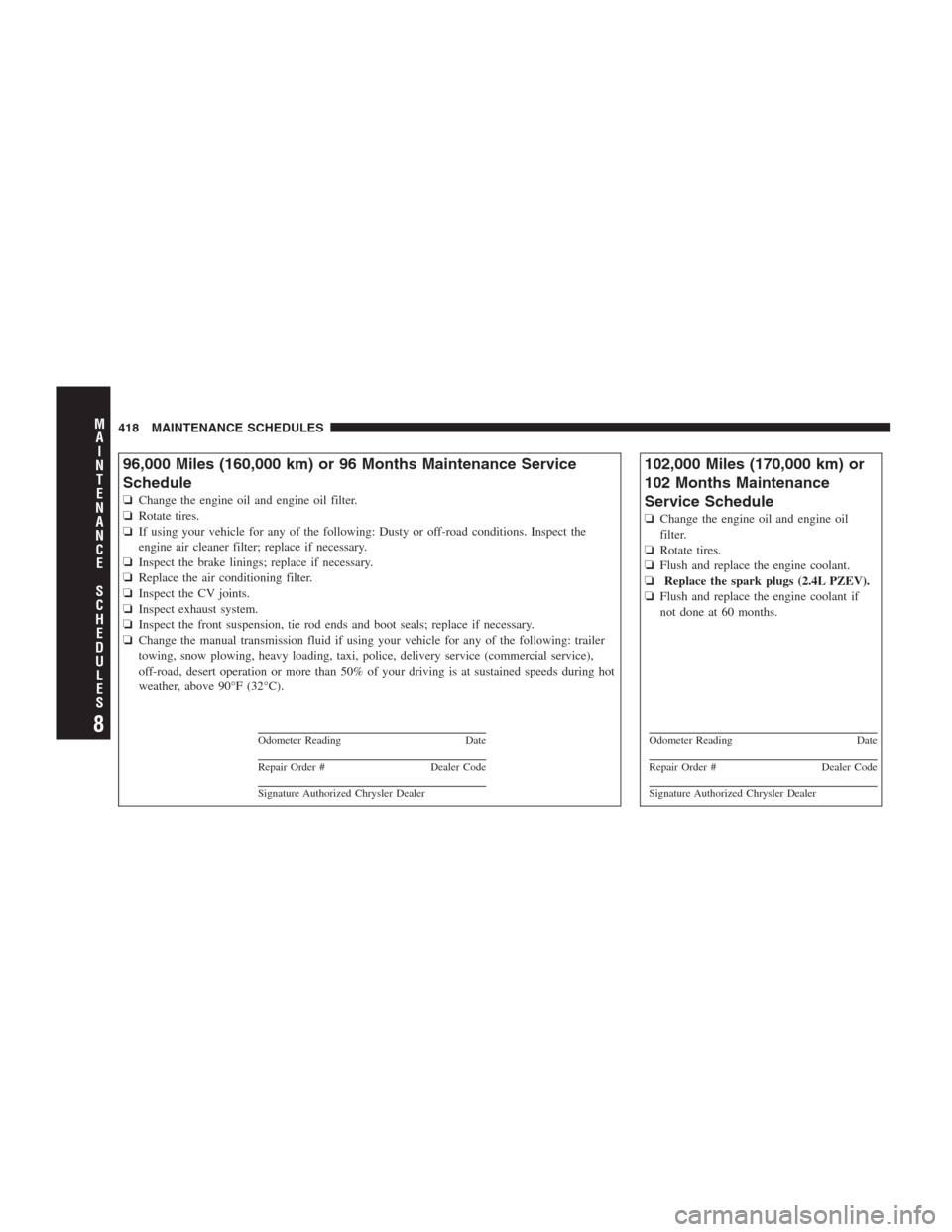
96,000 Miles (160,000 km) or 96 Months Maintenance Service
Schedule
❏Change the engine oil and engine oil filter.
❏Rotate tires.
❏If using your vehicle for any of the following: Dusty or off-road conditions. Inspect the
engine air cleaner filter; replace if necessary.
❏Inspect the brake linings; replace if necessary.
❏Replace the air conditioning filter.
❏Inspect the CV joints.
❏Inspect exhaust system.
❏Inspect the front suspension, tie rod ends and boot seals; replace if necessary.
❏Change the manual transmission fluid if using your vehicle for any of the following: trailer
towing, snow plowing, heavy loading, taxi, police, delivery service (commercial service),
off-road, desert operation or more than 50% of your driving is at sustained speeds during hot
weather, above 90°F (32°C).
Odometer Reading Date
Repair Order # Dealer Code
Signature Authorized Chrysler Dealer
102,000 Miles (170,000 km) or
102 Months Maintenance
Service Schedule
❏Change the engine oil and engine oil
filter.
❏Rotate tires.
❏Flush and replace the engine coolant.
❏Replace the spark plugs (2.4L PZEV).
❏Flush and replace the engine coolant if
not done at 60 months.
Odometer Reading Date
Repair Order # Dealer Code
Signature Authorized Chrysler Dealer
418 MAINTENANCE SCHEDULES
8
M
A
I
N
T
E
N
A
N
C
E
S
C
H
E
D
U
L
E
S