2009 JEEP PATRIOT radiator
[x] Cancel search: radiatorPage 247 of 457
NOTE:For maximum airflow to the rear seat passen-
gers, the center instrument panel outlets can be aimed, so
that the left center outlet is directed toward the right rear
passenger and the right center outlet is directed toward
the left rear passenger.
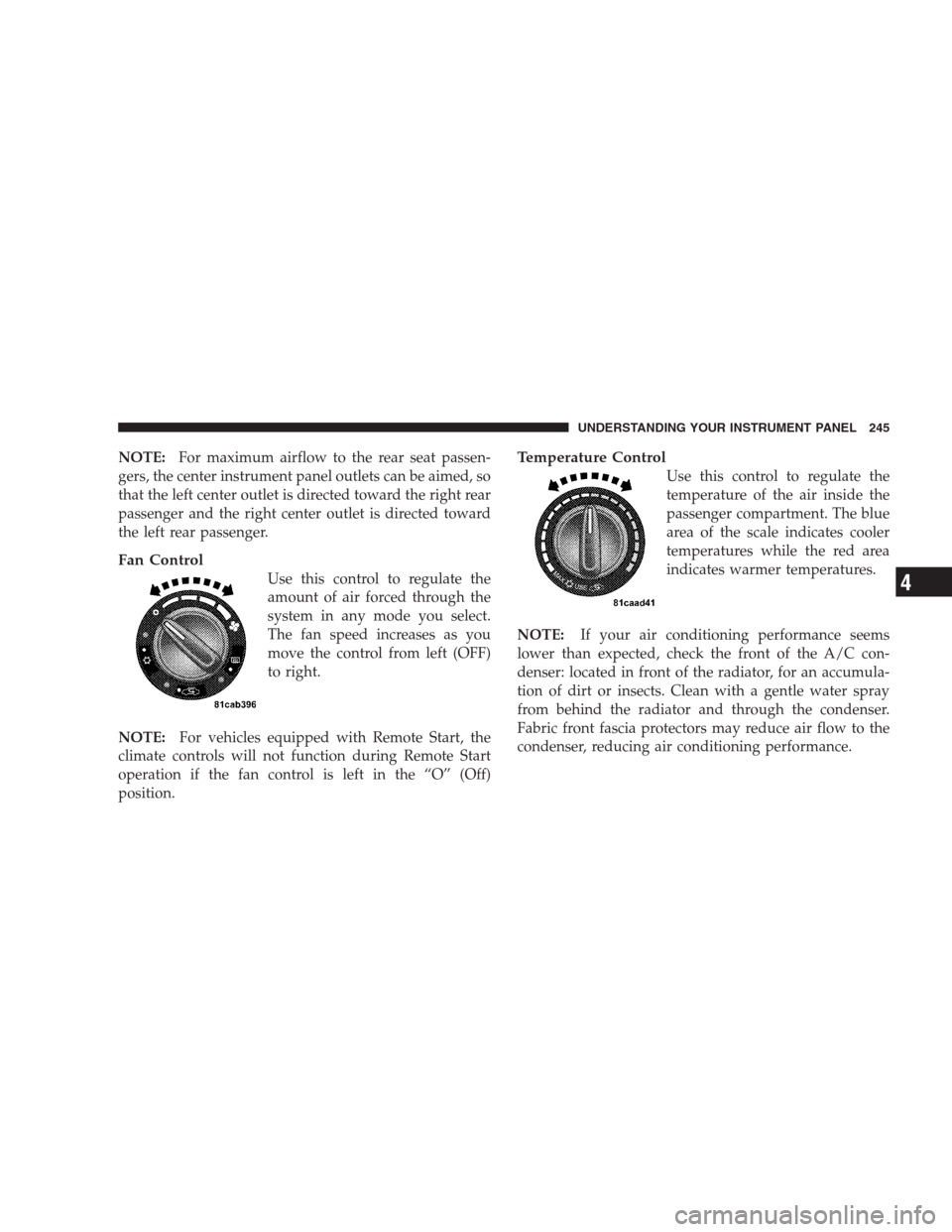
Fan Control
Use this control to regulate the
amount of air forced through the
system in any mode you select.
The fan speed increases as you
move the control from left (OFF)
to right.
NOTE:For vehicles equipped with Remote Start, the
climate controls will not function during Remote Start
operation if the fan control is left in the “O” (Off)
position.
Temperature Control
Use this control to regulate the
temperature of the air inside the
passenger compartment. The blue
area of the scale indicates cooler
temperatures while the red area
indicates warmer temperatures.
NOTE:If your air conditioning performance seems
lower than expected, check the front of the A/C con-
denser: located in front of the radiator, for an accumula-
tion of dirt or insects. Clean with a gentle water spray
from behind the radiator and through the condenser.
Fabric front fascia protectors may reduce air flow to the
condenser, reducing air conditioning performance.
UNDERSTANDING YOUR INSTRUMENT PANEL 245
4
Page 282 of 457
soft bottoms the vehicle will sink in, effectively increas-
ing the water level on the vehicle. Be sure to consider this
when determining the depth and the ability to safely
cross.
Crossing Puddles, Pools, Flooded Areas Or Other
Standing Water
Puddles, pools, flooded or other standing water areas
normally contain murky or muddy waters. These water
types normally contain hidden obstacles and make it
difficult to determine an accurate water depth, approach
angle, and bottom condition. Murky or muddy water
holes are where you want to hook up tow straps prior to
entering. This makes for a faster, cleaner and easier
vehicle recovery. If you are able to determine you can
safely cross, than proceed using the low and slow
method.
CAUTION!
Muddy waters can reduce the cooling system effec-
tiveness by depositing debris onto the radiator.
Crossing Ditches, Streams, Shallow Rivers Or
Other Flowing Water
Flowing water can be extremely dangerous. Never at-
tempt to cross a fast running stream or river even in
shallow water. Fast moving water can easily push your
vehicle downstream sweeping it out of control. Even in
very shallow water, a high current can still wash the dirt
out from around your tires putting you and your vehicle
in jeopardy. There is still a high risk of personal injury
and vehicle damage with slower water currents in depths
greater than the vehicle’s running ground clearance. You
should never attempt to cross flowing water which is
deeper than the vehicle’s running ground clearance. Even
280 STARTING AND OPERATING
Page 353 of 457
NOTE:There are steps that you can take to slow down
an impending overheat condition. If your air conditioner
is on, turn it off. The air conditioning system adds heat to
the engine cooling system and turning off the A/C
removes this heat. You can also turn the Temperature
control to maximum heat, the Mode control to floor, and
the fan control to high. This allows the heater core to act
as a supplement to the radiator and aids in removing heat
from the engine cooling system.CAUTION!
Driving with a hot cooling system could damage
your vehicle. If the temperature gauge reads “H”,
pull over when safe and stop the vehicle with the
engine at idle. Turn the air conditioner off and wait
until the pointer drops back into the normal range.
After appropriate action has been taken, if the
pointer remains on the “H”, turn the engine OFF
immediately and call for service.
WHAT TO DO IN EMERGENCIES 351
6
Page 360 of 457

JUMP-STARTING PROCEDURES
WARNING!
•Take care to avoid the radiator cooling fan when-
ever the hood is raised. It can start anytime the
ignition switch is on. You can be hurt by the fan.
•Do not attempt to push or tow your vehicle to get
it started. Vehicles equipped with an automatic
transaxle cannot be started this way and may be
damaged. Unburned fuel could enter the catalytic
converter and once the engine has started, ignite
and damage the converter and vehicle. If the
vehicle has a discharged battery, booster cables
may be used to obtain a start from another vehicle.
This type of start can be dangerous if done im-
properly, so follow this procedure carefully.
(Continued)
WARNING! (Continued)
•Wear eye protection and remove any metal jewelry
such as watch bands or bracelets that might make
an inadvertent electrical contact. You could be
seriously injured.
NOTE: Disconnecting the battery with the ignition in
the ON position will cause vehicles with an automatic
transaxle (CVT2) to go into “default mode” and turn on
the Malfunction Indicator Light (MIL). See your autho-
rized dealer to correct this condition.
1. When boosting from a battery in another vehicle, park
that vehicle within booster cable reach but without
letting the vehicles touch. Set the parking brake, place the
automatic transmission in PARK (the manual transmis-
sion in NEUTRAL) and turn the ignition to OFF for both
vehicles.
358 WHAT TO DO IN EMERGENCIES
Page 378 of 457

Operation of the wipers on dry glass for long periods
may cause deterioration of the wiper blades. Always use
washer fluid when using the wipers to remove salt or dirt
from a dry windshield. Avoid using the wiper blades to
remove frost or ice from the windshield. Make sure that
they are not frozen to the glass before turning them on to
avoid damaging the blade. Keep the blade rubber out of
contact with petroleum products such as engine oil,
gasoline, etc.
Adding Washer Fluid
The washer fluid reservoir is located in the engine
compartment, and the fluid level should be checked at
regular intervals. Fill the reservoir with windshield
washer solvent only (not radiator antifreeze).
WARNING!
Commercially available windshield washer solvents
are flammable. They could ignite and burn you. Care
must be exercised when filling or working around
the washer solution.
Exhaust System
The best protection against carbon monoxide entry into
the vehicle body is a properly maintained engine exhaust
system.
If you notice a change in the sound of the exhaust system,
or if exhaust fumes can be detected inside the vehicle or
when the underside or rear of the vehicle is damaged,
have a competent technician inspect the complete ex-
haust system and adjacent body areas for broken, dam-
aged, deteriorated, or mispositioned parts. Open seams
or loose connections could permit exhaust fumes to seep
into the passenger compartment. In addition, inspect the
376 MAINTAINING YOUR VEHICLE
Page 380 of 457

WARNING!
A hot exhaust system can start a fire if you park over
materials that can burn. Such materials might be
grass or leaves coming into contact with your exhaust
system. Do not park or operate your vehicle in areas
where your exhaust system can contact anything that
can burn.
In unusual situations involving grossly malfunctioning
engine operation, a scorching odor may suggest severe
and abnormal catalyst overheating. If this occurs, stop
the vehicle, turn off the engine and allow it to cool.
Service, including a tune up to manufacturers specifica-
tions, should be obtained immediately.To minimize the possibility of catalyst damage:•Do not shut off the engine or interrupt the ignition
when the transaxle is in gear and the vehicle is in
motion.
•Do not try to start the engine by pushing or towing the
vehicle.
•Do not idle the engine with any spark plug wires
disconnected for a prolonged period.
Cooling System
WARNING!
•When working near the radiator cooling fan, dis-
connect the fan motor lead or turn the ignition
switch to the OFF position. The fan is temperature
controlled and can start at any time the ignition
switch is in the ON position.
(Continued)
378 MAINTAINING YOUR VEHICLE
Page 381 of 457
WARNING! (Continued)
•You or others can be badly burned by hot coolant
or steam from your radiator. If you see or hear
steam coming from under the hood, do not open
the hood until the radiator has had time to cool.
Never try to open a cooling system pressure cap
when the radiator is hot.
Coolant Checks
Check engine coolant (antifreeze) protection every
12 months (before the onset of freezing weather, where
applicable). If the engine coolant (antifreeze) is dirty or
rusty in appearance, the system should be drained,
flushed and refilled with fresh engine coolant (anti-
freeze). Check the front of the A/C condenser for any
accumulation of bugs, leaves, etc. If dirty, clean by gently
spraying water from a garden hose vertically down the
face of the condenser.Check the coolant recovery bottle tubing for brittle rub-
ber, cracking, tears, cuts and tightness of the connection
at the bottle and radiator. Inspect the entire system for
leaks.
Cooling System — Drain, Flush And Refill
Refer to the “Maintenance Schedule” in Section 8 for
proper maintenance intervals.
If the engine coolant (antifreeze) is dirty or contains a
considerable amount of sediment, clean and flush with a
reliable cooling system cleaner. Follow with a thorough
rinsing to remove all deposits and chemicals. Properly
dispose of old engine coolant (antifreeze).
Selection Of Coolant
Refer to “Fluids, Lubricants, and Genuine Parts” in this
section for the correct fluid type.
MAINTAINING YOUR VEHICLE 379
7
Page 382 of 457
CAUTION!
•Mixing of engine coolant (antifreeze) other than
specified Hybrid Organic Additive Technology
(HOAT) engine coolant (antifreeze), may result in
engine damage and may decrease corrosion pro-
tection. If a non-HOAT engine coolant (antifreeze)
is introduced into the cooling system in an emer-
gency, it should be replaced with the specified
engine coolant (antifreeze) as soon as possible.
•Do not use water alone or alcohol based engine
coolant (antifreeze) products. Do not use addi-
tional rust inhibitors or antirust products, as they
may not be compatible with the radiator engine
coolant and may plug the radiator.
(Continued)
CAUTION! (Continued)
•This vehicle has not been designed for use with
Propylene Glycol based engine coolant (anti-
freeze). Use of Propylene Glycol based engine
coolant (antifreeze) is not recommended.
Adding Coolant
Your vehicle has been built with an improved engine
coolant (antifreeze) that allows extended maintenance
intervals. This engine coolant (antifreeze) can be used up
to five years or 102,000 miles (170 000 km) before
replacement. To prevent reducing this extended mainte-
nance period, it is important that you use the same
engine coolant (antifreeze) throughout the life of your
vehicle. Please review these recommendations for using
Hybrid Organic Additive Technology (HOAT) engine
coolant (antifreeze).
380 MAINTAINING YOUR VEHICLE