2009 JEEP LIBERTY ECU
[x] Cancel search: ECUPage 373 of 506
WARNING! (Continued)
•Never add fuel to the vehicle when the engine is
running.
•A fire may result if gasoline is pumped into a
portable container that is inside of a vehicle. You
could be burned. Always place gas containers on
the ground while filling.
NOTE:
•Tighten the gas cap until you hear a “clicking” sound.
This is an indication that the gas cap is tightened
properly. The MIL in the instrument cluster may turn
on if the gas cap is not secured properly. Make sure
that the gas cap is tightened each time the vehicle is
refueled.
•When the fuel nozzle “clicks” or shuts off, the fuel
tank is full.
Loose Fuel Filler Cap Message
If the vehicle diagnostic system determines that the fuel
filler cap in loose, improperly installed, or damaged, a
“gASCAP” message will display in the instrument clus-
ter. Tighten the gas cap until a “clicking” sound is heard.
This is an indication that the gas cap is properly tight-
ened. Press the trip odometer reset button to turn off the
message. If the problem persists, the message will appear
the next time the vehicle is started. This might indicate a
damaged cap. If the problem is detected twice in a row,
the system will turn on the MIL. Resolving the problem
will turn the MIL light off.
VEHICLE LOADING
Certification Label
As required by National Highway Traffic Safety Admin-
istration regulations, your vehicle has a certification label
affixed to the driver’s side door or B-Pillar.
STARTING AND OPERATING 371
5
Page 375 of 506
Inflation Pressure
This is the cold tire inflation pressure for your vehicle for
all loading conditions up to full GAWR.
Curb Weight
The curb weight of a vehicle is defined as the total weight
of the vehicle with all fluids, including vehicle fuel, at full
capacity conditions, and with no occupants or cargo
loaded into the vehicle. The front and rear curb weight
values are determined by weighing your vehicle on a
commercial scale before any occupants or cargo are
added.
Loading
The actual total weight and the weight of the front and
rear of your vehicle at the ground can best be determined
by weighing it when it is loaded and ready for operation.The entire vehicle should first be weighed on a commer-
cial scale to ensure that the GVWR has not been ex-
ceeded. The weight on the front and rear of the vehicle
should then be determined separately to be sure that the
load is properly distributed over front and rear axle.
Weighing the vehicle may show that the GAWR of either
the front or rear axles has been exceeded, but the total
load is within the specified GVWR. If so, weight must be
shifted from front to rear, or rear to front, as appropriate
until the specified weight limitations are met. Store the
heavier items down low and be sure that the weight is
distributed equally. Stow all loose items securely before
driving.
Improper weight distributions can have an adverse affect
on the way your vehicle steers and handles, and the way
the brakes operate.
STARTING AND OPERATING 373
5
Page 385 of 506
NOTE:Remember that everything put into or on the
trailer adds to the load on your vehicle. Also, additional
factory-installed options, or authorized dealer-installed
options, must be considered as part of the total load on
your vehicle. Refer to the “Tire and Loading Information”
placard for the maximum combined weight of occupants
and cargo for your vehicle.
Towing Requirements
To promote proper break-in of your new vehicle drive-
train components, the following guidelines are recom-
mended:
CAUTION!
•Avoid towing a trailer for the first 500 miles
(805 km) of vehicle operation. Doing so may dam-
age your vehicle.
•During the first 500 miles (805 km) of trailer
towing, limit your speed to 50 mph (80 km/h).
WARNING!
Improper towing can lead to an injury accident.
Follow these guidelines to make your trailer towing
as safe as possible:
Make certain that the load is secured in the trailer
and that is will not shift during travel. When traile-
ring cargo that is not fully secured, dynamic load
shifts can occur that may be difficult for the driver to
control. You could lose control of your vehicle and
have an accident.
•When hauling cargo, or towing a trailer, do not
overload your vehicle or trailer. Overloading can cause
a loss of control, poor performance, or damage to
brakes, axle, engine, transmission, steering, suspen-
sion, chassis structure, or tires.
STARTING AND OPERATING 383
5
Page 401 of 506
WARNING! (Continued)
•Do not let anyone sit in the vehicle when it is on a
jack.
•Do not get under the vehicle when it is on a jack.
•Only use the jack in the positions indicated and
for lifting this vehicle during a tire change.
•If working on or near a roadway, be extremely
careful of motor traffic.
•To assure that spare tires, flat or inflated, are
securely stowed, spares must be stowed with the
valve stem facing the ground.
•Turn on the Hazard Warning flasher.1. Remove spare tire.
2. Remove jack and tools from mounting bracket. As-
semble the tools by connecting the driver to the exten-
sion, and then to the lug wrench.
3. Loosen (but do not remove) the wheel lug nuts by
turning them to the left one turn while the wheel is still
on the ground.
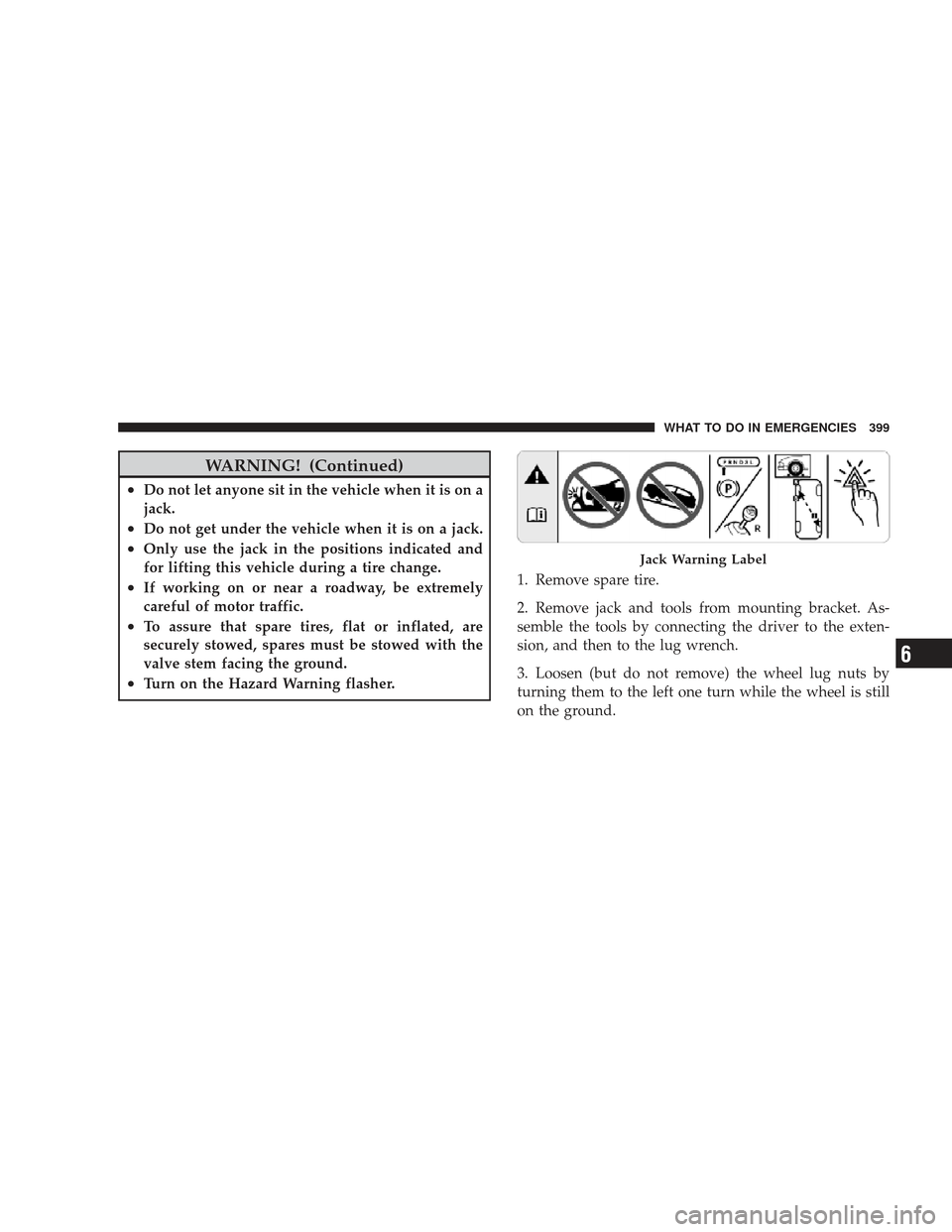
Jack Warning Label
WHAT TO DO IN EMERGENCIES 399
6
Page 403 of 506
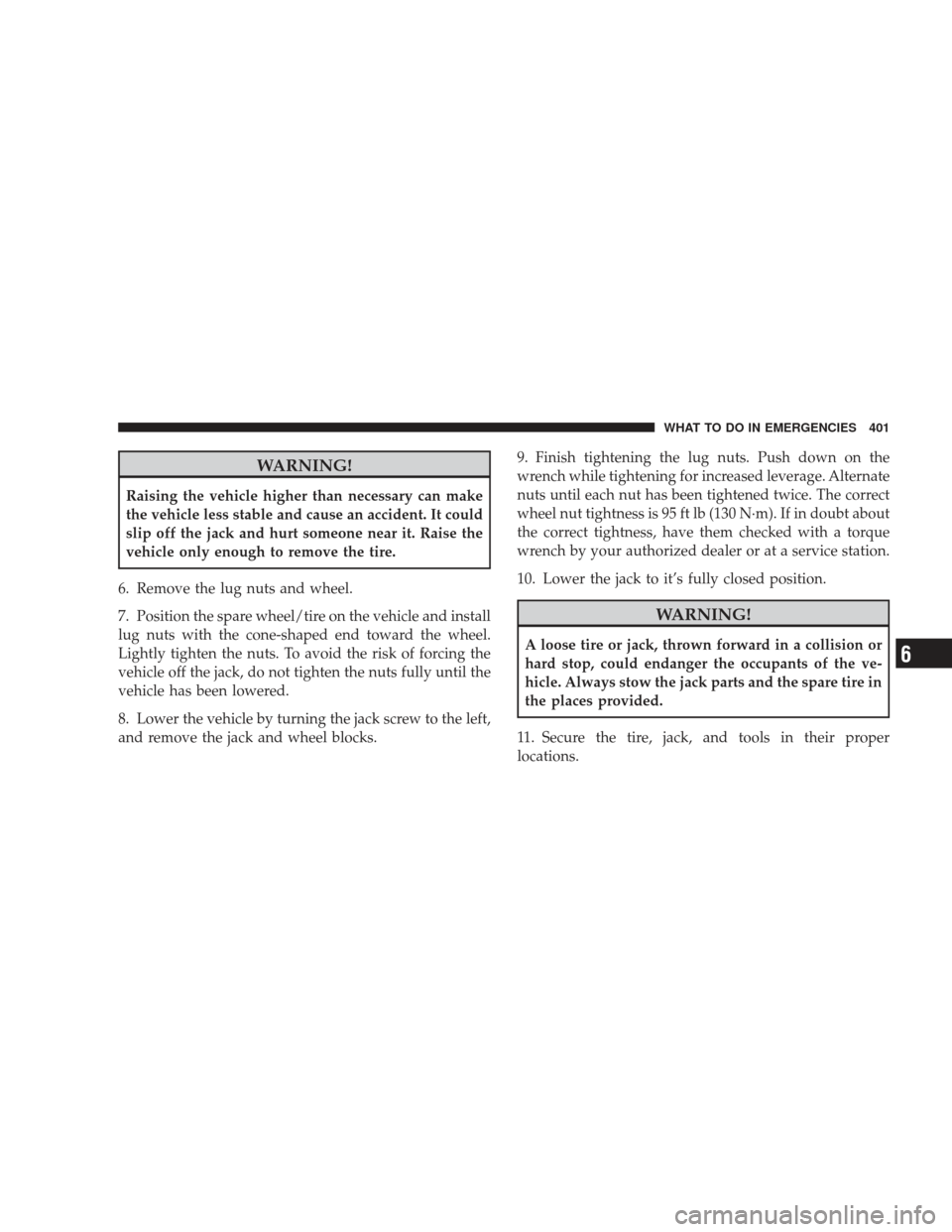
WARNING!
Raising the vehicle higher than necessary can make
the vehicle less stable and cause an accident. It could
slip off the jack and hurt someone near it. Raise the
vehicle only enough to remove the tire.
6. Remove the lug nuts and wheel.
7. Position the spare wheel/tire on the vehicle and install
lug nuts with the cone-shaped end toward the wheel.
Lightly tighten the nuts. To avoid the risk of forcing the
vehicle off the jack, do not tighten the nuts fully until the
vehicle has been lowered.
8. Lower the vehicle by turning the jack screw to the left,
and remove the jack and wheel blocks. 9. Finish tightening the lug nuts. Push down on the
wrench while tightening for increased leverage. Alternate
nuts until each nut has been tightened twice. The correct
wheel nut tightness is 95 ft lb (130 N·m). If in doubt about
the correct tightness, have them checked with a torque
wrench by your authorized dealer or at a service station.
10. Lower the jack to it’s fully closed position.
WARNING!
A loose tire or jack, thrown forward in a collision or
hard stop, could endanger the occupants of the ve-
hicle. Always stow the jack parts and the spare tire in
the places provided.
11. Secure the tire, jack, and tools in their proper
locations.
WHAT TO DO IN EMERGENCIES 401
6
Page 482 of 506
About Your Brakes....................... 320
ABS (Anti-Lock Brake System) ............321,324
Adding Engine Coolant (Antifreeze) .......... 425
Adding Fuel ........................... 370
Additives, Fuel ......................... 368
Air Cleaner, Engine (Engine Air Cleaner Filter) . . . 416
Air Conditioner Maintenance ............... 418
Air Conditioning ........................ 274
Air Conditioning Controls ................. 274
Air Conditioning Filter .................284,419
Air Conditioning, Operating Tips ............ 285
Air Conditioning Refrigerant .............418,419
Air Conditioning System .............274,277,418
Air Filter .............................. 416
Air Pressure, Tires ....................... 347
Airbag ................................ 53
Airbag Deployment ....................... 65
Airbag Light ....................... 68,83,215
Airbag Maintenance ....................... 67 Alarm, Panic
............................ 24
Alarm (Security Alarm) .................18,214
Alarm System (Security Alarm) ............... 18
Alterations/Modifications, Vehicle ............. 8
Antenna, Satellite Radio ................... 267
Antifreeze (Engine Coolant) ...........424,425,450
Disposal ............................ 427
Anti-Lock Brake System (ABS) ............321,324
Anti-Lock Warning Light .................. 206
Anti-Theft Security Alarm (Theft Alarm) ........ 18
Anti-Theft System ....................... 214
Appearance Care ........................ 435
Arming Theft System (Security Alarm) ......... 18
Assist, Hill Start ........................ 328
Assistance Towing ....................... 108
Auto Down Power Windows ................ 35
Auto Unlock, Doors ....................... 32
Automatic Dimming Mirror ................. 90
Automatic Door Locks ................... 31,32
480 INDEX
Page 498 of 506
Seats................................. 127
Adjustment .......................... 127
Easy Entry ........................... 139
Head Restraints ....................... 131
Heated ............................. 132
Height Adjustment ..................... 130
Lumbar Support ....................... 129
Memory ............................ 136
Power .............................. 130
Rear Folding ......................... 133
Reclining ............................ 128
Seatback Release ....................... 133
Tilting .............................. 130
Security Alarm (Theft Alarm) .............18,214
Selection of Coolant (Antifreeze) ..........424,451
Selection of Oil ......................... 414
Selec-Trac Operation ...................... 308
Sentry Key (Immobilizer) ................... 14
Sentry Key Programming ................... 16 Sentry Key Replacement
................... 16
Service Assistance ....................... 471
Service Contract ......................... 473
Service Engine Soon Light
(Malfunction Indicator) .................... 204
Service Manuals ........................ 475
Setting the Clock ................ 229,243,246,255
Settings, Personal ........................ 223
Shift Lock Manual Override ................ 295
Shifting Automatic Transmission ................. 296
Transfer Case ................. 302,304,308,310
Shoulder Belts ........................... 43
Side View Mirror Adjustment ................ 91
Side Window Demisters (Defrosters) .......... 284
Signals, Turn ................. 83,146,205,448,449
Sky Slider Power Roof .................174,433
Snow Chains (Tire Chains) ................. 353
Spare Tire .......................... 350,396
496 INDEX
Page 500 of 506
Theft Alarm (Security Alarm)................ 18
Theft System (Security Alarm) ............... 18
Tie Down Hooks, Cargo ................... 188
Tilt Steering Column ..................... 154
Time Delay, Headlight .................... 144
Tip Start .............................. 291
Tire and Loading Information Placard ......... 342
Tire Identification Number (TIN) ............. 341
Tire Markings .......................... 337
Tire Safety Information .................... 337
Tires ............................ 83,346,476
Air Pressure .......................... 347
Chains .............................. 353
Changing ............................ 395
Compact Spare ........................ 350
General Information .................... 346
High Speed .......................... 349
Inflation Pressures ..................... 347
Jacking ............................. 395 Life of Tires
.......................... 352
Load Capacity ........................ 342
Pressure Monitor System (TPMS) ........... 356
Pressure Warning Light .................. 202
Quality Grading ....................... 476
Radial .............................. 349
Replacement ......................... 352
Rotation ............................ 355
Safety .............................. 337
Sizes ............................... 339
Spare Tire ........................... 396
Spinning ............................ 351
Tread Wear Indicators ................... 351
To Open Hood .......................... 140
Tongue Weight/Trailer Weight .............. 382
Torque Converter Clutch .................. 301
Tow/Haul Indicator Light ................. 207
Towing ............................... 374
24-Hour Towing Assistance ............... 108
498 INDEX