Page 369 of 506
Problems that result from using methanol/gasoline or
E85 Ethanol blends are not the responsibility of the
manufacturer. While MTBE is an oxygenate made from
Methanol, it does not have the negative effects of
Methanol.
E-85 Usage In Non-Flex Fuel Vehicles
Non-FFV vehicles are compatible with gasoline contain-
ing 10% ethanol (E10). Gasoline with higher ethanol
content may void the vehicle’s warranty.
If a Non-FFV vehicle is inadvertently fueled with E-85
fuel, the engine will have some or all of these symptoms:
•operate in a lean mode
•OBD II “Malfunction Indicator Light” on
•poor engine performance
•poor cold start and cold drivability
•increased risk for fuel system component corrosionTo fix a Non-FFV vehicle inadvertently fueled once with
E-85 perform the following:
•drain the fuel tank (see your authorized dealer)
•change the engine oil and oil filter
•disconnect and reconnect the battery to reset the
engine controller memory
More extensive repairs will be required for prolonged
exposure to E-85 fuel.
MMT In Gasoline
MMT is a manganese containing metallic additive that is
blended into some gasoline to increase octane. Gasoline
blended with MMT provides no performance advantage
beyond gasoline of the same octane number without
MMT. Gasoline blended with MMT reduces spark plug
life and reduces emission system performance in some
vehicles. The manufacturer recommends that gasoline
without MMT be used in your vehicle. The MMT content
STARTING AND OPERATING 367
5
Page 370 of 506
of gasoline may not be indicated on the gasoline pump;
therefore, you should ask your gasoline retailer whether
the gasoline contains MMT. It is even more important to
look for gasolines without MMT in Canada, because
MMT can be used at levels higher than those allowed in
the United States. MMT is prohibited in Federal and
California reformulated gasoline.
Materials Added To Fuel
All gasoline sold in the United States is required to
contain effective detergent additives. Use of additional
detergents or other additives is not needed under normal
conditions and they would result in additional cost.
Therefore, you should not have to add anything to the
fuel.
Fuel System Cautions
CAUTION!
Use the following guidelines to maintain your vehi-
cle’s performance:
•The use of leaded gas is prohibited by Federal law.
Using leaded gasoline can impair engine performance,
and damage the emission control system.
•An out-of-tune engine, or certain fuel or ignition
malfunctions, can cause the catalytic converter to
overheat. If you notice a pungent burning odor or
some light smoke, your engine may be out of tune or
malfunctioning and may require immediate service.
Contact your authorized dealer for service assistance.
368 STARTING AND OPERATING
Page 372 of 506
ADDING FUEL
Fuel Filler Cap (Gas Cap)
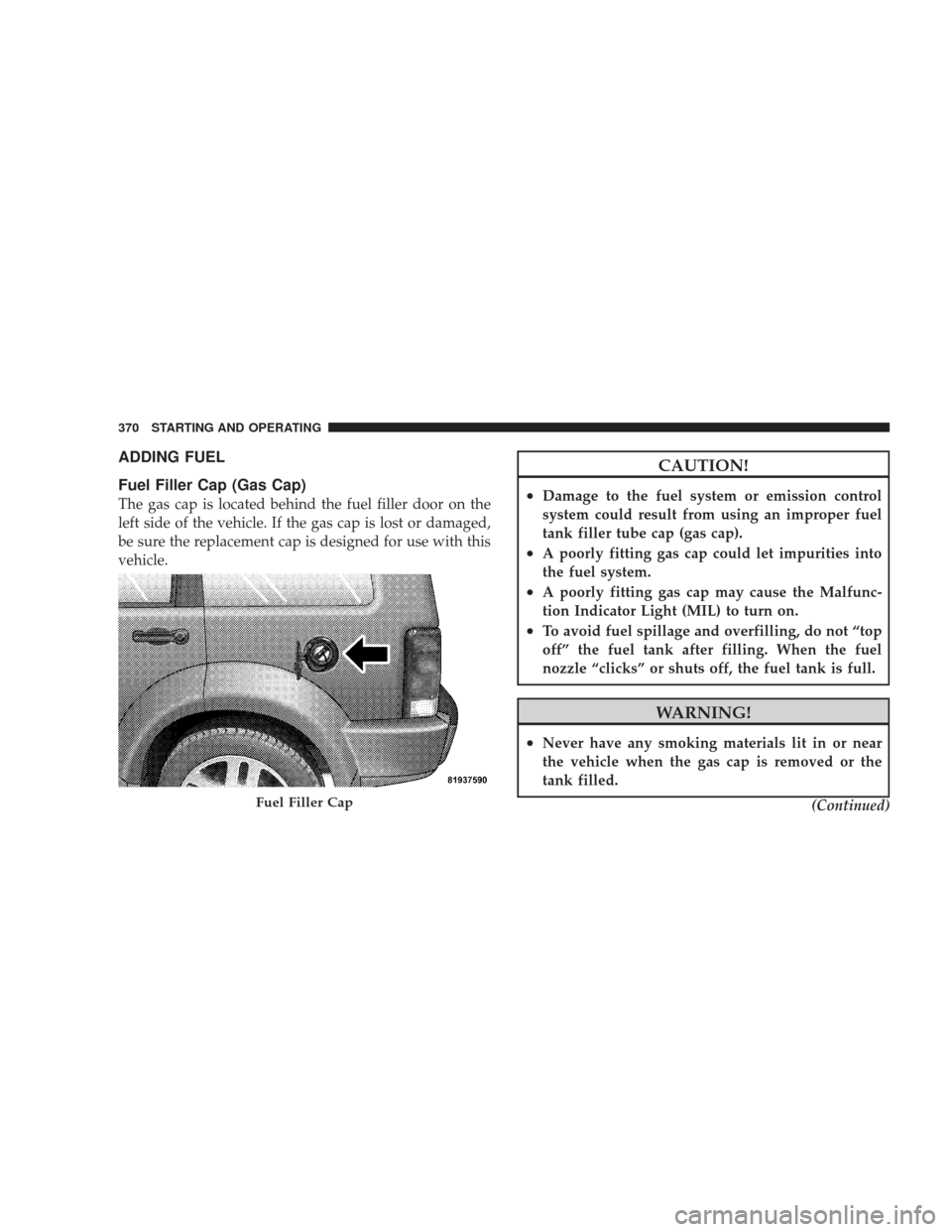
The gas cap is located behind the fuel filler door on the
left side of the vehicle. If the gas cap is lost or damaged,
be sure the replacement cap is designed for use with this
vehicle.
CAUTION!
•Damage to the fuel system or emission control
system could result from using an improper fuel
tank filler tube cap (gas cap).
•A poorly fitting gas cap could let impurities into
the fuel system.
•A poorly fitting gas cap may cause the Malfunc-
tion Indicator Light (MIL) to turn on.
•To avoid fuel spillage and overfilling, do not “top
off” the fuel tank after filling. When the fuel
nozzle “clicks” or shuts off, the fuel tank is full.
WARNING!
•Never have any smoking materials lit in or near
the vehicle when the gas cap is removed or the
tank filled.(Continued)
Fuel Filler Cap
370 STARTING AND OPERATING
Page 373 of 506
WARNING! (Continued)
•Never add fuel to the vehicle when the engine is
running.
•A fire may result if gasoline is pumped into a
portable container that is inside of a vehicle. You
could be burned. Always place gas containers on
the ground while filling.
NOTE:
•Tighten the gas cap until you hear a “clicking” sound.
This is an indication that the gas cap is tightened
properly. The MIL in the instrument cluster may turn
on if the gas cap is not secured properly. Make sure
that the gas cap is tightened each time the vehicle is
refueled.
•When the fuel nozzle “clicks” or shuts off, the fuel
tank is full.
Loose Fuel Filler Cap Message
If the vehicle diagnostic system determines that the fuel
filler cap in loose, improperly installed, or damaged, a
“gASCAP” message will display in the instrument clus-
ter. Tighten the gas cap until a “clicking” sound is heard.
This is an indication that the gas cap is properly tight-
ened. Press the trip odometer reset button to turn off the
message. If the problem persists, the message will appear
the next time the vehicle is started. This might indicate a
damaged cap. If the problem is detected twice in a row,
the system will turn on the MIL. Resolving the problem
will turn the MIL light off.
VEHICLE LOADING
Certification Label
As required by National Highway Traffic Safety Admin-
istration regulations, your vehicle has a certification label
affixed to the driver’s side door or B-Pillar.
STARTING AND OPERATING 371
5
Page 381 of 506
Trailer Hitch Classification
Your vehicle is capable of towing trailers up to 2,000 lbs
(907 kg) without added equipment or alterations to the
standard equipment. Your vehicle may be factory
equipped for safe towing of trailers weighing over
2,000 lbs (907 kg) with the optional Trailer Tow Prep
Package. See your authorized dealer for package content.
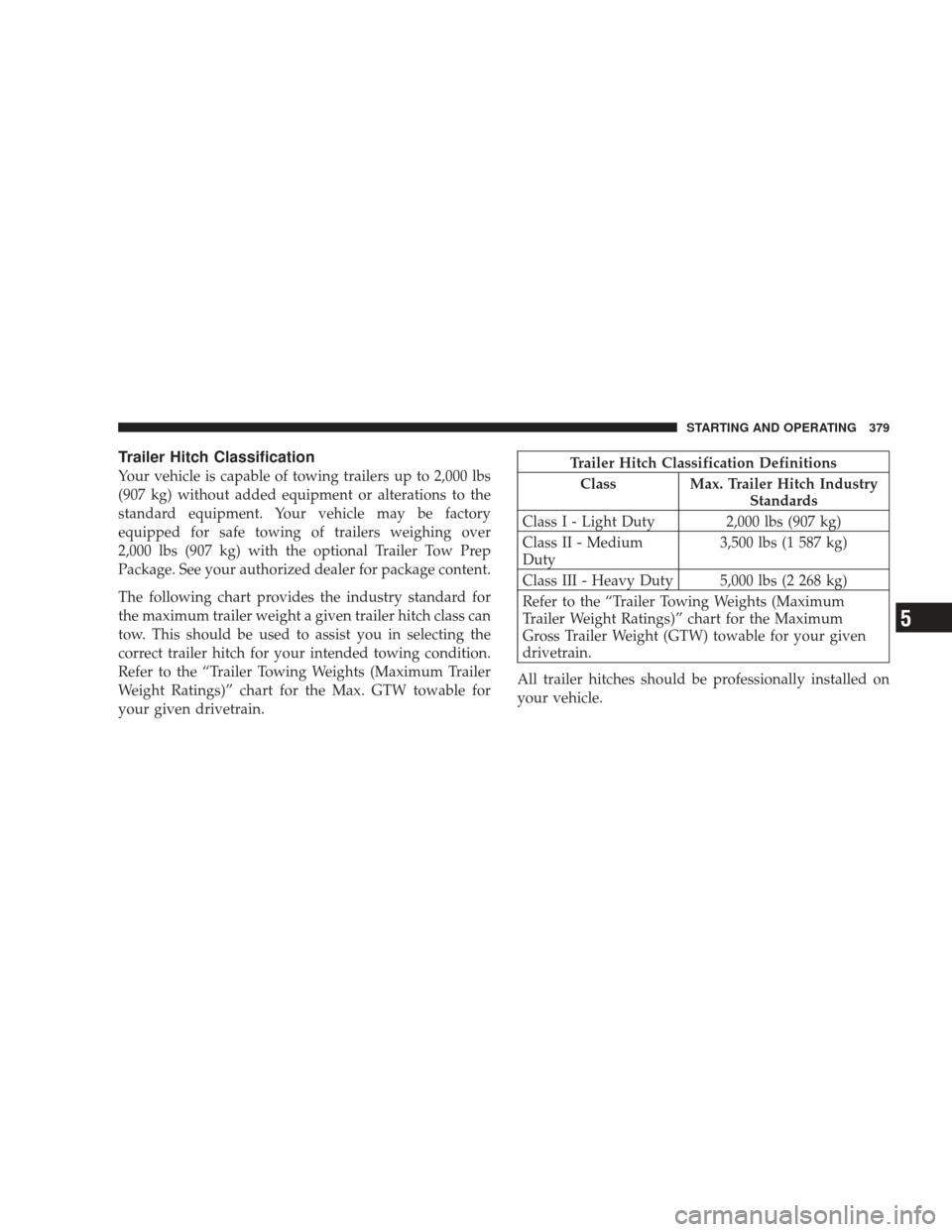
The following chart provides the industry standard for
the maximum trailer weight a given trailer hitch class can
tow. This should be used to assist you in selecting the
correct trailer hitch for your intended towing condition.
Refer to the “Trailer Towing Weights (Maximum Trailer
Weight Ratings)” chart for the Max. GTW towable for
your given drivetrain.Trailer Hitch Classification DefinitionsClass Max. Trailer Hitch Industry Standards
Class I - Light Duty 2,000 lbs (907 kg)
Class II - Medium
Duty 3,500 lbs (1 587 kg)
Class III - Heavy Duty 5,000 lbs (2 268 kg)
Refer to the “Trailer Towing Weights (Maximum
Trailer Weight Ratings)” chart for the Maximum
Gross Trailer Weight (GTW) towable for your given
drivetrain.
All trailer hitches should be professionally installed on
your vehicle.
STARTING AND OPERATING 379
5
Page 388 of 506
WARNING!
•Do not connect trailer brakes to your vehicle’s
hydraulic brake lines. It can overload your brake
system and cause it to fail. You might not have
brakes when you need them and could have an
accident.
•Towing any trailer will increase your stopping
distance. When towing you should allow for addi-
tional space between your vehicle and the vehicle
in front of you. Failure to do so could result in an
accident.
Towing Requirements — Trailer Lights And Wiring
Whenever you pull a trailer, regardless of the trailer size,
stoplights and turn signals on the trailer are required for
motoring safety.
The Trailer Tow Package may include a four and seven-
pin wiring harness. Use a factory approved trailer har-
ness and connector.
NOTE:Do not cut or splice wiring into the vehicles
wiring harness.
The electrical connections are all complete to the vehicle
but you must mate the harness to a trailer connector.
Refer to the following illustrations.
386 STARTING AND OPERATING
Page 390 of 506
Towing Tips
Before setting out on a trip, practice turning, stopping,
and backing the trailer in an area located away from
heavy traffic.
Automatic Transmission
The “D” range can be selected when towing. However, if
frequent shifting occurs while in this range, you will
want to activate the TOW/HAUL feature. Refer to “Au-
tomatic Transmission” in this section for additional in-
formation.
NOTE:Using the TOW/HAUL feature while operating
the vehicle under heavy operating conditions will im-
prove performance and extend transmission life by re-
ducing excessive shifting and heat build up. This action
will also provide better engine braking.
If you REGULARLY tow a trailer for more than 45 min-
utes of continuous operation, then change the automatic
transmission fluid and filter according to the interval specified for “police, taxi, fleet, or frequent trailer tow-
ing” in the “Maintenance Schedule” in this manual.
TOW/HAUL
To reduce potential for automatic transmission overheat-
ing, press the TOW HAUL button when driving in hilly
areas or shift the transmission to Drive position “2” on
more severe grades. Refer to “Automatic Transmission”
in this section for additional information.
Electronic Speed Control — If Equipped
Do not use in hilly terrain or with heavy loads.
When using the speed control, if you experience speed
drops greater than 10 mph (16 km/h), disengage until
you can get back to cruising speed.
Use speed control in flat terrain and with light loads to
maximize fuel efficiency.
388 STARTING AND OPERATING
Page 392 of 506
CAUTION! (Continued)
•Before recreational towing, perform the procedure
outlined under “Shifting into NEUTRAL” to be
certain that the transfer case is fully in NEUTRAL.
Otherwise, internal damage will result.
•Do not use a bumper mounted clamp-on tow bar on
your vehicle. The bumper face bar will be damaged.
WARNING!
You or others could be injured if you leave the
vehicle unattended with the transfer case in the
NEUTRAL position without first fully engaging the
parking brake. The transfer case NEUTRAL position
disengages both the front driveshaft and rear drive-
shaft from the powertrain and it will allow the
vehicle to move despite the transmission position.
The parking brake should always be applied when
the driver is not in the vehicle.
Shifting into NEUTRAL
Perform the following procedure to prepare your vehicle
for recreational towing:
1. Bring the vehicle to a complete stop.
2. Turn OFF the engine.
3. Turn the ignition switch to the ON position.
4. Press the brake pedal.
5. Shift the transmission into NEUTRAL.
6. Use the point of a ballpoint pen or similar object to
press the recessed transfer case NEUTRAL button for
four seconds. After the shift is complete, and the NEU-
TRAL light turns on, release the NEUTRAL button.
7. Start the engine.
8. Shift the transmission into REVERSE.
9. Release the brake pedal for five seconds and ensure
that there is no vehicle movement.
390 STARTING AND OPERATING