Page 375 of 521
Trailer Towing Weights (Maximum Trailer Weight Ratings)
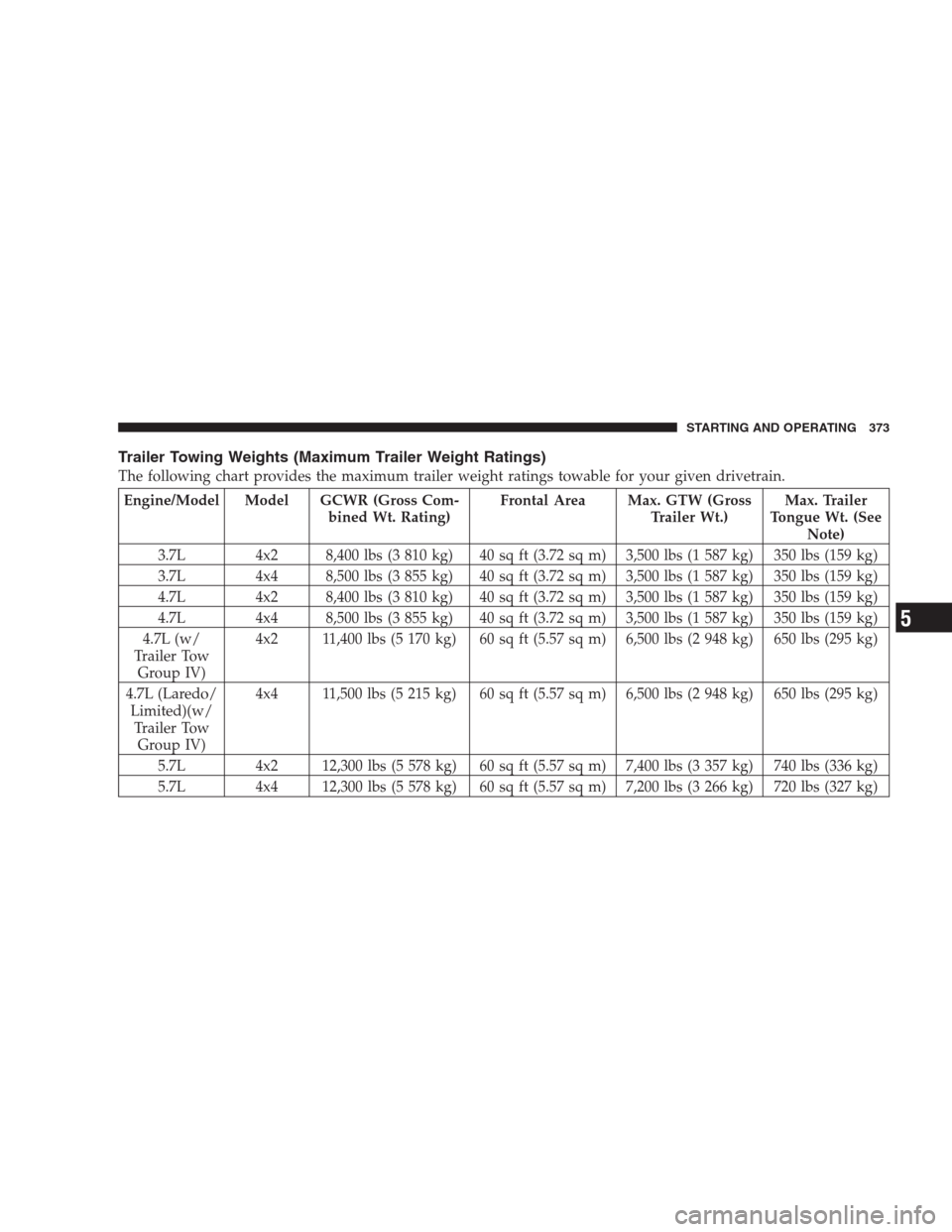
The following chart provides the maximum trailer weight ratings towable for your given drivetrain.
Engine/Model Model GCWR (Gross Com-
bined Wt. Rating)Frontal Area Max. GTW (Gross
Trailer Wt.)Max. Trailer
Tongue Wt. (See
Note)
3.7L 4x2 8,400 lbs (3 810 kg) 40 sq ft (3.72 sq m) 3,500 lbs (1 587 kg) 350 lbs (159 kg)
3.7L 4x4 8,500 lbs (3 855 kg) 40 sq ft (3.72 sq m) 3,500 lbs (1 587 kg) 350 lbs (159 kg)
4.7L 4x2 8,400 lbs (3 810 kg) 40 sq ft (3.72 sq m) 3,500 lbs (1 587 kg) 350 lbs (159 kg)
4.7L 4x4 8,500 lbs (3 855 kg) 40 sq ft (3.72 sq m) 3,500 lbs (1 587 kg) 350 lbs (159 kg)
4.7L (w/
Trailer Tow
Group IV)4x2 11,400 lbs (5 170 kg) 60 sq ft (5.57 sq m) 6,500 lbs (2 948 kg) 650 lbs (295 kg)
4.7L (Laredo/
Limited)(w/
Trailer Tow
Group IV)4x4 11,500 lbs (5 215 kg) 60 sq ft (5.57 sq m) 6,500 lbs (2 948 kg) 650 lbs (295 kg)
5.7L 4x2 12,300 lbs (5 578 kg) 60 sq ft (5.57 sq m) 7,400 lbs (3 357 kg) 740 lbs (336 kg)
5.7L 4x4 12,300 lbs (5 578 kg) 60 sq ft (5.57 sq m) 7,200 lbs (3 266 kg) 720 lbs (327 kg)
STARTING AND OPERATING 373
5
Page 376 of 521
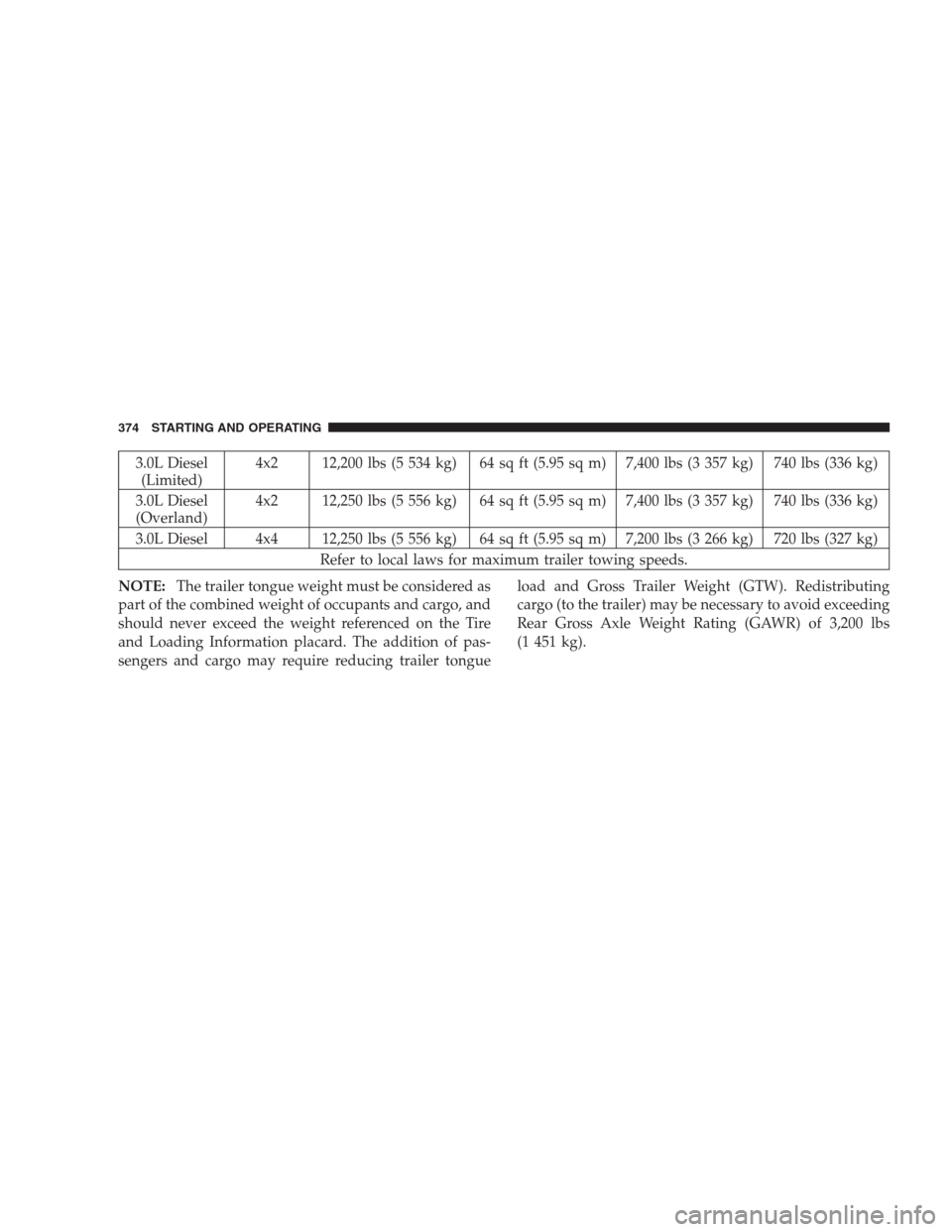
3.0L Diesel
(Limited)4x2 12,200 lbs (5 534 kg) 64 sq ft (5.95 sq m) 7,400 lbs (3 357 kg) 740 lbs (336 kg)
3.0L Diesel
(Overland)4x2 12,250 lbs (5 556 kg) 64 sq ft (5.95 sq m) 7,400 lbs (3 357 kg) 740 lbs (336 kg)
3.0L Diesel 4x4 12,250 lbs (5 556 kg) 64 sq ft (5.95 sq m) 7,200 lbs (3 266 kg) 720 lbs (327 kg)
Refer to local laws for maximum trailer towing speeds.
NOTE:The trailer tongue weight must be considered as
part of the combined weight of occupants and cargo, and
should never exceed the weight referenced on the Tire
and Loading Information placard. The addition of pas-
sengers and cargo may require reducing trailer tongueload and Gross Trailer Weight (GTW). Redistributing
cargo (to the trailer) may be necessary to avoid exceeding
Rear Gross Axle Weight Rating (GAWR) of 3,200 lbs
(1 451 kg).
374 STARTING AND OPERATING
Page 377 of 521
Trailer And Trailer Tongue Weight
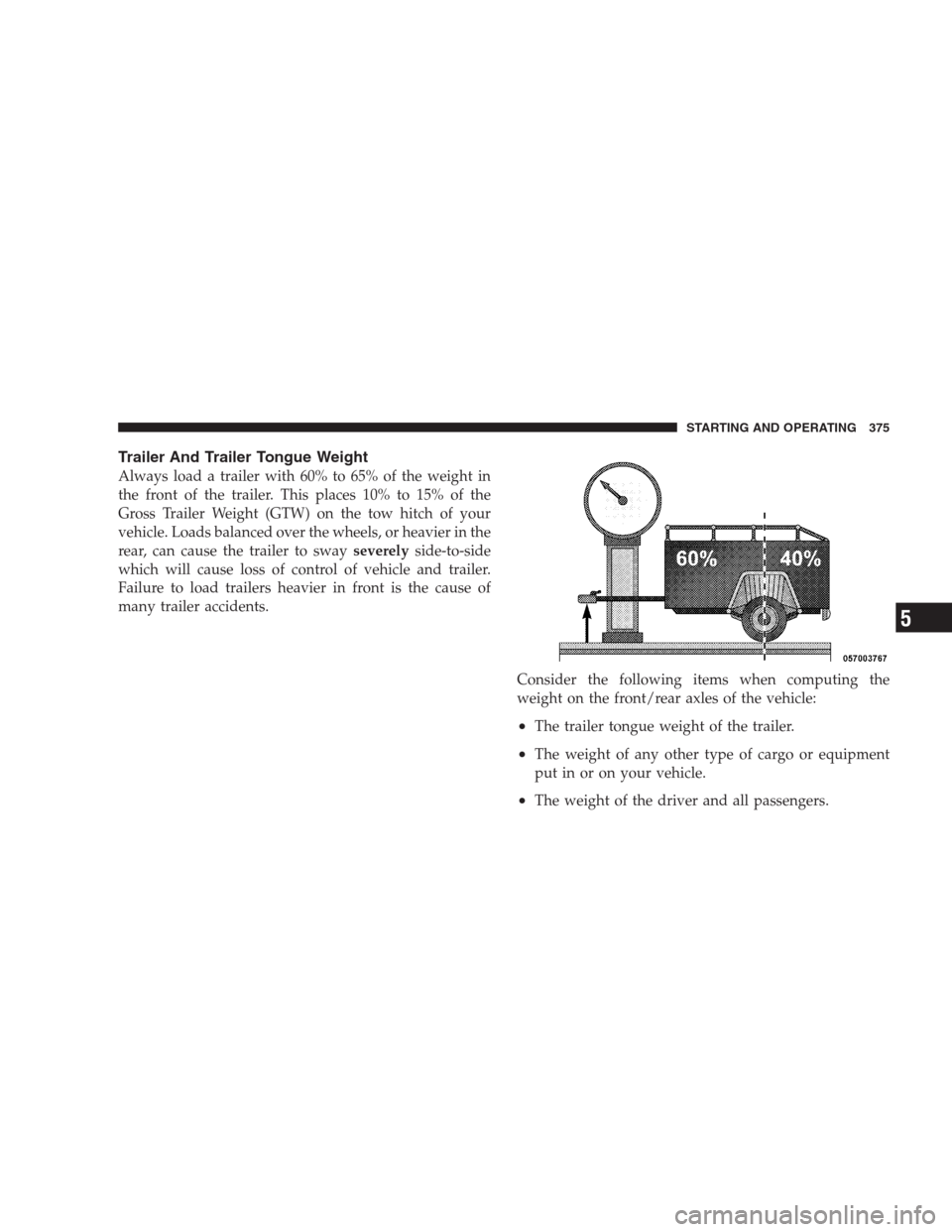
Always load a trailer with 60% to 65% of the weight in
the front of the trailer. This places 10% to 15% of the
Gross Trailer Weight (GTW) on the tow hitch of your
vehicle. Loads balanced over the wheels, or heavier in the
rear, can cause the trailer to swayseverelyside-to-side
which will cause loss of control of vehicle and trailer.
Failure to load trailers heavier in front is the cause of
many trailer accidents.
Consider the following items when computing the
weight on the front/rear axles of the vehicle:
•The trailer tongue weight of the trailer.
•The weight of any other type of cargo or equipment
put in or on your vehicle.
•The weight of the driver and all passengers.
STARTING AND OPERATING 375
5
Page 378 of 521
NOTE:Remember that everything put into or on the
trailer adds to the load on your vehicle. Also, additional
factory-installed options, or authorized dealer-installed
options, must be considered as part of the total load on
your vehicle. Refer to the Tire and Loading Information
placard in the “Tire Safety Information” section of this
manual for the maximum combined weight of occupants
and cargo for your vehicle.
Towing Requirements
To promote proper break-in of your new vehicle driv-
etrain components, the following guidelines are recom-
mended.
CAUTION!
•Avoid towing a trailer for the first 500 miles
(805 km) of vehicle operation. Doing so may dam-
age your vehicle.
(Continued)
CAUTION! (Continued)
•During the first 500 miles (805 km) of trailer
towing, limit your speed to 50 mph (80 km/h).
Perform the maintenance listed in the “Maintenance
Schedule.” Refer to Section 8 of this manual for the
proper maintenance intervals. When towing a trailer,
never exceed the GAWR, or GCWR, ratings.
WARNING!
•Make certain that the load is secured in the trailer
and will not shift during travel. When trailering
cargo that is not fully secured, dynamic load shifts
can occur that may be difficult for the driver to
control. You could lose control of your vehicle and
have an accident.
(Continued)
376 STARTING AND OPERATING
Page 379 of 521
WARNING! (Continued)
•Improper towing can lead to an injury accident.
Follow these guidelines to make your trailer tow-
ing as safe as possible:
•When hauling cargo or towing a trailer, do not over-
load your vehicle or trailer. Overloading can cause a
loss of control, poor performance or damage to brakes,
axle, engine, transmission, steering, suspension, chas-
sis structure or tires.
•Safety chains must always be used between your
vehicle and trailer. Always connect the chains to the
hook retainers of the vehicle hitch. Cross the chains
under the trailer tongue and allow enough slack for
turning corners.
•Vehicles with trailers should not be parked on a grade.
When parking, apply the parking brake on the tow
vehicle. Put the tow vehicle transmission in PARK. Forfour-wheel drive vehicles, make sure the transfer case
is not in NEUTRAL. Always, block or�chock�the
trailer wheels.
•GCWR must not be exceeded.
•Total weight must be distributed between the tow
vehicle and the trailer such that the following four
ratings are not exceeded:
1. GVWR
2. GTW
3. GAWR
4. Trailer tongue weight rating for the trailer hitch
utilized (This requirement may limit the ability to
always achieve the 10% to 15% range of tongue weight
as a percentage of total trailer weight).
STARTING AND OPERATING 377
5
Page 380 of 521
Towing Requirements — Tires
Do not attempt to tow a trailer while using a compact
spare tire.
Proper tire inflation pressures are essential to the safe
and satisfactory operation of your vehicle. Refer to
“Tires – General Information” for proper tire inflation
procedures.
Also, check the trailer tires for proper tire inflation
pressures before trailer usage.
Check for signs of tire wear or visible tire damage
before towing a trailer. Refer to “Tires – General
Information” for proper inspection procedure.
When replacing tires, refer to “Tires – General Infor-
mation” for proper tire replacement procedures. Re-
placing tires with a higher load carrying capacity will
not increase the vehicle’s GVWR and GAWR limits.
Towing Requirements — Trailer Brakes
Donotinterconnect the hydraulic brake system or
vacuum system of your vehicle with that of the trailer.
This could cause inadequate braking and possible
personal injury.
An electronically-actuated trailer brake controller is
required when towing a trailer with electronically-
actuated brakes. When towing a trailer equipped with
a hydraulic surge-actuated brake system, an electronic
brake controller is not required.
Trailer brakes are recommended for trailers over
1,000 lbs (454 kg), and required for trailers in excess of
2,000 lbs (907 kg).
378 STARTING AND OPERATING
Page 381 of 521
CAUTION!
If the trailer weighs more than 1,000 lbs (454 kg)
loaded, it should have its own brakes and they
should be of adequate capacity. Failure to do this
could lead to accelerated brake lining wear, higher
brake pedal effort, and longer stopping distances.
WARNING!
•Do not connect trailer brakes to your vehicle’s
hydraulic brake lines. It can overload your brake
system and cause it to fail. You might not have
brakes when you need them and could have an
accident.
(Continued)
WARNING! (Continued)
•Towing any trailer will increase your stopping
distance. When towing, you should allow for ad-
ditional space between your vehicle and the ve-
hicle in front of you. Failure to do so could result
in an accident.
Towing Requirements — Trailer Lights & Wiring
Whenever you pull a trailer, regardless of the trailer size,
stop lights and turn signals on the trailer are required for
motoring safety.
The Trailer Tow Package may include a 4 and 7–pin
wiring harness. Use a factory-approved trailer harness
and connector.
STARTING AND OPERATING 379
5
Page 382 of 521
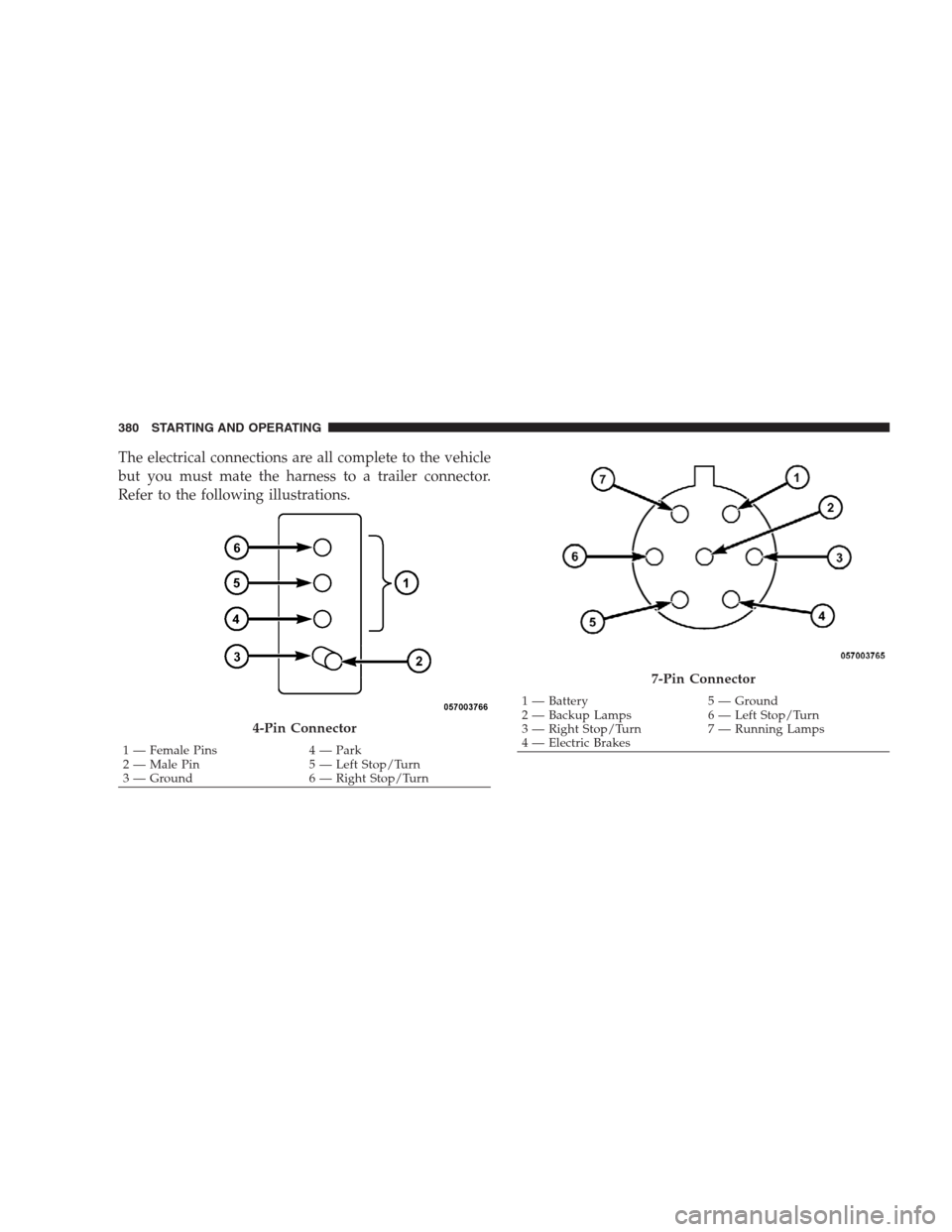
The electrical connections are all complete to the vehicle
but you must mate the harness to a trailer connector.
Refer to the following illustrations.
4-Pin Connector
1 — Female Pins 4 — Park
2 — Male Pin 5 — Left Stop/Turn
3 — Ground 6 — Right Stop/Turn
7-Pin Connector
1 — Battery 5 — Ground
2 — Backup Lamps 6 — Left Stop/Turn
3 — Right Stop/Turn 7 — Running Lamps
4 — Electric Brakes 380 STARTING AND OPERATING