Page 27 of 439

2. This device must accept any interference that may be
received including interference that may cause undesired
operation.
NOTE:Changes or modifications not expressly ap-
proved by the party responsible for compliance could
void the user’s authority to operate the equipment.
If your RKE transmitter fails to operate from a normal
distance, check for these two conditions:
1. Weak batteries in the RKE transmitter. The expected
life of batteries is five years.
2. Closeness to a radio transmitter such as a radio station
tower, airport transmitter, military base, and some mobile
or CB radios.
RKE Transmitter Battery Replacement
NOTE:Perchlorate Material – special handling may apply.
See “www.dtsc.ca.gov/hazardouswaste/perchlorate.”
The recommended replacement battery is CR2032.
1. If the RKE transmitter is equipped with a screw,
remove the screw. With the RKE transmitter buttons
facing down, use a flat blade to pry the two halves of the
RKE transmitter apart. Make sure not to damage the
elastomer seal during removal.
Separating RKE Transmitter Halves
THINGS TO KNOW BEFORE STARTING YOUR VEHICLE 25
2
Page 43 of 439
WARNING!
•A lap belt worn too high can increase the risk of
internal injury in a collision. The belt forces won’t
be at the strong hip and pelvic bones, but across
your abdomen. Always wear the lap belt as low as
possible and keep it snug.
•A twisted belt can’t do its job as well. In a collision
it could even cut into you. Be sure the belt is
straight. If you can’t straighten a belt in your
vehicle, take it to your authorized dealer and have
it fixed.
5. Position the shoulder belt on your chest so that it is
comfortable and not resting on your neck. The retractor
will withdraw any slack in the belt.6. To release the belt, push the red button on the buckle.
The belt will automatically retract to its stowed position.
If necessary, slide the latch plate down the webbing to
allow the belt to retract fully.
WARNING!
A frayed or torn belt could rip apart in a collision and
leave you with no protection. Inspect the belt system
periodically, checking for cuts, frays, or loose parts.
Damaged parts must be replaced immediately. Do
not disassemble or modify the system. Seat belt
assemblies must be replaced after a collision if they
have been damaged (bent retractor, torn webbing,
etc.).
THINGS TO KNOW BEFORE STARTING YOUR VEHICLE 41
2
Page 45 of 439
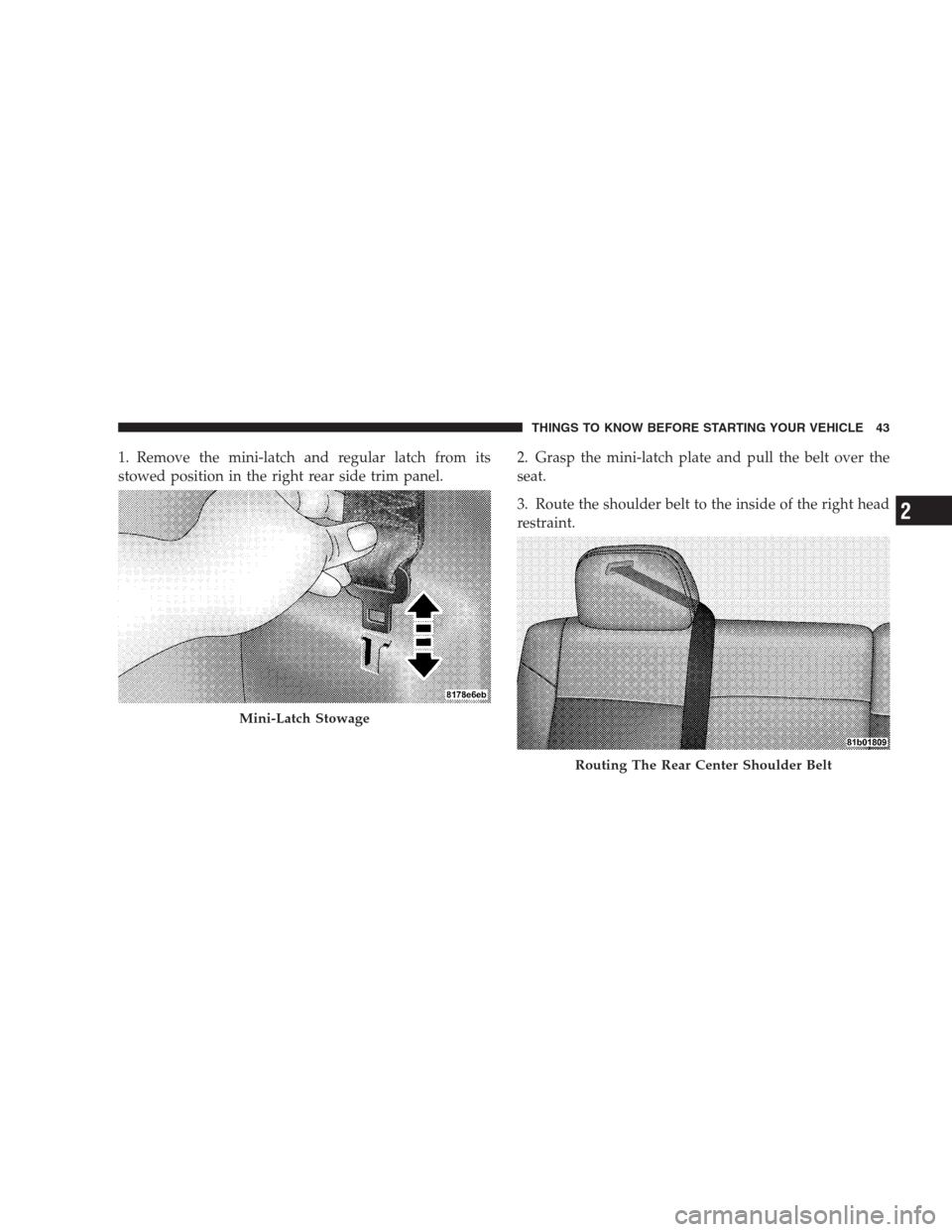
1. Remove the mini-latch and regular latch from its
stowed position in the right rear side trim panel.2. Grasp the mini-latch plate and pull the belt over the
seat.
3. Route the shoulder belt to the inside of the right head
restraint.
Mini-Latch Stowage
Routing The Rear Center Shoulder Belt
THINGS TO KNOW BEFORE STARTING YOUR VEHICLE 43
2
Page 48 of 439
10. To disengage the mini-latch from the mini-buckle for
storage, insert the regular latch plate into the black
button on the top of the mini-buckle. The belt will
automatically retract to its stowed position. If necessary,
slide the latch plate down the webbing to allow the belt
to retract fully. Insert the mini-latch plate into the slot
provided in the trim panel.
Seat Belt Pretensioners
The seat belts for both front seating positions are equipped
with pretensioning devices that are designed to automati-
cally remove any slack from the seat belts in the event of
a collision. These devices improve the performance of the
seat belt system by assuring that the belt is tight about the
occupant in a collision. Pretensioners work for all size
occupants, including those in child restraints.
NOTE:These devices are not a substitute for proper seat
belt placement by the occupant. The seat belt still must be
worn snugly and positioned properly.The pretensioners are triggered by the Occupant Re-
straint Controller (ORC) (refer to information on Airbags
in this section). Like the front airbags, the pretensioners
are single use items. After a collision that is severe
enough to deploy the airbags and pretensioners, both
must be replaced.
Enhanced Driver Seat Belt Reminder System
(BeltAlert�)
If the driver’s seat belt has not been buckled within
60 seconds of starting the vehicle and if the vehicle speed
is greater than 5 mph (8 km/h), the Enhanced Warning
System (BeltAlert�) will alert the driver to buckle their seat
belt. The driver should also instruct all other occupants to
buckle their seat belts. Once the warning is triggered,
BeltAlert�will continue to chime and flash the Seat Belt
Warning Light for 96 seconds or until the driver’s seat belt
is buckled. BeltAlert�will be reactivated if the driver’s
seat belt is unbuckled for more than 10 seconds and the
vehicle speed is greater than 5 mph (8 km/h).
46 THINGS TO KNOW BEFORE STARTING YOUR VEHICLE
Page 68 of 439
NOTE:When using the LATCH attaching system to
install a child restraint, please ensure that all seat belts
not being used for occupant restraints are stowed and out
of reach of children. It is recommended that before
installing the child restraint, buckle the seat belt so the
seat belt is tucked behind the child restraint and out of
reach. If the buckled seat belt interferes with the child
restraint installation, instead of tucking the seat belt
behind the child restraint, route the seat belt through the
child restraint belt path and then buckle it. This should
stow the seat belt out of the reach of an inquisitive child.
Remind all children in the vehicle that the seat belts are
not toys and should not be played with, and never leave
your child unattended in the vehicle.
Installing the Child Restraint System
We urge you to carefully follow the directions of the
manufacturer when installing your child restraint. Many,
but not all, restraint systems will be equipped with
separate straps on each side, with each having a hook orconnector and a means for adjusting the tension in the
strap. Forward-facing toddler restraints and some
rearward-facing infant restraints will also be equipped
with a tether strap with a hook and means for adjusting
the tension in the strap.
In general, you will first loosen the adjusters on the lower
and tether straps so that you can more easily attach the
hook or connector to the lower and tether anchorages.
The tether strap should be routed under the center of the
head restraint and attached to the tether anchor on the
rear of the seatback. Then tighten all three straps as you
push the child restraint rearward and downward into the
seat.
66 THINGS TO KNOW BEFORE STARTING YOUR VEHICLE
Page 77 of 439
MIRRORS
Inside Day/Night Mirror
A two-point pivot system allows for horizontal and
vertical mirror adjustment. Adjust the mirror to center on
the view through the rear window.
Headlight glare can be reduced by moving the small
control under the mirror to the night position (toward the
rear of vehicle). The mirror should be adjusted while set
in the day position (toward the windshield).
Adjusting Rearview Mirror
UNDERSTANDING THE FEATURES OF YOUR VEHICLE 75
3
Page 80 of 439
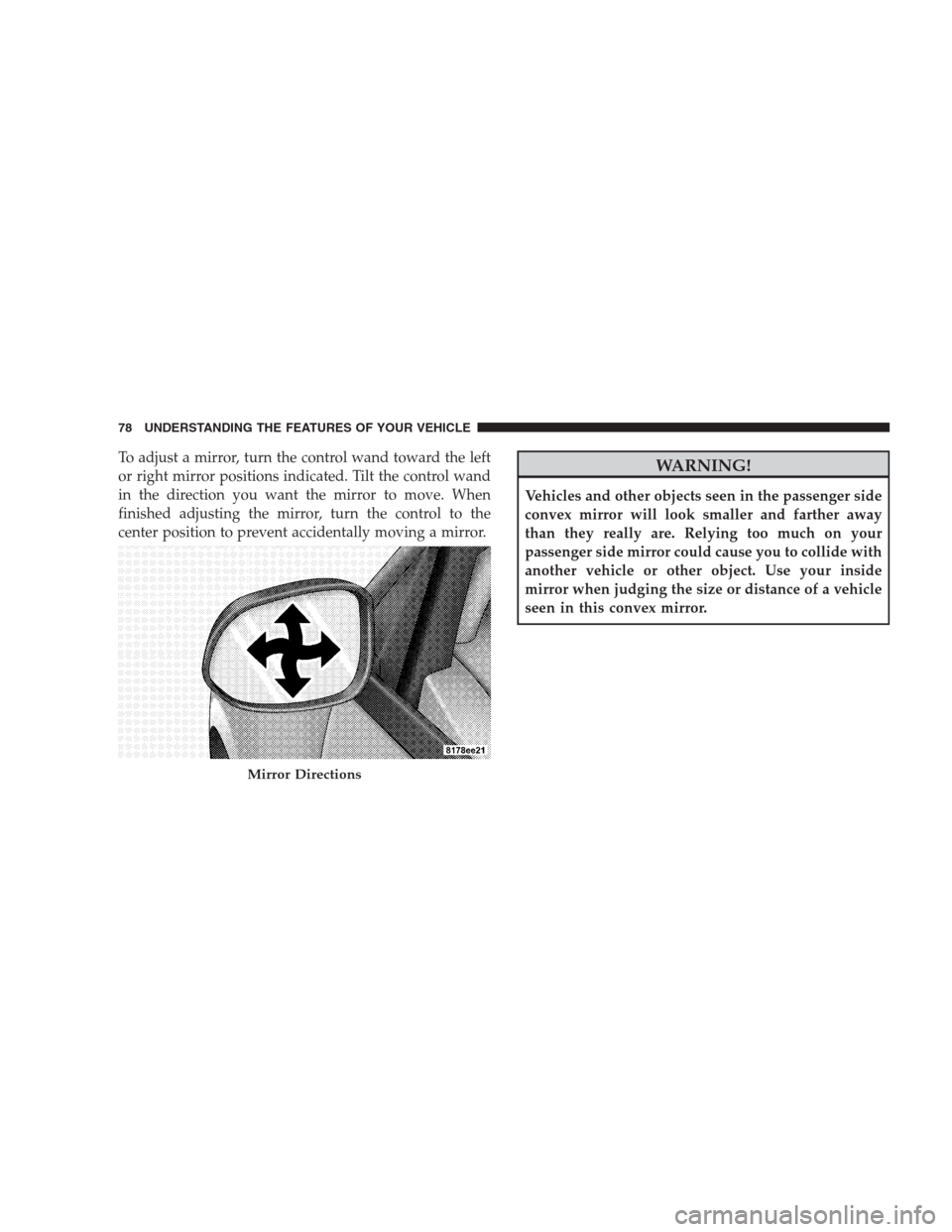
To adjust a mirror, turn the control wand toward the left
or right mirror positions indicated. Tilt the control wand
in the direction you want the mirror to move. When
finished adjusting the mirror, turn the control to the
center position to prevent accidentally moving a mirror.WARNING!
Vehicles and other objects seen in the passenger side
convex mirror will look smaller and farther away
than they really are. Relying too much on your
passenger side mirror could cause you to collide with
another vehicle or other object. Use your inside
mirror when judging the size or distance of a vehicle
seen in this convex mirror.
Mirror Directions
78 UNDERSTANDING THE FEATURES OF YOUR VEHICLE
Page 82 of 439

NOTE:The UConnect�system requires a cellular phone
equipped with the Bluetooth��Hands-Free Profile,�Ve r -
sion 0.96 or higher. See the UConnect�website for
supported phones.
NOTE:For UConnect�customer support, visit the
following websites:
•www.chrysler.com/uconnect
•www.dodge.com/uconnect
•www.jeep.com/uconnect
•or call 1–877–855–8400
UConnect�allows you to transfer calls between the
system and your cellular phone as you enter or exit your
vehicle and enables you to mute the system’s microphone
for private conversation.
The UConnect�system is driven through your
Bluetooth�“Hands-Free Profile” cellular phone.UConnect�features Bluetooth�technology - the global
standard that enables different electronic devices to con-
nect to each other without wires or a docking station, so
UConnect�works no matter where you stow your cellu-
lar phone (be it your purse, pocket, or briefcase), as long
as your phone is turned on and has been paired to the
vehicle’s UConnect�system. The UConnect�system
allows up to seven cellular phones to be linked to the
system. Only one linked (or paired) cellular phone can be
used with the system at a time. The system is available in
English, Spanish, or French languages.
Phone Button
The rearview mirror contains the microphone
for the system (depending on the type of
mirror and radio equipped), and either the
radio or the mirror has the two control buttons
(PHONE Button and VOICE RECOGNITION button)
that will enable you to access the system.
80 UNDERSTANDING THE FEATURES OF YOUR VEHICLE