Page 233 of 439

Next, turn the knob surrounding the joystick in the center
of the radio to scroll to Subscription, and then press and
release the joystick. All of the ESNs that apply to your
vehicle will display.
Selecting Satellite Mode
Press the SAT button until�SAT�appears in the display. A
CD may remain in the radio while in the Satellite radio
mode.
Satellite Antenna
To ensure optimum reception, do not place items on the
roof around the rooftop antenna location or strap items to
the trunk lid around the trunk lid antenna (if equipped).
Metal objects placed within the line of sight of the
antenna will cause decreased performance. Larger lug-
gage items such as bikes should be placed as far rearward
as possible, within the loading design of the rack. Do not
place items directly on or above the antenna.
Reception Quality
Satellite reception may be interrupted due to one of the
following reasons:
•The vehicle is parked in an underground parking
structure or under a physical obstacle.
•Dense tree coverage may interrupt reception in the
form of short audio mutes.
•Driving under wide bridges or along tall buildings can
cause intermittent reception.
•Placing objects over or too close to the antenna can
cause signal blockage.
Operating Instructions — Satellite Mode
NOTE:The ignition switch must be in the ON or ACC
position to operate the radio.
UNDERSTANDING YOUR INSTRUMENT PANEL 231
4
Page 304 of 439

Check TPMS Warnings
The Tire Pressure Monitoring Telltale Light will flash on
and off for 75 seconds and remain on solid when a system
fault is detected. The system fault will also sound a
chime. If the ignition key is cycled, this sequence will
repeat providing the system fault still exists. The Tire
Pressure Monitoring Telltale Light will turn off when the
fault condition no longer exists. A system fault can occur
with any of the following scenarios:
1. Jamming due to electronic devices or driving next to
facilities emitting the same radio frequencies as the TPM
sensors.
2. Installing some form of aftermarket window tinting
that affects radio wave signals.
3. Snow or ice around the wheels or wheel housings.
4. Using tire chains on the vehicle.
5. Using wheels/tires not equipped with TPM sensors.NOTE:Your vehicle is equipped with a compact spare
wheel and tire assembly.
1. The compact spare tire does not have a tire pressure
monitoring sensor. Therefore, the TPMS will not monitor
the tire pressure in the compact spare tire.
2. If you install the compact spare tire in place of a road
tire that has a pressure below the low-pressure warning
limit, upon the next ignition key cycle, a chime will
sound and the Tire Pressure Monitoring Telltale Light
will still turn ON due to the low tire.
3. However, after driving the vehicle for up to 20 min-
utes above 15 mph (25 km/h), the Tire Pressure Moni-
toring Telltale Light will flash on and off for 75 seconds
and then remain on solid.
4.
For each subsequent ignition key cycle, a chime will
sound and the Tire Pressure Monitoring Telltale Light will
flash on and off for 75 seconds and then remain on solid.
302 STARTING AND OPERATING
Page 308 of 439

If the ignition key is cycled, this sequence will repeat,
providing the system fault still exists. If the system fault
no longer exists, the Tire Pressure Monitoring Telltale
Light will no longer flash, the�CHECK TPM SYSTEM�
text message will not be present, and a pressure value
will be displayed instead of dashes. A system fault can
occur with any of the following scenarios:
1. Jamming due to electronic devices or driving next to
facilities emitting the same radio frequencies as the TPM
sensors.
2. Installing some form of aftermarket window tinting
that affects radio wave signals.
3. Snow or ice around the wheels or wheel housings.
4. Using tire chains on the vehicle.
5. Using wheels/tires not equipped with TPM sensors.NOTE:Your vehicle is equipped with a compact spare
wheel and tire assembly.
1. The compact spare tire does not have a tire pressure
monitoring sensor. Therefore, the TPMS will not monitor
the tire pressure in the compact spare tire.
2. If you install the compact spare tire in place of a road
tire that has a pressure below the low-pressure warning
limit, upon the next ignition key cycle, a chime will
sound and the Tire Pressure Monitoring Telltale Light
will still turn ON due to the low tire.
3. However, after driving the vehicle for up to 20 min-
utes above 15 mph (25 km/h), the Tire Pressure Moni-
toring Telltale Light will flash on and off for 75 seconds
and then remain on solid.
306 STARTING AND OPERATING
Page 326 of 439

CAUTION!
If the trailer weighs more than 1,000 lbs (454 kg)
loaded, it should have its own brakes and they
should be of adequate capacity. Failure to do this
could lead to accelerated brake lining wear, higher
brake pedal effort, and longer stopping distances.
WARNING!
Do not connect trailer brakes to your vehicle’s hy-
draulic brake lines. It can overload your brake sys-
tem and cause it to fail. You might not have brakes
when you need them and could have an accident.
Towing any trailer will increase your stopping dis-
tance. When towing you should allow for additional
space between your vehicle and the vehicle in front
of you. Failure to do so could result in an accident.
Towing Requirements — Trailer Lights and Wiring
Whenever you pull a trailer, regardless of the trailer size,
stop lights and turn signals on the trailer are required for
motoring safety.
The Trailer Tow Package may include a 4- and 7-pin
wiring harness. Use a factory approved trailer harness
and connector.
NOTE:Do not cut or splice wiring into the vehicles
wiring harness.
The electrical connections are all complete to the vehicle
but you must mate the harness to a trailer connector.
Refer to the following illustrations.
324 STARTING AND OPERATING
Page 332 of 439

HAZARD WARNING FLASHER
The Hazard Warning flasher switch is located on the
instrument panel, below the radio.
Press the switch to turn on the Hazard
Warning flashers. When the Hazard
Warning flasher switch is activated, all
directional turn signals will flash on
and off to warn oncoming traffic of an
emergency. Press the switch a second
time to turn off flashers.
Do not use this emergency warning system when the
vehicle is in motion. Use it when your vehicle is disabled
and is creating a safety hazard for other motorists.
If it is necessary to leave the vehicle to go for service, the
Hazard Warning flasher will continue to operate with the
ignition key removed and the vehicle locked.NOTE:With extended use, the Hazard Warning flasher
may wear down your battery.
IF YOUR ENGINE OVERHEATS
In any of the following situations, you can reduce the
potential for overheating by taking the appropriate ac-
tion.
•On the highways — Slow down.
•In city traffic — While stopped, put the transmission in
NEUTRAL, but do not increase engine idle speed.
If the pointer rises to theH(red) mark, the instrument
cluster will sound a chime. When safe, pull over and stop
the vehicle with the engine at idle. Turn off the air
conditioning and wait until the pointer drops back into
the normal range. If the pointer remains on theH(red)
mark for more than a minute, turn the engine off imme-
diately and call for service.
330 WHAT TO DO IN EMERGENCIES
Page 346 of 439

▫Brake System....................... 364
▫Automatic Transaxle (CVT).............. 366
▫Manual Transaxle.................... 366
▫Rear Drive Assembly (RDA) – AWD/4WD
Models Only........................ 367
▫Power Transfer Unit (PTU) – AWD/4WD
Models Only........................ 368
▫Appearance Care And Protection From
Corrosion.......................... 368
�Fuses.............................. 374
▫Integrated Power Module (IPM).......... 374
�Vehicle Storage....................... 377
�Replacement Bulbs..................... 377�Bulb Replacement..................... 378
▫Headlamps......................... 378
▫Fog Lights......................... 380
▫Tail Lights, Rear Turn Signals And Backup
Lights — Replacement................. 381
▫License Lights....................... 382
▫Center High-Mounted Stoplight.......... 384
▫Off-Road Light...................... 384
�Fluids And Capacities................... 386
�Fluids, Lubricants, And Genuine Parts....... 387
▫Engine............................ 387
▫Chassis............................ 388
344 MAINTAINING YOUR VEHICLE
Page 379 of 439

CAUTION! (Continued)
•When replacing a blown fuse, it is important to
use only a fuse having the correct amperage rating.
The use of a fuse with a rating other than indicated
may result in a dangerous electrical system over-
load. If a properly rated fuse continues to blow, it
indicates a problem in the circuit that must be
corrected.
VEHICLE STORAGE
If you will not be using your vehicle for more than
21 days, you may want to take steps to preserve your
battery.
•Disengage the mini-fuse in the Power Distribution
Center labeled IOD (Ignition Off-Draw).
•Disconnect the negative cable from the battery.
REPLACEMENT BULBS
All the inside bulbs are brass or glass wedge base.
Aluminum base bulbs are not approved and should not
be used for replacement.
LIGHT BULBS — Interior Bulb Number
Front Header Lamp......................T578
Center Dome Lamp......................T578
Rear Cargo/Flashlight.................8–A35LF
LIGHTS BULBS — Exterior Bulb No.
Low Beam/High Beam Headlight............ H13
Front Park/Turn Signal/Side
Marker Light..................3157AK or 3157A
Front Fog Light.........................9145
Center High Mounted Stop Light
(CHMSL)...................... LEDAssembly
Rear Tail/Turn/Stop.....................3157
Backup Light.....................W16W (921)
License Light.......................... W5W
Off-Road Light........................... H3
MAINTAINING YOUR VEHICLE 377
7
Page 383 of 439
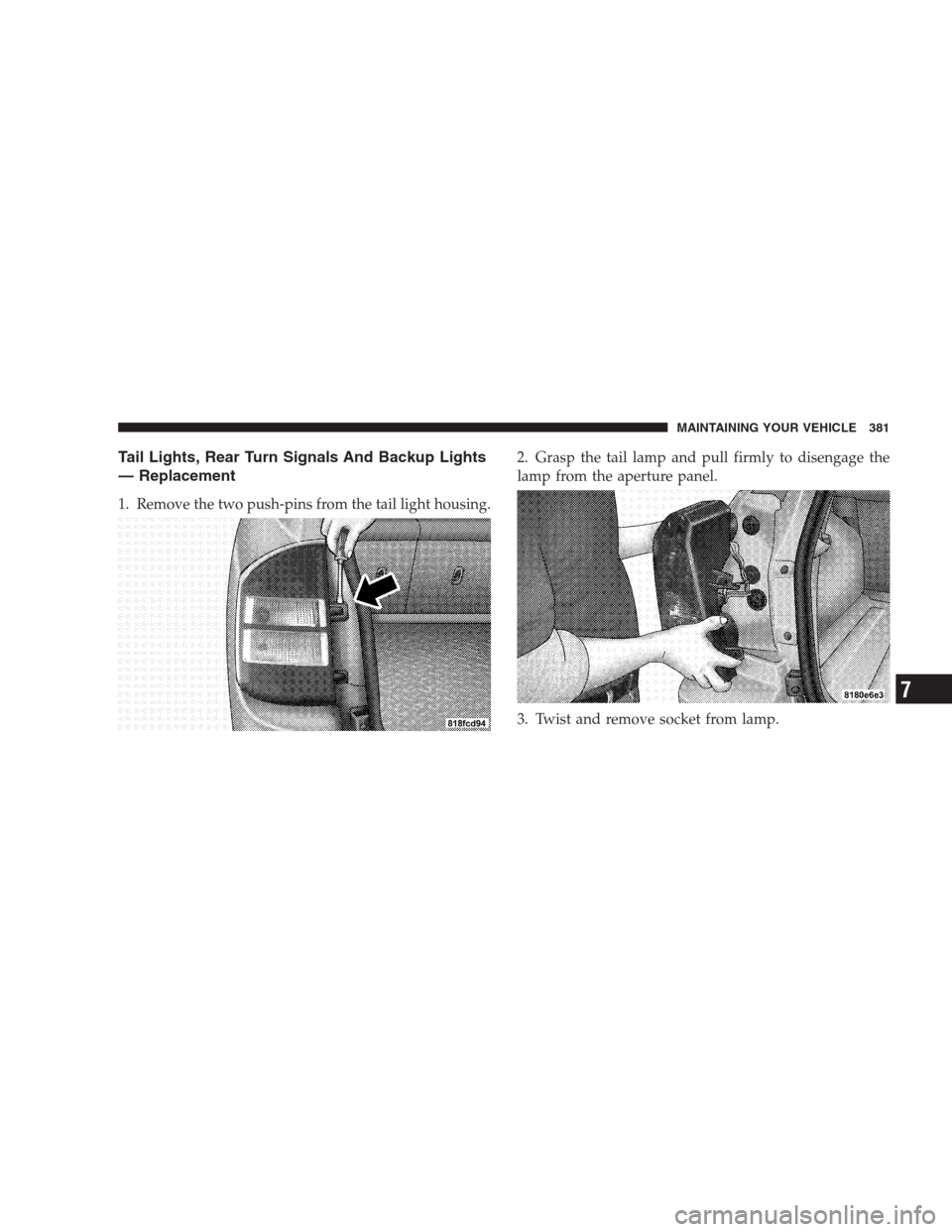
Tail Lights, Rear Turn Signals And Backup Lights
— Replacement
1. Remove the two push-pins from the tail light housing.2. Grasp the tail lamp and pull firmly to disengage the
lamp from the aperture panel.
3. Twist and remove socket from lamp.
MAINTAINING YOUR VEHICLE 381
7