Page 336 of 439

5. Turn on the Hazard Warning flasher.
6. Block both the front and rear of the
wheel diagonally opposite the jacking
position. For example, if changing the
right front tire, block the left rear
wheel.
NOTE:Passengers should not remain in the vehicle
while the vehicle is being jacked.
Jacking Instructions
WARNING!
Carefully follow these tire changing warnings to
help prevent personal injury or damage to your
vehicle:
(Continued)
WARNING! (Continued)
•Always park on a firm, level surface as far from
the edge of the roadway as possible before raising
the vehicle.
•Block the wheel diagonally opposite the wheel to
be raised.
•Set the parking brake firmly and set an automatic
transmission in PARK; a manual transmission in
REVERSE.
•Never start or run the engine with the vehicle on a
jack.
•Do not let anyone sit in the vehicle when it is on a
jack.
•Do not get under the vehicle when it is on a jack.
•Only use the jack in the positions indicated and
for lifting this vehicle during a tire change.
(Continued)
334 WHAT TO DO IN EMERGENCIES
Page 341 of 439

transaxle (CVT2) to go into “default mode” and turn on
the Malfunction Indicator Light (MIL). See your autho-
rized dealer to correct this condition.
1. When boosting from a battery in another vehicle, park
that vehicle within booster cable reach but without
letting the vehicles touch. Set the parking brake, place the
automatic transmission in PARK (the manual transmis-
sion in NEUTRAL) and turn the ignition to OFF for both
vehicles.
2. Turn off the heater, radio and all unnecessary electrical
loads.
3. Using the two finger screws on the cover, remove the
air intake duct covering the battery.
4. Connect one end of a jumper cable to the positive
terminal of the booster battery. Connect the other end of
the jumper cable to the positive terminal of the dis-
charged battery.WARNING!
•Battery fluid is a corrosive acid solution; do not
allow battery fluid to contact eyes, skin or cloth-
ing. Don’t lean over the battery when attaching the
clamps or allow the clamps to touch each other. If
acid splashes in your eyes or on your skin, flush
the contaminated area immediately with large
quantities of water.
•A battery generates hydrogen gas which is flam-
mable and explosive. Keep flame or spark away
from the vent holes. Do not use a booster battery
or any other booster source with an output that
exceeds 12-Volts.
5. Connect the other cable, first to the negative terminal
of the booster battery and then to the negative terminal of
the discharged battery. Make sure you have a good
contact.
WHAT TO DO IN EMERGENCIES 339
6
Page 343 of 439
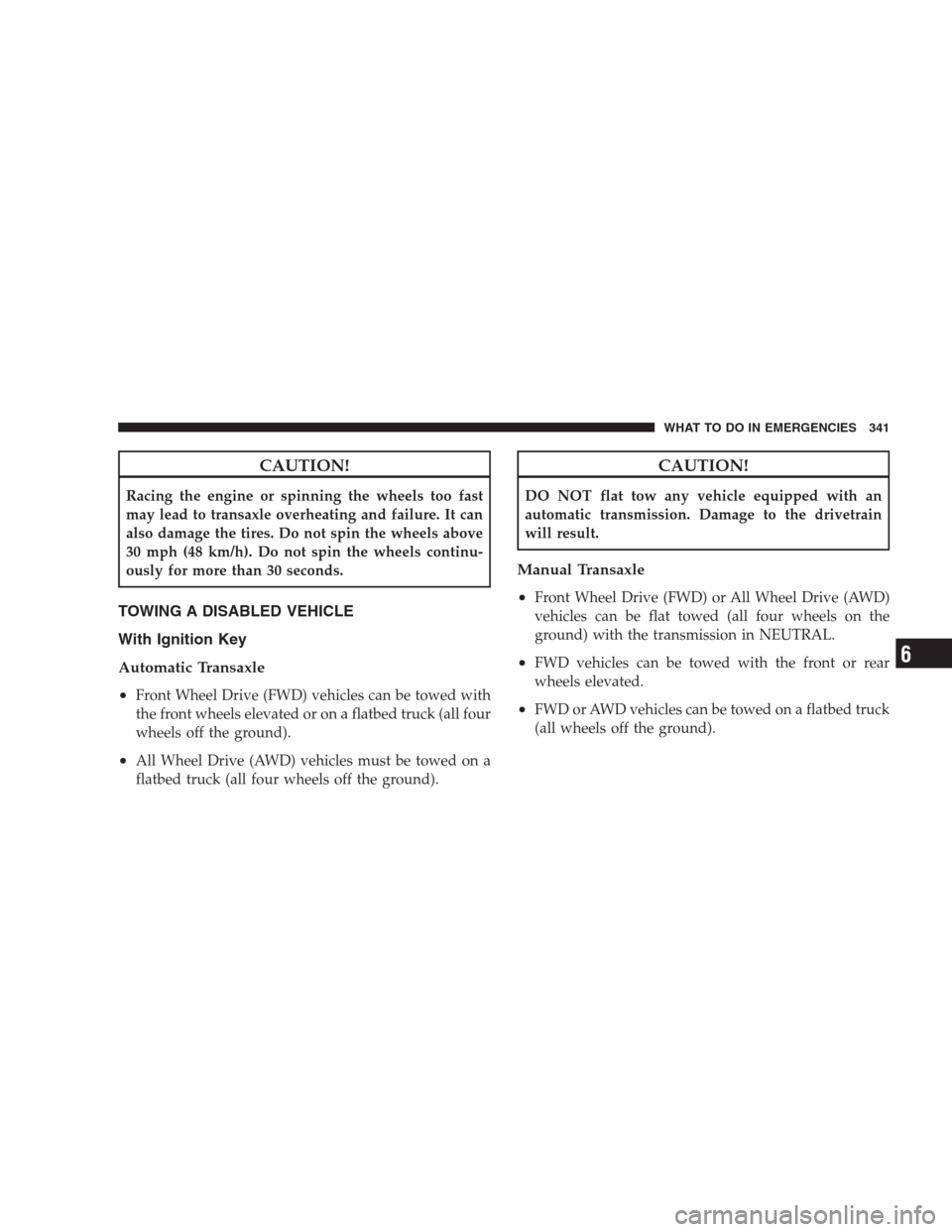
CAUTION!
Racing the engine or spinning the wheels too fast
may lead to transaxle overheating and failure. It can
also damage the tires. Do not spin the wheels above
30 mph (48 km/h). Do not spin the wheels continu-
ously for more than 30 seconds.
TOWING A DISABLED VEHICLE
With Ignition Key
Automatic Transaxle
•
Front Wheel Drive (FWD) vehicles can be towed with
the front wheels elevated or on a flatbed truck (all four
wheels off the ground).
•All Wheel Drive (AWD) vehicles must be towed on a
flatbed truck (all four wheels off the ground).
CAUTION!
DO NOT flat tow any vehicle equipped with an
automatic transmission. Damage to the drivetrain
will result.
Manual Transaxle
•
Front Wheel Drive (FWD) or All Wheel Drive (AWD)
vehicles can be flat towed (all four wheels on the
ground) with the transmission in NEUTRAL.
•FWD vehicles can be towed with the front or rear
wheels elevated.
•FWD or AWD vehicles can be towed on a flatbed truck
(all wheels off the ground).
WHAT TO DO IN EMERGENCIES 341
6
Page 368 of 439

Automatic Transaxle (CVT)
Selection Of Lubricant
It is important that the proper lubricant is used in the
transaxle to assure optimum transaxle performance. Use
only the manufacturer’s recommended transmission
fluid which has been formulated with special metal to
metal friction coefficient additives to provide the proper
steel belt traction on the drive and driven pulleys. Refer
to “Fluids, Lubricants, and Genuine Parts” in this section
for the correct fluid type.
CAUTION!
Using a transmission fluid other than the manufac-
turer’s recommended fluid will cause belt slip and
result in a complete transmission failure! Refer to
“Fluids, Lubricants, and Genuine Parts” in this sec-
tion for the correct fluid type.
Fluid Level Check
The fluid level in the automatic transaxle should be
checked only by a trained technician.
Fluid And Filter Changes
Refer to the “Maintenance Schedule” in Section 8 for the
correct maintenance interval.
Special Additives
Do not add any materials (other than leak detection dyes)
to Continuously Variable Transaxle (CVT) Fluid
(CVTF+4). CVTF+4 is an engineered product and its
performance may be impaired by supplemental
additives.
Manual Transaxle
Lubricant Selection
Use only the manufacturers recommended transmission
fluid. Refer to “Fluids, Lubricants, and Genuine Parts” in
this section for the correct fluid type.
366 MAINTAINING YOUR VEHICLE
Page 390 of 439
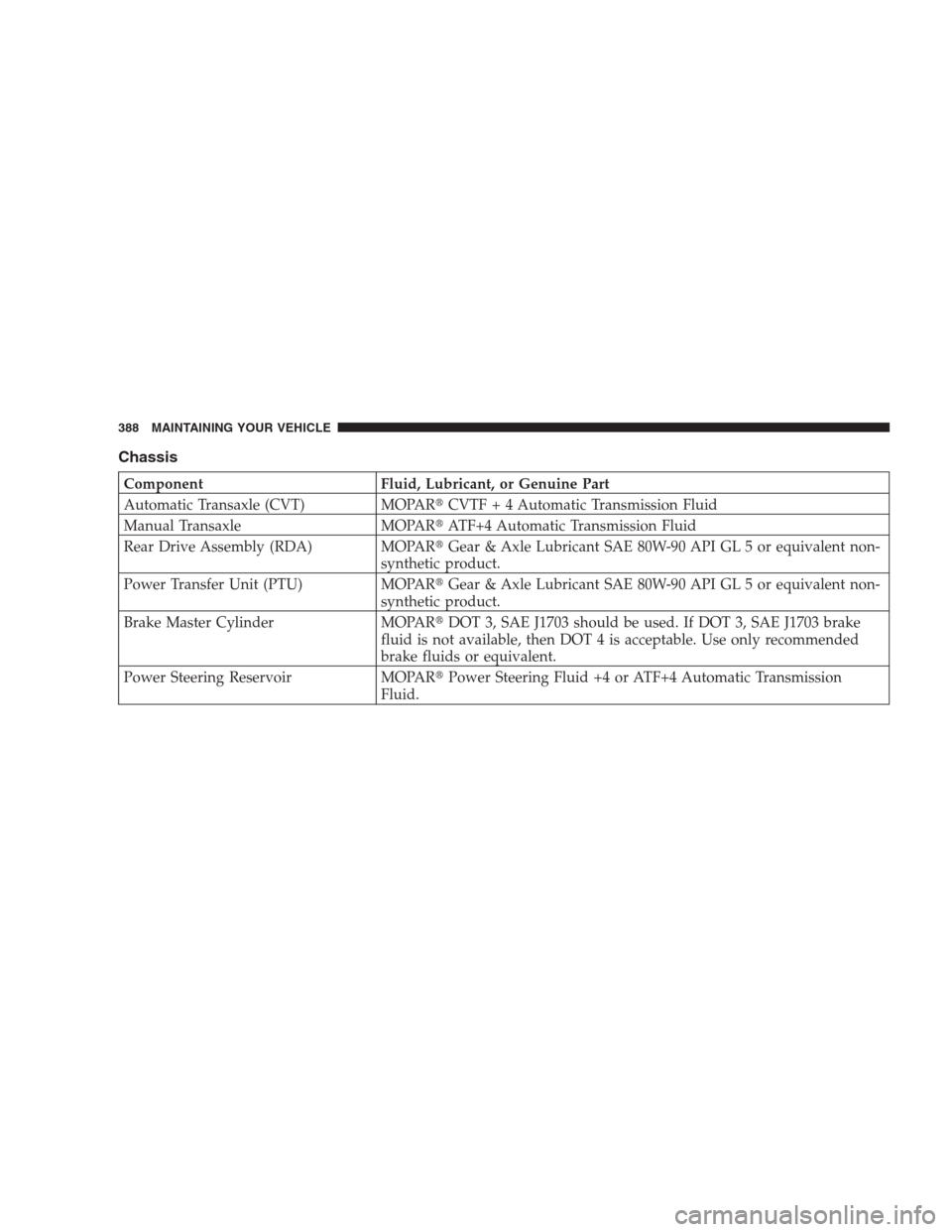
Chassis
Component Fluid, Lubricant, or Genuine Part
Automatic Transaxle (CVT) MOPAR�CVTF + 4 Automatic Transmission Fluid
Manual Transaxle MOPAR�ATF+4 Automatic Transmission Fluid
Rear Drive Assembly (RDA) MOPAR�Gear & Axle Lubricant SAE 80W-90 API GL 5 or equivalent non-
synthetic product.
Power Transfer Unit (PTU) MOPAR�Gear & Axle Lubricant SAE 80W-90 API GL 5 or equivalent non-
synthetic product.
Brake Master Cylinder MOPAR�DOT 3, SAE J1703 should be used. If DOT 3, SAE J1703 brake
fluid is not available, then DOT 4 is acceptable. Use only recommended
brake fluids or equivalent.
Power Steering Reservoir MOPAR�Power Steering Fluid +4 or ATF+4 Automatic Transmission
Fluid.
388 MAINTAINING YOUR VEHICLE
Page 399 of 439

60,000 Miles (100,000 km) or 60 Months Maintenance Service
Schedule
❏Change the engine oil and engine oil filter.
❏Rotate tires.
❏Replace the engine air cleaner filter.
❏Inspect the brake linings; replace if necessary.
❏Adjust the parking brake on vehicles equipped with four-wheel disc brakes.
❏Replace the air conditioning filter.
❏Replace the spark plugs (except 2.4L PZEV).
❏Replace rear drive assembly (RDA) fluid.
❏Replace power transfer unit (PTU) fluid.
❏Change the automatic transmission fluid and filter if using your vehicle for any of the
following: police, taxi, fleet, or frequent trailer towing.
❏Flush and replace the engine coolant at 60 months if not done at 102,000 miles
(170 000 km).
Odometer Reading Date
Repair Order # Dealer Code
Signature Authorized Chrysler Dealer
66,000 Miles (110,000 km) or
66 Months Maintenance
Service Schedule
❏Change the engine oil and engine oil
filter.
❏Rotate tires.
Odometer Reading Date
Repair Order # Dealer Code
Signature Authorized Chrysler Dealer
MAINTENANCE SCHEDULES 397
8
M
A
I
N
T
E
N
A
N
C
E
S
C
H
E
D
U
L
E
S
Page 404 of 439

120,000 Miles (200,000 km) or 120 Months Maintenance Service
Schedule
❏Change the engine oil and engine oil filter.
❏Rotate tires.
❏Replace the engine air cleaner filter.
❏Inspect the brake linings; replace if necessary.
❏Adjust the parking brake on vehicles equipped with four-wheel disc brakes.
❏Replace the air conditioning filter.
❏Inspect the CV joints.
❏Inspect exhaust system.
❏Inspect the front suspension, tie rod ends and boot seals; replace if necessary.
❏Replace the spark plugs (except 2.4L PZEV).
❏Replace rear drive assembly (RDA) fluid.
❏Replace power transfer unit (PTU) fluid.
❏Change the automatic transmission fluid and filter.
❏Replace the accessory drive belt(s).
Odometer Reading Date
Repair Order # Dealer Code
Signature Authorized Chrysler Dealer
126,000 Miles (210,000 km) or
126 Months Maintenance
Service Schedule
❏Change the engine oil and engine oil
filter.
❏Rotate tires.
Odometer Reading Date
Repair Order # Dealer Code
Signature Authorized Chrysler Dealer
402 MAINTENANCE SCHEDULES
8
M
A
I
N
T
E
N
A
N
C
E
S
C
H
E
D
U
L
E
S
Page 433 of 439

Speed Control (Cruise Control)...........131,169
Speedometer........................... 164
Starting............................... 251
Automatic Transmission................. 251
Engine Fails to Start.................... 253
Manual Transmission................... 251
Starting Procedures...................... 251
Steering
Power...........................265,266
Tilt Column.......................... 130
Wheel Lock........................... 15
Steering Wheel Mounted Sound
System Controls......................... 235
Storage............................147,377
Storage Bin............................ 147
Stuck, Freeing.......................... 340
Sun Roof.............................. 140
Sun Visor Extension....................... 79
Supplemental Restraint System - Airbag........ 48Synthetic Engine Oil...................... 351
Tachometer............................ 165
Taillights.............................. 381
Temperature Gauge, Engine Coolant.......168,331
Tether Anchor, Child Restraint............... 64
Theft Alarm (Security Alarm)................ 19
Theft System (Security Alarm)............... 19
Tie Down Hooks, Cargo................... 153
Tilt Steering Column..................... 130
Tire and Loading Information Placard......... 284
Tire Identification Number (TIN)............. 283
Tire Markings.......................... 279
Tire Safety Information.................... 279
Tires ............................70,288,414
Aging (Life of Tires).................... 294
Air Pressure.......................... 288
Chains.............................. 297
Changing............................ 332
INDEX 431
10
Page:
< prev 1-8 9-16 17-24