Page 75 of 439

▫Map/Reading Lights.................. 126
�Windshield Wipers And Washers.......... 127
▫Windshield Wiper Operation............ 127
▫Intermittent Wiper System.............. 128
▫Windshield Washers................... 128
▫Mist Feature........................ 129
�Tilt Steering Column................... 130
�Electronic Speed Control — If Equipped...... 131
▫To Activate......................... 131
▫To Set At A Desired Speed.............. 131
▫To Deactivate....................... 132
▫To Resume Speed.................... 132
▫To Vary The Speed Setting.............. 132▫Manual Transaxle.................... 133
▫To Accelerate For Passing............... 133
�Garage Door Opener — If Equipped........ 134
▫Programming HomeLink�.............. 135
▫Gate Operator/Canadian Programming..... 138
▫Using HomeLink�.................... 138
▫Reprogramming A Single HomeLink�
Button............................ 139
▫Security........................... 139
▫Troubleshooting Tips.................. 139
▫General Information................... 140
�Power Sunroof — If Equipped............. 140
▫Opening The Sunroof.................. 141
UNDERSTANDING THE FEATURES OF YOUR VEHICLE 73
3
Page 122 of 439
2. Move the safety catch outside the vehicle under the
front edge of the hood, toward the center and raise the
hood.
Lift the hood prop rod, clipped to the right side (left side
facing hood) of the engine compartment to secure thehood in the open position. Place the hood prop at the
location stamped into the inner hood surface.
CAUTION!
To prevent possible damage, do not slam the hood to
close it. Lower the hood until it is open approxi-
mately 8 in (20 cm) and then drop it. This should
secure both latches. Never drive your vehicle unless
the hood is fully closed, with both latches engaged.
WARNING!
If the hood is not fully latched it could fly up when
the vehicle is moving and block your forward vision.
You could have a collision. Be sure all hood latches
are fully latched before driving.
Safety Catch
120 UNDERSTANDING THE FEATURES OF YOUR VEHICLE
Page 136 of 439
GARAGE DOOR OPENER — IF EQUIPPED
HomeLink�replaces up to three remote controls (hand-
held transmitters) that operate devices such as garage
door openers, motorized gates, lighting, or home security
systems. The HomeLink�unit operates off your vehicle’s
battery.
The HomeLink�buttons that are located in the headliner
or sun visor designate the three different HomeLink�
channels.
NOTE:HomeLink�is disabled when the Vehicle Secu-
rity Alarm is active.
HomeLink�Buttons
134 UNDERSTANDING THE FEATURES OF YOUR VEHICLE
Page 140 of 439
Gate Operator/Canadian Programming
Canadian radio-frequency laws require transmitter sig-
nals to “time-out” (or quit) after several seconds of
transmission – which may not be long enough for
HomeLink�to pick up the signal during programming.
Similar to this Canadian law, some U.S. gate operators are
designed to “time-out” in the same manner.
It may be helpful to unplug the device during the cycling
process to prevent possible overheating of the garage
door or gate motor.
If you are having difficulties programming a garage door
opener or a gate operator, replace “Programming
HomeLink�” Step 3 with the following:
3. Continue to press and hold the HomeLink�button
while you press and release - every two seconds
(“cycle”) your hand-held transmitter until HomeLink�has successfully accepted the frequency signal. The
indicator light will flash slowly and then rapidly when
fully trained.
If you unplugged the device for training, plug it back in
at this time.
Then proceed with Step 4 under “Programming
HomeLink�” earlier in this section.
Using HomeLink�
To operate, simply press and release the programmed
HomeLink�button. Activation will now occur for the
trained device (i.e., garage door opener, gate operator,
Security system, entry door lock, home/office lighting,
etc. The hand-held transmitter of the device may also be
used at any time.
138 UNDERSTANDING THE FEATURES OF YOUR VEHICLE
Page 141 of 439

Reprogramming A Single HomeLink�Button
To re-program a channel that has been previously
trained, follow these steps:
1. Turn the ignition switch to the ON/RUN position.
2. Press and hold the desired HomeLink�button until
the indicator light begins to flash after 20 seconds.Do not
release the button.
3.Without releasing the button,proceed with Program-
ming Homelink�Step 2 and follow all remaining steps.
Security
It is advised to erase all channels before you sell or turn
in your vehicle.
To do this, press and hold the two outside buttons for
20 seconds until the red indicator flashes. Note that all
channels will be erased. Individual channels cannot be
erased.The HomeLink�Universal Transceiver is disabled when
the Vehicle Security Alarm is active.
Troubleshooting Tips
If you are having trouble programming HomeLink�, here
are some of the most common solutions:
•Replace the battery in the original transmitter.
•Press the “Learn” button on the Garage Door Opener
to complete the training for a Rolling Code.
•Did you unplug the device for training, and remember
to plug it back in?
If you have any problems, or require assistance, please
call toll-free 1–800–355–3515 or, on the Internet at
www.HomeLink.com for information or assistance.
UNDERSTANDING THE FEATURES OF YOUR VEHICLE 139
3
Page 143 of 439

WARNING!
•Never leave children in a vehicle, with the key in
the ignition switch. Occupants, particularly unat-
tended children, can become entrapped by the
power sunroof while operating the power sunroof
switch. Such entrapment may result in serious
injury or death.
•In an accident, there is a greater risk of being
thrown from a vehicle with an open sunroof. You
could also be seriously injured or killed. Always
fasten your seat belt properly and make sure all
passengers are properly secured too.
•Do not allow small children to operate the sun-
roof. Never allow fingers or other body parts, or
any object to project through the sunroof opening.
Injury may result.
Opening the Sunroof
Manual Mode
To open the sunroof, press and hold the switch rearward
to full open. Any release of the switch will stop the
movement and the sunroof will remain in a partial open
condition until the switch is pushed and held rearward
again.
Express Mode
Press the switch rearward and release, and the sunroof
will open automatically from any position. The sunroof
will open fully, and stop automatically, this is called
“express open”. During express open operation any
movement of the sunroof switch will stop the sunroof.
UNDERSTANDING THE FEATURES OF YOUR VEHICLE 141
3
Page 155 of 439
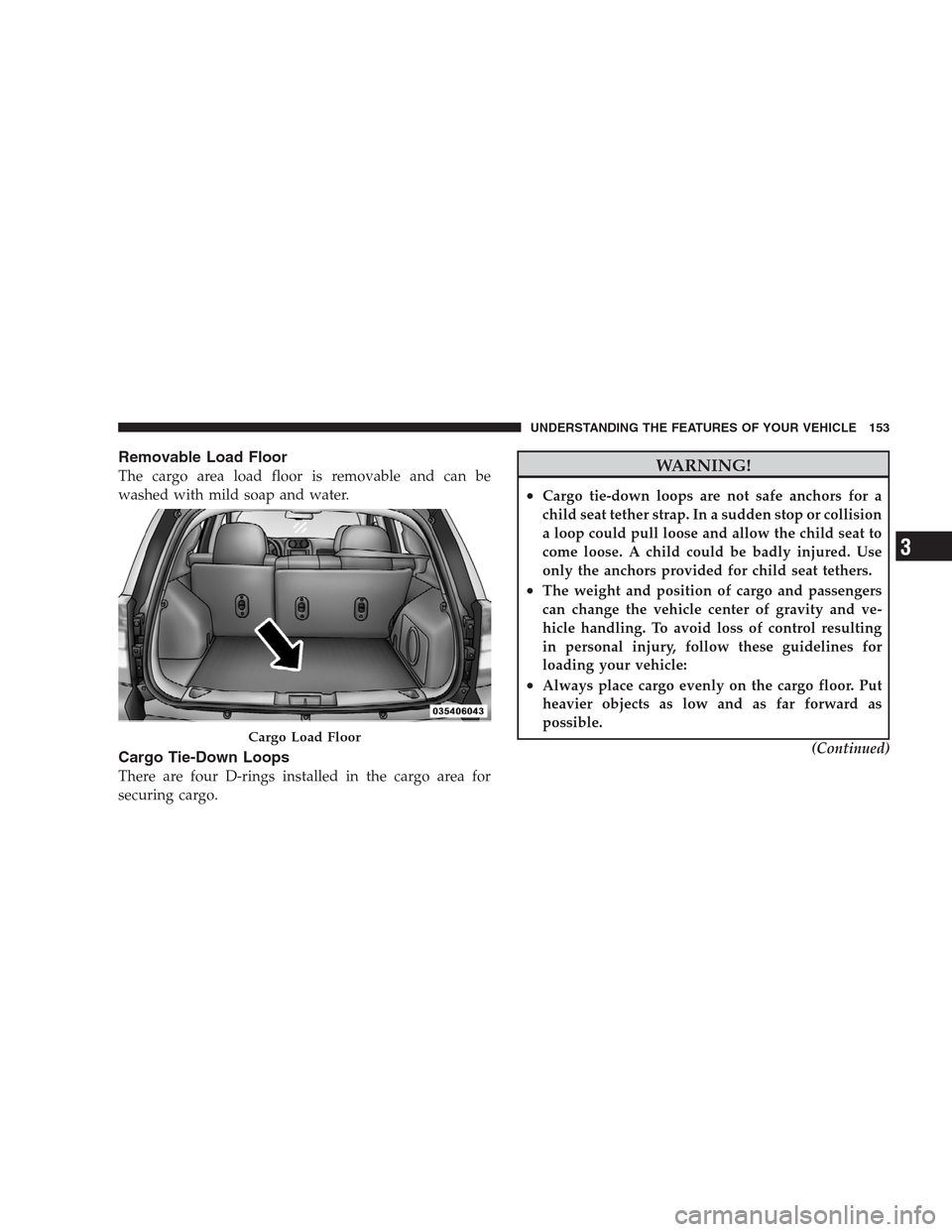
Removable Load Floor
The cargo area load floor is removable and can be
washed with mild soap and water.
Cargo Tie-Down Loops
There are four D-rings installed in the cargo area for
securing cargo.
WARNING!
•Cargo tie-down loops are not safe anchors for a
child seat tether strap. In a sudden stop or collision
a loop could pull loose and allow the child seat to
come loose. A child could be badly injured. Use
only the anchors provided for child seat tethers.
•The weight and position of cargo and passengers
can change the vehicle center of gravity and ve-
hicle handling. To avoid loss of control resulting
in personal injury, follow these guidelines for
loading your vehicle:
•Always place cargo evenly on the cargo floor. Put
heavier objects as low and as far forward as
possible.
(Continued)
Cargo Load Floor
UNDERSTANDING THE FEATURES OF YOUR VEHICLE 153
3
Page 170 of 439

The light also will turn on when the parking brake is
applied with the ignition switch in the ON position.
NOTE:This light shows only that the parking brake is
applied. It does not show the degree of brake application.
15. Transmission Temperature Indicator
During sustained high speed driving on hot
days, the automatic transmission oil may be-
come too hot. If this happens, the transmission
overheat indicator light will come on and the
vehicle will slow slightly until the automatic transmis-
sion cools down enough to allow a return to the re-
quested speed. If the high speed is maintained, the
overheating will reoccur as before in a cyclic fashion.
16. Vehicle Security Light — If Equipped
This light will flash at a fast rate for approxi-
mately 16 seconds, when the vehicle security
alarm is arming, and then will flash slowly
until the vehicle is disarmed.17. Temperature Gauge
The temperature gauge shows engine coolant tempera-
ture. Any reading within the normal range indicates that
the engine cooling system is operating satisfactorily.
The gauge pointer will likely indicate a higher tempera-
ture when driving in hot weather, up mountain grades,
or when towing a trailer. It should not be allowed to
exceed the upper limits of the normal operating range.
CAUTION!
Driving with a hot engine cooling system could
damage your vehicle. If temperature gauge reads “H”
pull over and stop the vehicle. Idle the vehicle with
the air conditioner turned off until the pointer drops
back into the normal range. If the pointer remains on
the “H” and you hear continuous chimes, turn the
engine off immediately, and call an authorized deal-
ership for service.
168 UNDERSTANDING YOUR INSTRUMENT PANEL