2009 Hyundai Sonata srs control module
[x] Cancel search: srs control modulePage 5 of 286

F4
A110A01A-AAT
VEHICLE DATA COLLECTION AND EVENT DATA RECORDERS
Your Hyundai vehicle is equipped with many high technology, electronically controlled systems
that help to ensure your vehicle operates properly and provides the performance that you
expect. These systems utilize computers to monitor the operation of various systems and
components and help to control their operation. These computerized system operations are
wide-ranging and involve components to reduce emissions, to continuously evaluate the
readiness of the airbag and seat belt pretensioner systems, to determine when the airbag and
seat belt pre-tensioner systems should be deployed and then to activate the deployment, and
if equipped, to operate anti-lock braking, traction control and electronic stability control to assist
the driver to control the vehicle in difficult driving situations. These systems electronically store
information that is useful to service technicians when they need to diagnose and repair these
systems. Additional information is stored only when a crash occurs that results in the
deployment of the airbags or seat belt pre-tensioners. This type of data storage is done by
devices called event data recorders(EDR).
After a crash event, the airbag and seat belt pre-tensioner computer system, known as the
Supplemental Restraint System Control Module (SRSCM) or Airbag Control Unit (ACU), may
record some information about the condition of the vehicle and how it was being operated. This
information consists of data related to seat belt usage and if there was diagnostic information
in the airbag or seat belt systems at the time that a crash occurred, and if the ACU sensed that
a crash of sufficient severity occurred to require seat belt pre-tensioner or airbag deployment.
To retrieve this information, special equipment is needed and access to the vehicle or the device
that stores the data is required. Hyundai will not access information about a crash event or share
it with others except:
o in response to an official request of police or similar government office, or
o with the consent of the vehicle owner or, if the vehicle is leased, with the consent of the lessee,
or
o as part of Hyundai’s defense of litigation, or
o as required by law.
Page 45 of 286
1FEATURES OF YOUR HYUNDAI32
!
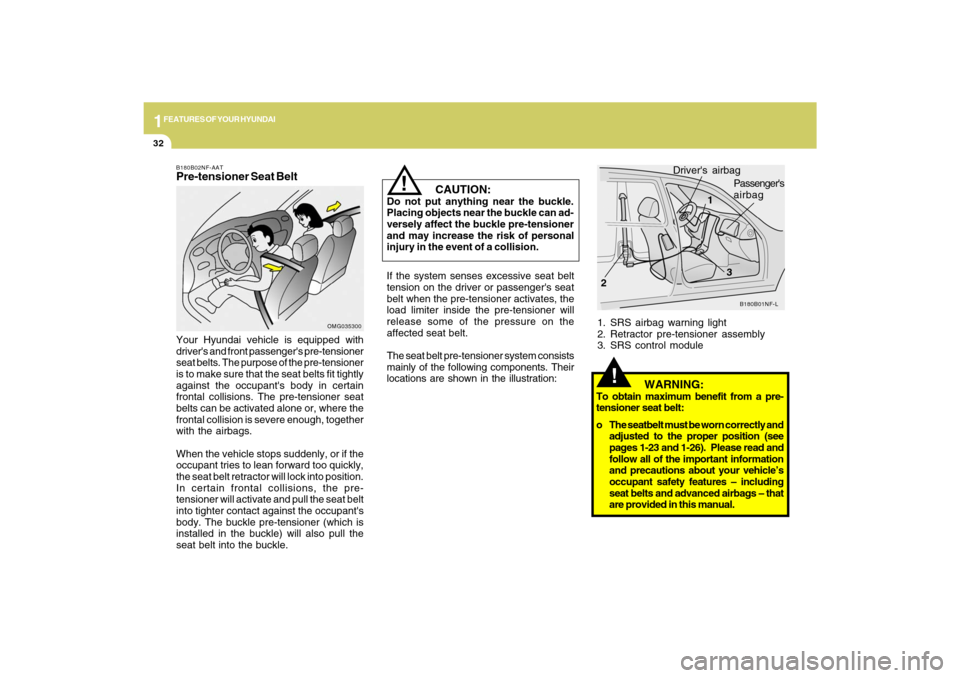
1. SRS airbag warning light
2. Retractor pre-tensioner assembly
3. SRS control module
B180B01NF-L
1
23 Driver's airbag
Passenger's
airbag
WARNING:
To obtain maximum benefit from a pre-
tensioner seat belt:
o The seatbelt must be worn correctly and
adjusted to the proper position (see
pages 1-23 and 1-26). Please read and
follow all of the important information
and precautions about your vehicle’s
occupant safety features – including
seat belts and advanced airbags – that
are provided in this manual.
!
CAUTION:
Do not put anything near the buckle.
Placing objects near the buckle can ad-
versely affect the buckle pre-tensioner
and may increase the risk of personal
injury in the event of a collision.
If the system senses excessive seat belt
tension on the driver or passenger's seat
belt when the pre-tensioner activates, the
load limiter inside the pre-tensioner will
release some of the pressure on the
affected seat belt.
The seat belt pre-tensioner system consists
mainly of the following components. Their
locations are shown in the illustration:
B180B02NF-AATPre-tensioner Seat BeltYour Hyundai vehicle is equipped with
driver's and front passenger's pre-tensioner
seat belts. The purpose of the pre-tensioner
is to make sure that the seat belts fit tightly
against the occupant's body in certain
frontal collisions. The pre-tensioner seat
belts can be activated alone or, where the
frontal collision is severe enough, together
with the airbags.
When the vehicle stops suddenly, or if the
occupant tries to lean forward too quickly,
the seat belt retractor will lock into position.
In certain frontal collisions, the pre-
tensioner will activate and pull the seat belt
into tighter contact against the occupant's
body. The buckle pre-tensioner (which is
installed in the buckle) will also pull the
seat belt into the buckle.
OMG035300
Page 48 of 286
1
FEATURES OF YOUR HYUNDAI
35
The SRS uses sensors to gather
information about the driver's and front
passenger's seat position, the driver's and
front passenger's seat belt usage and
impact severity.
The driver's and front passenger's seat
track position sensors, which are installed
on the seat track, determine if the seats are
fore or aft of a reference position. The seat
belt buckle sensors determine if the driver
and front passenger's seat belts are
fastened. These sensors provide the ability
to control the SRS deployment based on
how close the driver's seat is to the steering
wheel, how close the passenger's seat is
to the instrument panel, whether or not the
seat belts are fastened, and how severe
the impact is.
The advanced SRS offers the ability to
control the airbag inflation with two levels.
A first stage level is provided for moderate-
severity impacts. A second stage level is
provided for more severe impacts.
According to the impact severity, seating
position and seat belt usage, the
SRSCM(SRS Control Module) controls the
airbag inflation. Failure to properly wear
seat belts can increase the risk or severity
of injury in an accident.
CAUTION:
If a seat track position sensor or an
occupant classification system is not
working properly, the SRS airbag warning
light
on the instrument panel will
illuminate because the SRS airbag
warning light is connected with the seat
track position sensor and the occupant
classification system. If the SRS airbag
warning light does not illuminate when
the ignition key is turned to the "ON"
position, remains illuminated after
approximately 6 seconds when the igni-
tion key is turned to the "ON" position, or
if it illuminates while the vehicle is being
driven, have an authorized Hyundai
dealer inspect the advanced SRS airbag
system as soon as possible.
!
Additionally, your Hyundai is equipped
with an occupant classification system in
the front passenger's seat. The occupant
classification system detects the presence
of a passenger in the front passenger's
seat and will turn off the front passenger's
airbag under certain conditions. For more
detail, see "Occupant Classification
System" later in this section.
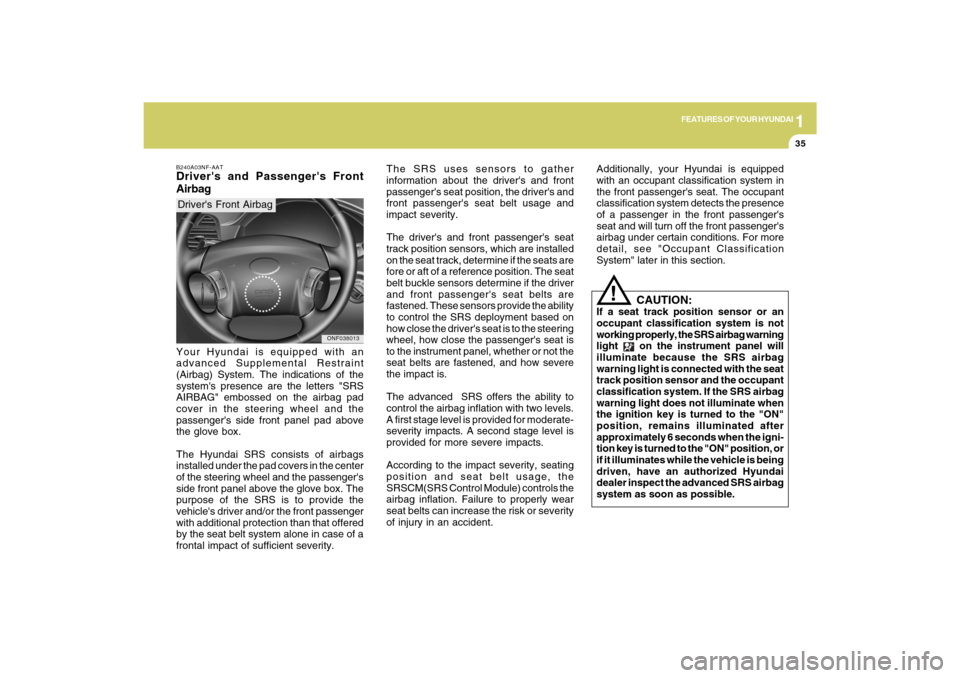
B240A03NF-AATDriver's and Passenger's Front
AirbagYour Hyundai is equipped with an
advanced Supplemental Restraint
(Airbag) System. The indications of the
system's presence are the letters "SRS
AIRBAG" embossed on the airbag pad
cover in the steering wheel and the
passenger's side front panel pad above
the glove box.
The Hyundai SRS consists of airbags
installed under the pad covers in the center
of the steering wheel and the passenger's
side front panel above the glove box. The
purpose of the SRS is to provide the
vehicle's driver and/or the front passenger
with additional protection than that offered
by the seat belt system alone in case of a
frontal impact of sufficient severity.Driver's Front Airbag
ONF038013
Page 49 of 286
1FEATURES OF YOUR HYUNDAI36
!
!
WARNING:
Always use seat belts and child restraints
– every trip, every time, everyone!
Airbags inflate with considerable force
and in the blink of an eye. Seat belts help
keep occupants in proper position to
obtain maximum benefit from the airbag.
Even with advanced airbags, improperly
belted and unbelted occupants can be
severely injured when the airbag inflates.
Always follow the precautions about seat
belts, airbags and occupant safety
contained in this manual.
To reduce the chance of serious or fatal
injuries and receive the maximum safety
benefit from your restraint system:
o Never place a child in any child or
booster seat in the front seat (see
child restraints 1-26).
o ABC – Always Buckle Children in the
back seat. It is the safest place for
children of any age to ride.
o Front and side impact airbags can
injure occupants improperly
positioned in the front seats.
o Move your seat as far back as
practical from the front airbags, while
still maintaining control of the vehicle.
o Never sit or lean unnecessarily close
to the front or side airbags.
!
WARNING:
o Modification to the seat structure can
adversely affect the seat track position
sensor and cause the airbag to deploy
at a different level than should be pro-
vided.
o Do not place any objects underneath
the front seats as they could damage
the seat track position sensor or
interfere with the occupant
classification system.
o Do not place any objects that may cause
magnetic fields near the front seat.
These may cause a malfunction of the
seat track position sensor.NOTE:o Be sure to read information about the
SRS on the labels provided on the back-
side of the sun visor.
o Advanced airbags are combined with
pre-tensioner seat belts to help provide
enhanced occupant protection in frontal
crashes. Front airbags are not intended
to deploy in collisions in which sufficient
protection can be provided by the pre-
tensioner seat belt.
o If you are considering modification of
your vehicle due to a disability, please
contact the Hyundai Customer Assis-
tance Center at 1-800-633-5151.o Never lean against the door or center
console – always sit in an upright posi-
tion.
o Do not allow an adult passenger to ride
in the front seat when the “Passenger
Airbag OFF” indicator is illuminated,
because the airbag will not deploy in the
event of a moderate or severe frontal
crash.
o Never place objects over or near any
airbag module (front or side impact
airbags), because these objects can
injure passengers in a crash.
o Never place covers, blankets or after-
market seat warmers on the passenger
seat as these may interfere with the
occupant classification system.
o Do not tamper or disconnect SRS wiring
or other components. Injuries could
result from inadvertent deployment or
failure of the airbag to deploy in a crash.
o If the SRS airbag warning light (see pg
1-50) remains illuminated while the
vehicle is being driven, have an
authorized Hyundai dealer inspect the
airbag system as soon as possible.
o Airbags can only be used once – have
an authorized Hyundai dealer replace
the airbag immediately after
deployment.
WARNING:
Page 50 of 286
1
FEATURES OF YOUR HYUNDAI
37
!
WARNING:
o Move your seat as far back as
practical from the front airbags, while
still maintaining control of the vehicle.
You and your passengers should
never sit or lean unnecessarily close
to the airbags. Improperly positioned
drivers and passengers can be
severely injured by inflating airbags.
o No objects should be placed over or
near the airbag modules on the steer-
ing wheel, instrument panel, and the
front passenger's panel above the
glove box, because any such object
could cause harm if the vehicle is in a
crash severe enough to cause the
airbags to deploy.
o If the airbags deploy, they must be
replaced by an authorized Hyundai
dealer. Deployed airbags WILL NOT
inflate again and will provide no
protection in subsequent collisions.
o Do not tamper with or disconnect SRS
wiring or other components of the
SRS system. Doing so could result in
injury, due to accidental deployment
of the airbags or by rendering the SRS
inoperative.
!
WARNING:
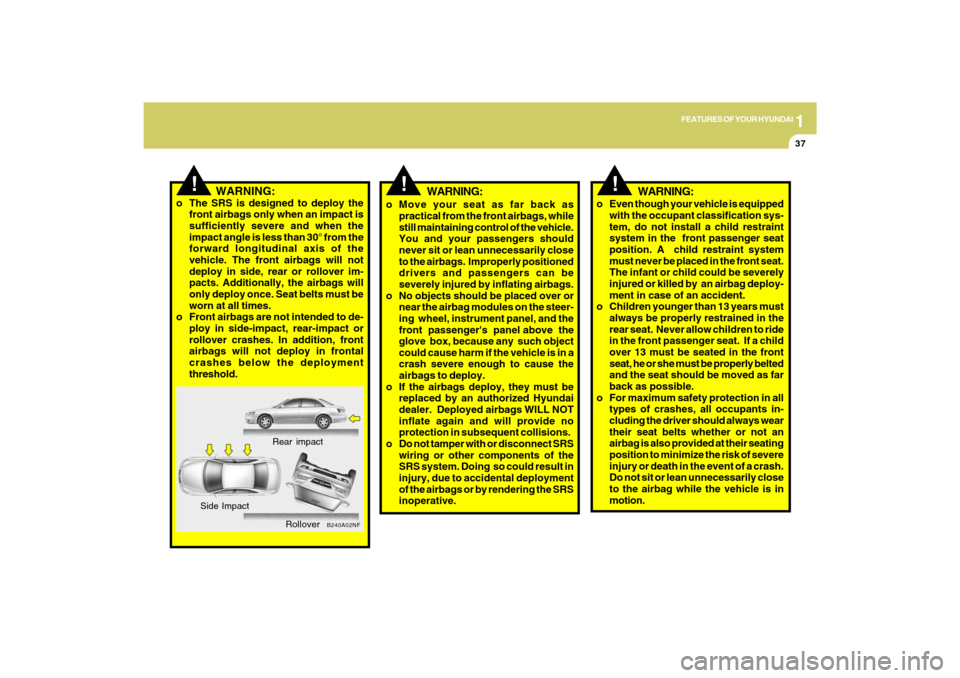
o The SRS is designed to deploy the
front airbags only when an impact is
sufficiently severe and when the
impact angle is less than 30° from the
forward longitudinal axis of the
vehicle. The front airbags will not
deploy in side, rear or rollover im-
pacts. Additionally, the airbags will
only deploy once. Seat belts must be
worn at all times.
o Front airbags are not intended to de-
ploy in side-impact, rear-impact or
rollover crashes. In addition, front
airbags will not deploy in frontal
crashes below the deployment
threshold.
!
WARNING:
o Even though your vehicle is equipped
with the occupant classification sys-
tem, do not install a child restraint
system in the front passenger seat
position. A child restraint system
must never be placed in the front seat.
The infant or child could be severely
injured or killed by an airbag deploy-
ment in case of an accident.
o Children younger than 13 years must
always be properly restrained in the
rear seat. Never allow children to ride
in the front passenger seat. If a child
over 13 must be seated in the front
seat, he or she must be properly belted
and the seat should be moved as far
back as possible.
o For maximum safety protection in all
types of crashes, all occupants in-
cluding the driver should always wear
their seat belts whether or not an
airbag is also provided at their seating
position to minimize the risk of severe
injury or death in the event of a crash.
Do not sit or lean unnecessarily close
to the airbag while the vehicle is in
motion.
B240A02NF
Rear impact
Side Impact
Rollover
Page 51 of 286
1FEATURES OF YOUR HYUNDAI38
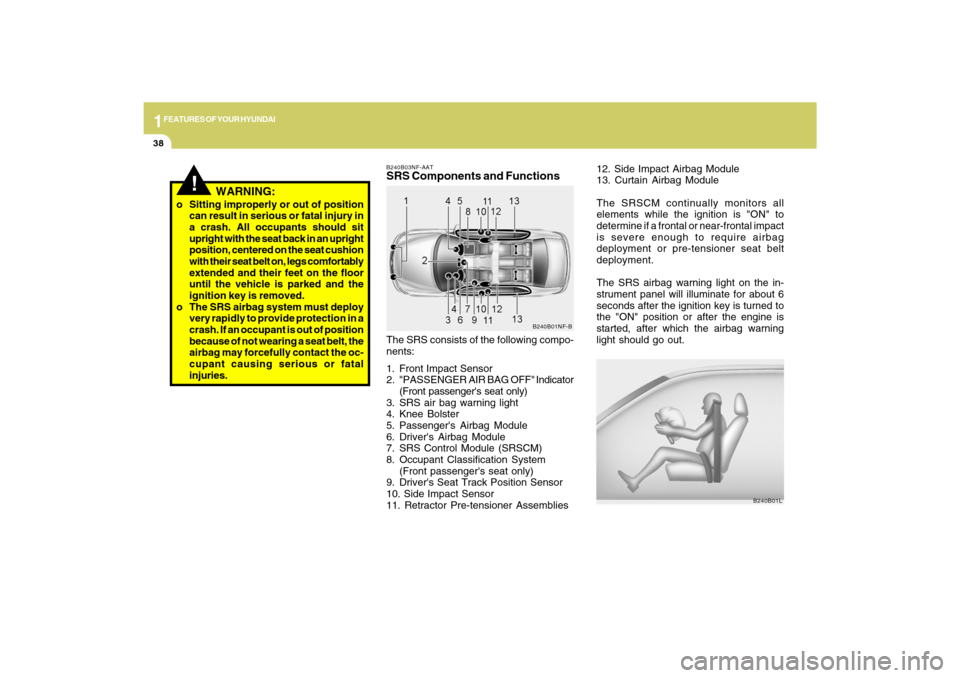
12. Side Impact Airbag Module
13. Curtain Airbag Module
The SRSCM continually monitors all
elements while the ignition is "ON" to
determine if a frontal or near-frontal impact
is severe enough to require airbag
deployment or pre-tensioner seat belt
deployment.
The SRS airbag warning light on the in-
strument panel will illuminate for about 6
seconds after the ignition key is turned to
the "ON" position or after the engine is
started, after which the airbag warning
light should go out.
!
WARNING:
o Sitting improperly or out of position
can result in serious or fatal injury in
a crash. All occupants should sit
upright with the seat back in an upright
position, centered on the seat cushion
with their seat belt on, legs comfortably
extended and their feet on the floor
until the vehicle is parked and the
ignition key is removed.
o The SRS airbag system must deploy
very rapidly to provide protection in a
crash. If an occupant is out of position
because of not wearing a seat belt, the
airbag may forcefully contact the oc-
cupant causing serious or fatal
injuries.
B240B03NF-AATSRS Components and FunctionsThe SRS consists of the following compo-
nents:
1. Front Impact Sensor
2. "PASSENGER AIR BAG OFF" Indicator
(Front passenger's seat only)
3. SRS air bag warning light
4. Knee Bolster
5. Passenger's Airbag Module
6. Driver's Airbag Module
7. SRS Control Module (SRSCM)
8. Occupant Classification System
(Front passenger's seat only)
9. Driver's Seat Track Position Sensor
10. Side Impact Sensor
11. Retractor Pre-tensioner Assemblies
B240B01NF-B
B240B01L
Page 52 of 286
1
FEATURES OF YOUR HYUNDAI
39
B240B02L
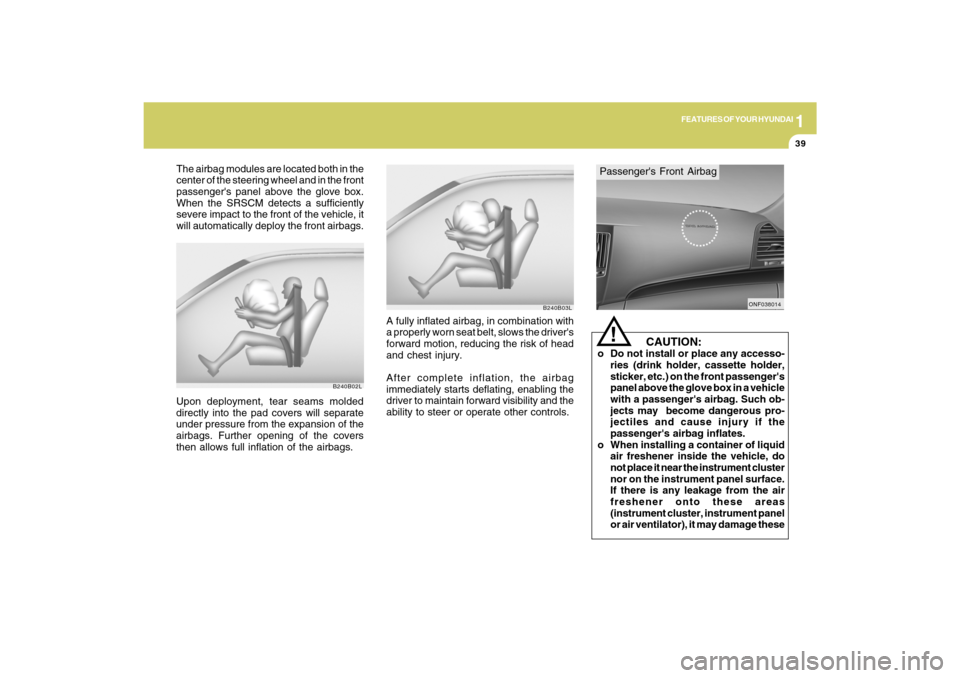
Upon deployment, tear seams molded
directly into the pad covers will separate
under pressure from the expansion of the
airbags. Further opening of the covers
then allows full inflation of the airbags.A fully inflated airbag, in combination with
a properly worn seat belt, slows the driver's
forward motion, reducing the risk of head
and chest injury.
After complete inflation, the airbag
immediately starts deflating, enabling the
driver to maintain forward visibility and the
ability to steer or operate other controls.
B240B03L
The airbag modules are located both in the
center of the steering wheel and in the front
passenger's panel above the glove box.
When the SRSCM detects a sufficiently
severe impact to the front of the vehicle, it
will automatically deploy the front airbags.
CAUTION:
o Do not install or place any accesso-
ries (drink holder, cassette holder,
sticker, etc.) on the front passenger's
panel above the glove box in a vehicle
with a passenger's airbag. Such ob-
jects may become dangerous pro-
jectiles and cause injury if the
passenger's airbag inflates.
o When installing a container of liquid
air freshener inside the vehicle, do
not place it near the instrument cluster
nor on the instrument panel surface.
If there is any leakage from the air
freshener onto these areas
(instrument cluster, instrument panel
or air ventilator), it may damage these
!
ONF038014
Passenger's Front Airbag
Page 254 of 286

6
DO-IT-YOURSELF MAINTENANCE
39
PROTECTED COMPONENTS
FUSE RATING FUSE
SPARE 15A(Spare)
SPARE 15A(Spare)
ETACS 10ABCM(Body Control Module), Sunroof control module, Electronic chrome mirror, Rheostat
ESC 10A ESC module, Blower relay
C/LIGHTER 20ACigarette lighter
SPARE 15A(Spare)
TAIL RH 10AIllumination lights, Right : License light (LH, RH), Rear combination light, Headlight, Glove box light
TAIL LH 10A Front fog light relay, Left : Rear combination light, Headlight
IONIZER 10A (Spare)
H/LP 10ADRL control module, Headlight relay, AQS and ambient sensor
WIPER 25A Wiper and washer
A/CON 10AA/C control module
A/BAG 15A SRS control module, Passenger's Airbag switch
P/OUTLET 20AFront accessory socket, Rear power outlet
D/CLOCK 10ADigital clock, Audio, A/T shift lock control module, Power outside mirror and mirror folding, BCM
SAFETY PWR 25A Safety window module
ECS 15A (Spare)
ATM KEY LOCK 10A A/T shift lock control module
P/WDW RR LH 25A Power window main switch, Left rear power window switch
P/WDW RH 30A Power window main switch, Right power window switch
Inner Panel