2009 Hyundai Sonata trunk
[x] Cancel search: trunkPage 65 of 286
1FEATURES OF YOUR HYUNDAI52
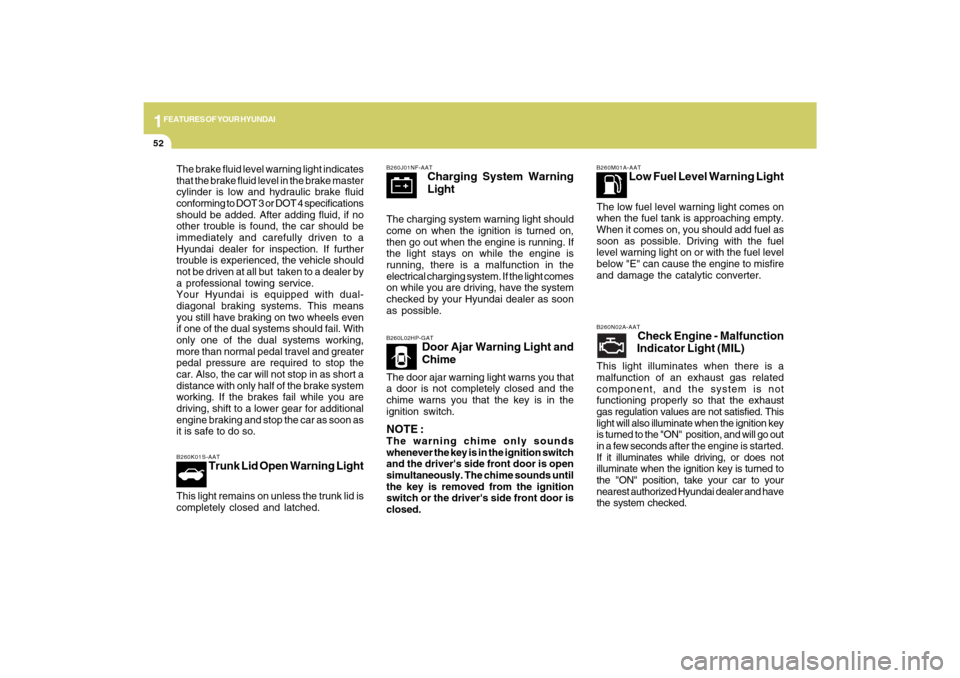
B260L02HP-GAT
Door Ajar Warning Light and
Chime
The door ajar warning light warns you that
a door is not completely closed and the
chime warns you that the key is in the
ignition switch.NOTE :The warning chime only sounds
whenever the key is in the ignition switch
and the driver's side front door is open
simultaneously. The chime sounds until
the key is removed from the ignition
switch or the driver's side front door is
closed.
B260M01A-AAT
Low Fuel Level Warning Light
The low fuel level warning light comes on
when the fuel tank is approaching empty.
When it comes on, you should add fuel as
soon as possible. Driving with the fuel
level warning light on or with the fuel level
below "E" can cause the engine to misfire
and damage the catalytic converter.B260N02A-AAT
Check Engine - Malfunction
Indicator Light (MIL)
This light illuminates when there is a
malfunction of an exhaust gas related
component, and the system is not
functioning properly so that the exhaust
gas regulation values are not satisfied. This
light will also illuminate when the ignition key
is turned to the "ON" position, and will go out
in a few seconds after the engine is started.
If it illuminates while driving, or does not
illuminate when the ignition key is turned to
the "ON" position, take your car to your
nearest authorized Hyundai dealer and have
the system checked. The brake fluid level warning light indicates
that the brake fluid level in the brake master
cylinder is low and hydraulic brake fluid
conforming to DOT 3 or DOT 4 specifications
should be added. After adding fluid, if no
other trouble is found, the car should be
immediately and carefully driven to a
Hyundai dealer for inspection. If further
trouble is experienced, the vehicle should
not be driven at all but taken to a dealer by
a professional towing service.
Your Hyundai is equipped with dual-
diagonal braking systems. This means
you still have braking on two wheels even
if one of the dual systems should fail. With
only one of the dual systems working,
more than normal pedal travel and greater
pedal pressure are required to stop the
car. Also, the car will not stop in as short a
distance with only half of the brake system
working. If the brakes fail while you are
driving, shift to a lower gear for additional
engine braking and stop the car as soon as
it is safe to do so.
B260J01NF-AAT
Charging System Warning
Light
The charging system warning light should
come on when the ignition is turned on,
then go out when the engine is running. If
the light stays on while the engine is
running, there is a malfunction in the
electrical charging system. If the light comes
on while you are driving, have the system
checked by your Hyundai dealer as soon
as possible.
B260K01S-AAT
Trunk Lid Open Warning Light
This light remains on unless the trunk lid is
completely closed and latched.
Page 84 of 286
1
FEATURES OF YOUR HYUNDAI
71
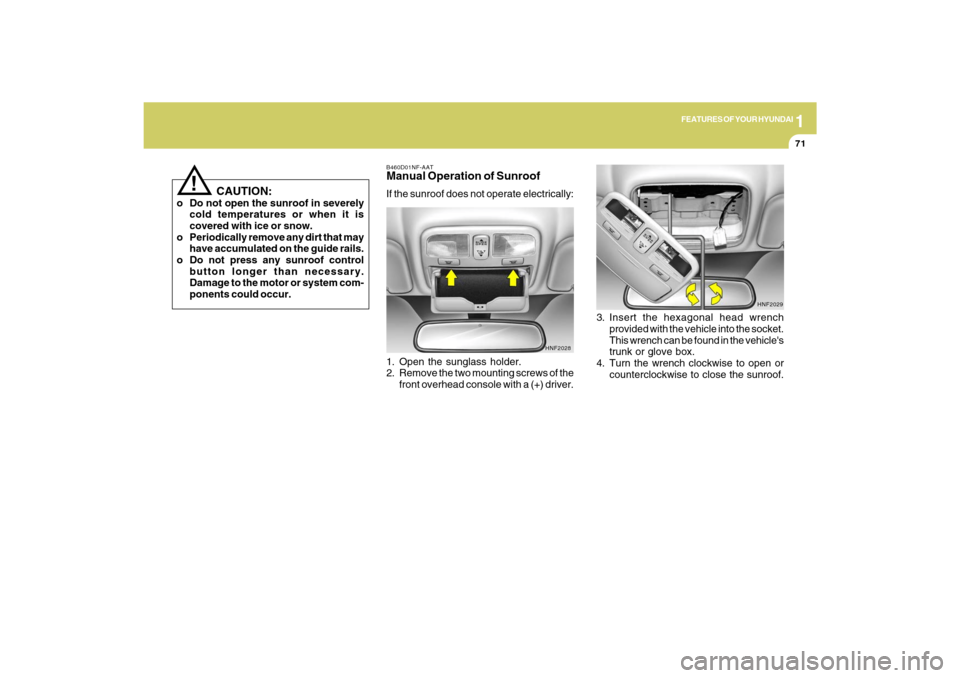
B460D01NF-AATManual Operation of SunroofIf the sunroof does not operate electrically:
1. Open the sunglass holder.
2. Remove the two mounting screws of the
front overhead console with a (+) driver.
HNF2028
!
CAUTION:
o Do not open the sunroof in severely
cold temperatures or when it is
covered with ice or snow.
o Periodically remove any dirt that may
have accumulated on the guide rails.
o Do not press any sunroof control
button longer than necessary.
Damage to the motor or system com-
ponents could occur.
3. Insert the hexagonal head wrench
provided with the vehicle into the socket.
This wrench can be found in the vehicle's
trunk or glove box.
4. Turn the wrench clockwise to open or
counterclockwise to close the sunroof.
HNF2029
Page 97 of 286
1FEATURES OF YOUR HYUNDAI84
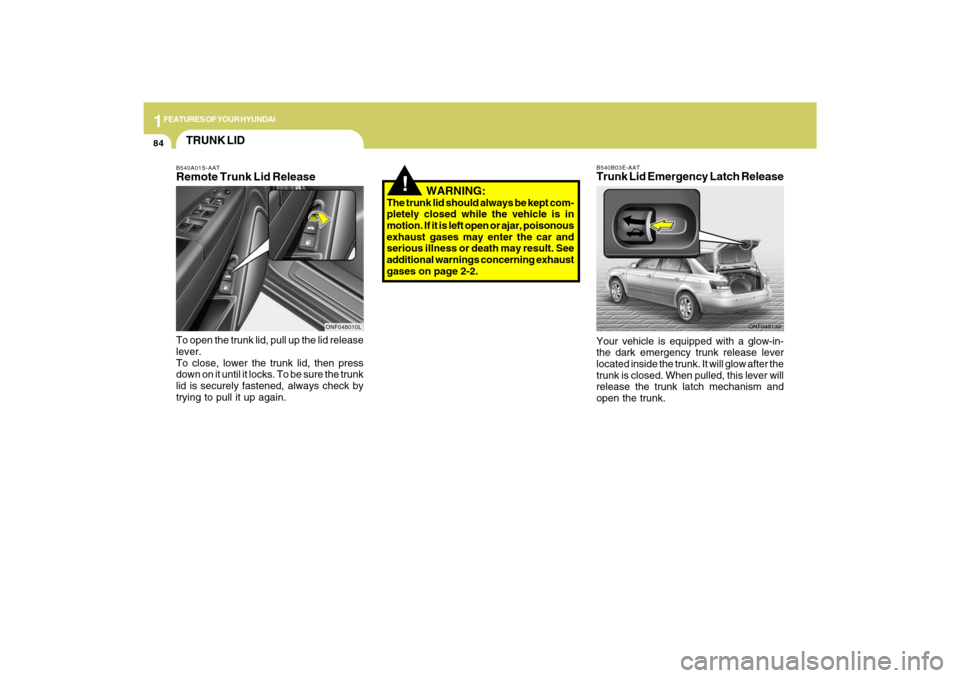
ONF048132 B540B03E-AAT
Trunk Lid Emergency Latch ReleaseYour vehicle is equipped with a glow-in-
the dark emergency trunk release lever
located inside the trunk. It will glow after the
trunk is closed. When pulled, this lever will
release the trunk latch mechanism and
open the trunk.
!
WARNING:
The trunk lid should always be kept com-
pletely closed while the vehicle is in
motion. If it is left open or ajar, poisonous
exhaust gases may enter the car and
serious illness or death may result. See
additional warnings concerning exhaust
gases on page 2-2.
TRUNK LIDB540A01S-AATRemote Trunk Lid ReleaseTo open the trunk lid, pull up the lid release
lever.
To close, lower the trunk lid, then press
down on it until it locks. To be sure the trunk
lid is securely fastened, always check by
trying to pull it up again.
ONF048010L
Page 98 of 286
1
FEATURES OF YOUR HYUNDAI
85
!
WARNING:
o If a person becomes locked in the
trunk, pull the emergency trunk
release lever of the inside panel in the
trunk to open the trunk lid.
o Keep cars locked and keys out of the
reach of children. HYUNDAI recom-
mends parents teach children about
the emergency trunk release lever in
their vehicle and how to open the trunk
lid if they are accidentally locked in
the trunk.
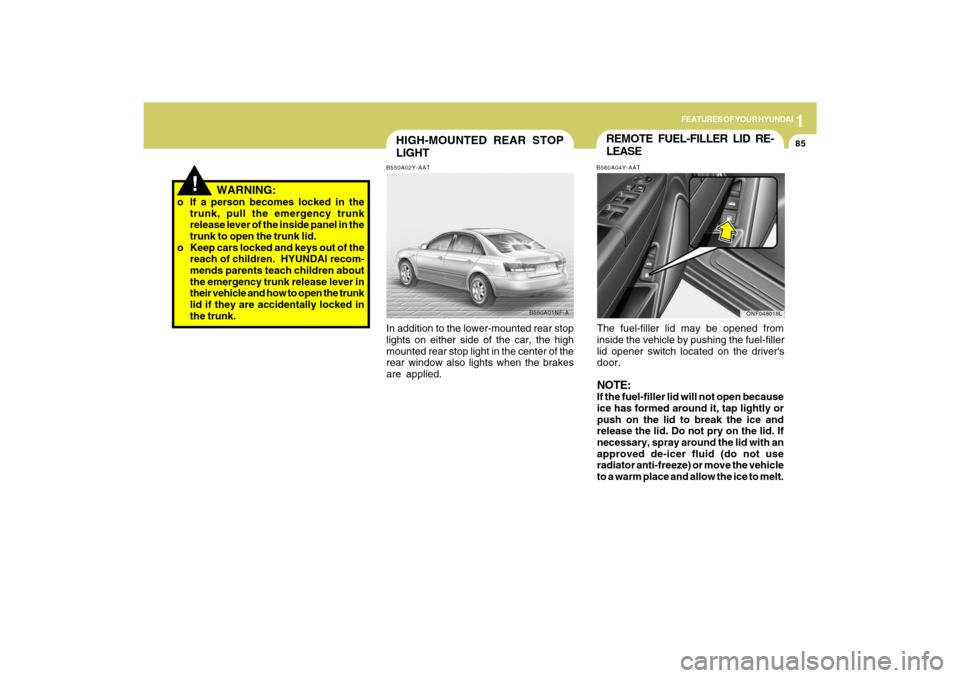
HIGH-MOUNTED REAR STOP
LIGHTB550A02Y-AATIn addition to the lower-mounted rear stop
lights on either side of the car, the high
mounted rear stop light in the center of the
rear window also lights when the brakes
are applied.
B550A01NF-A
REMOTE FUEL-FILLER LID RE-
LEASEB560A04Y-AATThe fuel-filler lid may be opened from
inside the vehicle by pushing the fuel-filler
lid opener switch located on the driver's
door.NOTE:If the fuel-filler lid will not open because
ice has formed around it, tap lightly or
push on the lid to break the ice and
release the lid. Do not pry on the lid. If
necessary, spray around the lid with an
approved de-icer fluid (do not use
radiator anti-freeze) or move the vehicle
to a warm place and allow the ice to melt.
ONF048018L
Page 100 of 286
1
FEATURES OF YOUR HYUNDAI
87
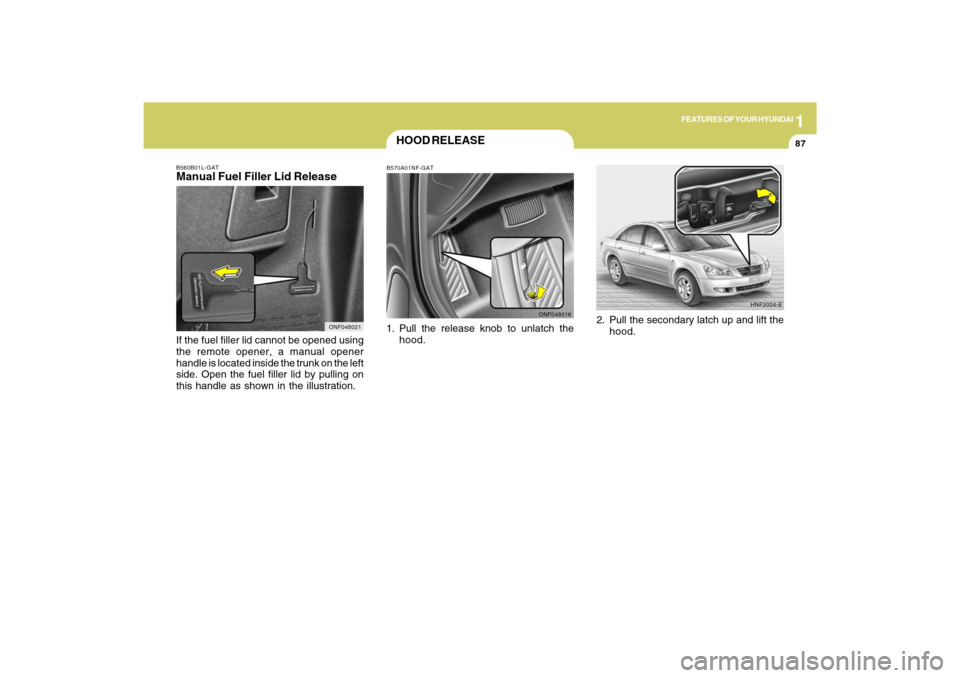
B560B01L-GATManual Fuel Filler Lid ReleaseIf the fuel filler lid cannot be opened using
the remote opener, a manual opener
handle is located inside the trunk on the left
side. Open the fuel filler lid by pulling on
this handle as shown in the illustration.
ONF048021
HOOD RELEASEB570A01NF-GAT1. Pull the release knob to unlatch the
hood.2. Pull the secondary latch up and lift the
hood.
ONF048016HNF2024-E
Page 155 of 286
2
DRIVING YOUR HYUNDAI
2
WARNING: ENGINE EXHAUST CAN BE DANGEROUS!
C010A03A-AATEngine exhaust fumes can be extremely dangerous. If, at any time, you smell exhaust fumes inside the vehicle, open the
windows immediately.
o Do not inhale exhaust fumes.
Exhaust fumes contain carbon monoxide, a colorless, odorless gas that can cause unconsciousness and death by
asphyxiation.
o Be sure the exhaust system does not leak.
The exhaust system should be checked whenever the vehicle is raised to change the oil or for any other purpose. If you
hear a change in the sound of the exhaust or if you drive over something that strikes the underneath side of the car, have
the exhaust system checked as soon as possible by your Hyundai dealer.
o Do not run the engine in an enclosed area.
Letting the engine idle in your garage, even with the garage door open, is a hazardous practice. Never run the engine
in your garage any longer than it takes to start the engine and back the car out.
o Avoid idling the engine for prolonged periods with people inside the car.
If it is necessary to idle the engine for a prolonged period with people inside the car, be sure to do so only in an open area
with the air intake set at "Fresh" and fan operating at one of the higher speeds so fresh air is drawn into the interior.
If you must drive with the trunk lid open because you are carrying objects that make this necessary:
1. Close all windows.
2. Open side vents.
3. Set the air intake control at "Fresh", the air flow control at "Floor" or "Face" and the fan at one of the higher speeds.
To assure proper operation of the ventilation system, be sure the ventilation air intakes located just in front of the windshield
are kept clear of snow, ice, leaves or other obstructions.
!!
PROPOSITION 65 WARNING:
Engine exhaust and a wide variety of automobile components and parts, including components found in the interior
furnishings in a vehicle, contain or emit chemicals known to the State of California to cause cancer and birth defects
and reproductive harm. In addition, certain fluids contained in vehicles and certain products of component wear contain
or emit chemicals known to the State of California to cause cancer and birth defects or other reproductive harm.
Page 175 of 286
2
DRIVING YOUR HYUNDAI
22
C190F01Y-GATTrailer or Vehicle Towing Tips1. Before towing, check hitch and safety
chain connections as well as proper
operation of the trailer running lights,
brake lights, and turn signals.
2. Always drive your vehicle at a moderate
speed. (Less than 60 mph)
3. Trailer towing requires more fuel than
normal conditions.
4. To maintain engine braking efficiency
and electrical charging performance,
do not tow a trailer with the transaxle in
fifth gear (manual transaxle).
5. Always secure items in the trailer to
prevent load shift while driving.
6. Check the condition and air pressure of
all tires on the trailer and your car. Low
tire pressure can seriously affect the
handling. Also check the spare tire.
7. The vehicle/trailer combination is more
affected by crosswind and buffeting.
When being passed by a large vehicle,
keep a constant speed and steer straight
ahead. If there is too much wind
buffeting, slow down to get out of the
other vehicle's air turbulence.
!
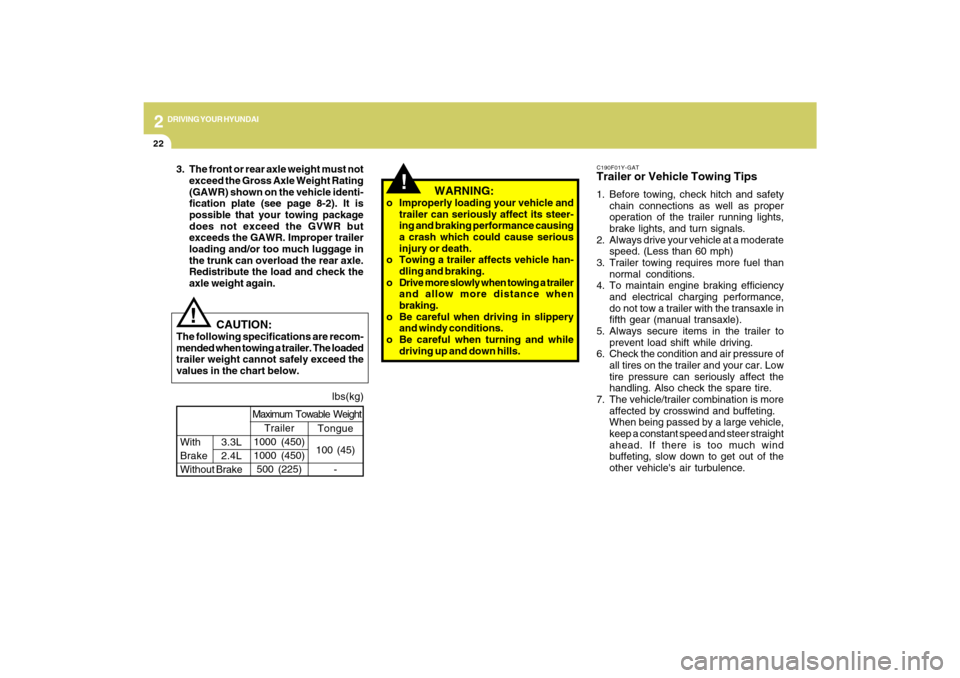
lbs(kg)
!
Tongue
100 (45)
- With3.3L
Brake 2.4L
Without BrakeMaximum Towable Weight
Trailer
1000 (450)
1000 (450)
500 (225)
CAUTION:
The following specifications are recom-
mended when towing a trailer. The loaded
trailer weight cannot safely exceed the
values in the chart below.
WARNING:
o Improperly loading your vehicle and
trailer can seriously affect its steer-
ing and braking performance causing
a crash which could cause serious
injury or death.
o Towing a trailer affects vehicle han-
dling and braking.
o Drive more slowly when towing a trailer
and allow more distance when
braking.
o Be careful when driving in slippery
and windy conditions.
o Be careful when turning and while
driving up and down hills. 3. The front or rear axle weight must not
exceed the Gross Axle Weight Rating
(GAWR) shown on the vehicle identi-
fication plate (see page 8-2). It is
possible that your towing package
does not exceed the GVWR but
exceeds the GAWR. Improper trailer
loading and/or too much luggage in
the trunk can overload the rear axle.
Redistribute the load and check the
axle weight again.
Page 192 of 286
3
WHAT TO DO IN AN EMERGENCY
11
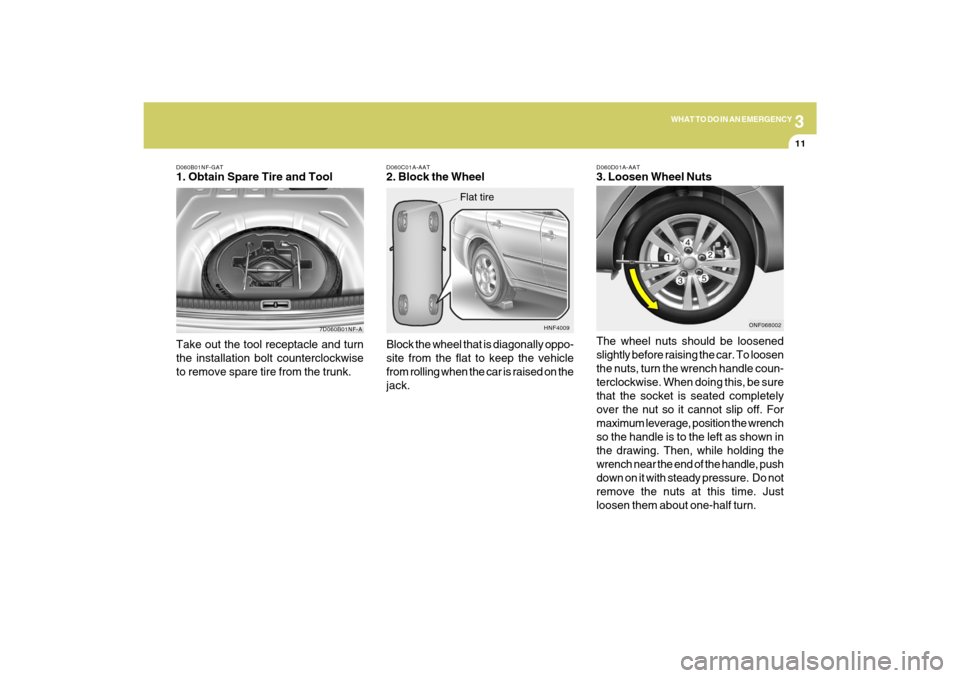
D060B01NF-GAT1. Obtain Spare Tire and Tool
7D060B01NF-A
Take out the tool receptacle and turn
the installation bolt counterclockwise
to remove spare tire from the trunk.
D060C01A-AAT2. Block the Wheel
Block the wheel that is diagonally oppo-
site from the flat to keep the vehicle
from rolling when the car is raised on the
jack.
HNF4009
Flat tire
D060D01A-AAT3. Loosen Wheel Nuts
The wheel nuts should be loosened
slightly before raising the car. To loosen
the nuts, turn the wrench handle coun-
terclockwise. When doing this, be sure
that the socket is seated completely
over the nut so it cannot slip off. For
maximum leverage, position the wrench
so the handle is to the left as shown in
the drawing. Then, while holding the
wrench near the end of the handle, push
down on it with steady pressure. Do not
remove the nuts at this time. Just
loosen them about one-half turn.
ONF068002