2009 Hyundai Santa Fe seats
[x] Cancel search: seatsPage 40 of 353
1
FEATURES OF YOUR HYUNDAI
29
B150G02A-AATDo Not Lie DownTo reduce the chance of injuries in the
event of an accident and to achieve maxi-
mum effectiveness of the restraint system,
all passengers should be sitting up and the
front seats should be in an upright position
when the car is moving. A seat belt cannot
provide proper protection if the person is
lying down in the rear seat or if the front seat
is in a reclined position.
WARNING:
Riding with a reclined seatback in-
creases your chance of serious or fatal
injuries in the event of a collision or
sudden stop. The protection of your
restraint system (seat belts and air
bags) is greatly reduced by reclining
your seat. Seat belts must be snug
against your hips and chest to work
properly. The more the seatback is re-
clined, the greater the chance that an
occupant's hips will slide under the lap
belt causing serious internal injuries or
the occupant's neck could strike the
shoulder belt. Drivers and passengers
should always sit well back in their seats,
properly belted (see page 1-31), and with
the seatbacks upright.
!
!
B160A02A-AATCare of Seat BeltsSeat belt systems should never be disas-
sembled or modified. In addition, care
should be taken to assure that seat belts
and belt hardware are not damaged by
seat hinges, doors or other abuse.
WARNING:
When you return the rear seatback to its
upright position after the rear seatback
was folded down, be careful not to dam-
age the seat belt webbing or buckle. Be
sure that the webbing or buckle does not
get caught or pinched in the rear seat. A
seat belt with damaged webbing or buckle
will not be as strong and could possibly
fail during a collision or sudden stop,
resulting in serious injury.
Page 44 of 353
1
FEATURES OF YOUR HYUNDAI
33
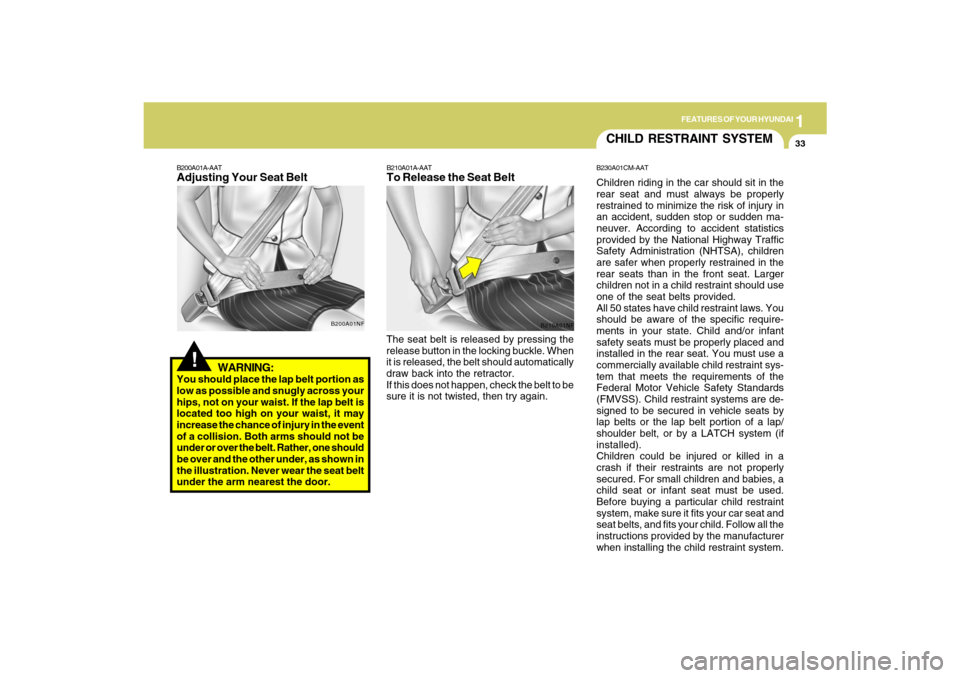
WARNING:
You should place the lap belt portion as
low as possible and snugly across your
hips, not on your waist. If the lap belt is
located too high on your waist, it may
increase the chance of injury in the event
of a collision. Both arms should not be
under or over the belt. Rather, one should
be over and the other under, as shown in
the illustration. Never wear the seat belt
under the arm nearest the door.
!
B200A01A-AATAdjusting Your Seat Belt
B200A01NF
The seat belt is released by pressing the
release button in the locking buckle. When
it is released, the belt should automatically
draw back into the retractor.
If this does not happen, check the belt to be
sure it is not twisted, then try again.B210A01A-AATTo Release the Seat Belt
B210A01NF
CHILD RESTRAINT SYSTEMB230A01CM-AATChildren riding in the car should sit in the
rear seat and must always be properly
restrained to minimize the risk of injury in
an accident, sudden stop or sudden ma-
neuver. According to accident statistics
provided by the National Highway Traffic
Safety Administration (NHTSA), children
are safer when properly restrained in the
rear seats than in the front seat. Larger
children not in a child restraint should use
one of the seat belts provided.
All 50 states have child restraint laws. You
should be aware of the specific require-
ments in your state. Child and/or infant
safety seats must be properly placed and
installed in the rear seat. You must use a
commercially available child restraint sys-
tem that meets the requirements of the
Federal Motor Vehicle Safety Standards
(FMVSS). Child restraint systems are de-
signed to be secured in vehicle seats by
lap belts or the lap belt portion of a lap/
shoulder belt, or by a LATCH system (if
installed).
Children could be injured or killed in a
crash if their restraints are not properly
secured. For small children and babies, a
child seat or infant seat must be used.
Before buying a particular child restraint
system, make sure it fits your car seat and
seat belts, and fits your child. Follow all the
instructions provided by the manufacturer
when installing the child restraint system.
Page 47 of 353

1FEATURES OF YOUR HYUNDAI36
2. Route the child restraint seat tether strap
over the seatback. Seaback behind the rear seat
OCM052213L
Front of VehicleChild
restraint
hook
holders
!For vehicles with adjustable headrests,
route the tether strap under the head-
rest and between the headrest posts,
otherwise route the tether strap over the
top of the seatback.
3. Connect the tether strap hook to the
child restraint hook holder and tighten
to secure the seat.
WARNING:
o Adjust the rear seatback in a semi-
reclined position from the upright po-
sition, before installing the Child Re-
straint Seat. With the seatback in the
proper reclining angle, push and pull
the child restraint seat in different
directions to be sure it is secure.
o A child can be seriously injured or
killed in a collision if the child restraint
is not properly anchored. Always
follow the child seat manufacturer’s
instructions for installation and use.
o Never mount more than one child re-
straint to a single tether or to a single
lower anchorage point. The increased
load caused by multiple seats may
cause the tethers or anchorage points
to break, causing serious injury or
death.
Tether strap
hook
To install the child restraint seat
tether1. Open the tether anchor cover.
OCM051006L
Tether
anchor coverChild Restraint
Hook Holder
Page 48 of 353
1
FEATURES OF YOUR HYUNDAI
37
!
WARNING:
o A child can be seriously injured or
killed in a collision if the child restraint
is not properly anchored. Always
follow the child seat manufacturer’s
instructions for installation and use.
o Never install a child restraint using
the lower anchors at the center posi-
tion of the rear seat. In a crash, the
LATCH anchors may break if a car
seat is improperly placed in the cen-
ter position resulting in serious or
fatal injuries. Only place a LATCH or
LATCH-compatible child seat in the
left or right out-board rear seating
positions (as shown) to the appropri-
ate LATCH anchors provided.
B230D04CM-AATSecuring the Child Restraint Seat
with the "Child Seat Lower Anchor"
systemSome child seat manufacturers make safety
seats that are labeled as LATCH or LATCH-
compatible child seats. LATCH stands for
"Lower anchors and Tethers for Children".
These seats include two rigid or webbing
mounted attachments that connect to two
lower anchors at specific seating positions
in your vehicle. This type of child seat
eliminates the need to use seat belts to
attach the child seat; the tether strap must
also be attached to the proper tether an-
chor point. For information on using tether
straps, refer to “Installing a Child Restraint
Seat with the “Tether Anchorage” system”.
OCM051007L
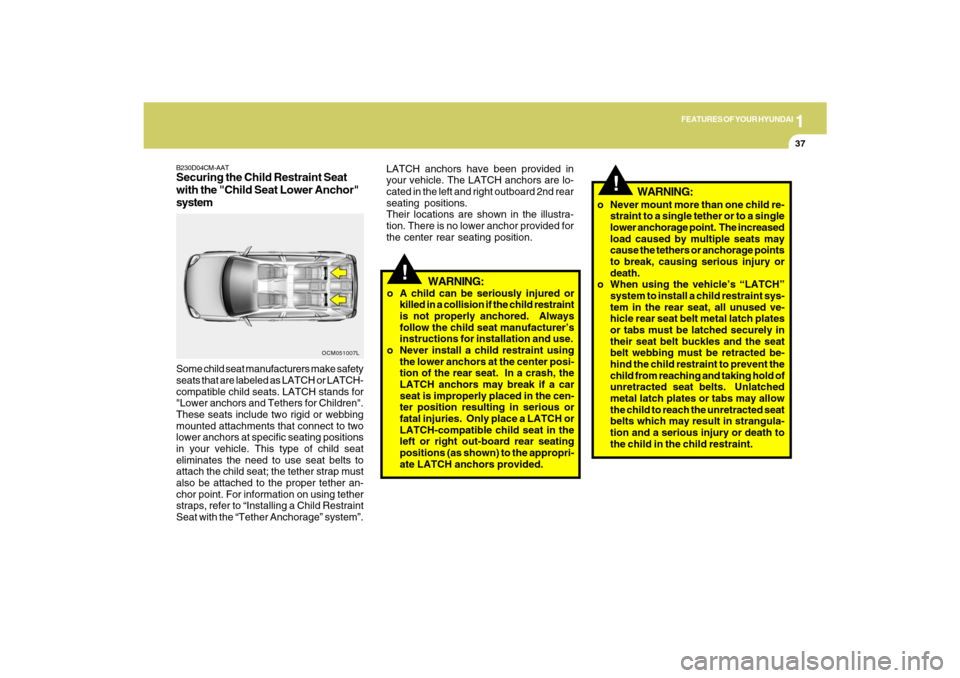
LATCH anchors have been provided in
your vehicle. The LATCH anchors are lo-
cated in the left and right outboard 2nd rear
seating positions.
Their locations are shown in the illustra-
tion. There is no lower anchor provided for
the center rear seating position.
!
o Never mount more than one child re-
straint to a single tether or to a single
lower anchorage point. The increased
load caused by multiple seats may
cause the tethers or anchorage points
to break, causing serious injury or
death.
o When using the vehicle’s “LATCH”
system to install a child restraint sys-
tem in the rear seat, all unused ve-
hicle rear seat belt metal latch plates
or tabs must be latched securely in
their seat belt buckles and the seat
belt webbing must be retracted be-
hind the child restraint to prevent the
child from reaching and taking hold of
unretracted seat belts. Unlatched
metal latch plates or tabs may allow
the child to reach the unretracted seat
belts which may result in strangula-
tion and a serious injury or death to
the child in the child restraint.
WARNING:
Page 49 of 353
1FEATURES OF YOUR HYUNDAI38
!
WARNING:
o A child can be seriously injured or
killed in a collision if the child restraint
is not properly anchored to the car
and the child is not properly restrained
in the child restraint. Always follow
the child seat manufacturer’s instruc-
tions for installation and use.
o Adjust the rear seatback in a semi-
reclined position from the upright po-
sition, before installing the Child Re-
straint Seat. With the seatback in the
proper reclining angle, push and pull
the child restraint seat in different
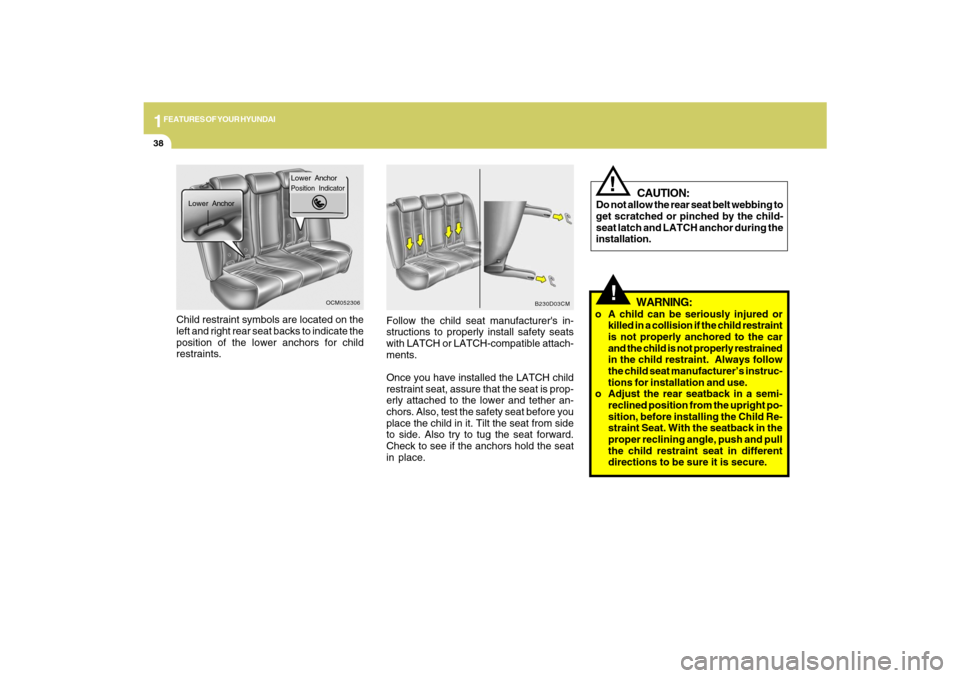
directions to be sure it is secure. Child restraint symbols are located on the
left and right rear seat backs to indicate the
position of the lower anchors for child
restraints.Follow the child seat manufacturer's in-
structions to properly install safety seats
with LATCH or LATCH-compatible attach-
ments.
Once you have installed the LATCH child
restraint seat, assure that the seat is prop-
erly attached to the lower and tether an-
chors. Also, test the safety seat before you
place the child in it. Tilt the seat from side
to side. Also try to tug the seat forward.
Check to see if the anchors hold the seat
in place.
Lower AnchorPosition Indicator
Lower Anchor
OCM052306
B230D03CM
CAUTION:
Do not allow the rear seat belt webbing to
get scratched or pinched by the child-
seat latch and LATCH anchor during the
installation.
!
Page 50 of 353
1
FEATURES OF YOUR HYUNDAI
39
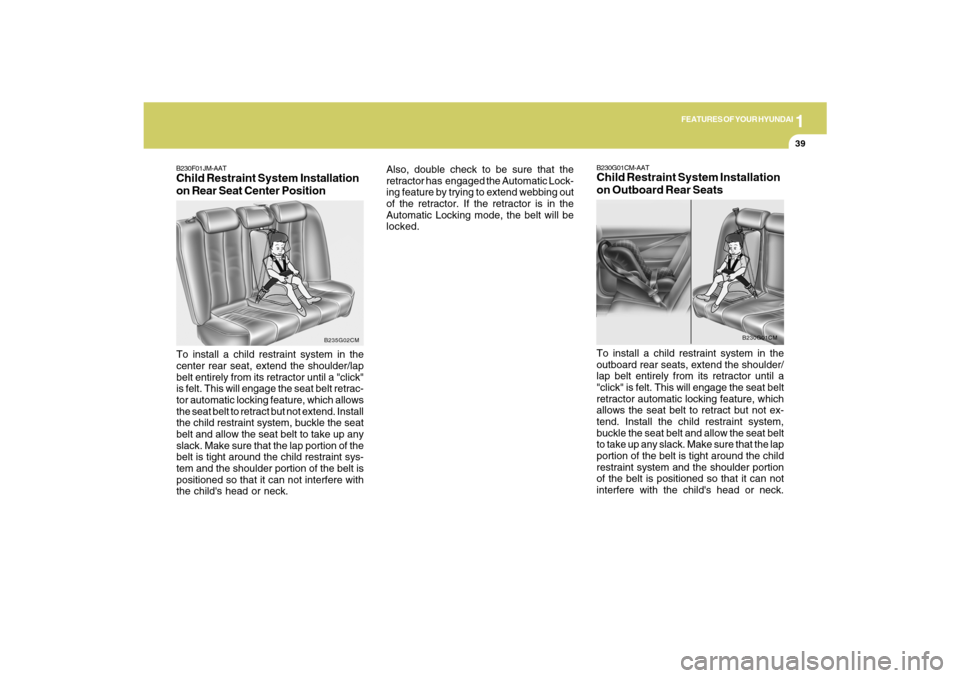
B230F01JM-AATChild Restraint System Installation
on Rear Seat Center PositionTo install a child restraint system in the
center rear seat, extend the shoulder/lap
belt entirely from its retractor until a "click"
is felt. This will engage the seat belt retrac-
tor automatic locking feature, which allows
the seat belt to retract but not extend. Install
the child restraint system, buckle the seat
belt and allow the seat belt to take up any
slack. Make sure that the lap portion of the
belt is tight around the child restraint sys-
tem and the shoulder portion of the belt is
positioned so that it can not interfere with
the child's head or neck.
B235G02CM
Also, double check to be sure that the
retractor has engaged the Automatic Lock-
ing feature by trying to extend webbing out
of the retractor. If the retractor is in the
Automatic Locking mode, the belt will be
locked.
B230G01CM-AATChild Restraint System Installation
on Outboard Rear SeatsTo install a child restraint system in the
outboard rear seats, extend the shoulder/
lap belt entirely from its retractor until a
"click" is felt. This will engage the seat belt
retractor automatic locking feature, which
allows the seat belt to retract but not ex-
tend. Install the child restraint system,
buckle the seat belt and allow the seat belt
to take up any slack. Make sure that the lap
portion of the belt is tight around the child
restraint system and the shoulder portion
of the belt is positioned so that it can not
interfere with the child's head or neck.
B230G01CM
Page 55 of 353
1FEATURES OF YOUR HYUNDAI44
The SRS uses a collection of sensors to
gather information about the driver's and
front passenger's seat position, the driver's
and front passenger's seat belt usage and
impact severity.
The driver's seat position sensors, which
are installed on the seat track, determine
if the seats are fore or aft of a reference
position. Similarly, the seat belt usage
sensors determine if the driver and front
passenger's seat belts are fastened. These
sensors provide the ability to control the
SRS deployment based on how close the
driver's seat is to the steering wheel,
whether or not the seat belts are fastened,
and how severe the impact is.
The advanced SRS offers the ability to
control the air bag inflation with two levels.
A first stage level is provided for moderate-
severity impacts. A second stage level is
provided for more severe impacts.According to the impact severity, driver's
seating position, the SRSCM(SRS Con-
trol Module) controls the air bag inflation.
Failure to properly wear seat belts can
increase the risk or severity of injury in an
accident.
Additionally, your Hyundai is equipped
with an occupant classification system in
the front passenger's seat. The occupant
classification system detects the presence
of a passenger in the front passenger's
seat and will turn off the front passenger's
air bag under certain conditions. For more
detail, see "Occupant Classification Sys-
tem" later in this section.
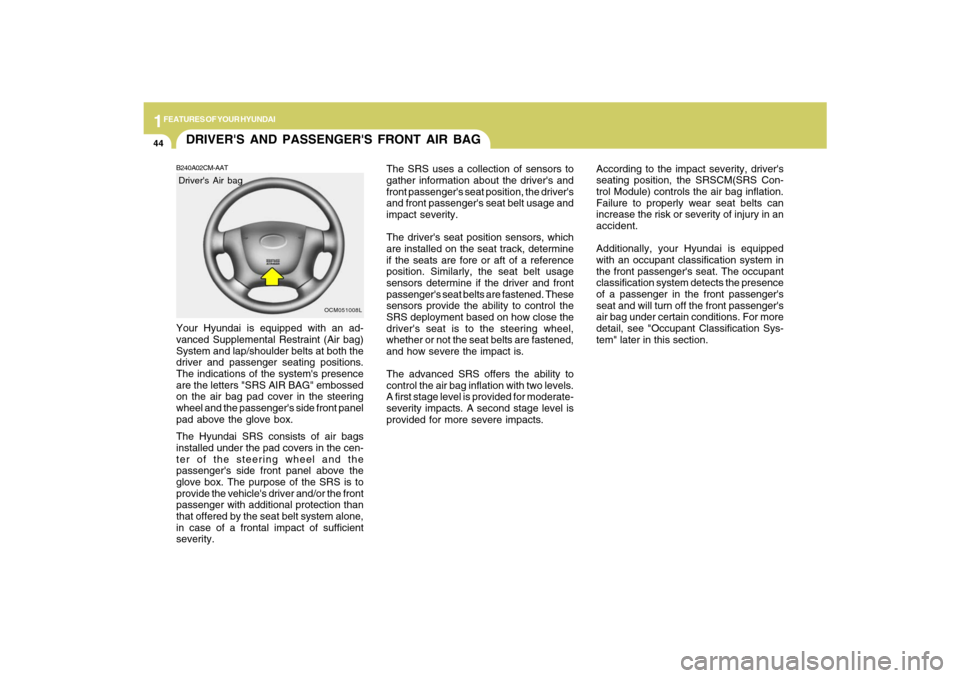
DRIVER'S AND PASSENGER'S FRONT AIR BAGB240A02CM-AATYour Hyundai is equipped with an ad-
vanced Supplemental Restraint (Air bag)
System and lap/shoulder belts at both the
driver and passenger seating positions.
The indications of the system's presence
are the letters "SRS AIR BAG" embossed
on the air bag pad cover in the steering
wheel and the passenger's side front panel
pad above the glove box.
The Hyundai SRS consists of air bags
installed under the pad covers in the cen-
ter of the steering wheel and the
passenger's side front panel above the
glove box. The purpose of the SRS is to
provide the vehicle's driver and/or the front
passenger with additional protection than
that offered by the seat belt system alone,
in case of a frontal impact of sufficient
severity.
OCM051008L
Driver's Air bag
Page 56 of 353
1
FEATURES OF YOUR HYUNDAI
45
!
WARNING:
o Modification to the seat structure can
adversely affect the seat position
sensor and cause the air bag to de-
ploy at a different level than should be
provided.
o Do not place any objects underneath
the front seats which could damage
the seat position sensor or interfere
with the occupant classification sys-
tem.
o Do not place any objects that may
cause magnetic fields near the front
seats. These may cause a malfunc-
tion of the seat position sensor.
NOTE:o Be sure to read information about the
SRS on the labels provided on the sun
visor.
o Advanced air bags are combined with
pre-tensioner seat belts to help pro-
vide enhanced occupant protection
in frontal crashes. Front air bags are
not intended to deploy in light colli-
sions in which protection can be pro-
vided by the pre-tensioner seat belt.
o If you are considering modification of
your vehicle due to a disability, please
contact the Hyundai Customer As-
sistance Center at 1-800-633-5151.
CAUTION:
If the seat position sensor is not working
properly, the SRS air bag warning light
on the instrument panel will illumi-
nate even if there is no malfunction of the
SRS air bag system, because the SRS
air bag warning light is connected with
the seat position sensor. If the SRS air
bag warning light does not illuminate
when the ignition key is turned to the
"ON" position, if it remains illuminated
after coming on for approximately 6 sec-
onds, or if it illuminates while the vehicle
is being driven, have an authorized
Hyundai dealer inspect the seat position
sensor and the advanced SRS air bag
system as soon as possible.
!AIR
BAG