2009 Hyundai Santa Fe awd
[x] Cancel search: awdPage 230 of 353
2
DRIVING YOUR HYUNDAI
20
!
CAUTION:
If one of the front or rear wheels begins
to spin in mud, snow, etc., the vehicle can
sometimes be driven out by depressing
the accelerator pedal further; however,
avoid running the engine continuously at
high rpm because doing so could dam-
age the AWD system. (10)When using tire chains, always at-
tach them to the four wheels. In some
unavoidable circumstances, install
them on only the front wheels, not the
rear wheels.
(11) If the front or rear wheels get stuck in
the mud, do not spin them recklessly.
The AWD system could be damaged.
!
WARNING:
o Avoid high cornering speeds.
o Do not make quick steering wheel
movements, such as sharp lane
charges or fast, sharp turns.
o The risk of rollover is greatly in-
creased if you lose control of your
vehicle at highway speeds.
o While the full-time AWD vehicle is
being raised on a jack, never start the
engine or cause the tires to rotate.
There is danger that rotating tires
touching the ground could cause the
vehicle to go off the jack and to jump
forward.
o In a collision, an unbelted person is
signicantly more likely to be seriously
injured or killed than a person wearing
a seat belt.
o Loss of control may occurs if two or
more wheels drop off the roadway
and the driver oversteers to reenter
the roadway.
o In the event your vehicle leaves the
roadway, do not steer sharply. Instead,
slow down before pulling back into the
travel lanes.
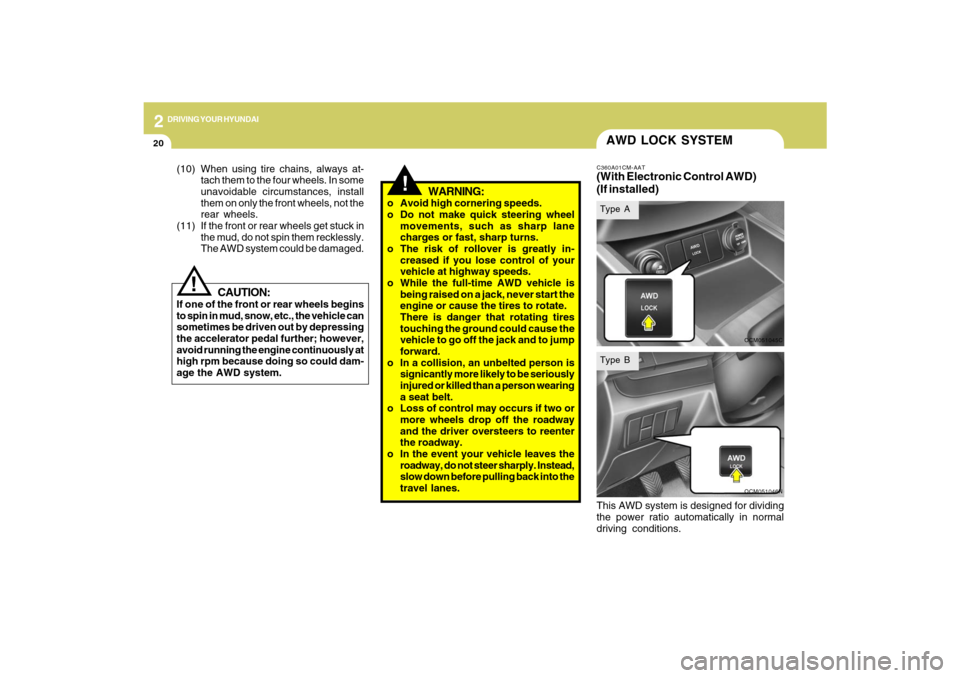
AWD LOCK SYSTEMC360A01CM-AAT(With Electronic Control AWD)
(If installed)
OCM051045COCM051046N
Type AType BThis AWD system is designed for dividing
the power ratio automatically in normal
driving conditions.
Page 231 of 353
2
DRIVING YOUR HYUNDAI
21
GOOD BRAKING PRACTICESC130A02A-AAT
WARNING:
o Whenever leaving vehicle or parking,
always set the parking brake as far as
possible and fully engage the vehicle's
transaxle into the park position. Ve-
hicles not fully engaged in park with
the parking brake set are at risk for
moving inadvertently and injuring
yourself or others.
o All vehicles should always have the
parking brake fully engaged when
parking to avoid inadvertent move-
ment of the car which can injure occu-
pants or pedestrians.
o Nothing should be carried on top of
the shelf panel behind the rear seat. If
there were an accident or a sudden
stop, such objects could move for-
ward and cause damage to the ve-
hicle or injure the occupants.
!
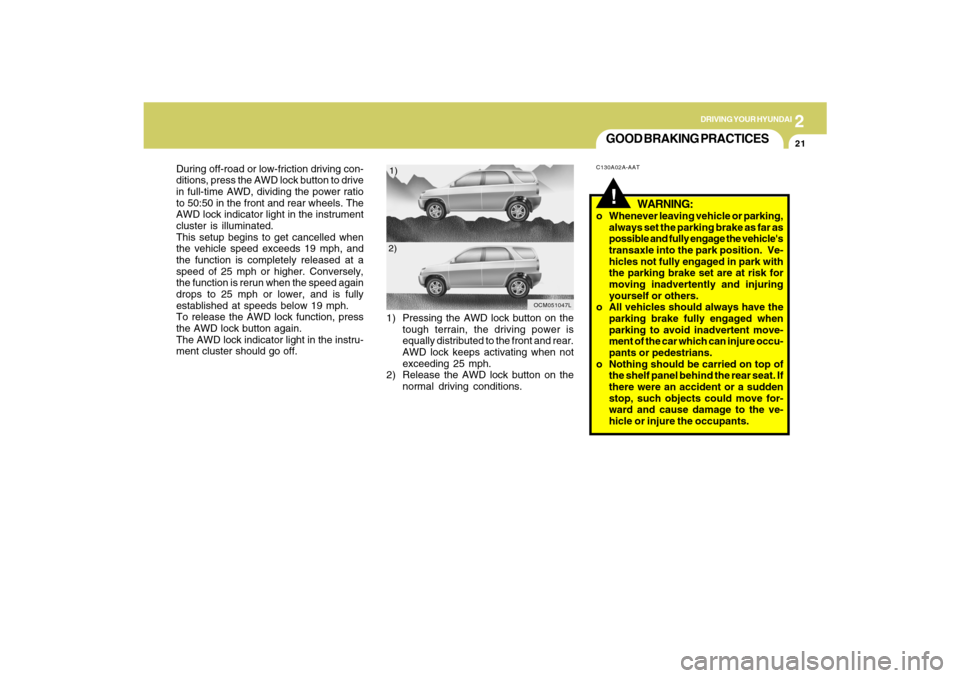
During off-road or low-friction driving con-
ditions, press the AWD lock button to drive
in full-time AWD, dividing the power ratio
to 50:50 in the front and rear wheels. The
AWD lock indicator light in the instrument
cluster is illuminated.
This setup begins to get cancelled when
the vehicle speed exceeds 19 mph, and
the function is completely released at a
speed of 25 mph or higher. Conversely,
the function is rerun when the speed again
drops to 25 mph or lower, and is fully
established at speeds below 19 mph.
To release the AWD lock function, press
the AWD lock button again.
The AWD lock indicator light in the instru-
ment cluster should go off.1) Pressing the AWD lock button on the
tough terrain, the driving power is
equally distributed to the front and rear.
AWD lock keeps activating when not
exceeding 25 mph.
2) Release the AWD lock button on the
normal driving conditions.
OCM051047L
1)
2)
Page 234 of 353
2
DRIVING YOUR HYUNDAI
24
It should be noted that installing tire chains
on the tire will provide a greater driving
force, but will not prevent side skids.NOTE:o Tire chains are not legal in all states.
Check state laws before fitting tire
chains.
o When using tire chains, attach them
to the drive wheels as follows.
2WD : Front wheels
AWD : All four wheels
In some unavoidable circumstances,
install them on only the front wheels,
not the rear wheels.
C160A01A-AATThe more severe weather conditions of
winter result in greater wear and other
problems. To minimize the problems of
winter driving, you should follow these
suggestions:C160B01CM-AATSnowy or Icy ConditionsTo drive your vehicle in deep snow, it may
be necessary to use snow tires or to install
tire chains on your tires. If snow tires are
needed, it is necessary to select tires
equivalent in size and type of the original
equipment tires. Failure to do so may ad-
versely affect the safety and handling of
your car. Furthermore, speeding, rapid
acceleration, sudden brake applications,
and sharp turns are potentially very haz-
ardous practices.
During deceleration, use engine braking
to the fullest extent. Sudden brake applica-
tions on snowy or icy roads may cause
skids to occur. You need to keep sufficient
distance between the vehicle in operation
in front and your vehicle. Also, apply the
brake gently.WINTER DRIVING
SMOOTH CORNERINGC150A01A-AATAvoid braking or gear changing in corners,
especially when roads are wet. Ideally,
corners should always be taken under
gentle acceleration. If you follow these
suggestions, tire wear will be held to a
minimum.
Page 266 of 353
3
WHAT TO DO IN AN EMERGENCY
19
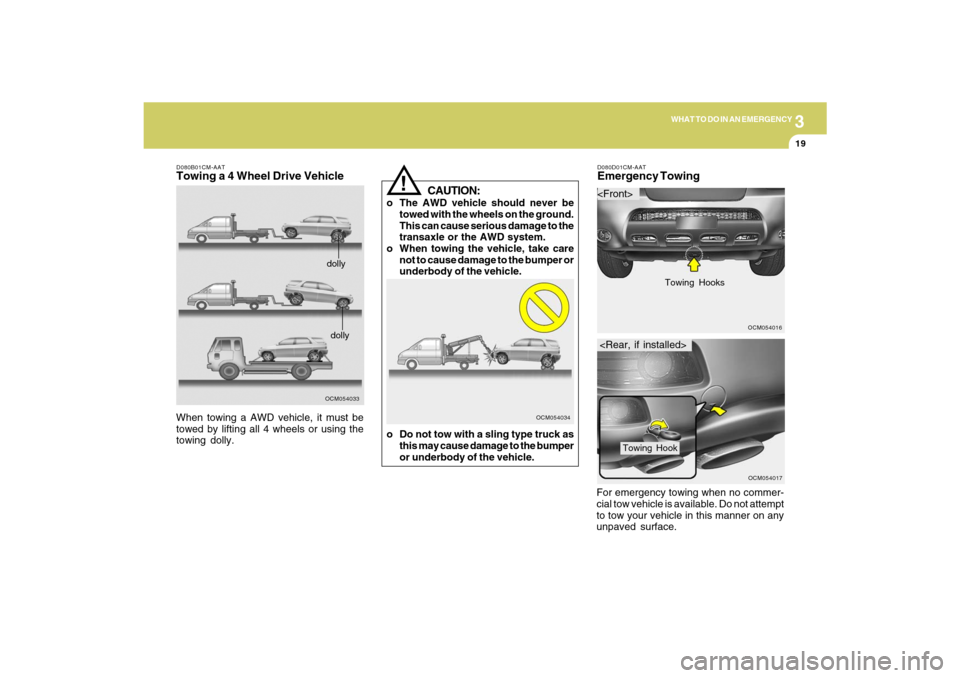
D080B01CM-AATTowing a 4 Wheel Drive Vehicle
OCM054033dollydolly
When towing a AWD vehicle, it must be
towed by lifting all 4 wheels or using the
towing dolly.
CAUTION:
o The AWD vehicle should never be
towed with the wheels on the ground.
This can cause serious damage to the
transaxle or the AWD system.
o When towing the vehicle, take care
not to cause damage to the bumper or
underbody of the vehicle.
!
OCM054034
o Do not tow with a sling type truck as
this may cause damage to the bumper
or underbody of the vehicle.
D080D01CM-AATEmergency Towing
OCM054016
OCM054017
Towing Hooks
Towing Hook
For emergency towing when no commer-
cial tow vehicle is available. Do not attempt
to tow your vehicle in this manner on any
unpaved surface.
Page 267 of 353
320
WHAT TO DO IN AN EMERGENCY
!
CAUTION:
If the car is being towed with all four
wheels on the ground, it can be towed
only from the front. Be sure that the
transaxle is in neutral. If your vehicle is
equipped with an automatic transaxle,
do not tow at speeds greater than 30 mph
(50 km/h) and for more than 15 miles (25
km).
Be sure the steering is unlocked by plac-
ing the key in the "ACC" position. A
driver must be in the towed vehicle to
operate the steering and brakes. (3)Attach a tow cable, chain or strap to the
towing hook on the rear bumper.
NOTE:o To avoid serious damage to your AWD
vehicle, limit the towing to 10 mph (15
km/h) and not for more than 1 mile (1.5
km) at ANY TIME.
o Before towing, check the level of the
automatic transaxle fluid. If it is below
the 75°C range on the dipstick, add
fluid. If you cannot add fluid, a towing
dolly must be used.
CAUTION:
If the Engine is not running, the power
assist for the brakes and steering will
not work so steering and braking will be
much harder than usual.
!
This could result in serious damage to your
car. Nor should towing be attempted if the
wheels, drive train, axles, steering or
brakes are damaged. Before towing, be
sure the transaxle is in neutral and the key
is in "ACC" (with the engine off) or in the
"ON" position (with the engine running). A
driver must be in the towed car to steer it
and operate the brakes.
CAUTION
It should be tightened firmly with your
fingers until there is no more play in the
towing hole. Towing hook is located in the
luggage compartment.
!
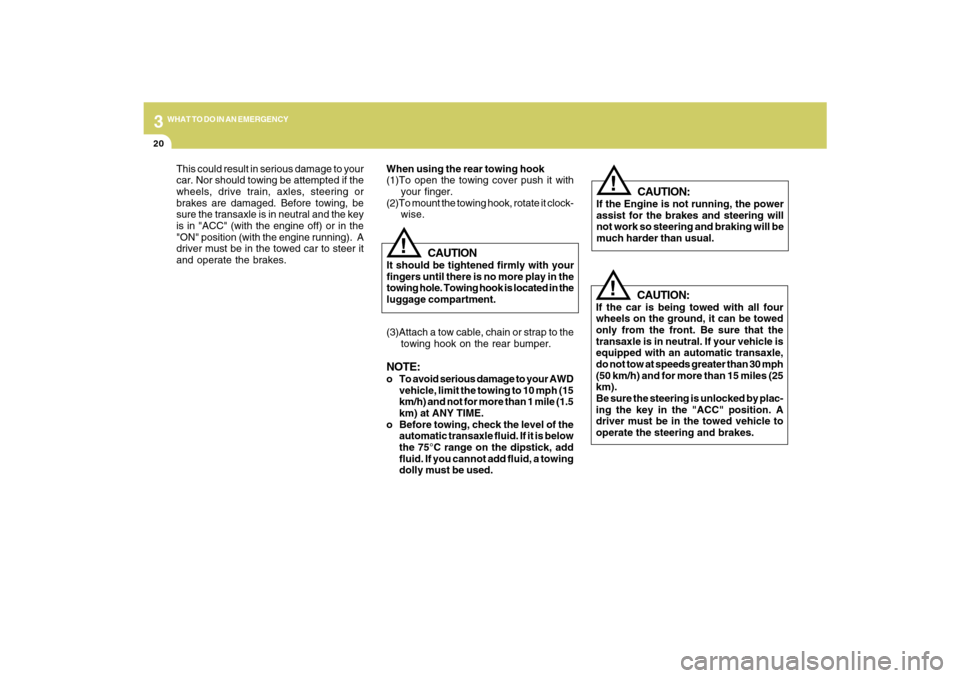
When using the rear towing hook
(1)To open the towing cover push it with
your finger.
(2)To mount the towing hook, rotate it clock-
wise.
Page 280 of 353
5
VEHICLE MAINTENANCE REQUIREMENTS
5
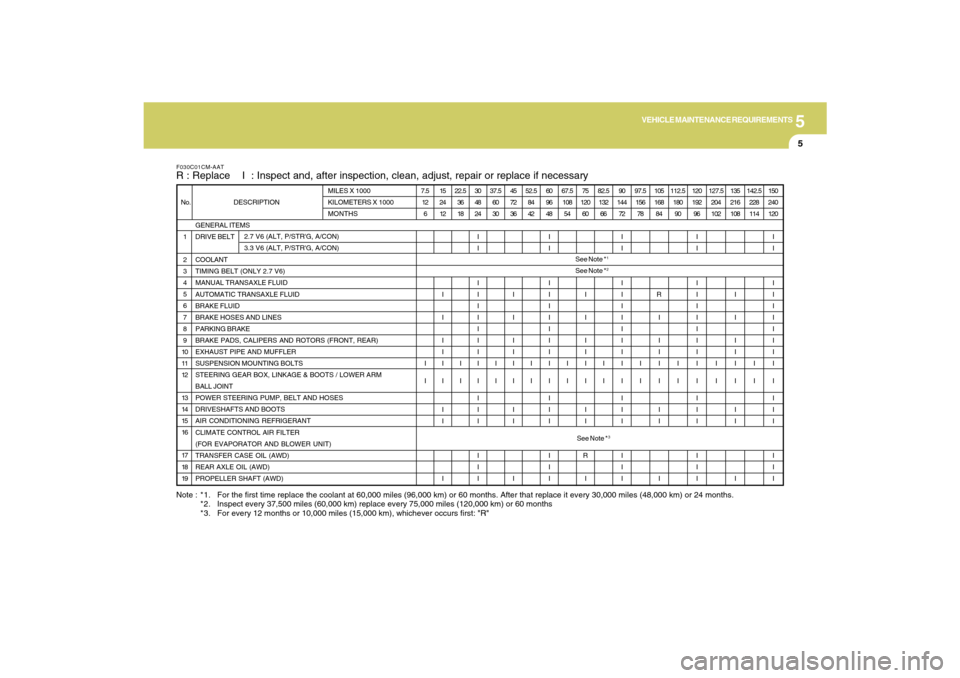
Note : *1. For the first time replace the coolant at 60,000 miles (96,000 km) or 60 months. After that replace it every 30,000 miles (48,000 km) or 24 months.
*2. Inspect every 37,500 miles (60,000 km) replace every 75,000 miles (120,000 km) or 60 months
*3. For every 12 months or 10,000 miles (15,000 km), whichever occurs first: "R"F030C01CM-AATR : Replace I : Inspect and, after inspection, clean, adjust, repair or replace if necessary
GENERAL ITEMS
DRIVE BELT
COOLANT
TIMING BELT (ONLY 2.7 V6)
MANUAL TRANSAXLE FLUID
AUTOMATIC TRANSAXLE FLUID
BRAKE FLUID
BRAKE HOSES AND LINES
PARKING BRAKE
BRAKE PADS, CALIPERS AND ROTORS (FRONT, REAR)
EXHAUST PIPE AND MUFFLER
SUSPENSION MOUNTING BOLTS
STEERING GEAR BOX, LINKAGE & BOOTS / LOWER ARM
BALL JOINT
POWER STEERING PUMP, BELT AND HOSES
DRIVESHAFTS AND BOOTS
AIR CONDITIONING REFRIGERANT
CLIMATE CONTROL AIR FILTER
(FOR EVAPORATOR AND BLOWER UNIT)
TRANSFER CASE OIL (AWD)
REAR AXLE OIL (AWD)
PROPELLER SHAFT (AWD) 1
2
3
4
5
6
7
8
9
10
11
12
13
14
15
16
17
18
19 No. DESCRIPTIONMILES X 1000
KILOMETERS X 1000
MONTHS
2.7 V6 (ALT, P/STR'G, A/CON)
3.3 V6 (ALT, P/STR'G, A/CON)7.5
12
6
I
I15
24
12
I
I
I
I
I
I
I
I
I22.5
36
18
I
I30
48
24
I
I
I
I
I
I
I
I
I
I
I
I
I
I
I
I
I37.5
60
30
I
I45
72
36
I
I
I
I
I
I
I
I
I52.5
84
42
I
I60
96
48
I
I
I
I
I
I
I
I
I
I
I
I
I
I
I
I
I67.5
108
54
I
I75
120
60
I
I
I
I
I
I
I
I
R
I82.5
132
66
I
I90
144
72
I
I
I
I
I
I
I
I
I
I
I
I
I
I
I
I
I97.5
156
78
I
I105
168
84
R
I
I
I
I
I
I
I
I112.5
180
90
I
I120
192
96
I
I
I
I
I
I
I
I
I
I
I
I
I
I
I
I
I127.5
204
102
I
I135
216
108
I
I
I
I
I
I
I
I
I142.5
228
114
I
I150
240
120
I
I
I
I
I
I
I
I
I
I
I
I
I
I
I
I
ISee Note *
1
See Note *
2
See Note *
3
Page 281 of 353
5
VEHICLE MAINTENANCE REQUIREMENTS6
MAINTENANCE UNDER SEVERE USAGE
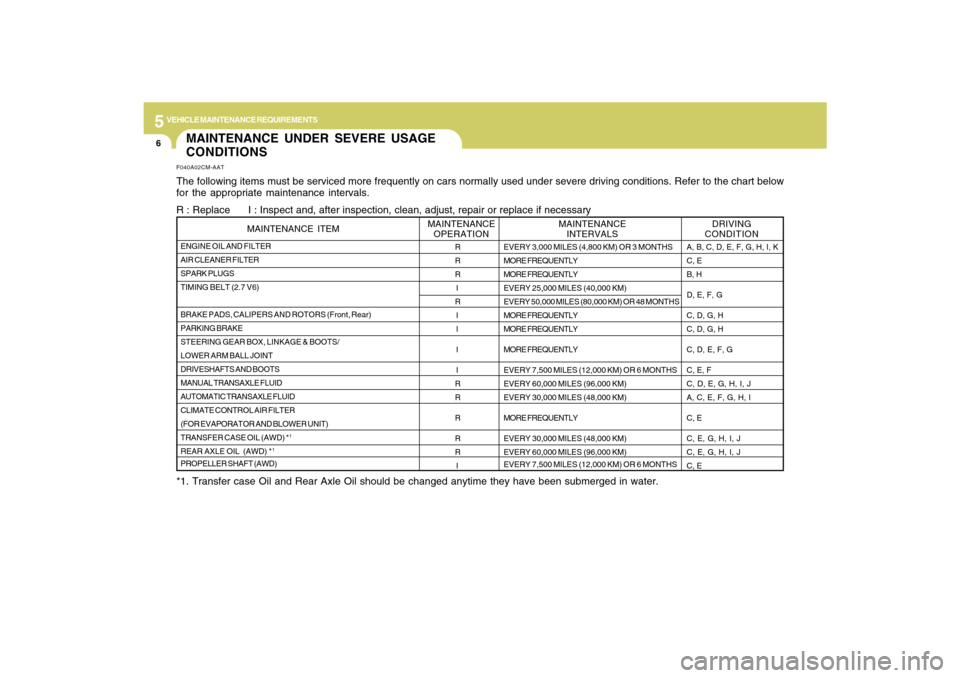
CONDITIONSF040A02CM-AATThe following items must be serviced more frequently on cars normally used under severe driving conditions. Refer to the chart below
for the appropriate maintenance intervals.
R : Replace I : Inspect and, after inspection, clean, adjust, repair or replace if necessary
*1. Transfer case Oil and Rear Axle Oil should be changed anytime they have been submerged in water.ENGINE OIL AND FILTER
AIR CLEANER FILTER
SPARK PLUGS
TIMING BELT (2.7 V6)
BRAKE PADS, CALIPERS AND ROTORS (Front, Rear)
PARKING BRAKE
STEERING GEAR BOX, LINKAGE & BOOTS/
LOWER ARM BALL JOINT
DRIVESHAFTS AND BOOTS
MANUAL TRANSAXLE FLUID
AUTOMATIC TRANSAXLE FLUID
CLIMATE CONTROL AIR FILTER
(FOR EVAPORATOR AND BLOWER UNIT)
TRANSFER CASE OIL (AWD) *
1
REAR AXLE OIL (AWD) *
1
PROPELLER SHAFT (AWD)
MAINTENANCE ITEM
R
R
R
I
R
I
I
I
I
R
R
R
R
R
I
EVERY 3,000 MILES (4,800 KM) OR 3 MONTHS
MORE FREQUENTLY
MORE FREQUENTLY
EVERY 25,000 MILES (40,000 KM)
EVERY 50,000 MILES (80,000 KM) OR 48 MONTHS
MORE FREQUENTLY
MORE FREQUENTLY
MORE FREQUENTLY
EVERY 7,500 MILES (12,000 KM) OR 6 MONTHS
EVERY 60,000 MILES (96,000 KM)
EVERY 30,000 MILES (48,000 KM)
MORE FREQUENTLY
EVERY 30,000 MILES (48,000 KM)
EVERY 60,000 MILES (96,000 KM)
EVERY 7,500 MILES (12,000 KM) OR 6 MONTHS
DRIVING
CONDITION MAINTENANCE
INTERVALS MAINTENANCE
OPERATION
A, B, C, D, E, F, G, H, I, K
C, E
B, H
D, E, F, G
C, D, G, H
C, D, G, H
C, D, E, F, G
C, E, F
C, D, E, G, H, I, J
A, C, E, F, G, H, I
C, E
C, E, G, H, I, J
C, E, G, H, I, J
C, E
Page 318 of 353

6
DO-IT-YOURSELF MAINTENANCE
33
FUSE RATING
15A
15A
15A
10A
10A
25A
20A
10A
40A
40A
50A
20A
15A
10A
10A
10A
10A
10A
10A
10A
10A
15A
20A
25A
30ACIRCUIT PROTECTED
FUEL PUMP RELAY
H/LP LO LH RELAY
H/LP LO RH RELAY
FR FOG RELAY
I/P JUNCTION BOX
FR WIPER RELAY, RAIN SNSR RELAY, FRONT WIPER MOTOR, MULTIFUNCTION SWITCH
H/LP HI RELAY
HEAD LAMP, INSTRUMENT CLUSTER
IGNITION SWITCH
IGNITION SWITCH, START RELAY
I/P JUNCTION BOX
ATM RELAY(GASOLINE), AWD ECM
PCM(GASOLINE)
GENERATOR
VEHICLE SPEED SENSOR, PCM(GASOLINE), SEMI ACTIVE CONTROL MODULE(GASOLINE)
CON FAN #1 RELAY, CON FAN #2 RELAY
INPUT SPEED SENSOR, OUTPUT SPEED SENSOR, TRANSAXLE RANGE SWITCH, BACK-UP LAMP SWITCH
ABS CONTROL MODULE, ESC CONTROL MODULE, YAW RATE SENSOR, AWD ECM, STOP LAMP SWITCH(GASOLINE), MULTIPURPOSE
CHECK CONNECTOR
REAR COMBINATION LAMP LH, POSITION LAMP LH
REAR COMBINATION LAMP RH, POSITION LAMP RH
GLOVE BOX LAMP, ICM RELAY BOX
-
-
-
-
-
FUEL PUMP
H/LP LO LH
H/LP LO RH
FR FOG
H/LP
FR WIPER
H/LP HI
H/LP HI IND
IGN #1
IGN #2
BATT
AT M
TCU
ALT DSL
ECU
COOLING
B/UP UP
ESC
TAIL LH
TAIL RH
SPARE
SPARE
SPARE
SPARE
SPAREFUSE