2009 Hyundai H-1 (Grand Starex) oil
[x] Cancel search: oilPage 4 of 303
Introduction
4
1
A020105AUN-UK
Do not use methanol
Fuels containing methanol (wood alco-
hol) should not be used. This type of fuel
can reduce vehicle performance anddamage components of the fuel system.
A020106AUN-UK
Fuels for cleaner air
To help contribute to cleaner air,
HYUNDAI recommends use of fuels
treated with detergent additives, which
help to prevent deposit formation in the
engine. These fuels will help the engines
run cleaner and increase the Emission
Control System performance.
A020107AUN-UK
Operation in foreign countries
Drivers of vehicles which are to be oper-
ated in foreign countries must satisfy
themselves that:
The vehicle meets all local regulations
with respect to insurance, specifica- tions etc..
The correct types and grades of fuel are available for satisfactory operation
of the vehicle. Diesel engine
A020201AUN-UK
Diesel fuel
Diesel engines must be operated only on
commercially available diesel fuel that
complies with EN 590 or comparable
standard. (EN stands for "European
Norm"). Do not use marine diesel fuel,
heating oils, or non-approved fuel addi-
tives, these will increase wear and causedamage to the engine and fuel system.
The use of non-approved fuels and / or
fuel additives will invalidate the New
Vehicle Warranty.
Diesel fuel of 52 to 54 cetane must be
used in HYUNDAI diesel engined vehi-
cles. If two types of diesel fuel are avail-
able, use summer or winter fuel properly
according to the following temperature
conditions.
Above -5°C(23°F) ... Summer type
diesel fuel.
Below -5°C(23°F) ... Winter type diesel
fuel.
Watch the fuel gauge very carefully : If
the engine stops due to fuel failure, the
circuits must be completely purged to
permit restarting.
CAUTION
Do not allow petrol or water to enter the fuel tank. If this happens, thetank should be completely drainedand the fuel lines must all be
cleaned out to prevent the fuel pump from becoming contaminat-ed.
Page 5 of 303
15
Introduction
A020202AUN
Biodiesel
Commercially supplied biodiesel blends of no more than 5% biodiesel, commonly
known as "B5 biodiesel" may be used in
your vehicle if it meets EN 14214 or
equivalent specifications. (EN stands for
"European Norm"). The use of biofuels
made from rapeseed methyl ester
(RME), fatty acid methyl ester (FAME),
vegetable oil methyl ester (VME) etc. ormixing diesel with biodiesel will cause
increased wear or damage to the engine
and fuel system. Repair or replacement
of worn or damaged components due to
the use of non approved fuels will not be
covered by the manufactures warranty.A090000AEN-UK
As with other vehicles of this type, failure
to operate this vehicle correctly mayresult in loss of control, an accident or
vehicle rollover.
Specific design characteristics (higher
ground clearance, track, etc.) give this
vehicle a higher centre of gravity than
other types of vehicles. In other words
they are not designed for cornering at the
same speeds as conventional 2-wheel
drive vehicles. Avoid sharp turns or
abrupt manoeuvres. Again, failure to
operate this vehicle correctly may result
in loss of control, an accident or vehicle
rollover.
Be sure to read the “Reducing
the risk of a rollover” driving guide-
lines, in section 5 of this manual. A030000AUN-UK
No special run-in period is needed. By
following a few simple precautions for the
first 600 miles (1,000 km) you may add to
the performance, economy and life of
your vehicle.
Do not race the engine.
Whilst driving, keep your engine speed
(rpm, or revolutions per minute)
between 2,000 rpm and 4,000 rpm.
Do not maintain a single speed for long periods of time, either fast or slow.
Varying engine speed is needed to
properly run-in the engine.
Avoid hard stops, except in emergen- cies, to allow the brakes to seat prop-
erly.
Don't let the engine idle longer than 3 minutes at one time.
Don't tow a trailer/caravan during the first 1,200 miles (2,000 km) of opera-tion.
VEHICLE RUN-IN PROCESS
VEHICLE HANDLING
INSTRUCTIONS
CAUTION
Never use any fuel, whether
diesel or B5 biodiesel that fails tomeet the latest petroleum indus-try specification.
Never use any fuel additives or treatments that are not recom-mended or approved by the vehi-cle manufacturer.
Page 6 of 303
Introduction
6
1
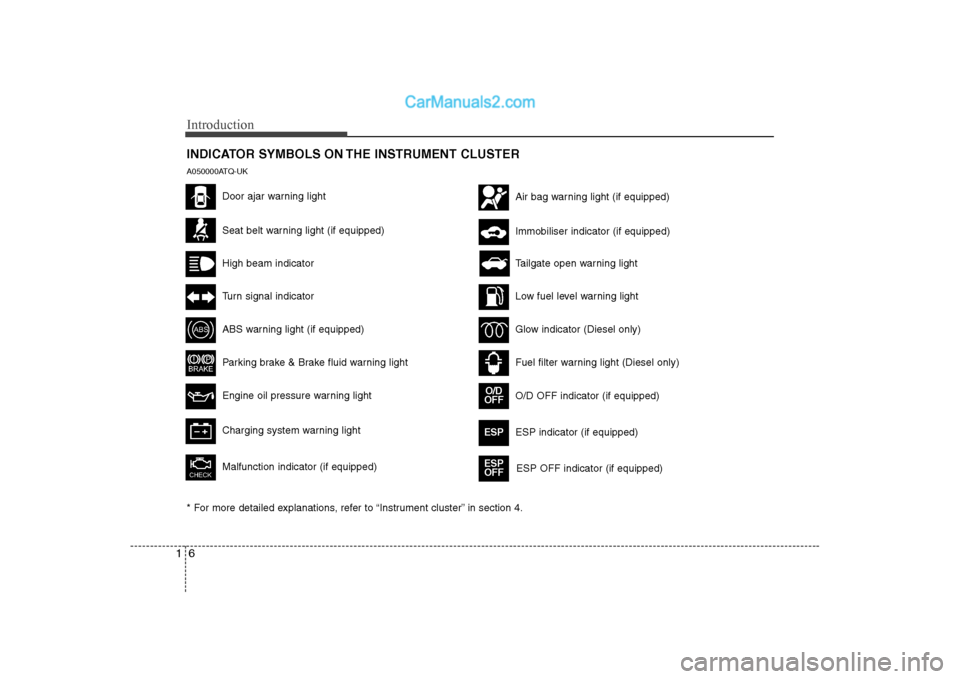
INDICATOR SYMBOLS ON THE INSTRUMENT CLUSTER
Seat belt warning light (if equipped)
High beam indicator
Turn signal indicator
ABS warning light (if equipped)
Parking brake & Brake fluid warning light
Engine oil pressure warning light
Malfunction indicator (if equipped)
Air bag warning light (if equipped)
Immobiliser indicator (if equipped)
Low fuel level warning light
Glow indicator (Diesel only)
Fuel filter warning light (Diesel only)
* For more detailed explanations, refer to “Instrument cluster” in section 4.
Charging system warning light
A050000ATQ-UK
Door ajar warning light
Tailgate open warning light
O/D OFF indicator (if equipped) O/D
OFF
ESP
ESP OFF
ESP indicator (if equipped)
ESP OFF indicator (if equipped)
Page 10 of 303
Your vehicle at a glance
4
2
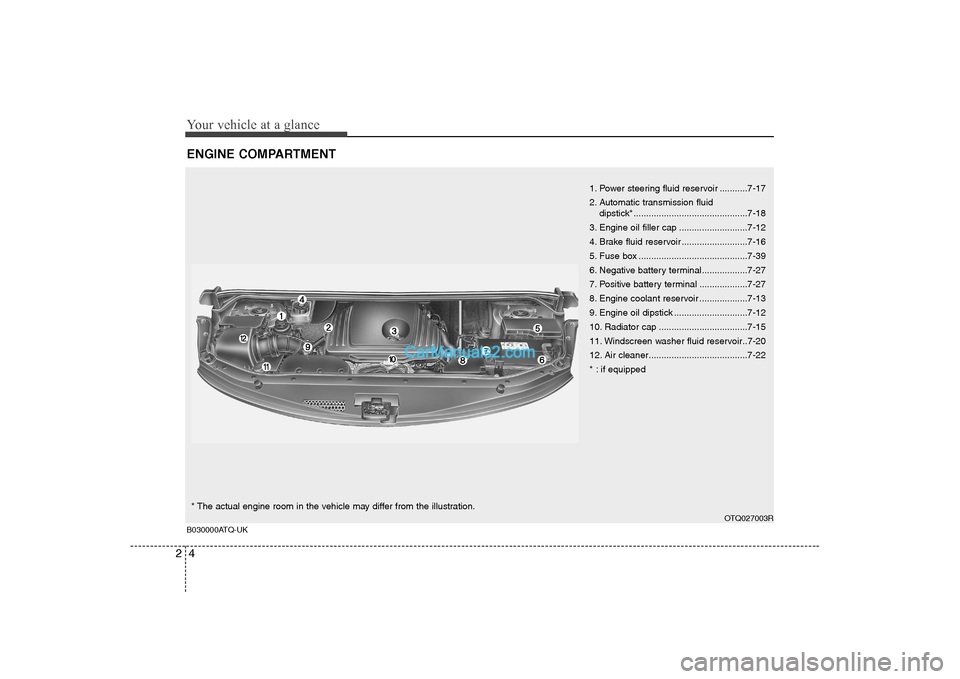
ENGINE COMPARTMENT
1. Power steering fluid reservoir ...........7-17
2. Automatic transmission fluid
dipstick*.............................................7-18
3. Engine oil filler cap ...........................7-12
4. Brake fluid reservoir ..........................7-16
5. Fuse box ...........................................7-39
6. Negative battery terminal..................7-27
7. Positive battery terminal ...................7-27
8. Engine coolant reservoir ...................7-13
9. Engine oil dipstick .............................7-12
10. Radiator cap ...................................7-15
11. Windscreen washer fluid reservoir..7-20
12. Air cleaner.......................................7-22
* : if equipped
OTQ027003R
B030000ATQ-UK* The actual engine room in the vehicle may differ from the illustration.
Page 23 of 303
313
Safety features of your vehicle
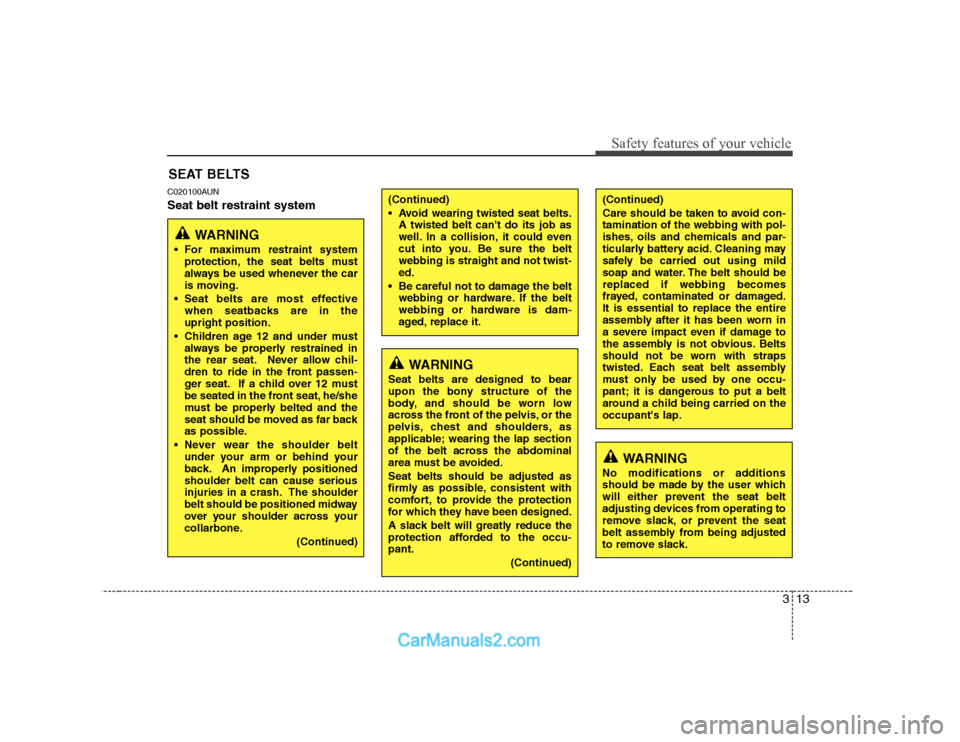
C020100AUN Seat belt restraint systemSEAT BELTS
WARNING
For maximum restraint system protection, the seat belts must
always be used whenever the car
is moving.
Seat belts are most effective when seatbacks are in theupright position.
Children age 12 and under must always be properly restrained in
the rear seat. Never allow chil-
dren to ride in the front passen-
ger seat. If a child over 12 must
be seated in the front seat, he/she
must be properly belted and the
seat should be moved as far back
as possible.
Never wear the shoulder belt under your arm or behind your
back. An improperly positionedshoulder belt can cause serious
injuries in a crash. The shoulder
belt should be positioned midway
over your shoulder across your
collarbone.
(Continued)
WARNING
Seat belts are designed to bear
upon the bony structure of the
body, and should be worn low
across the front of the pelvis, or the
pelvis, chest and shoulders, as
applicable; wearing the lap section
of the belt across the abdominal
area must be avoided. Seat belts should be adjusted as
firmly as possible, consistent with
comfort, to provide the protection
for which they have been designed.
A slack belt will greatly reduce the
protection afforded to the occu-pant.
(Continued)
(Continued)
Care should be taken to avoid con- tamination of the webbing with pol-
ishes, oils and chemicals and par-
ticularly battery acid. Cleaning may
safely be carried out using mild
soap and water. The belt should bereplaced if webbing becomes
frayed, contaminated or damaged.It is essential to replace the entire
assembly after it has been worn in
a severe impact even if damage to
the assembly is not obvious. Belts
should not be worn with straps
twisted. Each seat belt assembly
must only be used by one occu-
pant; it is dangerous to put a belt
around a child being carried on theoccupant's lap.
WARNING
No modifications or additions
should be made by the user which
will either prevent the seat belt
adjusting devices from operating to
remove slack, or prevent the seat
belt assembly from being adjusted
to remove slack.
(Continued)
Avoid wearing twisted seat belts. A twisted belt can't do its job as
well. In a collision, it could even
cut into you. Be sure the beltwebbing is straight and not twist-ed.
Be careful not to damage the belt webbing or hardware. If the belt
webbing or hardware is dam-
aged, replace it.
Page 100 of 303
439
Features of your vehicle
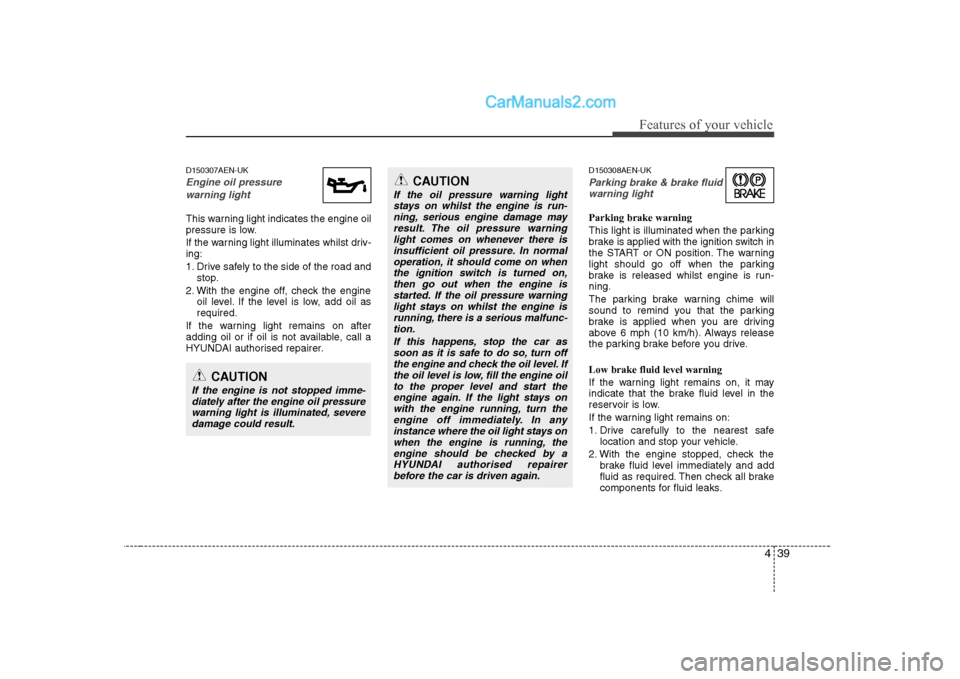
D150307AEN-UK
Engine oil pressure warning light
This warning light indicates the engine oil
pressure is low.
If the warning light illuminates whilst driv- ing:
1. Drive safely to the side of the road and stop.
2. With the engine off, check the engine oil level. If the level is low, add oil as required.
If the warning light remains on after
adding oil or if oil is not available, call a
HYUNDAI authorised repairer. D150308AEN-UK
Parking brake & brake fluid
warning light
Parking brake warning
This light is illuminated when the parking
brake is applied with the ignition switch in
the START or ON position. The warning
light should go off when the parking
brake is released whilst engine is run-ning.
The parking brake warning chime will
sound to remind you that the parking
brake is applied when you are driving
above 6 mph (10 km/h). Always release
the parking brake before you drive. Low brake fluid level warning
If the warning light remains on, it may
indicate that the brake fluid level in the
reservoir is low.
If the warning light remains on:
1. Drive carefully to the nearest safe location and stop your vehicle.
2. With the engine stopped, check the brake fluid level immediately and add
fluid as required. Then check all brake
components for fluid leaks.
CAUTION
If the engine is not stopped imme-
diately after the engine oil pressure
warning light is illuminated, severedamage could result.
CAUTION
If the oil pressure warning light
stays on whilst the engine is run- ning, serious engine damage mayresult. The oil pressure warning
light comes on whenever there isinsufficient oil pressure. In normaloperation, it should come on when the ignition switch is turned on,
then go out when the engine is started. If the oil pressure warninglight stays on whilst the engine is running, there is a serious malfunc-
tion.
If this happens, stop the car assoon as it is safe to do so, turn off the engine and check the oil level. If
the oil level is low, fill the engine oil to the proper level and start the engine again. If the light stays onwith the engine running, turn the
engine off immediately. In anyinstance where the oil light stays onwhen the engine is running, the engine should be checked by a
HYUNDAI authorised repairer before the car is driven again.
Page 157 of 303
53
Driving your vehicle
E020100AUN-UK
Before entering vehicle
• Ensure that all windows, mirrors andlamps are clean.
Check condition of all tyres.
Ensure that no fluid leaks are evident.
Ensure that the area around the vehi- cle is clear before driving off.
E020200AUN
Necessary inspections
Fluid levels, such as engine oil, engine
coolant, brake fluid, and washer fluid
should be checked on a regular basis,
with the exact interval depending on the
fluid. Further details are provided in
Section 7, “Maintenance”.
E020300AUN-UK
Before starting
Close and lock all doors.
Position the seat so that all controls are easily reached.
Adjust the inside and outside rearview mirrors.
Be sure that all lights work.
Check all gauges. Check the operation of warning lights
when the ignition switch is turned to the ON position.
Release the parking brake and make sure the brake warning light goes out.
For safe operation, be sure you are famil-
iar with your vehicle and its equipment.
BEFORE DRIVING
WARNING
All passengers must be properly
belted whenever the vehicle is mov-
ing. Refer to “Seat belts” in section
3 for more information on their
proper use.
WARNING
Always check the surrounding
areas near your vehicle for people,
especially children, before putting a
car into D (Drive) or R (Reverse).
WARNING - Driving under
the influence of alcohol or drugs
Drinking and driving is dangerous.
Drunk driving is the number one
contributor to the highway death
toll each year. Even a small amount
of alcohol will affect your reflexes,
perceptions and judgement.Driving whilst under the influence
of drugs is as dangerous or more
dangerous than driving drunk.
You are much more likely to have a
serious accident if you drink or
take drugs and drive.
If you are drinking or taking drugs,
don’t drive. Do not ride with a driv-er who has been drinking or taking
drugs. Choose a designated driveror call a cab.
WARNING
When you intend to park or stop the
vehicle with the engine on, be care-ful not to depress the accelerator
pedal for a long period of time. It
may overheat the engine or exhaust
system and cause fire.
Page 188 of 303
Driving your vehicle
34
5
E110700AUN-UK
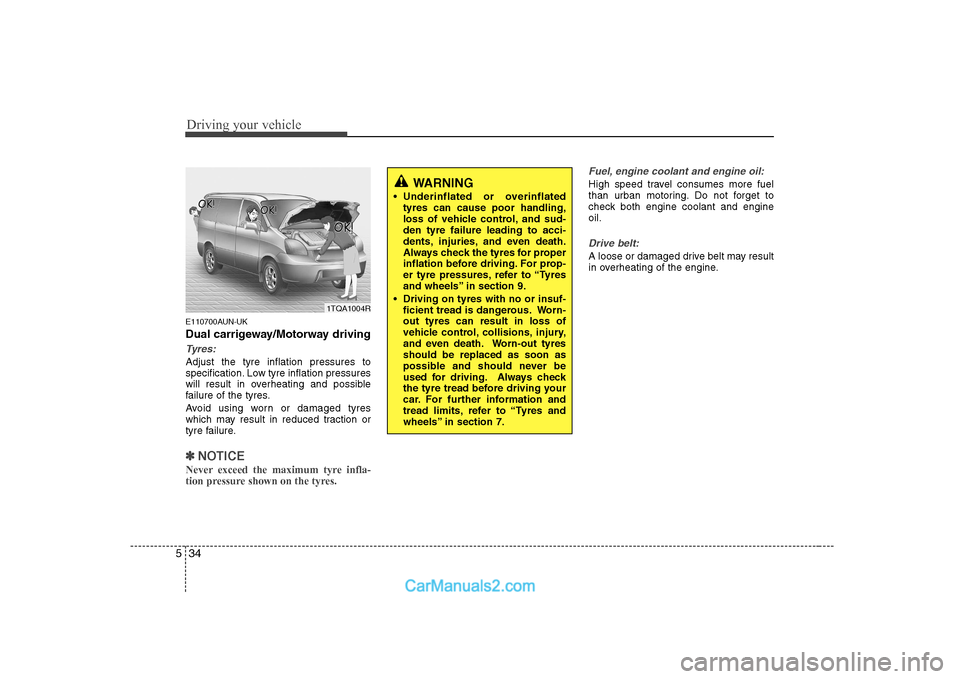
Dual carrigeway/Motorway driving
Tyres:
Adjust the tyre inflation pressures to
specification. Low tyre inflation pressures
will result in overheating and possible
failure of the tyres.
Avoid using worn or damaged tyres
which may result in reduced traction or
tyre failure.
✽✽
NOTICE
Never exceed the maximum tyre infla-
tion pressure shown on the tyres.
Fuel, engine coolant and engine oil:
High speed travel consumes more fuel
than urban motoring. Do not forget to
check both engine coolant and engineoil.
Drive belt:
A loose or damaged drive belt may result
in overheating of the engine.
WARNING
Underinflated or overinflated tyres can cause poor handling,
loss of vehicle control, and sud-den tyre failure leading to acci-
dents, injuries, and even death.
Always check the tyres for proper
inflation before driving. For prop-
er tyre pressures, refer to “Tyres
and wheels” in section 9.
Driving on tyres with no or insuf- ficient tread is dangerous. Worn-out tyres can result in loss of
vehicle control, collisions, injury,
and even death. Worn-out tyresshould be replaced as soon as
possible and should never be
used for driving. Always check
the tyre tread before driving your
car. For further information and
tread limits, refer to “Tyres and
wheels” in section 7.
1TQA1004R